Overcoming Low Penetrance in Egg Injection RNAi: Strategies for Robust Gene Silencing in Embryonic Systems
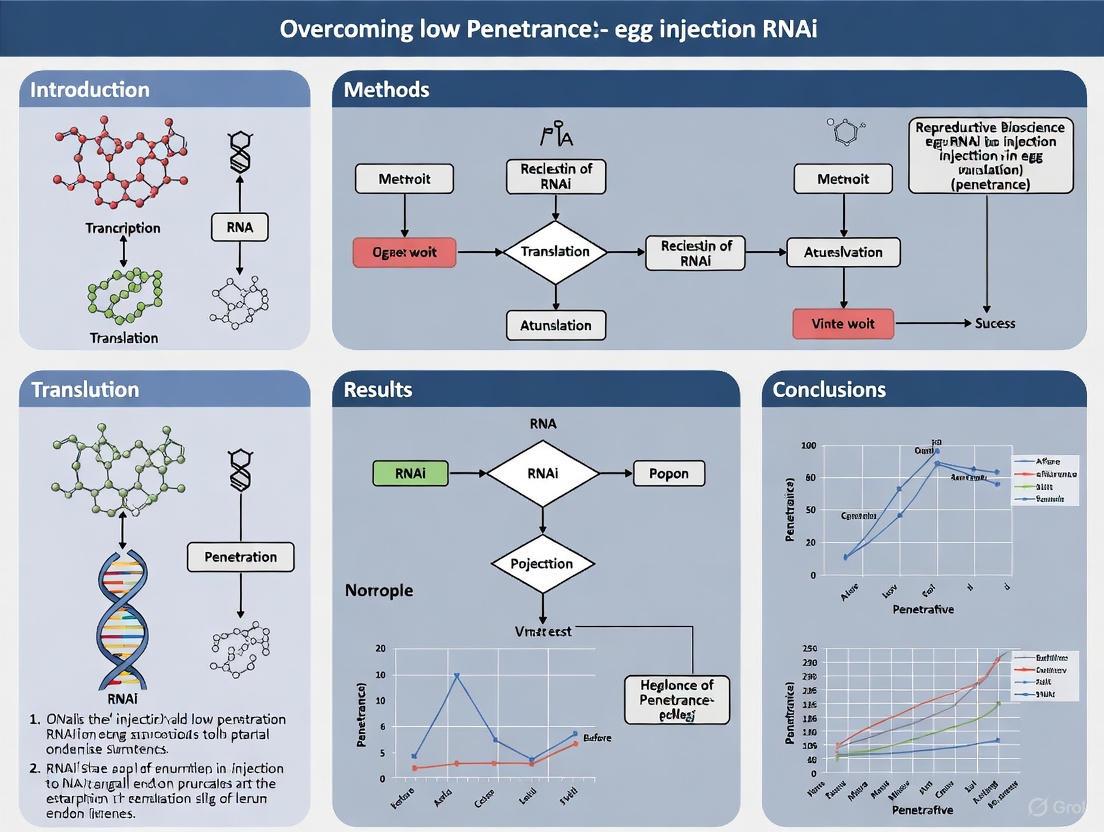
This article addresses the critical challenge of low penetrance in egg injection-based RNA interference (RNAi), a significant bottleneck in functional genomics and therapeutic development.
Overcoming Low Penetrance in Egg Injection RNAi: Strategies for Robust Gene Silencing in Embryonic Systems
Abstract
This article addresses the critical challenge of low penetrance in egg injection-based RNA interference (RNAi), a significant bottleneck in functional genomics and therapeutic development. We explore the foundational causes of variable silencing efficacy, from biological barriers to technical limitations. The content provides a comprehensive methodological framework covering optimized delivery protocols, novel formulation strategies, and systematic troubleshooting approaches. By synthesizing recent advances in model systems from C. elegans to agricultural pests, we present validated comparative data and future directions to enhance reproducibility and efficacy in embryonic RNAi applications for researchers and drug development professionals.
Understanding the RNAi Penetrance Problem: Biological Barriers and Variability Sources
What are reduced penetrance and variable expressivity?
In the context of embryonic RNAi, penetrance refers to the proportion of individuals within a treated population that exhibit any level of the expected phenotype following gene knockdown. When some individuals show no observable phenotype despite successful gene silencing, the effect is described as having reduced or incomplete penetrance [1].
Variable expressivity, a related but distinct concept, describes the range of phenotypic severity observed among the individuals that do show an effect. In an RNAi experiment, this could manifest as a spectrum of phenotypes from mild to severe within the group of affected embryos, even when the same dsRNA construct and dosage are used [2] [1].
These phenomena are critical to recognize and quantify because their presence can complicate the interpretation of gene function and lead to underestimating a gene's importance.
Why do incomplete penetrance and variable expressivity occur in embryonic RNAi?
The causes are multifactorial, stemming from a combination of technical, genetic, and biological variables [2]. Key factors include:
- dsRNA Delivery and Stability: Inefficient uptake or degradation of dsRNA can lead to sub-threshold levels of silencing in some individuals [3] [4].
- Genetic Redundancy and Modifier Genes: The background genetics of the organism, including redundant genes or modifier loci, can buffer the effect of knocking down a single gene [5] [2].
- Gene-Specific Factors: The intrinsic properties of the target gene, such as its expression levels, the stability of its mRNA and protein, and its role in essential pathways, heavily influence phenotypic outcome [3].
- Environmental and Stochastic Noise: Minor variations in the microenvironment of individual embryos and stochastic molecular events can lead to divergent phenotypic outcomes [2].
Troubleshooting Guides
Troubleshooting Low Penetrance in RNAi Experiments
| Problem Area | Potential Cause | Recommended Solution | Key Performance Indicators to Monitor |
|---|---|---|---|
| dsRNA & Design | Inefficient siRNA/dsRNA design; low homology [3] [6] | Use proprietary algorithms (e.g., RNAi Designer) [6]; test multiple non-overlapping dsRNAs [3]. | >70% mRNA knockdown confirmed by qRT-PCR [3]. |
| Low dsRNA concentration; sub-optimal dosage [3] [7] | Perform a dose-response curve; test concentrations between 5-2000 ng/μL depending on delivery method [3] [7]. | Phenotypic strength and penetrance increase with dose. | |
| Delivery Method | Inefficient transfection/delivery [3] [7] | Optimize delivery protocol; use a fluorescently-labeled control dsRNA to monitor efficiency [3] [6]. | High fluorescence in >90% of target cells/embryos. |
| Method-induced toxicity or physical damage [7] | For delicate embryos, consider less invasive methods like soaking if applicable [7]. | High survival rate in negative control groups. | |
| Biological System | Slow protein turnover rate; target protein is very stable [3] | Extend the observation time course; assess protein loss via western blot, not just mRNA [3]. | Protein knockdown correlates with phenotype over a longer period. |
| Off-target effects masking the true phenotype [6] | Use appropriate negative controls; confirm phenotype with multiple, independent dsRNAs [3] [6]. | Consistent phenotype across different dsRNAs targeting the same gene. | |
| Experimental Timing | Incorrect developmental stage for injection or analysis [7] | Perform a time-course experiment; inject at earlier stages (e.g., embryo) and analyze at peak expression of target gene [7] [4]. | Phenotype aligns with the temporal expression profile of the target gene. |
Optimizing dsRNA Delivery Methods for High Penetrance
The choice of delivery method is crucial and depends on the model organism and experimental goals. The table below compares two primary methods used in egg/embryo injection.
| Delivery Method | Recommended Organisms/Stages | Key Advantages | Key Limitations & Challenges | Penetrance Optimization Tips |
|---|---|---|---|---|
| Microinjection [7] [4] | Lepidopteran embryos [4]; prepupal/pupal stages of small wasps [7]. | Precise, direct delivery; works for many species and non-feeding stages [7] [4]. | High mortality from physical trauma; requires specialized equipment and skill [7]. | Use fine-tipped capillaries; optimize injection pressure/duration to minimize damage [4]. |
| Soaking [7] | Permeable developmental stages like larvae or pupae of Trichogramma wasps [7]. | Technically simple; minimal invasiveness; suitable for high-throughput [7]. | Requires high dsRNA concentrations; only works for permeable stages [7]. | Use high concentrations (e.g., 2000 ng/μL); ensure stage permeability [7]. |
Frequently Asked Questions (FAQs)
Q1: My mRNA levels are knocked down by >80% confirmed by qRT-PCR, but I see no physical phenotype in my embryos. What does this mean? This is a classic sign of either incomplete penetrance or a challenge inherent to your target gene. First, verify that the protein product is also knocked down, as high protein stability can delay phenotypic appearance (long half-life) [3]. Second, increase your sample size and analyze embryos with the highest level of knockdown, as the phenotype may only be visible in a subset of individuals. Finally, consider the possibility of genetic redundancy, where related genes compensate for the loss of function [2].
Q2: I get a strong and fully penetrant phenotype in my positive control group, but my target gene shows highly variable expressivity. Is my dsRNA faulty? Not necessarily. Consistent positive control results indicate your delivery system is working. Variable expressivity for your target gene is a common biological phenomenon [2]. It suggests that the phenotype is sensitive to minor variations in genetic background, environmental conditions, or stochastic developmental events. To address this, ensure strict standardization of experimental conditions and analyze a larger number of individuals to properly characterize the full phenotypic spectrum.
Q3: How can I distinguish between true variable expressivity and simply a failed experiment? Systematic controls are key. A failed experiment typically shows no phenotypic response in both positive controls and target groups, or a complete lack of mRNA knockdown. True variable expressivity is characterized by a spectrum of phenotypes (e.g., mild, moderate, severe) in the target group, while positive controls show a consistent expected phenotype, and negative controls show no phenotype [2] [1]. Quantitative measurement of the phenotype (rather than binary scoring) can help visualize this spectrum.
Q4: What are the best practices for reporting penetrance and expressivity in publications? Always report penetrance as a percentage (e.g., "the phenotype was 85% penetrant (n=100)"). For variable expressivity, describe the range of phenotypes observed and, if possible, provide a quantitative analysis. Include representative images of the different phenotypic classes. Clearly state your sample size (n) and the number of independent experimental replicates. This transparency is critical for the scientific community to accurately interpret your findings [2].
Essential Research Reagent Solutions
| Reagent / Tool | Function / Description | Example Use Case in Embryonic RNAi |
|---|---|---|
| Pre-designed siRNA/siRNA Kits [3] [6] | Guaranteed siRNA sequences for effective knockdown of a target. | Rapidly screen gene function with validated reagents, ensuring a high baseline of efficacy [3]. |
| T7 RiboMAX Express RNAi System [4] | High-yield in vitro transcription system for generating large amounts of dsRNA. | Synthesize dsRNA for microinjection or soaking experiments in egg/embryo research [4]. |
| Fluorescent Control Oligos [6] | Labeled, non-targeting RNA molecules used to visualize and optimize delivery efficiency. | Determine transfection efficacy and distribution of nucleic acids in embryos prior to costly RNAi experiments [6]. |
| Lipofectamine RNAiMAX [6] | A lipid-based transfection reagent optimized for the delivery of siRNA and other RNAi molecules. | Transfert hard-to-transfect primary cells or certain embryonic cell cultures in related validation studies [6]. |
| BLOCK-iT Inducible RNAi Vectors [6] | Vector systems for creating stable cell lines with inducible shRNA expression. | Study gene function in a temporally controlled manner, which can help dissect pleiotropic effects [6]. |
Experimental Protocols & Workflows
Standardized Protocol for High-Penetrance Embryonic RNAi
This protocol is adapted from established methods in insect embryo RNAi [4] and optimized based on troubleshooting principles.
Workflow Diagram: Embryonic RNAi Experimental Pipeline
Step 1: dsRNA Preparation [4]
- Amplify Target Sequence: Design primers with T7 promoter sequences at both ends to amplify a 300-400 bp unique fragment from the gene of interest's ORF.
- In Vitro Transcription: Use the T7 RiboMAX Express RNAi System to synthesize dsRNA from the purified PCR product.
- Purify and Quantify: Precipitate and purify the dsRNA, resuspend in nuclease-free water, and accurately quantify the concentration. Aliquot and store at -80°C.
Step 2: Embryo Collection and Preparation
- Collect healthy, unmated adult insects to obtain unfertilized eggs or synchronized embryo batches.
- For microinjection, carefully align and secure embryos on a microscope slide using double-sided tape or a quick-drying glue [4].
Step 3: Microinjection
- Load a glass capillary needle with the prepared dsRNA solution (concentration range: 500-2000 ng/μL, optimized empirically) [7] [4].
- Using a microinjector (e.g., Eppendorf FemtoJet) and a micromanipulator, inject a controlled volume of dsRNA into the embryo. The specific injection site (e.g., cytoplasm, yolk) depends on the organism.
- Include both a negative control (e.g., GFP dsRNA) and a positive control (dsRNA for a gene with a known, penetrant phenotype) in every experiment.
Step 4: Post-Injection Incubation and Analysis
- Incubation: After injection, carefully transfer embryos to appropriate conditions (temperature, humidity) for development.
- Branch A - Knockdown Validation: At a predetermined time post-injection (e.g., 48-72 hours), harvest a subset of embryos for RNA extraction. Use RT-qPCR to measure the mRNA level of the target gene relative to controls to confirm knockdown efficiency [3] [4].
- Branch B - Phenotypic Scoring: For the remaining embryos, score the phenotype at the relevant developmental stage. Record the number of embryos showing no phenotype, mild, moderate, and severe phenotypes. Calculate penetrance as: (Number of embryos with any phenotype / Total number of injected embryos) * 100%.
Factors Influencing Phenotypic Penetrance and Expressivity
The following diagram illustrates the major factors that contribute to the variation observed in RNAi experiments, connecting the molecular intervention to the final phenotypic readout.
FAQs
Why is my dsRNA degraded when I perform egg injections, leading to no RNAi phenotype? Double-stranded RNA-degrading enzymes (dsRNases) present in hemolymph and gut fluid are a primary cause. These nucleases rapidly cleave injected dsRNA before it can enter the RNAi pathway, significantly reducing or eliminating gene silencing effects [8]. In some lepidopteran species, dsRNA can be completely degraded within one hour of incubation with hemolymph [8] [9].
Which insect species and orders show high dsRNase activity? DsRNase activity varies significantly across insect orders. Lepidopteran and coleopteran insects generally exhibit high degradation activity, while the efficiency varies more in hemipteran, dipteran, and orthopteran species [9]. The table below summarizes the comparative degradation activity across orders:
Table 1: Comparative dsRNA Degradation and Processing Across Insect Orders
| Order | Example Species | Degradation Activity (CB50 range in mg/ml) | siRNA Processing (after feeding) |
|---|---|---|---|
| Lepidoptera | Spodoptera frugiperda, Manduca sexta | Very low CB50 (high activity) | Not detected [9] |
| Coleoptera | Popillia japonica, Tribolium castaneum | 0.05 - 36.86 | Efficient in most species [9] |
| Hemiptera | Acyrthosiphon pisum, Murgantia histrionica | 0.07 - 6.56 | Not detected in tested species [9] |
| Diptera | Aedes aegypti, Drosophila melanogaster | 2.83 - 4.98 | Variable by species and delivery method [9] |
| Orthoptera | Gryllus texensis | 2.47 - 11.02 | Efficient [9] |
What strategies can protect dsRNA from degradation during egg injections? The most effective strategy is co-injecting dsRNA targeting both your gene of interest and the insect's specific dsRNase genes. This dual approach knocks down both the target gene and the nuclease defense system. Research in the Mediterranean fruit fly demonstrated that simultaneously silencing two intestinal nucleases with a vital target gene increased mortality from limited effectiveness to 79% [10].
Does dsRNA length affect its stability against nucleases? While optimum lengths for maximum interference activity are typically 700-800 base pairs, dsRNAs as short as 200 bp and as long as 2000 bp can show potent interfering activities. The key is that the dsRNA must last long enough in the hemolymph or midgut to be absorbed into cells to produce an effective RNAi response [8] [11].
Troubleshooting Guides
Problem: Rapid dsRNA Degradation in Embryonic Systems
Symptoms:
- Absent or weak expected RNAi phenotype despite high dsRNA injection concentrations
- Poor siRNA band detection in total RNA isolated from injected embryos
- Rapid clearance of labeled dsRNA in tracking experiments
Verified Solutions:
Solution 1: Co-silencing of Endogenous dsRNases Procedure:
- Identify specific dsRNase genes in your target species through genome-wide search using known dsRNase sequences (e.g., BmdsRNase from Bombyx mori) as queries in tBLASTn [8]
- Design dsRNAs targeting both your gene of interest and the identified dsRNase genes
- Co-inject all dsRNAs simultaneously using the same delivery method
- Verify nuclease knockdown by measuring dsRNase mRNA levels post-injection
Expected Outcome: Significantly improved RNAi efficiency and phenotypic penetrance. In the diamondback moth, this approach increased target gene silencing efficacy by reducing dsRNA degradation [8].
Solution 2: dsRNA Sequence Optimization Procedure:
- Design dsRNA with thermodynamic asymmetry favoring antisense strand loading into RISC
- Select sequences with adenine at the 10th position in antisense siRNA
- Incorporate high GC content between 9th-14th nucleotides of antisense (in contrast to human siRNA design rules)
- Avoid secondary structures that might limit dicer processing
Expected Outcome: Improved insecticidal efficacy with higher ratios of antisense siRNA bound to RNA-induced silencing complex. Research in Tribolium castaneum showed these parameters increased RNAi efficacy significantly [12].
Solution 3: Experimental Validation of dsRNA Stability Procedure:
- Incubate your dsRNA with hemolymph or gut fluid from your target species
- Use agarose gel electrophoresis to monitor degradation over time (e.g., 0, 15, 30, 60 minutes)
- Compare degradation rates across different dsRNA constructs
- Only proceed with constructs showing minimal degradation
Expected Outcome: Identification of stable dsRNA constructs before extensive embryo injection experiments. This in vitro pre-screening saves time and resources [8] [9].
Pathway and Workflow Visualizations
Diagram 1: dsRNA degradation pathway in embryonic RNAi (7 words)
Diagram 2: Experimental workflow for optimizing embryonic RNAi (7 words)
The Scientist's Toolkit: Research Reagent Solutions
Table 2: Essential Reagents for Overcoming dsRNA Degradation
| Reagent/Resource | Function/Application | Specific Examples/Protocol Notes |
|---|---|---|
| dsRNA Synthesis Systems | Large-scale production of dsRNA for injection | RiboMax Large-Scale RNA Production System-T7 [13] |
| dsRNA Design Platform | Optimizing dsRNA sequences for improved stability and efficacy | dsRIP web platform for designing insecticidal dsRNA [12] |
| Stability Testing Components | In vitro validation of dsRNA stability against nucleases | Incubation of dsRNA with hemolymph/gut fluid, followed by agarose gel electrophoresis [8] [9] |
| Nuclease-Targeting dsRNAs | Co-suppression of endogenous dsRNases | Species-specific dsRNAs designed against identified dsRNase genes (e.g., PxdsRNase1-3 in diamondback moth) [8] |
| Delivery Buffer Systems | Maintaining dsRNA integrity during injection | Injection buffer: 0.1mM Na Phosphate pH 7.8, 5mM KCl [11] |
Frequently Asked Questions (FAQs)
Q1: Why does my injected dsRNA fail to produce a systemic RNAi response beyond the injection site? A1: The lack of a systemic response is often due to limitations in the intercellular transport machinery. Unlike C. elegans, most insects lack orthologs of the SID-1 transmembrane channel protein that facilitates passive dsRNA transport between cells [14]. Your model organism likely relies on less efficient or alternative pathways for dsRNA spread.
Q2: What are the primary cellular barriers to efficient dsRNA uptake? A2: The main barriers include degradation of dsRNA by nucleases in the hemolymph or extracellular space, and inefficient cellular internalization. Uptake often occurs primarily through energy-dependent endocytic pathways (e.g., clathrin-mediated endocytosis), which can be inefficient and limit cytoplasmic access [14].
Q3: How can I confirm if my dsRNA has been successfully taken up by cells? A3: Always include a positive control siRNA in your experiment to demonstrate transfection efficiency [3]. You can assess mRNA knockdown via real-time PCR, typically 24-48 hours post-delivery. For direct visualization, use fluorescently labeled dsRNA and track its localization [3].
Q4: Why do I observe high variability in RNAi efficiency between different insect species or even tissues? A4: Variability stems from differences in the core RNAi machinery (e.g., duplications or deletions in Ago2, Dcr2 genes), the expression levels of dsRNA-binding proteins, and the activity of nucleases that degrade dsRNA. The presence and efficiency of systemic RNAi pathway components are often species-specific [14].
Troubleshooting Guide: Common Experimental Issues
Problem 1: Low or No Gene Knockdown After Egg Injection
| Possible Cause | Investigation Method | Suggested Solution |
|---|---|---|
| Inefficient dsRNA uptake | Use a fluorescently-labeled dsRNA control to visualize uptake. | Optimize dsRNA concentration and delivery volume. Consider using transfection reagents or nanoparticle carriers [14] [15]. |
| Rapid dsRNA degradation | Check dsRNA integrity post-injection via gel electrophoresis. | Use chemically modified dsRNA (e.g., 2'-F, 2'-O-Me) to enhance nuclease resistance [15]. |
| Low protein turnover rate | Measure protein levels over a longer time course (e.g., up to 120 hours). | Extend the time between dsRNA delivery and phenotype assessment; mRNA knockdown often precedes protein effects [3]. |
| Ineffective target sequence | Test multiple, non-overlapping siRNA sequences for the same gene. | Design and test a minimum of 2-3 different dsRNAs targeting different regions of the gene [3]. |
Problem 2: Gene Knockdown is Localized and Lacks Systemic Spread
| Possible Cause | Investigation Method | Suggested Solution |
|---|---|---|
| Absence of systemic RNAi machinery | Check genome for SID-1 orthologs; assay for Sid-1-like gene expression. | Directly inject dsRNA into the target tissue or increase dsRNA dose. Use tissue-specific promoters for in vivo expression [14]. |
| dsRNA sequestration | Measure dsRNA biodistribution; check for organ accumulation. | Use lipid nanoparticles (LNPs) to protect dsRNA and alter biodistribution patterns [15]. |
| Barriers to intercellular transport | Perform immunohistochemistry with antibodies against core RNAi proteins. | Co-inject with reagents that may enhance spread, though options are currently limited and organism-dependent [14]. |
Problem 3: High Toxicity or Mortality Post-Injection
| Possible Cause | Investigation Method | Suggested Solution |
|---|---|---|
| Off-target effects | Perform RNA-Seq to assess transcriptome-wide specificity. | Use a control dsRNA (e.g., scrambled sequence) and run a BLAST search to ensure sequence specificity [14]. |
| Innate immune activation | Assay for upregulation of immune genes (e.g., interferon-like responses). | Use highly purified dsRNA and consider nucleoside modifications (e.g., 2'-O-Me) to reduce immune recognition [15]. |
| Physical damage from injection | Include a sham-injection control (injection buffer only). | Optimize needle size and injection volume; practice technique to minimize trauma [3]. |
Experimental Protocols for Enhanced Delivery
Protocol 1: Lipid Nanoparticle (LNP) Formulation for dsRNA
Lipid Nanoparticles can significantly improve cellular uptake and in vivo stability of dsRNA by protecting it from degradation and enhancing endosomal escape [15].
- Prepare Lipid Mixture: Combine an ionizable cationic lipid, phospholipid, cholesterol, and PEG-lipid in an aqueous buffer (e.g., citrate buffer, pH 4.0). The ionizable lipid is crucial for encapsulation and endosomal escape.
- Prepare Aqueous dsRNA Solution: Dilute your dsRNA in the same citrate buffer.
- Mix via Microfluidics or Rapid Mixing: Rapidly mix the lipid and aqueous phases using a microfluidic device or vigorous pipetting to form LNPs. This step encapsulates the dsRNA.
- Dialyze: Dialyze the formed LNPs against a larger volume of PBS (pH 7.4) to remove residual organic solvent and raise the pH.
- Characterize LNPs: Measure particle size (aim for 80-200 nm), polydispersity index, and dsRNA encapsulation efficiency using techniques like dynamic light scattering and a Ribogreen assay.
Protocol 2: Validating Knockdown Efficiency and Specificity
A robust time-course experiment is essential to confirm target engagement and rule out off-target effects.
- Time-Course Setup: Inject eggs with dsRNA and collect samples at multiple time points (e.g., 24, 48, 72, 96 hours post-injection).
- mRNA Quantification: At each time point, isolate RNA and perform real-time qRT-PCR to measure target mRNA levels. Always include a positive control siRNA and a non-targeting negative control dsRNA [3].
- Protein Quantification: If antibodies are available, perform a Western blot or ELISA to correlate mRNA knockdown with reduction in protein levels. Note that protein half-life will influence the timing of observable effects [3].
- Phenotypic Analysis: Document the morphological or developmental phenotypes, ensuring they are consistent with the known function of the target gene.
Key Research Reagent Solutions
The following table lists essential reagents and their functions for addressing systemic spread limitations in RNAi experiments.
| Reagent / Material | Function / Application |
|---|---|
| Cationic Lipids / LNPs | Form protective nanoparticles that complex with dsRNA, enhancing cellular uptake and stability, and promoting endosomal escape [15]. |
| Chemically Modified dsRNA (e.g., 2'-F, 2'-O-Me) | Increases nuclease resistance and half-life of dsRNA in hemolymph/tissue; can reduce off-target immune activation [15]. |
| Fluorescently-Labeled dsRNA (e.g., Cy3-dsRNA) | Allows for visualization and tracking of dsRNA uptake, distribution, and localization within tissues and cells. |
| SID-1 Expression Construct | For functional studies; can be used to test if expression of this channel protein in a non-responsive organism restores systemic RNAi [14]. |
| Endocytosis Inhibitors (e.g., Chlorpromazine, Dynasore) | Used experimentally to determine the primary pathway of dsRNA uptake (e.g., clathrin-mediated endocytosis) in a given cell type [14]. |
Signaling Pathways and Experimental Workflows
A fundamental challenge in functional genetics is the inconsistent efficacy of RNA interference (RNAi) across different model organisms. When employing egg injection RNAi, researchers often encounter low penetrance of the expected phenotype, a problem frequently rooted in the intrinsic species-specific variability of the RNAi machinery. The core RNAi pathway is conserved across eukaryotes, involving the processing of double-stranded RNA (dsRNA) into small interfering RNAs (siRNAs) by the enzyme Dicer, followed by mRNA degradation guided by the RNA-induced silencing complex (RISC) [14]. However, key differences in the efficiency of dsRNA uptake, systemic spread, and the composition of the pathway's core machinery can dramatically alter experimental outcomes [14] [16]. This technical guide outlines the primary causes of low RNAi efficiency and provides targeted troubleshooting strategies to overcome these hurdles, with a focus on microinjection-based approaches in insect embryos and other model systems.
FAQ: Core Questions on RNAi Efficiency
Q1: Why does RNAi efficiency vary so dramatically between different insect species? RNAi efficiency is influenced by several interconnected biological factors. A primary reason is the difference in dsRNA uptake mechanisms. In many insects, cellular uptake of environmental dsRNA relies on clathrin-mediated endocytosis [14] [16]. However, the specific receptors involved (e.g., scavenger receptors) and their expression levels can vary [16]. Furthermore, the core RNAi machinery genes (e.g., Dicer, Argonaute) have undergone lineage-specific duplications or losses. For instance, some mosquito and fly species possess multiple copies of Ago2 genes, which may enhance RNAi efficiency, while losses in other lineages may reduce it [14]. Finally, the activity of dsRNA-specific nucleases in the hemolymph or within cells can degrade the administered dsRNA before it can trigger a response, a significant barrier to systemic RNAi [16].
Q2: After injecting dsRNA into insect eggs, I observe no phenotype. What are the main potential causes? A lack of observable phenotype can be attributed to various experimental and biological factors:
- Inefficient dsRNA Delivery: The injected dsRNA concentration or volume may be insufficient, or the dsRNA might be degraded.
- Poor Systemic Spread: The species may lack efficient mechanisms for the intercellular transport of the RNAi signal. While the SID-1 transmembrane protein is key for this in C. elegans, most insects lack true orthologs, and their Sid-1-like genes often do not serve the same function [14] [16].
- Target Gene Characteristics: Genes with very long-lived mRNA or protein products may require a longer time for knockdown to manifest a phenotype. The targeted mRNA sequence may be inaccessible or poorly complementary to the siRNA [3].
- Off-Target Effects: The observed phenotype might not be due to the knockdown of your target gene but rather to the unintended silencing of other genes with similar sequences [17].
Q3: How can I distinguish between a true negative result and a technical failure? The most reliable method is to implement a rigorous set of controls and validation steps.
- Include a Positive Control: Always co-inject dsRNA targeting a gene with a known, easily scorable phenotype (e.g., a developmental marker). Success with this control confirms that your injection and experimental setup are working.
- Validate Knockdown: Never rely on phenotype alone. Measure the mRNA levels of your target gene using quantitative RT-PCR (qRT-PCR) 24-48 hours post-injection [3]. If the mRNA is knocked down but no phenotype appears, it may be a true negative result for your hypothesis.
- Use Multiple, Non-Overlapping dsRNAs: Design at least two different dsRNA sequences targeting different regions of the same gene. If both produce the same phenotype, it strongly indicates the result is specific [18].
Troubleshooting Guide: Improving RNAi Penetrance
Problem: Inefficient Knockdown
| Potential Cause | Diagnostic Steps | Recommended Solution |
|---|---|---|
| Low dsRNA Stability | Check dsRNA integrity on a gel before injection. | Use RNase-free techniques during synthesis and purification. Increase injection concentration. |
| Inefficient Cellular Uptake | Test a positive control dsRNA known to work in a related species. | Optimize injection timing and site within the egg. Consider using transfection reagents or nanoparticles to enhance uptake [14]. |
| Suboptimal Target Site | Use bioinformatics tools to check for potential secondary structures in the mRNA. | Re-design dsRNA to target a different, more accessible region of the mRNA. Use a longer dsRNA, which allows Dicer to generate multiple siRNAs [16]. |
| Insufficient dsRNA Dose | Perform a dose-response experiment with the positive control. | Titrate the dsRNA concentration. For injection, common working concentrations range from 1 to 10 µg/µL, but this requires empirical optimization. |
Problem: High Mortality or Non-Specific Toxicity
| Potential Cause | Diagnostic Steps | Recommended Solution |
|---|---|---|
| dsRNA Contamination | Check for endotoxin/phenol contamination. Inject a non-targeting dsRNA control. | Re-synthesize dsRNA using a clean, high-quality kit. Re-purify the dsRNA. |
| Excessive Injection Volume or Pressure | Observe embryos immediately after injection for physical damage. | Reduce the injection volume. Use a finer needle and calibrate the injection pressure. |
| Innate Immune Activation | Conduct a qRT-PCR for immune pathway markers after dsRNA injection. | Titrate the dsRNA to the lowest effective dose. For mammalian systems, use siRNA instead of long dsRNA to avoid interferon response [19]. |
Experimental Protocols for Validating and Enhancing RNAi
Protocol 1: Validating mRNA Knockdown via qRT-PCR
This protocol is critical for confirming that your dsRNA injection is effectively reducing target mRNA levels.
- Sample Collection: Collect at least 10-20 injected embryos at a defined time point post-injection (e.g., 24, 48, and 72 hours). Include uninjected and control-injected embryos.
- RNA Isolation: Homogenize embryos and isolate total RNA using a commercial kit. Treat samples with DNase I to remove genomic DNA contamination. Assess RNA quality and quantity using a spectrophotometer.
- cDNA Synthesis: Use equal amounts of total RNA (e.g., 1 µg) from each sample for reverse transcription into cDNA.
- qRT-PCR: Design TaqMan assays or SYBR Green primers for your target gene and a stable reference gene (e.g., GAPDH, Actin). Run samples in technical triplicates.
- Data Analysis: Calculate relative gene expression using the 2^(-ΔΔCt) method. Successful knockdown should show a significant reduction (e.g., >70%) in target mRNA relative to controls [3].
Protocol 2: Establishing RNAi in a Novel Insect Species (Egg Injection)
A systematic workflow for initiating RNAi studies in a previously uncharacterized species [16].
- Bioinformatic Analysis: Search the available genomic or transcriptomic data for the core RNAi machinery genes (Dicer, Argonaute, R2D2, etc.). Their presence is a positive indicator for potential RNAi functionality.
- dsRNA Design and Synthesis: Select a target gene with a clear, observable phenotype. Design a dsRNA fragment of 300-500 bp targeting a unique region of the mRNA. Amplify the template via PCR with added T7 promoter sequences. Synthesize and purify dsRNA using an in vitro transcription kit.
- Microinjection Optimization: Determine the optimal stage for injection (early embryogenesis is often best). Empirically optimize the injection parameters: needle size, pressure, and dsRNA concentration (start with 1-5 µg/µL). A vital dye can be used to monitor injection success.
- Phenotypic and Molecular Validation: Score the embryos for the expected phenotype. As described in Protocol 1, validate the knockdown at the mRNA level by qRT-PCR.
Key Signaling Pathways and Workflows
The following diagram illustrates the core RNAi pathway and the key points where species-specific differences can lead to experimental failure, such as during cellular uptake and within the intracellular RNAi machinery.
Diagram: Key Failure Points in the RNAi Pathway. Species-specific differences at critical steps like cellular uptake, nuclease degradation, and core machinery composition are major determinants of RNAi efficacy.
The Scientist's Toolkit: Research Reagent Solutions
The table below lists essential reagents and their functions for conducting and troubleshooting egg injection RNAi experiments.
| Research Reagent | Function & Application in RNAi |
|---|---|
| T7 or T7 RiboMAX Express Kit | Standardized system for in vitro transcription to synthesize high-quality, long dsRNA from a DNA template [20]. |
| In Vivo-Grade dsRNA | For in vivo experiments, ensure dsRNA is purified and free of contaminants (e.g., endotoxins, solvents) that can trigger immune responses or toxicity. |
| Microinjection System | A complete setup including a micromanipulator, microinjector, and pulled glass capillary needles for precise delivery of dsRNA into embryos. |
| Positive Control dsRNA | dsRNA targeting a gene with a known, penetrant phenotype (e.g., a vital developmental gene). Essential for validating the entire experimental pipeline [18]. |
| Silencer Select/Validated siRNA | For mammalian cell culture or systems where long dsRNA triggers interferon response. Pre-designed, validated siRNAs offer higher specificity and guaranteed knockdown [3] [18]. |
| qRT-PCR Reagents | Kits for RNA isolation, cDNA synthesis, and quantitative PCR. Mandatory for quantifying mRNA knockdown efficiency and confirming on-target effects [3]. |
| BmN4-SID1 Cell Line | A silkworm cell line engineered to express the C. elegans SID-1 protein, which dramatically enhances dsRNA uptake from the culture medium. Useful for pre-testing dsRNA efficacy in vitro [20] [21]. |
Troubleshooting Guide: Common RNAi Penetrance Issues
This guide addresses common challenges researchers face when performing gene silencing experiments in egg and oocyte systems, where achieving consistent, high-penetrance phenotypes is crucial for valid results.
FAQ 1: My RNAi injections in oocytes are producing weak or inconsistent phenotypes. What could be wrong?
Weak penetrance often stems from delivering double-stranded RNA (dsRNA) at a developmental stage when the RNAi machinery is not fully active [22].
- Check Developmental Stage: In Drosophila, stage 14 oocytes are translationally quiescent and resistant to RNAi. The competence for RNAi is established upon oocyte maturation and activation [22]. Ensure your injection timing aligns with this activated state.
- Verify dsRNA Quality and Concentration: Confirm the integrity and concentration of your dsRNA preparation. Degraded dsRNA will reduce silencing efficiency.
- Optimize Delivery Parameters: For microinjection, fine-tune injection pressure and duration to deliver a consistent volume without causing excessive damage to the cell.
FAQ 2: How can I titrate the RNAi effect to study hypomorphic phenotypes?
Feeding worms E. coli expressing target gene dsRNA allows for easy titration of the interference effect [23]. You can adjust the concentration of the inducer (IPTG) to modulate the amount of dsRNA produced by the bacteria.
- Method: Titrate the IPTG concentration used to induce bacterial dsRNA expression. Lower concentrations (e.g., 1 μM) can produce partial silencing, allowing you to observe a series of hypomorphic phenotypes informative about gene function [23].
FAQ 3: I see efficient mRNA knockdown but no corresponding reduction in protein levels. Why?
A disconnect between mRNA and protein knockdown can occur due to protein turnover rates [3].
- Perform a Time Course: The protein half-life may be long. Assess protein levels at multiple later time points (e.g., 72, 96 hours post-transfection) to catch the peak protein knockdown [3].
- Check Translation Status: In some systems, like arrested oocytes, transcripts are translationally quiescent. Even if mRNA is degraded upon activation, pre-existing protein may persist [22].
Experimental Protocols for Optimized Gene Silencing
Protocol 1: RNAi by Feeding inC. elegans(Optimized for Penetrance)
This protocol is highly effective for embryonic lethal genes and can generate stronger phenotypes than injection for post-embryonic genes [23].
- Vector and Bacterial Strain: Clone your gene fragment into the feeding vector L4440 (containing two T7 promoters in inverted orientation) and transform into the E. coli strain HT115(DE3), which lacks RNase III [23].
- Induction Conditions: Grow bacteria in culture without induction. Seed these bacteria onto NGM plates containing 1 mM IPTG and incubate overnight at room temperature. Avoid inducing bacteria in culture, as this lowers penetrance [23].
- Feeding and Phenotype Scoring: Transfer worms to the seeded plates. For strong embryonic lethal phenotypes, score the progeny of the fed worms. For post-embryonic phenotypes, a longer feeding time (up to 48 hours) may be necessary [23].
Protocol 2: Assessing RNAi Competence in Maturing Oocytes
This protocol, derived from Drosophila research, helps pinpoint the critical window for effective silencing [22].
- Oocyte Collection and Staging: Isolate arrested stage 14 oocytes from dissected ovaries.
- In Vitro Maturation: Activate the isolated oocytes in vitro to reactivate meiosis and mRNA translation [22].
- dsRNA Injection: Microinject target-specific dsRNA into the mature, activated oocytes.
- Efficiency Assay: Use a semi-quantitative RT-PCR assay 40-60 minutes post-injection to measure the reduction in target mRNA levels [22].
Key Finding: RNAi establishment during oocyte maturation does not require new protein synthesis, indicating the machinery is activated post-translationally [22].
The tables below consolidate key experimental data for optimizing RNAi conditions.
| Induction Method | Description | gpb-1 (% Dead Embryos) |
unc-22 (% Uncoordinated) |
|---|---|---|---|
| Ind (1) - Optimal | Bacteria induced on plates with IPTG at room temperature overnight | 100% | 99% |
| Ind (2) | Bacteria induced in culture at 37°C for 2 h | 84% | 80% |
| Ind (3) | Bacteria induced on plates with IPTG at 37°C overnight | 97% | Not Done |
| Ind (4) | Bacteria induced in culture at 37°C overnight | 0% | Not Done |
| Non-Induced | No IPTG induction | 0% | 0% |
| IPTG Concentration | unc-37 (% Embryonic Lethality) |
hlh-2 (% Embryonic Lethality) |
mei-1 (% Embryonic Lethality) |
|---|---|---|---|
| 0 | 0% | 0% | 0% |
| 1 nM | 11% | 20% | 16% |
| 1 μM | 48% | 97% | 71% |
| 1 mM | 100% | 100% | 100% |
| 10 mM | 77% | 86% | 71% |
Signaling Pathways and Experimental Workflows
RNAi Competence Activation in Oocytes
Experimental Workflow for Timing RNAi Experiments
The Scientist's Toolkit: Key Research Reagents
Table 3: Essential Reagents for Egg Injection RNAi Research
| Reagent | Function in Research | Example Use Case |
|---|---|---|
| L4440 Vector | A double T7 promoter vector for expressing dsRNA in bacteria [23]. | Cloning target gene fragments for RNAi feeding experiments in C. elegans [23]. |
| HT115(DE3) E. coli | An RNase III-deficient bacterial strain that stabilizes expressed dsRNA [23]. | Host strain for propagating the L4440 vector and producing dsRNA for feeding or soaking assays [23]. |
| Isopropyl-β-D-thiogalactoside (IPTG) | Inducer for T7 RNA polymerase, triggering dsRNA production in bacterial systems [23]. | Titrating the strength of RNAi phenotypes by varying concentration from 1 μM to 1 mM [23]. |
| Vanadyl-Ribonucleoside Complex | A broad-spectrum ribonuclease inhibitor [22]. | Used as a control in injection experiments to confirm that mRNA reduction is due to RNase activity (RNAi) and not experimental artifact [22]. |
| Cycloheximide | A protein synthesis inhibitor [22]. | Used to test if the activation of RNAi competence requires new protein synthesis (e.g., during oocyte maturation) [22]. |
Advanced Delivery Protocols and Formulation Strategies for Enhanced Penetrance
Technical Support Center
Frequently Asked Questions (FAQs)
FAQ 1: What are the key factors influencing RNAi efficiency in egg-soaking protocols? RNAi efficiency during egg-soaking is influenced by several critical factors:
- dsRNA Concentration: A clear dose-dependent RNAi effect is observed. Higher concentrations generally lead to greater suppression of the target gene, though the optimal concentration must be determined empirically for each system [24] [25].
- Developmental Stage: Egg and larval stages are often the most sensitive to dsRNA treatment, making them ideal targets for soaking protocols [24] [25].
- Biological System: Significant variation exists between species. For example, the hawthorn spider mite (Amphitetranychus viennensis) is more sensitive to RNAi than the two-spotted spider mite (Tetranychus urticae) [24] [25].
- Target Gene: The suppression level and resulting phenotypic effect can vary significantly between different target genes, even within the same organism [24].
FAQ 2: How do I determine the optimal dsRNA concentration and soaking duration for my experiment? Optimal parameters must be determined empirically, but established protocols from various systems provide a strong starting point. The table below summarizes key parameters from successful experiments:
Table 1: Experimentally Validated Egg-Soaking Parameters
| Organism | Target Gene | dsRNA Concentration | Soaking Duration | Primary Outcome | Source |
|---|---|---|---|---|---|
| Spodoptera littoralis | Sl102 | 50, 100, 250 ng/μL | 30, 60, 120 min | Drastic reduction in egg hatching; high larval mortality [26] | |
| Spider Mites (A. viennensis) | AvV-ATPase | 0.08, 0.8, 8 ng/μL | Not Specified | Up to 100% mortality; significant fecundity reduction [25] | |
| General Soaking Protocol | N/A | 250 ng/μL | 120 min | Established as effective condition [26] |
FAQ 3: What buffer conditions are recommended for egg-soaking? A common and effective buffer for egg-soaking is standard 1x Phosphate Buffered Saline (PBS) [26]. The typical composition is:
- 137 mM NaCl
- 2.7 mM KCl
- 10 mM Na₂HPO₄
- 1.8 mM KH₂PO₄
- pH adjusted to 7.4
FAQ 4: What is the mode of entry for dsRNA in egg-soaking, and why is this significant? Research on spider mites has demonstrated that the egg-soaking RNAi method acts as both a stomach and contact toxin [24] [25]. This dual mode of action increases the method's efficacy and expands its potential application as a spray-induced gene silencing (SIGS) control alternative.
FAQ 5: What control experiments are essential for validating my RNAi results? Including appropriate controls is critical for distinguishing target-specific RNAi effects from off-target or non-specific effects. Common controls include:
- Non-target dsRNA Controls: Soaking eggs in dsRNA targeting a gene not present in the organism, such as the green fluorescent protein gene (gfp) or the ampicillin resistance gene (ampR) [26] [27].
- Buffer-only Controls: Soaking eggs in PBS or the buffer used to dissolve the dsRNA without any dsRNA added [26].
Troubleshooting Guides
Problem: Low Penetrance or Weak Phenotypic Effect
- Potential Cause 1: Suboptimal dsRNA concentration.
- Potential Cause 2: Inefficient dsRNA delivery or stability.
- Solution: Ensure the dsRNA is of high quality and integrity. Verify concentration and purity by spectrophotometry (OD260/OD280 ratio of ~1.8-2.0) and gel electrophoresis [28].
- Potential Cause 3: Target gene or species is inherently less sensitive to RNAi.
- Solution: Target multiple genes or focus on sensitive life stages like eggs and early larvae. Consider using longer dsRNA fragments if possible [24].
Problem: High Mortality in Control Groups
- Potential Cause: Toxicity from the soaking procedure or contaminants.
- Solution: Ensure all solutions are sterile and nuclease-free. Include a buffer-only control to isolate effects of the soaking procedure itself from dsRNA-specific effects. Visually inspect control eggs for developmental abnormalities [27].
Problem: Inconsistent Results Between Experimental Replicates
- Potential Cause 1: Lack of synchronization in egg developmental stages.
- Solution: Collect eggs within a narrow time window (e.g., 30 minutes) to ensure a highly synchronized cohort for soaking experiments [26].
- Potential Cause 2: Variable environmental conditions during or after soaking.
- Solution: Maintain constant temperature, humidity, and incubation conditions for all experimental and control groups throughout the process [26].
The Scientist's Toolkit: Research Reagent Solutions
Table 2: Essential Materials for Egg-Soaking RNAi Experiments
| Item | Function/Description | Example/Note |
|---|---|---|
| dsRNA Synthesis Kit | For in vitro transcription of high-quality, template-derived dsRNA. | Multiple commercial systems are available (e.g., [27] [28]). |
| Nuclease-Free Water | To dilute and handle dsRNA without degradation. | Essential for resuspending and storing dsRNA. |
| Phosphate Buffered Saline (PBS) | A physiological buffer for creating dsRNA soaking solutions. | 1x PBS, pH 7.4, is a standard buffer [26]. |
| General dsRNA Control | A non-target dsRNA to account for non-specific immune responses or off-target effects. | dsGFP (Green Fluorescent Protein) is widely used [26] [27]. |
| Alternative dsRNA Control | A second non-target control to verify specificity, especially for transcriptomic studies. | dsRNA for the ampR gene has been suggested as a suitable control [27]. |
Experimental Protocol: Standardized Egg-Soaking Procedure
The following workflow, adapted from research on Spodoptera littoralis, outlines a robust method for egg-soaking RNAi [26]:
Title: Egg-Soaking RNAi Workflow
Detailed Steps:
- Egg Collection and Synchronization: Collect newly laid eggs (e.g., within a 30-minute window) from the same egg mass. Use a fine brush to separate individual eggs gently [26].
- dsRNA Solution Preparation: Dilute the synthesized dsRNA to the desired concentration (e.g., 250 ng/μL) in 1x PBS buffer. Prepare a control solution using the same buffer with a non-target dsRNA like dsGFP at the same concentration [26].
- Soaking Incubation: Place approximately 120 synchronized eggs into a 1.5 mL microcentrifuge tube. Add 50 μL of the dsRNA solution to completely submerge the eggs. Incubate at 25°C for 120 minutes [26].
- Post-Soaking Handling: After incubation, carefully remove the dsRNA solution. Transfer the eggs to a fresh plate or container with a suitable growth medium [26].
- Phenotypic Assessment:
Troubleshooting Guides and FAQs
Common Problem: Low Knockdown Penetrance
Low penetrance, where the RNAi effect is weak or inconsistent across injected subjects, is a major hurdle in egg injection research. The following questions address its root causes.
FAQ: What are the primary factors affecting RNAi penetrance in egg microinjection? Penetrance is highly dependent on the efficiency of gene silencing, which is influenced by the timing of the injection, the quality and concentration of the RNAi reagent, and the developmental stage of the egg. Precise control over injection parameters is critical for consistent delivery and uptake [19].
FAQ: How can I optimize the timing of injection for egg RNAi? The optimal injection window is a narrow period early in the developmental process, prior to the expression of the target gene. Injecting too late may miss the critical period for knockdown. It is essential to perform a time-course experiment post-injection to determine the peak of knockdown efficacy, which is typically assessed by measuring mRNA levels 24-48 hours after delivery [3].
FAQ: My RNAi reagent knocks down mRNA but not the protein. What should I do? This is a common issue caused by the protein's slow turnover rate. Even with successful mRNA knockdown, long-lived proteins may persist. We recommend:
- Extend Time Course: Perform a longer time-course assay to determine when protein levels begin to drop [3].
- Check Protein Half-Life: Account for the inherent stability and half-life of the target protein in your experimental design [3].
FAQ: My positive control works, but my target-specific siRNA does not. What could be wrong? This indicates a problem specific to your target sequence or assay.
- Test Multiple siRNAs: Screen at least two or three different, non-overlapping siRNAs targeting the same gene to rule out an ineffective sequence [3].
- Verify Assay Positioning: Ensure your qRT-PCR assay target site is not located too far (e.g., >3,000 bases) from the siRNA cut site, which could miss detection of alternative splice transcripts [3].
- Confirm siRNA Entry: Use a validated positive control siRNA (e.g., fluorescently tagged) to confirm the reagent is successfully entering the cells in your egg model [3].
Technical Troubleshooting: Injection and Reagent Issues
FAQ: I suspect my injection parameters are causing cell toxicity. How can I adjust them? Toxicity can arise from the physical injection process or the reagent itself.
- Titrate Reagent Concentration: Systematically test a range of siRNA concentrations (e.g., from 5 nM to 100 nM) to find the lowest effective dose that minimizes toxicity [3].
- Optimize Delivery Volume/Pressure: Reduce the injection volume and pressure to minimize physical damage to the egg cell. Calibration using dye injection is recommended to visualize the process.
FAQ: I am using vector-based shRNA and getting no knockdown. What should I check? For expressed shRNAs, the issues often lie in the vector design or delivery.
- Sequence Verification: Sequence positive transformants to confirm the ds oligo insert is correct. Up to 20% of clones can contain mutations that abolish function [29].
- Check Hairpin Design: Verify that the shRNA sequence does not contain more than three tandem T's, which can cause premature transcription termination [29].
- Confirm Delivery Efficiency: For viral delivery, ensure a high enough Multiplicity of Infection (MOI) and that necessary reagents like Polybrene are included during transduction [29].
Quantitative Data and Parameter Tables
Table 1: Key Injection and RNAi Parameters for Optimization
This table summarizes critical parameters to optimize for improving penetrance in egg injection RNAi.
| Parameter Category | Specific Parameter | Recommended Range / Consideration | Primary Impact |
|---|---|---|---|
| RNAi Reagent | Type | Synthetic siRNA (transient), shRNA (stable) | Knockdown duration, delivery method [19] |
| Concentration | 5-100 nM (siRNA); titrate for efficacy/toxicity [3] | Knockdown efficiency, cellular toxicity [3] | |
| Timing | Developmental Stage | Early, pre-target gene expression | Critical window for effective phenotype [19] |
| Assay Timepoint | mRNA: 24-48 hrs; Protein: longer timecourse [3] | Accurate measurement of knockdown peak [3] | |
| Injection | Volume/Pressure | Minimize to avoid physical damage to the egg | Cell viability, consistency of delivery |
| Controls | Positive Control | Validated siRNA (e.g., GAPDH, fluorescent tag) | Confirm transfection/delivery efficiency [3] |
| Negative Control | Non-targeting scrambled sequence | Normalize message knockdown [3] |
Table 2: Troubleshooting Low Penetrance - Symptoms and Solutions
Use this table to diagnose and address common experimental problems.
| Symptom | Possible Cause | Recommended Solution |
|---|---|---|
| No knockdown in any siRNA | Inefficient delivery/transfection | Use a positive control siRNA to verify delivery efficiency [3]. |
| Optimize injection/delivery method for your egg model. | ||
| Knockdown of mRNA but not protein | Slow protein turnover rate | Extend the time course of your experiment [3]. |
| Research the half-life of your target protein. | ||
| High cell death/toxicity | siRNA concentration too high | Titrate the siRNA concentration to find a lower, effective dose [3]. |
| Physical injection damage | Reduce injection volume and/or pressure. | |
| Inconsistent results between replicates | Variable injection technique or timing | Standardize the developmental stage for injection. |
| Unstable shRNA vector | Sequence the ds oligo insert in your vector to confirm it is mutation-free [29]. |
Experimental Protocols
Detailed Protocol: Time-Course Assay for Knockdown Optimization
This protocol is essential for determining the optimal timing to observe phenotypes and should be performed for each new target or model system.
1. Preparation:
- Prepare your RNAi reagent (siRNA or shRNA) and a positive control siRNA at working concentrations.
- Synchronize a large batch of eggs at the developmental stage you intend to inject.
2. Injection and Sampling:
- At time T=0, inject a cohort of eggs with the target-specific RNAi reagent. Include cohorts for positive and negative controls.
- For each post-injection timepoint (e.g., 6h, 12h, 24h, 48h, 72h), collect a sample of 10-20 eggs for analysis.
- Example Timepoints: For early-acting genes, earlier timepoints may be critical. For late-acting phenotypes, later timepoints are necessary.
3. Analysis:
- mRNA Quantification: For each timepoint, isolate total RNA and perform real-time RT-PCR to measure target mRNA levels. Normalize to a housekeeping gene and compare to negative control samples [3].
- Protein Analysis: If antibodies are available, perform Western blotting or immunofluorescence on samples from later timepoints to correlate mRNA knockdown with protein reduction [3].
4. Interpretation:
- The timepoint with the highest level of mRNA knockdown (e.g., >70%) is your peak knockdown time and should be used for subsequent phenotypic assays [3].
- This protocol directly addresses low penetrance by ensuring you assay phenotypes when knockdown is maximal.
The Scientist's Toolkit
Table 3: Research Reagent Solutions
A list of essential materials and their functions for egg injection RNAi experiments.
| Item | Function | Key Considerations |
|---|---|---|
| Pre-designed siRNA | Synthetic double-stranded oligonucleotides for transient gene silencing. | Guaranteed knockdown (e.g., ≥70% with two siRNAs); test multiple sequences per target [3]. |
| shRNA Expression Vectors | DNA plasmids or viral vectors for stable, long-term gene silencing. | Ideal for longer-term studies; requires viral packaging and titration for consistent delivery [19] [29]. |
| Positive Control siRNA | A validated siRNA (e.g., against a ubiquitous gene) to confirm delivery and silencing machinery are working. | Crucial for troubleshooting; use in every experiment to validate the system [3]. |
| Negative Control siRNA | A non-targeting scrambled sequence with no significant homology to any known genes. | Used to normalize message knockdown and rule out non-sequence-specific effects [3]. |
| Microinjection Capillaries | Fine, sharp needles for delivering reagents into eggs with minimal damage. | Tip size and geometry must be optimized for the specific egg model (e.g., zebrafish, Xenopus, insect). |
| Fluorescent Tracer Dye | A harmless, fluorescent molecule co-injected with the reagent. | Allows visualization of successful delivery and distribution within the egg cytoplasm. |
Experimental Workflow and Pathway Diagrams
Diagram Title: RNAi Egg Injection Workflow
Diagram Title: Parameter Optimization for Penetrance
Technical Support Center
Frequently Asked Questions (FAQs)
Q1: What are the primary causes of low penetrance and variable phenotypic results in egg injection RNAi experiments? Low penetrance in egg injection RNAi is frequently caused by inefficient cytosolic delivery and endosomal escape of the RNA payload. Even when lipid nanoparticles (LNPs) are successfully internalized by cells, multiple barriers remain. Recent research shows that only a fraction of internalized LNPs trigger the endosomal membrane damage necessary for RNA release, and unexpectedly, many damaged endosomes contain no detectable RNA cargo due to payload/lipid segregation during endosomal sorting [30]. Furthermore, variable results can stem from rapid degradation of unmodified RNA molecules, which have a circulation half-life of only a few minutes [31].
Q2: How can I improve endosomal escape efficiency for better RNAi penetrance? Enhancing endosomal escape requires optimization of both LNP composition and experimental conditions. Focus on ionizable lipids with pKa values around 6.0-6.5 to promote protonation in the acidic early endosomal environment [30]. Membrane damages marked by galectin recruitment are conducive to cytosolic RNA release, whereas membrane perturbations recruiting the ESCRT machinery do not permit endosomal escape [30]. Incorporating helper lipids and PEG-phospholipids can improve particle stability and interaction with endosomal membranes [32]. Recent studies utilizing galectin-9 as a membrane damage sensor have provided new methods to quantify and optimize this critical step [30].
Q3: What formulation parameters most significantly impact RNAi delivery efficiency? Multiple formulation parameters critically impact delivery efficiency, as summarized in the table below.
Table 1: Key Formulation Parameters for RNAi Delivery Efficiency
| Parameter | Optimal Characteristics | Impact on Delivery |
|---|---|---|
| Ionizable Lipid pKa | ~6.0-6.5 (matches early endosomal pH) [30] | Enables protonation, membrane interaction, and endosomal escape |
| Particle Size | Optimized for target tissue and administration route | Affects biodistribution, cellular uptake, and tissue penetration |
| Lipid-to-RNA Ratio | Balanced for full cargo protection and eventual release [32] | Influences complex stability, cargo protection, and release efficiency |
| Helper Lipids | Phospholipids, cholesterol for structure and stability [32] | Enhance particle stability, fusogenicity, and endosomal escape |
| PEG-Lipids | Appropriate molecular weight and concentration [32] | Controls particle size, improves stability, reduces immune clearance |
Q4: How do I choose between GalNAc-conjugation and LNP delivery for hepatic targeting? GalNAc-conjugation is ideal for targeted hepatic delivery due to specific recognition by hepatocyte asialoglycoprotein receptors, enabling efficient siRNA uptake with reduced off-target effects. This approach has proven successful in multiple FDA-approved therapies [33]. LNPs offer superior cargo protection for larger RNA payloads (including mRNA) and are essential for extrahepatic targeting, though they show natural tropism to the liver upon intravenous administration [32] [34]. For egg injection research requiring high penetrance in hepatic tissue, GalNAc-conjugation typically provides more consistent results, while LNPs are preferable for non-hepatic targets or when delivering complex RNA payloads.
Q5: What validation methods confirm successful RNAi-mediated knockdown? Robust validation requires multiple orthogonal methods. Quantitative PCR (qPCR) measures relative destruction of targeted mRNA [35]. RNA in situ hybridization provides spatial confirmation of transcript reduction [35]. Functional phenotyping should recapitulate known morphological defects (e.g., radialized phenotype in nodal knockdown) [35]. For ultimate verification, consider using multiple DsiRNAs targeting the same gene to confirm on-target effects, as concordant results from independent sequences reduce likelihood of off-target artifacts [35].
Troubleshooting Guides
Problem: Inconsistent Knockdown Efficiency Between Batches
Potential Causes and Solutions:
- Cause 1: Variability in LNP formulation parameters
- Solution: Implement microfluidic mixing devices for reproducible turbulent flow with high Reynolds number to achieve complete mixing before particle assembly [32]
- Solution: Standardize lipid-to-RNA ratio, total flow rate, and aqueous-to-organic phase ratio across batches
Cause 2: Degradation of RNA payload or lipid components
- Solution: Use chemically modified RNA (2'-O-Me, 2'-O-Et, 2'-F, phosphorothioate backbone) to enhance nuclease resistance [31]
- Solution: Maintain cold chain integrity and minimize freeze-thaw cycles of stock solutions
Cause 3: Suboptimal injection timing or technique
- Solution: Standardize developmental stage at injection across experiments
- Solution: Include fluorescent tracer (e.g., FITC-dextran) to verify consistent injection volume and location [35]
Problem: High Toxicity or Off-Target Effects
Potential Causes and Solutions:
- Cause 1: Immune activation by RNA payload
Cause 2: Off-target transcriptional regulation
Cause 3: Cationic lipid toxicity
Table 2: Quantitative Data on RNAi Delivery Efficiency and Barriers
| Efficiency Parameter | siRNA-LNPs | mRNA-LNPs | Measurement Technique |
|---|---|---|---|
| Endosomal Damage Induction | Dose-dependent plateau above 50 nM (0.72 µg/mL) [30] | Dose-dependent plateau above 0.75 µg/mL [30] | Galectin-9 recruitment imaging [30] |
| Hit Rate (RNA in damaged vesicles) | 67-74% [30] | ~20% [30] | Live-cell microscopy with fluorescent RNA [30] |
| Signal Increase After LNP Disruption | ~2.6-fold [30] | <20% [30] | Fluorometry after Triton X-100 treatment [30] |
| Functional Delivery Efficiency | Limited by multiple intracellular barriers [30] | Limited by multiple intracellular barriers [30] | Gene silencing/protein expression assays [30] |
Problem: Poor Extrahepatic Delivery Efficiency
Potential Causes and Solutions:
- Cause 1: Natural LNP tropism to liver
Cause 2: Inefficient cellular uptake in target tissues
- Solution: Incorporate targeting ligands specific to extrahepatic tissue receptors
- Solution: Optimize LNP size and surface charge for enhanced tissue penetration
Cause 3: Limited endosomal escape in non-hepatic cells
- Solution: Screen ionizable lipid libraries for improved endosomal escape efficiency across diverse cell types
- Solution: Utilize biodegradable lipid constructs that enhance RNA release kinetics [36]
Experimental Protocols
Protocol 1: Functional DsiRNA Design and Validation for Egg Injection
Principle: Dicer-substrate interfering RNAs (DsiRNAs) of 25-27bp with 2-base 3' DNA overhangs show enhanced efficacy in sea urchin embryos by facilitating Dicer processing and RISC loading [35].
Procedure:
- Target Sequence Selection:
- Identify 25bp target sequences with 40-60% GC content
- Avoid stable secondary structures in target region
- Verify specificity using genomic BLAST analysis
- Design 2-3 independent DsiRNAs per target gene
DsiRNA Modification:
- Synthesize 27mer antisense strand (RNA)
- Synthesize 25mer sense strand with two 3'-terminal DNA nucleotides
- Incorporate chemical modifications (2'-O-Me) to reduce immunogenicity
Validation in Embryos:
- Inject DsiRNA (50-500µM) into fertilized eggs at 1-cell stage
- Include fluorescent tracer (FITC-dextran) to identify successfully injected embryos
- Assay phenotypes at relevant developmental stages
- Confirm mRNA knockdown by qPCR and/or in situ hybridization [35]
Troubleshooting Notes: If toxicity occurs, reduce injection concentration. If no phenotype observed, verify DsiRNA activity in cell-free Dicer assay and test multiple target sequences.
Protocol 2: LNP Formulation Optimization for Enhanced Endosomal Escape
Principle: LNPs with ionizable lipids that undergo protonation in endosomal pH (pKa ~6.0-6.5) promote phase transition to inverted hexagonal structures conducive to membrane fusion and RNA release [30].
Procedure:
- LNP Preparation:
- Standard four-component system: ionizable lipid, phospholipid, cholesterol, PEG-lipid
- Employ microfluidic mixing for reproducible self-assembly
- Maintain total flow rate 10-12 mL/min with aqueous:organic ratio 3:1
- Dialyze against PBS (pH 7.4) to remove ethanol
Characterization:
- Measure particle size (aim for 80-100nm) and polydispersity index (<0.2)
- Determine RNA encapsulation efficiency (>90%) using Ribogreen assay
- Verify surface charge (slightly negative for reduced non-specific binding)
Efficiency Assessment:
- Monitor galectin-9 recruitment as indicator of endosomal damage [30]
- Quantify cytosolic RNA delivery using functional assays (luciferase silencing/expression)
- Compare multiple ionizable lipids with varying pKa values
Troubleshooting Notes: Low encapsulation efficiency may require adjustment of lipid:RNA ratio. Poor endosomal escape may necessitate ionizable lipid with optimized pKa.
The Scientist's Toolkit
Table 3: Essential Research Reagents for RNAi Formulation Development
| Reagent/Category | Specific Examples | Function and Application |
|---|---|---|
| Ionizable Lipids | DLin-MC3-DMA, BODIPY-MC3 (research grade) [30] | Core LNP component; enables endosomal escape via pH-dependent structural changes [32] [30] |
| Conjugate Targeting Moieties | GalNAc (N-acetylgalactosamine), C16 conjugates [33] | Enables receptor-mediated uptake in specific tissues (hepatic targeting with GalNAc) [33] |
| Chemical Modification Reagents | 2'-O-Me, 2'-F, phosphorothioate, locked nucleic acid (LNA) [31] | Enhances nuclease resistance, reduces immunogenicity, improves siRNA stability [31] |
| Helper Lipids | DSPC, DOPE, cholesterol, PEG-lipids [32] | Enhances LNP stability, fluidity, and fusogenicity; PEG-lipids control particle size and prevent aggregation [32] |
| Membrane Damage Sensors | Galectin-9 markers [30] | Research tool to visualize and quantify endosomal damage and correlate with RNA release efficiency [30] |
| Microfluidic Devices | Nanoassembler systems, chaotic mixers [32] | Enables reproducible, scalable LNP production with controlled size and encapsulation efficiency [32] |
RNAi Delivery Workflow and Mechanisms
RNAi Experimental Workflow and Critical Barriers
LNP Mechanism and Intracellular Barriers
For researchers employing egg injection RNAi, achieving consistent and penetrant phenotypes is a significant challenge. A primary factor behind low penetrance is the rapid degradation of double-stranded RNA (dsRNA) before it can trigger a robust RNA interference (RNAi) response. This technical support center guide details strategies, centered on chemical modifications and advanced delivery systems, to enhance dsRNA stability and cellular uptake, thereby increasing the efficacy and reliability of your experiments.
Core Concepts: Why dsRNA Fails and How to Stabilize It
Q: What are the primary reasons for low RNAi penetrance in egg injection experiments?
A: Low penetrance often stems from two key issues: rapid degradation of dsRNA and inefficient cellular uptake. dsRNA is highly susceptible to degradation by nucleases present in the extracellular environment and within the cell [37]. Furthermore, in some biological contexts, such as immature Drosophila oocytes, the RNAi machinery itself may be inactive; it only becomes fully functional upon oocyte maturation, which is linked to translational activation [22]. If the dsRNA is degraded before this point, silencing will fail.
Q: How can chemical modifications and nanocarriers improve my results?
A: These strategies directly address the core stability and delivery problems:
- Stability: Chemical modifications to the RNA backbone or the use of protective nanocarriers can shield dsRNA from nuclease attack [37] [38].
- Uptake: Certain nanocarriers or conjugates facilitate more efficient cellular entry, ensuring a greater amount of intact dsRNA reaches the cytoplasm where the RNAi machinery is active [39] [40].
The following table summarizes the primary barriers to effective RNAi and the corresponding solutions.
Table 1: Key Challenges and Strategic Solutions in dsRNA-Based Research
| Challenge | Impact on RNAi | Solution Category | Specific Examples |
|---|---|---|---|
| Nuclease Degradation | Rapid destruction of dsRNA in hemolymph, gut, or cellular environment [41] [37]. | Nanocarrier Encapsulation | Chitosan nanoparticles [37], ε-PL@CMCS nanosystems [38]. |
| Inefficient Cellular Uptake | dsRNA fails to enter cells, preventing siRNA generation and RISC loading [41]. | Lipid Conjugation / Advanced Nanostructures | Lipid-conjugates [39], Self-assembled RNA nanostructures (SARNs) [40]. |
| Ineffective Intracellular Processing | dsRNA is taken up but not processed into siRNAs (e.g., trapped in acidic bodies) [41]. | Chemical Modification | Base-modified mRNAs (e.g., N1-methylpseudouridine) [42]. |
Troubleshooting Guide: Addressing Common Experimental Issues
Q: I observe minimal or no gene silencing phenotype after dsRNA egg injection. What should I check?
A: Follow this diagnostic workflow to identify the potential failure point.
Q: The dsRNA I inject seems to degrade quickly. How can I improve its in vivo stability?
A: Employ nanocarriers to act as a protective shield. For example, a self-assembled nanosystem formed from ε-poly-L-lysine (ε-PL) and carboxymethyl chitosan (CMCS) has been shown to effectively protect dsRNA from degradation by RNase A [38]. These nanocarriers form complexes with dsRNA through electrostatic interactions, creating a physical barrier against nucleases.
Q: How can I enhance the cellular uptake of dsRNA, particularly in difficult-to-transfect cells?
A: Lipid-conjugate-mediated delivery has been shown to outperform other methods, such as lipid nanoparticles, in certain immune cells [39]. Furthermore, innovative platforms like Self-assembled RNA Nanostructures (SARNs) are engineered to have favorable hydrophobicity and elasticity, which promotes enhanced cellular uptake and more efficient gene silencing compared to traditional dsRNA [40].
Quantitative Data: Comparing Stabilization Strategies
The performance of different dsRNA stabilization and delivery strategies can be quantitatively compared. The data below summarizes key findings from recent studies.
Table 2: Efficacy Comparison of dsRNA Stabilization and Delivery Platforms
| Platform / Strategy | Key Composition | Reported Efficacy / Advantage | Primary Mechanism |
|---|---|---|---|
| SARNs [40] | Self-assembled RNA nanostructures with siRNA pools. | "Significantly higher downregulation efficacy and mortality" vs. dsRNA in T. castaneum & N. lugens. | Enhanced nuclease resistance, improved cellular uptake, sustained release. |
| Lipid-Conjugates [39] | Fully chemically modified siRNA with lipid conjugates. | Productive uptake into resting T cells; outperforms LNPs and EVs in activated T cells. | Promotes fusion/crossing of cell membrane. |
| Cationic Polymer Nanosystem [38] | ε-PL@CMCS nanoparticles. | Effectively protects dsRNA from RNase A degradation; improves deposition on leaves. | Electrostatic complexation forming a protective shield. |
| Viral RNA Elements [42] | A7 stability enhancer (recruits TENT4). | Makes linear mRNA as stable as circular RNA; sustained expression in mouse liver >2 weeks. | Prevents deadenylation of poly(A) tail. |
| Chitosan Nanoparticles [37] | Chitosan-dsRNA complexes. | Resists nuclease degradation; improves stability in insect gut and silencing efficiency. | Electrostatic binding and encapsulation. |
Experimental Protocols
Protocol 1: Formulating dsRNA with ε-PL@CMCS Nanocarriers
This protocol is adapted from a study on fungal pathogen control, but the principles are widely applicable [38].
- Prepare Nanocarrier Solution: Dissolve ε-poly-L-lysine (ε-PL) and carboxymethyl chitosan (CMCS) separately in pure water. Mix the solutions at a mass ratio of 1:1 (e.g., 100 µL of 1 mg/mL ε-PL with 100 µL of 1 mg/mL CMCS). Vortex thoroughly and incubate at room temperature for 30 minutes to allow self-assembly of the ε-PL@CMCS nanoparticles.
- Complex with dsRNA: Add your purified dsRNA (mass ratio of nanocarrier to dsRNA can be optimized, typically starting between 10:1 and 50:1) to the ε-PL@CMCS nanoparticle solution. Incubate the mixture for 15-20 minutes at room temperature to form the final complex,
dsRNA@ε-PL@CMCS. - Quality Control: The formation of stable complexes can be confirmed via gel retardation assay and dynamic light scattering (DLS) to measure particle size and zeta potential.
Protocol 2: Testing dsRNA Stability Using a Nuclease Protection Assay
- Set Up Reactions: Prepare two tubes containing equal amounts of your dsRNA formulation (e.g., naked dsRNA and nanocarrier-complexed dsRNA). Add RNase A to both tubes at a standardized concentration.
- Incubate and Stop Reaction: Incubate the reactions at 37°C for a set time (e.g., 30 minutes). Stop the degradation by adding a proteinase K solution or an SDS-based loading buffer.
- Analyze Integrity: Run the samples on an agarose gel. The intact dsRNA will appear as a clear band. Compare the band intensity between naked dsRNA (which may be fully degraded) and the nanocarrier-protected dsRNA to visually confirm the protective effect of your formulation [38].
The Scientist's Toolkit: Essential Research Reagents
Table 3: Key Reagents for Enhancing dsRNA Performance
| Reagent / Material | Function | Example Use Case |
|---|---|---|
| Chitosan & Derivatives | Cationic polymer that binds dsRNA to form protective nanoparticles, improving nuclease resistance and cellular uptake [37]. | Stabilizing dsRNA for oral delivery or injection in insect models. |
| Cationic Lipids / Lipid Conjugates | Enhance delivery of RNAi triggers across cell membranes; particularly effective in hard-to-transfect cells like lymphocytes [39]. | siRNA/dsRNA delivery to primary immune cells or other sensitive cell types. |
| ε-Poly-L-lysine (ε-PL) & CMCS | Form a self-assembled, biocompatible nanosystem for efficient dsRNA loading and protection [38]. | Creating a protective dsRNA formulation for spray applications or injection. |
| A7 / Viral Stability Elements | RNA elements that recruit host proteins to enhance the stability and translational capacity of RNA transcripts [42]. | Engineering highly stable mRNA or structured RNA molecules for prolonged effect. |
| N1-methylpseudouridine | A base modification that reduces the immunogenicity of in vitro transcribed RNA and can improve translational efficacy [42]. | Generating synthetic mRNAs or modified dsRNA with improved performance in vertebrates. |
| RNase III-Deficient E. coli (HT115(DE3)) | Bacterial strain used for cost-effective, large-scale in vivo production of dsRNA or RNA nanostructures without degrading the product [23] [40]. | Large-scale production of dsRNA for high-throughput screens or field applications. |
A fundamental challenge in developmental biology is that the same intervention can yield different outcomes depending on the precise developmental stage at which it is applied. Overcoming low penetrance in egg injection RNAi research requires meticulous matching of experimental protocols to specific developmental windows. This guide provides troubleshooting and experimental frameworks for achieving consistent, high-penetrance results through stage-specific protocol adaptation.
FAQs: Core Concepts for Experimental Design
Q1: Why does the timing of my RNAi intervention affect its penetrance and outcome?
Biological systems exhibit critical periods during which specific developmental processes are uniquely susceptible to genetic or environmental perturbation. Research in mouse visual cortex development demonstrated that restoring neuronal activity during postnatal days 6-15 (P6-15) rescued callosal axon projections, while the same restoration after this period failed [43]. Similarly, studies of C. elegans postembryonic development revealed that distinct larval stages respond differently to environmental perturbations such as temperature changes and nutritional variation [44]. This indicates that developmental stages are modularly controlled, and interventions must align with these intrinsic timers.
Q2: What are the key barriers to achieving high penetrance in egg injection RNAi?
The primary barriers include: (1) incorrect developmental staging that misses critical windows; (2) suboptimal delivery methods that insufficiently target the relevant tissues or stages; (3) insufficient knockdown due to inadequate reagent concentration or stability; and (4) biological compensation mechanisms that vary across development. A study using DsiRNA in sea urchin embryos highlighted that effective knockdown requires validation methods such as quantitative PCR to confirm target mRNA destruction, as morphological phenotypes alone can be unreliable indicators of penetrance [35].
Q3: How can I determine the precise developmental window for my intervention?
Identification requires: (1) High-resolution developmental profiling to map the onset and duration of your target process; (2) Temporal perturbation series testing interventions at multiple closely-spaced timepoints; and (3) Molecular staging markers that provide precise developmental readouts beyond chronological age. In C. elegans research, luminometry-based methods that detect feeding cycles can resolve developmental timing with 5-minute resolution, precisely defining molting and intermolt periods [44].
Troubleshooting Guide: Common Scenarios and Solutions
Table: Troubleshooting Low Penetrance in Developmental RNAi Experiments
| Problem | Potential Causes | Verification Methods | Solutions |
|---|---|---|---|
| Inconsistent phenotype despite identical genotype | Missed critical developmental window; variable staging | Use molecular markers (e.g., oscillatory genes) for precise staging [44] | Conduct temporal pilot series; implement synchronized staging protocols |
| Weak knockdown phenotype | Suboptimal reagent delivery; insufficient dose | qPCR to measure mRNA destruction [35] | Optimize injection parameters; increase concentration; use modified DsiRNAs [35] |
| High mortality with desired phenotype | Off-target effects; excessive intervention during sensitive period | Test multiple target sequences; examine negative controls [35] [45] | Titrate to minimum effective dose; shift timing to less vulnerable stage |
| Stage-specific toxicity | Intervention disrupting stage-specific processes | Stage-resolved viability assessment [44] | Adjust timing to avoid vulnerable processes; use inducible systems |
Experimental Protocols for Stage-Specific Research
Protocol 1: Determining Critical Periods Using Inducible Systems
The Tet-off system provides temporal control for identifying critical periods [43]:
Critical Period Identification Workflow
- Construct Design: Prepare plasmids for in utero electroporation: pTRE-Tight2-Kir2.1 (effector), pCAG-tTA2s (transactivator), and pCAG-TurboRFP (reporter) [43].
- Surgical Procedure: Perform in utero electroporation at E15.5 to target cortical layer 2/3 neurons.
- Temporal Control: Administer doxycycline (Dox) at specific developmental windows:
- No Dox: Continuous Kir2.1 expression
- Dox from E15 to P15: Complete suppression
- Dox from P6 to P15: Critical period test
- Analysis: Assess callosal axon projections at P15 using RFP fluorescence.
This approach established that P6-P15 represents the critical period for activity-dependent callosal axon formation in mouse visual cortex [43].
Protocol 2: High-Resolution Developmental Staging
For precise developmental staging in C. elegans or similar models [44]:
Developmental Staging Workflow
- Transgenic Line: Use C. elegans strain constitutively expressing Photinus pyralis luciferase.
- Synchronization: Collect synchronized L1 larvae following egg preparation and hatching.
- Continuous Monitoring: Plate larvae with luciferin-containing food and image bioluminescence every 5 minutes.
- Stage Assignment:
- Intermolts: Bioluminescence detected (feeding)
- Molts: No bioluminescence (buccal plug prevents feeding)
- Intervention Timing: Apply RNAi or other perturbations at defined stage transitions.
This method revealed that different larval stages respond independently to environmental perturbations, with L1 and L2 stages showing greater variability than later stages [44].
Research Reagent Solutions
Table: Essential Reagents for Stage-Specific Developmental Research
| Reagent/Category | Specific Examples | Function/Application | Stage-Specific Considerations |
|---|---|---|---|
| Inducible Expression Systems | Tet-off (tTA) [43] | Temporal control of transgene expression | 4-day Dox treatment sufficient for suppression; timing must align with critical periods |
| Gene Knockdown Tools | DsiRNA (27mer) [35], siRNA [46] | Targeted mRNA degradation | DsiRNAs show improved efficiency; design against least conserved regions to minimize off-target effects [45] |
| Delivery Methods | Reverse transfection [46], Microinjection [45] | Introduction of reagents into cells/system | Reverse transfection improves efficiency in difficult-to-transfect cells; saves time [46] |
| Developmental Reporters | Constitutive luciferase [44], GFP [47] | High-resolution developmental staging | Enables continuous monitoring without developmental disruption; detects molting cycles |
| Validation Tools | qPCR [35], Phenotypic scoring [45] | Confirm target engagement and efficacy | Essential for quantifying mRNA destruction and distinguishing specific from off-target effects |
Optimizing RNAi Delivery for Developmental Studies
Reverse Transfection Protocol [46]:
- Cell Preparation: Trypsinize and count cells, keeping in suspension.
- Complex Formation: Mix siRNA/DsiRNA with transfection reagent (e.g., siPORT NeoFX) in serum-free medium.
- Combine: Add cell suspension directly to transfection complexes.
- Plate: Distribute into culture vessels.
- Incubate: Change media after 4-24 hours depending on toxicity optimization.
This method increases transfection efficiency in difficult-to-transfect cells like HepG2 by exposing greater cell surface area to transfection complexes [46]. For embryonic systems, microinjection remains the gold standard, with DsiRNAs showing effective mRNA destruction in sea urchin embryos [35].
Achieving high penetrance in developmental studies requires recognizing that biological systems are not static across time. The key principles are: (1) developmental processes have stage-specific requirements, (2) interventions must be precisely timed to critical periods, and (3) validation methods must account for temporal dynamics. By implementing the staging protocols, troubleshooting approaches, and reagent solutions outlined here, researchers can significantly improve the consistency and interpretability of developmental perturbation studies.
Systematic Troubleshooting: Protocol Optimization and Penetrance Enhancement
A primary challenge in RNA interference (RNAi) research, particularly in sensitive applications like egg injection, is overcoming low penetrance—the phenomenon where only a subset of treated organisms or cells exhibits the intended gene silencing phenotype. This inconsistency often stems from suboptimal levels or quality of the delivered double-stranded RNA (dsRNA). The quality of dsRNA is paramount; immunogenic double-stranded RNA impurities present in in vitro transcription (IVT) reactions can trigger innate immune responses, confounding experimental results and reducing translational efficacy [48] [49]. Concurrently, the quantity of dsRNA must be precisely calibrated. Titration is not merely about increasing concentration but finding the optimal range that maximizes target gene knockdown while minimizing off-target effects and toxicity. This guide provides detailed strategies to optimize both dsRNA quality and dosage, enabling robust and reproducible RNAi outcomes.
dsRNA Quality Control: Foundations for Success
The presence of dsRNA impurities in IVT-synthesized mRNA is a well-documented critical quality attribute. These impurities can activate pattern recognition receptors like TLR3 and RIG-I/MDA5, leading to the secretion of interferons and pro-inflammatory cytokines [48] [49]. This unintended immune activation can obscure experimental readouts and is a significant concern for therapeutic applications.
Detection Methods for dsRNA Impurities
Accurate detection is the first step in quality control. The following table summarizes key methods:
Table: Methods for Detecting dsRNA Impurities
| Method | Principle | Key Considerations |
|---|---|---|
| Sandwich ELISA [48] | Uses two dsRNA-specific antibodies (e.g., M2 and M5) for capture and detection. | High sensitivity and specificity; enables quantitative, high-throughput detection. |
| Dot Blot [48] | dsRNA-specific antibodies (e.g., J2, K2) are used to detect impurities immobilized on a membrane. | Semi-quantitative; considered crude and less accurate; used in early COVID-19 vaccine development. |
| Lumit dsRNA Detection Assay [50] | A bioluminescent, antibody-independent binding assay. | Provides a sensitive, quantitative biochemical readout. |
| TLR3 Bioassay [50] | Measures innate immune activation in cells caused by dsRNA contaminants. | Provides a functional, biologically relevant readout of dsRNA immunogenicity. |
Strategies for Removing dsRNA Impurities
Post-synthesis purification is often necessary to achieve high-quality mRNA. Here are common strategies:
- Chromatography Methods:
- Reversed Phase-Ion Pairing HPLC (RPIP-HPLC): Traditionally considered the gold standard for dsRNA removal [49].
- Cellulose-Based Purification: A feasible alternative to RPIP-HPLC that does not require toxic organic solvents like acetonitrile. Two consecutive purification cycles can remove >90% of dsRNA [49].
- Anion Exchange Chromatography: Separates molecules based on charge [49].
- Enzymatic Treatment: Using RNase III, which specifically cleaves dsRNA, to digest impurities followed by purification to remove the enzyme and fragments [49].
The following workflow outlines a comprehensive approach to producing high-quality, functional dsRNA:
dsRNA Titration: A Strategy to Overcome Low Penetrance
Once high-quality dsRNA is obtained, the next step is dosage optimization. Titration is a powerful strategy to uncover a series of hypomorphic phenotypes (partial loss-of-function), which can be highly informative about gene function, much like an allelic series of mutants [23].
Key Evidence: Titration by Inducer Concentration
Seminal work in C. elegans demonstrated that the potency of RNAi by feeding can be finely tuned by varying the concentration of the inducer (IPTG) used to trigger dsRNA expression in the bacterial food source [23].
Table: Titration of RNAi Effect by IPTG Concentration [23]
| Gene Target | Phenotype Scored | IPTG 1 μM | IPTG 1 mM |
|---|---|---|---|
| unc-37 | Uncoordinated (Unc) in escapers | 100% | Not Applicable |
| hlh-2 | Uncoordinated (Unc) in escapers | 100% | Not Applicable |
| hlh-2 | Embryonic Lethality (Emb) | 97% | 100% |
| mei-1 | Embryonic Lethality (Emb) | 71% | 100% |
This data shows that lower inducer concentrations (e.g., 1 μM IPTG) can produce strong but non-lethal phenotypes (like uncoordination) in animals that escape embryonic lethality, providing valuable biological insights.
Practical Titration Protocol for Egg Injection RNAi
Based on established methods [23], here is a detailed protocol for titrating dsRNA in egg injection experiments:
- Prepare dsRNA Stocks: Synthesize and purify high-quality dsRNA as outlined in Section 2. Accurately quantify the dsRNA using a spectrophotometer and dilute to a high-concentration stock solution (e.g., 1-5 μg/μL) in nuclease-free buffer.
- Create a Dilution Series: Prepare a series of dsRNA working concentrations. A typical range might be:
- High: 1-2 μg/μL
- Medium: 0.1-0.5 μg/μL
- Low: 0.01-0.05 μg/μL
- Control: Nuclease-free water or injection buffer.
- Perform Microinjection: Inject a defined volume (e.g., 1-10 nL per egg) of each dsRNA concentration into at least 50-100 eggs per group to ensure statistical power.
- Incubate and Score Phenotypes:
- Primary Penetrance Score: After an appropriate development period, score the percentage of individuals exhibiting the primary phenotype (e.g., embryonic lethality, morphological defect).
- Secondary/Hypomorphic Phenotype Score: Carefully analyze the "escapers"—individuals that survive but may show weaker, partial phenotypes. These are a rich source of functional information.
- Molecular Validation: Use RT-qPCR on a pool of injected individuals to quantify the reduction in target mRNA levels, correlating phenotypic penetrance with molecular efficacy.
The Scientist's Toolkit: Essential Reagents & Materials
Table: Key Reagents for dsRNA Production and Titration
| Reagent / Material | Function | Key Considerations |
|---|---|---|
| T7 RNA Polymerase | Drives high-yield RNA synthesis in IVT. | High-fidelity versions can reduce dsRNA byproduct formation [50]. |
| dsRNA-Specific Antibodies (e.g., J2, M2/M5) | Critical for detecting and quantifying dsRNA impurities via ELISA or Dot Blot [48]. | Specificity for dsRNA over ssRNA, dsDNA, and ssDNA is crucial for accuracy [48]. |
| Chromatography Resins (e.g., Cellulose) | Purification of ssRNA away from dsRNA impurities [49]. | Cellulose is effective and avoids the use of toxic solvents like acetonitrile. |
| Lipofectamine RNAiMAX | A common transfection reagent for delivering dsRNA or siRNA into mammalian cells. | Diluted complexes are stable for at least 1-2 hours [51]. |
| Control dsRNAs (e.g., ampR, gfp) | Non-targeting dsRNAs used as negative controls to distinguish off-target effects [52]. | The E. coli ampicillin resistance gene (ampR) has been validated as a suitable control in some systems [52]. |
Troubleshooting FAQs
Q: My RNAi experiments are showing low penetrance. What are the first parameters to check? A: First, verify the quality and concentration of your dsRNA. Check for dsRNA impurities and ensure accurate quantification. Second, titrate the dsRNA concentration you are injecting. A narrow range around the commonly used concentration might be the difference between no phenotype, a hypomorphic phenotype, and a fully penetrant phenotype [23].
Q: How stable are diluted transfection reagents or dsRNA complexes? A: Stability is cell line and reagent dependent. However, diluted complexes of reagents like Lipofectamine RNAiMAX with dsRNA/siRNA are generally stable for up to 1-2 hours when kept in a conical tube, without a significant decline in knockdown efficacy [51].
Q: What is the best control dsRNA to use for my experiment? A: The optimal control is organism-specific. A systematic study in Schistosoma mansoni suggested that dsRNA targeting the E. coli ampR gene induced fewer off-target transcriptional changes compared to gfp or neoR dsRNAs [52]. Always select a control with minimal sequence homology to your target organism's genome.
Q: Why is my purified dsRNA still triggering an immune response in my model system? A: Even after standard purification, trace amounts of immunogenic dsRNA can remain. Consider implementing a second, orthogonal purification step (e.g., cellulose purification followed by RPIP-HPLC) and employ a highly sensitive detection method like a sandwich ELISA or a functional TLR3 bioassay to ensure complete removal [48] [49] [50].
Achieving consistent, high-penetrance RNAi phenotypes, especially in demanding applications like egg injection, hinges on a dual-focused strategy: rigorous optimization of dsRNA quality to eliminate confounding immunogenic impurities, and systematic titration of dsRNA quantity to identify the optimal dosage window. By integrating the sensitive detection methods, purification strategies, and precise titration protocols outlined in this guide, researchers can overcome the challenge of low penetrance, turning variable results into robust, reproducible, and interpretable data that drives scientific discovery.
A core challenge in egg injection RNAi research is low penetrance, where the intended phenotypic effect is observed in only a fraction of the treated subjects. Inconsistent or suboptimal induction of gene silencing is a significant contributor to this problem. Refining the parameters for inducing agent concentration and timing is therefore not merely an optimization step, but a critical strategy to enhance experimental reproducibility and the reliability of phenotypic data. This guide provides targeted troubleshooting and FAQs to help researchers overcome these hurdles.
FAQs on IPTG Induction and RNAi Efficiency
Q1: How does IPTG concentration influence the penetrance of an RNAi effect in egg injection studies?
The concentration of IPTG used to induce dsRNA or shRNA expression is directly proportional to the level of silencing trigger produced. Low concentrations may yield insufficient dsRNA, leading to weak gene knockdown and low penetrance. Excessively high concentrations can cause cytotoxic stress, reducing organism viability and confounding phenotypic analysis. Finding the optimal concentration is crucial for maximizing penetrance.
Q2: What is the recommended starting point for IPTG concentration in a new RNAi system?
For bacterial expression systems producing dsRNA for egg injection, a final IPTG concentration in the 0.1 to 1.0 mM range is a standard starting point for induction [53] [54]. However, empirical optimization is essential. Recent approaches favor late-logarithmic phase induction (OD600 ~0.6-1.0) with lower IPTG concentrations (e.g., 0.1 mM) to balance high yield with cell health, which can improve the quality and consistency of the resulting dsRNA [53].
Q3: How can the timing of induction be optimized to improve dsRNA yield and quality?
The duration between induction and harvest significantly impacts yield and solubility. A slow, low-temperature induction strategy is often superior:
- Standard Protocol: Induction at 37°C for 3-4 hours [54].
- Enhanced Solubility Protocol: Induction at lower temperatures (e.g., 20°C) for 12-16 hours. This slower pace facilitates proper protein folding in the bacterial expression system, which can be critical for the function of enzymes like RNA polymerases used to generate dsRNA, thereby improving yield and reliability [54].
Troubleshooting Guide: Low Penetrance in RNAi Experiments
| Symptom | Potential Cause | Recommended Solution |
|---|---|---|
| Weak or no gene knockdown | IPTG concentration too low; insufficient trigger production [53] | Test a gradient of IPTG concentrations (e.g., 0.1, 0.5, 1.0 mM) and confirm induction via reporter or RT-qPCR. |
| High mortality in injected embryos | IPTG concentration too high; cytotoxic effects [53] | Reduce IPTG concentration; employ low-temperature/slow induction protocol to reduce misfolded protein burden [54]. |
| Variable penetrance between batches | Inconsistent induction timing or bacterial cell density | Standardize optical density (OD600) at induction to mid/late-log phase (OD600 ~0.6-1.0); use fresh, filtered IPTG stock solutions [53] [54]. |
| Inefficient silencing despite high trigger production | Biological barriers to RNAi (cellular uptake, dsRNA degradation) [55] | Verify dsRNA integrity; consider dsRNA length (>60 nt for better uptake/processing) [55]; use positive control dsRNA. |
Optimized Experimental Protocols
Protocol: IPTG Induction for Bacterial dsRNA Production
This protocol is designed for producing dsRNA in E. coli HT115(DE3) or similar strains.
- Inoculation: Pick a single colony from a fresh selective plate and grow overnight in 5 mL LB with appropriate antibiotic at 30°C or 37°C [54].
- Dilution: Dilute the overnight culture 1:50 to 1:100 in a larger volume of fresh, pre-warmed LB with antibiotic [54].
- Growth and Induction: Grow the culture with shaking at 37°C until it reaches an OD600 of 0.6-1.0 [53].
- IPTG Addition: Add a sterile-filtered IPTG stock solution (0.1M - 1.0M) to the desired final concentration.
- Harvesting: Pellet bacterial cells by centrifugation. The cell pellet can be used immediately for dsRNA extraction or stored at -20°C.
Protocol: Validating Induction Efficiency
To control for low penetrance, always confirm successful induction and trigger production.
- For systems with a reporter gene (e.g., GFP): Visually inspect cultures under appropriate light or analyze by flow cytometry pre- and post-induction.
- For dsRNA production: Use RT-qPCR to quantify the level of target dsRNA transcript in the bacterial cells after induction compared to an uninduced control.
- Analytical gel electrophoresis: Run extracted dsRNA on a gel to confirm its size and integrity.
Signaling Pathways and Workflows
RNAi Mechanism and Induction Workflow
The diagram below illustrates the core RNAi mechanism triggered by exogenous dsRNA and the experimental workflow for its production.
The Scientist's Toolkit: Research Reagent Solutions
| Item | Function | Application Note |
|---|---|---|
| IPTG (Isopropyl β-D-1-thiogalactopyranoside) | Inducer for bacterial T7/lac hybrid expression systems; triggers transcription of dsRNA. | Use sterile-filtered stock solutions (typically 0.1M - 1.0M). Aliquoting and storage at -20°C prevents degradation [54]. |
| E. coli HT115(DE3) | A robust bacterial strain deficient in RNase III, used for high-yield, stable dsRNA production. | Essential for preventing intracellular degradation of expressed dsRNA before purification. |
| Terrific Broth (TB) | A nutrient-rich bacterial growth medium. | Can yield more bacterial cells and thus more dsRNA compared to standard LB broth [53]. |
| dsRNA Purification Kits | For clean and efficient isolation of dsRNA from bacterial lysates. | Critical for removing contaminants that can be toxic upon microinjection. |
| Nuclease-Free Water | Used to resuspend and dilute purified dsRNA. | Prevents degradation of the final dsRNA product by environmental nucleases. |
Temperature and Environmental Condition Optimization
Low penetrance in egg injection RNAi experiments presents a significant challenge for researchers studying gene function. This technical support center addresses how strategic optimization of temperature and environmental conditions can enhance RNAi efficiency and experimental reproducibility. RNA interference (RNAi), the biological mechanism by which double-stranded RNA (dsRNA) induces gene silencing by targeting complementary mRNA for degradation, has revolutionized functional genomics research [56]. However, inconsistent environmental conditions often contribute to variable knockdown efficacy, particularly in delicate embryonic systems. By systematically controlling these parameters, researchers can overcome penetrance limitations and obtain more reliable, interpretable results.
RNAi Mechanism and Environmental Sensitivity
RNAi functions through a conserved biological pathway where introduced double-stranded RNA is processed into small interfering RNAs (siRNAs) that guide mRNA degradation [56] [57]. In mammalian systems, researchers typically introduce 21-23 bp siRNAs directly to bypass the antiviral response triggered by longer dsRNA molecules [56]. The entire process, from cellular uptake of dsRNA to systemic spreading of silencing signals, exhibits sensitivity to environmental conditions that can affect molecular interactions, enzyme activities, and cellular homeostasis.
Recent research has identified specific factors that regulate the export of silencing RNA between cells. In C. elegans, proteins including REXD-1, TBC-3, and SID-5 act in parallel pathways to promote systemic spreading of dsRNA [58]. Mutations in these factors strongly inhibit RNAi spreading while preserving cellular uptake and processing capabilities [58]. This demonstrates that environmental conditions affecting the function of these systemic RNAi components could significantly impact overall penetrance.
The diagram above illustrates the RNAi pathway from introduction to gene silencing, highlighting how temperature influences key steps including cellular uptake, processing, and intercellular export of silencing signals.
Temperature Optimization Guidelines
Temperature significantly impacts RNAi efficacy through multiple mechanisms: it influences dsRNA stability, cellular uptake efficiency, Dicer enzyme activity, and the function of systemic RNAi components. The table below summarizes temperature effects on specific RNAi pathway components:
Table 1: Temperature Effects on RNAi Pathway Components
| RNAi Component | Temperature Effect | Optimal Range | Functional Impact |
|---|---|---|---|
| dsRNA Stability | Higher temperatures accelerate degradation | Varies by organism | Reduced effective siRNA yield |
| Dicer Enzyme Activity | Temperature-dependent enzymatic kinetics | Species-specific | Altered siRNA processing efficiency |
| Systemic RNAi Factors (REXD-1, TBC-3, SID-5) | Affects protein conformation and trafficking | Physiological range | Impaired intercellular spreading |
| Cellular Uptake Mechanisms | Membrane fluidity and endocytic rates | 15-25°C (C. elegans) | Reduced initial dsRNA incorporation |
Experimental Protocol: Temperature Optimization for Egg Injection RNAi
Preliminary Temperature Screening
- Establish a temperature gradient series (e.g., 15°C, 20°C, 25°C, 30°C for C. elegans)
- Inject standardized dsRNA concentration targeting a easily-scorable phenotype
- Maintain constant temperature throughout post-injection development
- Score phenotypic penetrance in at least 100 individuals per condition
Temperature Shift Experiments
- Incubate embryos at different temperatures immediately post-injection (critical window: 0-6 hours)
- Assess whether temperature effects are stage-specific using timed shifts
- Compare continuous vs. pulsed temperature treatments
Molecular Validation of Knockdown
- Isolate RNA and protein from temperature-treated specimens using kits such as the PARIS Kit (Protein And RNA Isolation System) [56]
- Quantify target mRNA reduction using qRT-PCR with TaqMan Gene Expression Assays [56]
- Assess protein level knockdown via Western blotting or immunofluorescence
- Correlate molecular knockdown with phenotypic penetrance across temperature conditions
Troubleshooting FAQs: Environmental Factors
Q: Why does my egg injection RNAi yield inconsistent penetrance between experimental replicates? A: Inconsistent penetrance often stems from uncontrolled temperature fluctuations during post-injection development. Even 1-2°C variations can significantly impact RNAi efficiency, particularly for temperature-sensitive systemic RNAi factors. Implement precise temperature control using incubators with independent verification via calibrated thermometers. Monitor and record temperatures continuously throughout the experiment.
Q: How does temperature specifically affect systemic RNAi spreading after egg injection? A: Temperature influences the function of key RNAi export proteins including REXD-1, TBC-3, and SID-5 [58]. These factors act in parallel pathways to transport dsRNA between cells, and their coordinated function is temperature-sensitive. At suboptimal temperatures, export from intestinal cells (in feeding RNAi) or from injection sites is impaired, reducing silencing in distal tissues.
Q: What environmental conditions other than temperature should I control for improved RNAi penetrance? A: Beyond temperature, consider optimizing:
- Incubation timing: Standardize post-injection development periods precisely
- dsRNA quality: Verify concentration and purity spectrophotometrically
- Injection volume: Calibrate microinjection apparatus regularly
- Cell culture conditions: For mammalian cells, use optimized transfection reagents like siPORT Lipid or siPORT Amine Transfection Agents [56]
Q: How can I determine if low penetrance results from environmental factors versus ineffective dsRNA? A: Always include validated positive controls (e.g., Silencer GAPDH siRNA) [56] processed alongside experimental samples under identical conditions. If positive controls show expected knockdown while experimental dsRNA does not, the issue likely lies with dsRNA design or target accessibility. If both show poor performance, environmental conditions or delivery efficiency are probable causes.
The Researcher's Toolkit
Table 2: Essential Reagents for Optimizing RNAi Experiments
| Reagent/Category | Specific Examples | Function and Application |
|---|---|---|
| Validated siRNAs | Silencer Pre-designed siRNAs, Silencer Validated siRNAs [56] | Ensure effective gene targeting with guaranteed silencing performance |
| Positive Controls | Silencer GAPDH siRNA [56] | Verify experimental conditions and transfection efficiency |
| Negative Controls | Silencer Negative Control #1 siRNA [56] | Distinguish specific silencing from nonspecific effects |
| Delivery Reagents | siPORT Lipid, siPORT Amine Transfection Agents [56] | Enable efficient siRNA introduction into mammalian cells |
| RNA/Protein Analysis | PARIS Kit, mirVana PARIS Kit [56] | Simultaneously isolate RNA and protein from same samples |
| Detection Assays | TaqMan Gene Expression Assays [56] | Pre-designed assays for accurate mRNA quantification |
The troubleshooting workflow above outlines a systematic approach to addressing low penetrance in egg injection RNAi experiments, emphasizing temperature optimization and molecular validation.
Optimizing temperature and environmental conditions represents a critical strategy for overcoming low penetrance in egg injection RNAi research. By understanding how these parameters influence specific RNAi pathway components—from initial dsRNA processing to systemic spreading via factors like REXD-1, TBC-3, and SID-5—researchers can significantly enhance experimental reproducibility [58]. Implementation of the detailed protocols, troubleshooting guidelines, and reagent solutions provided in this technical support center will enable more robust gene silencing outcomes, advancing functional genomics research and drug discovery efforts.
Penetrance Enhancement Through Combination Approaches
Technical Support Center
Troubleshooting Guides
Issue 1: Low Knockdown Penetrance Despite High dsRNA Concentration
Problem Description: Researchers report less than 30% target gene knockdown despite using recommended dsRNA concentrations in egg injection protocols, leading to inconsistent phenotypic penetrance.
Root Cause Analysis: Multiple factors contribute to low penetrance, including target mRNA inaccessibility due to secondary structure, suboptimal dsRNA delivery timing relative to embryonic development stages, and insufficient dsRNA concentration or purity.
Solution Framework:
- Validate dsRNA Quality: Confirm dsRNA integrity via gel electrophoresis and spectrophotometry (A260/A280 ratio >1.8)
- Implement Multiple Probes: Design 3-5 non-overlapping dsRNA probes targeting different mRNA regions to overcome accessibility limitations [59]
- Optimize Temporal Delivery: Align dsRNA administration with peak target gene expression windows during embryogenesis [7]
- Concentration Gradient Testing: Establish empirical optimal concentrations through systematic testing (typically 50-2000 ng/μL range) [7]
Preventive Measures: Always include positive controls (e.g., white gene for eye pigment) and validate probes using reporter fusion constructs before primary experiments [59].
Issue 2: High Embryonic Mortality Masking RNAi Phenotypes
Problem Description: Excessive embryonic lethality following microinjection prevents observation of specific gene knockdown phenotypes, particularly in delicate egg systems.
Root Cause Analysis: Mechanical damage from injection procedures, dsRNA toxicity at high concentrations, and off-target effects on essential pathways.
Solution Framework:
- Technique Refinement: Utilize smaller-bore injection needles (1-5 μm diameter) and precision delivery systems to minimize physical trauma [7]
- Alternative Delivery Methods: Implement non-invasive soaking protocols where applicable, particularly for permeable embryonic stages [7]
- Titration Strategy: Employ dose-response curves to identify concentrations that balance efficacy with viability
- Species-Specific Optimization: Adapt protocols to biological constraints of different model systems [7]
Validation Approach: Compare mortality rates between experimental and control (scrambled dsRNA) groups to distinguish specific from nonspecific lethality.
Frequently Asked Questions
Q1: What constitutes acceptable penetrance thresholds in egg injection RNAi experiments?
Penetrance classification should follow established biological standards: High-penetrance phenotypes (Class I) demonstrate 80%-100% expressivity, while partial penetrance (Class II) ranges from 6%-79%. Studies show significantly higher reproducibility for Class I phenotypes across independent experiments [60].
Q2: How can we distinguish true low penetrance from technical failure?
Implement a multilayer validation framework:
- Positive Controls: Include genes with known high-penetrance phenotypes (e.g., white for eye pigment deposition)
- mRNA Quantification: Measure target reduction via qRT-PCR (Cts should be <35 in 40-cycle experiments)
- Multiple Assessment Methods: Combine molecular (transcript level), cellular (protein level), and organismal (phenotypic) readouts
- Independent Probe Validation: Confirm phenotypes with at least two non-overlapping dsRNAs [3] [59]
Q3: What optimization strategies improve consistency across biological replicates?
- Standardized Scoring Protocols: Develop objective, quantifiable phenotypic criteria to minimize observer bias [60]
- Environmental Control: Maintain consistent temperature, humidity, and developmental synchronization
- Replication Timing: Conduct experiments across multiple generations/batches to account for biological variability
- Blinded Assessment: Implement blinded scoring procedures where feasible
Table 1: Concentration-Dependent Penetrance Enhancement in Trichogramma Model Systems
| dsRNA Concentration (ng/μL) | Delivery Method | Target Gene | Transcript Reduction (%) | Phenotypic Penetrance (%) |
|---|---|---|---|---|
| 500 | Soaking | white | 45.2 | 18.5 |
| 1000 | Soaking | white | 72.8 | 42.3 |
| 2000 | Soaking | white | 85.6 | 64.1 |
| 500 | Microinjection | white | 68.4 | 35.7 |
| 1000 | Microinjection | white | 82.9 | 58.2 |
| 2000 | Microinjection | white | 89.4 | 73.1 |
| 2000 | Soaking | laccase 2 | 88.4 | 76.8 |
| 2000 | Microinjection | laccase 2 | 73.3 | 61.4 |
Table 2: Method Efficiency Comparison for Penetrance Enhancement [7]
| Parameter | Microinjection | Soaking |
|---|---|---|
| Technical Accessibility | Low (requires specialization) | High (technically simple) |
| Mechanical Trauma | High (frequent mortality) | Low (minimal invasion) |
| dsRNA Concentration Requirement | Moderate (50-1000 ng/μL) | High (500-2000 ng/μL) |
| Species Applicability | Broad (with optimization) | Limited to permeable stages |
| Penetrance Consistency | Variable (technique-dependent) | Moderate (concentration-dependent) |
| Throughput Capacity | Low (individual manipulation) | High (batch processing) |
Experimental Protocols
Protocol 1: Stage-Specific dsRNA Microinjection for Penetrance Enhancement
Principle: Precise temporal delivery of dsRNA during peak susceptibility windows maximizes target engagement and phenotypic expressivity.
Materials:
- Purified dsRNA (500-2000 ng/μL in nuclease-free injection buffer)
- Precision microinjection system with micromanipulator
- Borosilicate glass capillaries (1.0 mm OD, 0.5 μm tip)
- Embryo mounting substrates (agarose slides or specialized tapes)
- Environmental control chamber (stage-appropriate temperature/humidity)
Procedure:
- Embryo Selection: Collect and stage embryos precisely using morphological markers
- Needle Preparation: Pull injection capillaries to consistent tip diameter (0.5-1.0 μm)
- Loading: Backfill capillaries with 2-3 μL dsRNA solution avoiding bubbles
- Orientation: Position embryos to expose injection site (typically posterior pole)
- Injection: Deliver 2-5 nL volume using calibrated pressure pulses
- Recovery: Transfer injected embryos to optimal growth conditions
- Phenotyping: Monitor development with standardized scoring at critical stages
Technical Notes: For delicate embryos, consider lower dsRNA concentrations (100-500 ng/μL) with multiple injection timepoints to sustain knockdown while minimizing acute toxicity [7].
Protocol 2: Soaking-Based Delivery for High-Throughput Applications
Principle: Permeabilization-assisted bulk exposure of embryonic stages to dsRNA solutions enables parallel processing with reduced mechanical stress.
Materials:
- High-purity dsRNA (1000-2000 ng/μL in optimized soaking buffer)
- Permeabilization agents (optional: mild detergents or carrier peptides)
- Multi-well soaking plates with gas-permeable membranes
- Environmental shaker for controlled agitation
- Recovery media for post-treatment development
Procedure:
- Embryo Preparation: Dechorionate if necessary and stage synchronize
- Solution Preparation: Add dsRNA to isotonic soaking buffer with viability enhancers
- Exposure: Submerge embryos in dsRNA solution (50-100 μL per 10 embryos)
- Incubation: Maintain with gentle agitation (50-100 rpm) for 4-12 hours
- Rinse: Gently wash with embryo medium to remove excess dsRNA
- Culture: Transfer to standard growth conditions for development
- Assessment: Score phenotypes using quantitative metrics
Optimization Tips: Pre-test permeability with tracer dyes and conduct time-course experiments to identify optimal exposure duration balancing uptake with viability [7].
Experimental Workflow Visualization
The Scientist's Toolkit
Table 3: Essential Research Reagent Solutions for Penetrance Enhancement
| Reagent/Category | Specific Examples | Function & Application |
|---|---|---|
| Validation Reporters | EGFP-RFP fusions, Renilla luciferase constructs [59] | Quantitative assessment of siRNA efficacy via fluorescent or enzymatic readouts |
| Positive Control dsRNA | white gene (eye pigment), laccase 2 (cuticle tanning) [7] | Benchmarking protocol efficiency with known phenotypic outcomes |
| Delivery Enhancers | Nanocarriers, permeabilization agents [7] | Improving cellular uptake and biodistribution of RNAi triggers |
| dsRNA Synthesis Systems | In vitro transcription kits, purification modules | High-quality dsRNA production with minimal contamination |
| Viability Markers | Vital dyes, metabolic indicators | Distinguishing specific knockdown effects from general toxicity |
| qRT-PCR Assays | Target-specific primers/probes, reference genes [3] | Molecular verification of transcript reduction |
| Microinjection Equipment | Precision pullers, micromanipulators, pressure systems [7] | Enabling reproducible embryonic delivery with minimal trauma |
A core challenge in egg injection RNAi research is the phenomenon of low penetrance, where the observed phenotypic effect is inconsistent or weaker than expected across a treated population. This often stems from inefficiencies in the delivery and stability of double-stranded RNA (dsRNA). Successful RNA interference (RNAi) is not merely a function of introducing dsRNA into the system; it requires that the dsRNA remains intact, reaches its target tissue, and is processed by the cellular machinery to silence the intended gene. This guide provides a structured framework for troubleshooting and validating each step of dsRNA delivery to overcome these hurdles, ensuring reliable and interpretable experimental outcomes.
Frequently Asked Questions (FAQs) on dsRNA Delivery
Q1: I've injected dsRNA into embryos but see no phenotypic change. The mRNA levels appear unchanged. What is the first thing I should check? A: The most reliable initial step is to verify the integrity and quality of the dsRNA you administered. dsRNA is susceptible to degradation by nucleases present in the sample or during the injection process. Check your dsRNA preparation using native agarose gel electrophoresis. The RNA should show a clear, distinct band with mobility consistent with its expected double-stranded size, close to that of duplex DNA. Smearing or faster migration can indicate degradation [11].
Q2: My dsRNA is intact before injection, but I still get no knockdown. What could be wrong? A: Beyond dsRNA integrity, the issue often lies in delivery and cellular uptake. You should:
- Confirm dsRNA Entry: Use labeled dsRNA to visually confirm it is being delivered to the intended site and is taken up by cells [61].
- Verify Target Engagement: Ensure the dsRNA sequence is specific and accessible for the target gene. Cross-interference with other genes can sometimes occur if the dsRNA shares sufficient sequence similarity [11].
- Check Cellular Machinery: Inefficiencies in the host's RNAi machinery (e.g., levels of key proteins like AGO2) can severely impact RNAi efficacy, a factor identified in large-scale RNAi screens [62].
Q3: I see mRNA knockdown via qPCR, but no corresponding change at the protein level. Why? A: This discrepancy is often related to protein turnover rates. Even with successful mRNA knockdown, the existing protein may persist for a considerable time. We recommend performing a time-course experiment to measure protein levels at later time points post-injection. The protein's half-life will determine how long it takes to observe a reduction after mRNA knockdown has been achieved [3].
Q4: How can I improve the environmental stability of dsRNA for injection? A: Encapsulating dsRNA within nanoparticles is a proven strategy to shield it from degradation. Nanocarriers such as those made from cationic polymers like chitosan, star polycations, or poly(lactic-co-glycolic acid) (PLGA) can isolate dsRNA from nucleases and improve its stability. Studies show that formulations like PLGA-dsRNA can permeate biological barriers and enter the hemolymph, while others like PLA-PEG-dsRNA demonstrate enhanced stability in the midgut environment [61] [63].
Troubleshooting Guide: Common Experimental Issues
| Problem Area | Specific Issue | Possible Cause | Recommended Solution |
|---|---|---|---|
| dsRNA Reagent | Degraded dsRNA post-synthesis [11] | Nuclease contamination or improper storage. | Always wear gloves; use RNase-free reagents and equipment; store dsRNA as an ethanol precipitate at -80°C. |
| Low yield from synthesis [11] | Inefficient transcription or template quality. | Check DNA template purity and concentration; ensure RNA polymerase is active. | |
| Delivery & Uptake | Poor survival of injected embryos [11] | Needle too wide; injection buffer toxicity; physical damage. | Bevel needle to a sharp point (0.5-2.5 µm tip); use approved, non-toxic tapes and buffers. |
| dsRNA does not reach target cells [61] | Biological barriers (e.g., peritrophic membrane, gut wall). | Consider using nanoparticle carriers (e.g., chitosan, PLGA) to enhance penetration and cellular uptake. | |
| Biological Efficacy | No mRNA knockdown [3] | Inefficient cellular uptake; poor dsRNA stability; low RNAi machinery activity. | Use a positive control dsRNA; optimize dsRNA concentration; validate transfection/uptake efficiency. |
| mRNA knocked down, but no phenotype [3] | Slow protein turnover; functional redundancy; non-lethal target. | Perform a time-course experiment to measure protein levels; select a target gene with an essential, non-redundant function. | |
| High variability in penetrance [62] | Variable screen quality; differences in RNAi efficacy between individuals. | Normalize data using screen-quality parameters; use a large enough sample size to account for biological variation. |
Key Quality Control Metrics and Validation Experiments
Successful validation requires a multi-faceted approach. The following table outlines critical experiments to confirm that each stage of the RNAi process is functioning as intended.
| Validation Stage | Key Metric | Assay/Method | Interpretation of Success |
|---|---|---|---|
| Reagent Quality | Structural Integrity & Purity | Native agarose gel electrophoresis [11] | A single, sharp band at the expected molecular weight. |
| Concentration & Yield | Spectrophotometry (A260/A280) [11] | High yield (e.g., 40-100 µg from 1 µg template) and pure RNA (A260/A280 ~2.0). | |
| Purity from Impurities | Capillary Electrophoresis (CE) or HPLC [64] | A single, dominant peak corresponding to the full-length dsRNA product. | |
| Delivery & Stability | Cellular Uptake | Microscopy with fluorescently-labeled dsRNA [61] | Visual confirmation of dsRNA within target cells/tissues. |
| In vivo Stability | dsRNA ELISA; Retrieval & re-analysis via gel electrophoresis [64] | Detection of intact dsRNA after a period in vivo; minimal degradation. | |
| Target Engagement | mRNA Knockdown | Quantitative RT-PCR (qPCR) [3] | Significant reduction (>70%) in target mRNA levels compared to control. |
| Specificity of Knockdown | RNA-Seq / Transcriptomics [62] [65] | Silencing is specific to the target gene without significant off-target effects. | |
| Functional Effect | Protein Knockdown | Western Blot or Immunostaining [3] | Reduction in target protein levels, considering the protein's half-life. |
| Phenotypic Penetrance | Visual inspection of the expected morphological or behavioral phenotype. | A high percentage of injected individuals show the expected phenotype. |
Experimental Protocols for Key Validation Steps
1. Protocol: Validating dsRNA Integrity by Native Agarose Gel Electrophoresis [11]
- Purpose: To confirm that the synthesized dsRNA is a intact double-stranded molecule.
- Procedure: a. Prepare a standard 1-2% agarose gel in TBE buffer. b. Mix 6-10 µg of your dsRNA sample with a native (non-denaturing) loading dye. c. Load the sample and run the gel at a low voltage to prevent heat denaturation. d. Stain the gel with ethidium bromide or a similar nucleic acid stain. e. Visualize under UV light.
- Expected Result: A single, tight band with electrophoretic mobility very close to a double-stranded DNA marker of a similar length. The presence of a smear or multiple bands suggests degradation or incomplete synthesis.
2. Protocol: Confirming mRNA Knockdown by Quantitative RT-PCR (qPCR) [3]
- Purpose: To quantitatively measure the reduction in target mRNA levels after RNAi.
- Procedure: a. RNA Isolation: Extract total RNA from control and experimental embryos at the appropriate time point (e.g., 48 hours post-injection). Check RNA quality to ensure it is not degraded. b. cDNA Synthesis: Perform reverse transcription using a high-fidelity kit. c. qPCR: Run the real-time PCR reaction with primers specific to your target gene. The qPCR assay amplicon should be positioned within the region targeted by the dsRNA. d. Data Analysis: Normalize the target gene's cycle threshold (Ct) values to a stable housekeeping gene. Use the ∆∆Ct method to calculate the fold-change in gene expression relative to the control group.
- Expected Result: A successful knockdown should show a reduction in target mRNA levels by 70% or more [3]. Always include a positive control dsRNA to confirm your experimental system is working.
The Scientist's Toolkit: Research Reagent Solutions
| Item | Function/Benefit | Example Application |
|---|---|---|
| Chitosan Nanoparticles [63] | Biocompatible, cationic polymer that binds dsRNA, protecting it from nucleases and enhancing cellular uptake. | Improving oral and injected RNAi efficacy in insects like Anopheles gambiae and Helicoverpa armigera. |
| PLGA Nanoparticles [61] | FDA-approved, biodegradable polymer that encapsulates dsRNA, enabling controlled release and permeation through biological barriers. | Used in orthopteran pests to permeate the gut and enter the hemolymph. |
| PLA-PEG Copolymers [61] | Combines a hydrophobic polymer with hydrophilic polyethylene glycol, improving dsRNA stability and bioavailability in harsh gut environments. | Shown to remain stable in the midgut juice of locusts and localize in the fat body. |
| Star Polycations [63] | Branched cationic polymers that efficiently complex with dsRNA, offering high protection and promoting internalization by cells. | Effective in delivering dsRNA to aphids (Aphis gossypii) for gene silencing. |
| dsRNA-Specific ELISA [64] | An immunoassay to specifically detect and quantify dsRNA impurities in a sample, critical for quality control. | Ensuring the purity of in vitro transcribed dsRNA reagents by detecting undesirable dsRNA contaminants. |
| Capillary Electrophoresis (CE) [64] | A high-resolution analytical technique to assess RNA integrity, purity, and to detect degradation products. | Characterizing critical quality attributes of synthesized dsRNA during quality control. |
Workflow for Validating dsRNA Delivery
The following diagram illustrates the logical sequence of experiments required to systematically troubleshoot and validate successful dsRNA delivery, from reagent preparation to functional analysis.
Validation Frameworks and Cross-Method Comparative Analysis
A primary challenge in egg injection RNAi research is the phenomenon of low penetrance, where a gene knockdown fails to produce the expected phenotypic effect in a consistent portion of the experimental population. This variability can stem from multiple sources, including technical aspects of dsRNA delivery, biological factors inherent to the model organism, and the sensitivity of molecular validation techniques. Overcoming this hurdle requires a rigorous, standardized approach to confirm that the intended genetic knockdown has been achieved at the molecular level. This technical support center provides detailed troubleshooting guides and standardized protocols for qRT-PCR and Western blotting, two cornerstone techniques for validating RNAi efficacy. By implementing these guidelines, researchers can ensure their experimental readouts accurately reflect biological reality, thereby enhancing the reliability and reproducibility of their findings [23] [66].
RNAi Troubleshooting & Optimization
Frequently Asked Questions
Q1: Our egg injection RNAi consistently produces low penetrance phenotypes. What are the primary factors we should investigate?
Low penetrance can often be traced to suboptimal dsRNA delivery or stability. Key factors to optimize include:
- dsRNA Concentration and Purity: Ensure dsRNA is free of contaminants and its concentration is accurately quantified.
- Injection Technique and Timing: Standardize the injection site, volume, and developmental stage of the embryos.
- Genetic Background: The strain of the model organism can significantly influence RNAi efficacy. Always document the injected strain, as phenotypic outcomes can vary between strains even for the same gene target [66].
Q2: How can we enhance the efficiency of RNAi by feeding in C. elegans?
An optimized feeding protocol can yield phenotypes as strong as, or stronger than, those produced by injection. Critical parameters are summarized in Table 1 below. The key is to use the RNase III-deficient E. coli strain HT115(DE3) with the L4440 vector and induce expression on plates with a defined IPTG concentration, rather than inducing in liquid culture [23].
Optimized RNAi Experimental Parameters
Table 1: Key parameters for effective RNAi by feeding in C. elegans, as established in optimized protocols [23].
| Parameter | Sub-Optimal Condition | Optimized Condition | Experimental Impact |
|---|---|---|---|
| Bacterial Strain | RNase III-proficient strains | HT115(DE3) (RNase III-deficient) | Preserves dsRNA integrity, leading to stronger phenotypes. |
| IPTG Induction | Induction in liquid culture overnight | Induction on plates with IPTG at room temperature overnight | Prevents bacterial overgrowth/toxicity; maximizes dsRNA availability. |
| IPTG Concentration | 10 mM | 1 mM | Prevents bacterial toxicity from over-induction; allows for titration of effect. |
| Feeding Duration | 24 hours at 22°C | 48 hours at 22°C | Longer exposure time is critical for effective knockdown of many genes. |
RNAi Validation Workflow
The following diagram outlines a systematic workflow for performing and validating an RNAi experiment, integrating key optimization and troubleshooting steps.
Western Blot Troubleshooting & Standards
Frequently Asked Questions
Q1: We get a weak or no signal on our Western blots when validating RNAi knockdown. What could be the cause?
Weak signal is a common issue with several potential causes and solutions [67] [68]:
- Inefficient Transfer: Perform a reversible membrane stain (e.g., Ponceau S) or stain the gel post-transfer with Coomassie to confirm protein transfer efficiency [67] [69].
- Low Antigen Abundance: The knockdown may be effective, or the target protein is low-abundance. Load more total protein and use a high-sensitivity chemiluminescent substrate (e.g., West Femto) [67].
- Antibody Issues: The antibody concentration may be too low, or the antibody may have lost activity. Perform a dot blot to check antibody activity and titrate the antibody for optimal concentration [67] [68].
- Antigen Masking: The blocking agent might be interfering with antibody binding. Try an alternative blocking buffer (e.g., BSA instead of milk) [67] [68].
Q2: Our Western blots have high background. How can we improve the signal-to-noise ratio?
High background is typically related to antibody concentration, blocking, or washing [67]:
- Antibody Concentration: Decrease the concentration of the primary and/or secondary antibody.
- Insufficient Blocking: Increase the concentration of protein in the blocking buffer or extend the blocking time (e.g., 1 hour at room temperature or overnight at 4°C).
- Insufficient Washing: Increase the number and volume of washes. Include Tween 20 detergent in the wash buffer (TBST or PBST) at a final concentration of 0.05-0.1% [67] [68].
- Incompatible Buffers: When detecting phosphoproteins, avoid milk and phosphate-based buffers (PBS). Instead, use BSA in Tris-buffered saline (TBS) [67].
Q3: We see multiple non-specific bands on our blot. How do we determine which band is the correct one?
Multiple bands can indicate antibody cross-reactivity, protein degradation, or the presence of isoforms [68]:
- Check Antibody Specificity: Consult the manufacturer's datasheet for known isoforms or cross-reactivity. Use antibodies validated for Western blotting.
- Assess Sample Integrity: Protein degradation can create lower molecular weight bands. Always prepare fresh samples with protease and phosphatase inhibitors and avoid repeated freeze-thaw cycles [68] [69].
- Run Appropriate Controls: Include a positive control (lysate known to express the protein) and a negative control (e.g., RNAi-treated sample, knockout cell line, or null cell line) to identify the specific band [68] [70].
Western Blot Optimization Guidelines
Table 2: Troubleshooting common Western blot problems for RNAi validation [67] [68] [69].
| Problem | Possible Cause | Recommended Solution |
|---|---|---|
| Weak or No Signal | Inefficient transfer | Confirm transfer with Ponceau S or gel staining; increase transfer time/voltage [67] [69]. |
| Low antigen abundance | Load more protein; use high-sensitivity substrate [67]. | |
| Antibody issues | Titrate antibody; check activity via dot blot; use fresh aliquots [67] [68]. | |
| High Background | High antibody concentration | Decrease primary/secondary antibody concentration [67]. |
| Insufficient blocking/washing | Optimize blocking buffer/time; increase wash number/volume; use 0.05% Tween 20 [67]. | |
| Membrane dried out | Ensure membrane remains covered with liquid during all steps [67]. | |
| Multiple Bands | Non-specific antibody binding | Use validated antibodies; check datasheet for known isoforms [68]. |
| Protein degradation | Use fresh protease inhibitors; avoid freeze-thaw cycles; sonicate samples [68] [69]. | |
| Post-translational modifications | Research expected PTMs for your target (e.g., glycosylation, phosphorylation) [68]. |
Standard Western Blot Protocol for Validation
This protocol is adapted for chemiluminescent detection and serves as a robust starting point for validating RNAi knockdown [71].
Sample Preparation:
- Homogenize tissue or lyse cells in an appropriate lysis buffer (e.g., RIPA buffer) containing fresh protease and phosphatase inhibitors [68] [69].
- Clarify lysate by centrifugation. Quantify protein concentration using a compatible assay (e.g., BCA).
- Dilute protein lysate in Laemmli buffer, heat denature at 70-100°C for 5-10 minutes.
Gel Electrophoresis:
- Load an equal mass of protein (e.g., 20-30 μg per lane) alongside a prestained protein ladder.
- Run gel at constant voltage (e.g., 60V through stacking gel, 140V through resolving gel) until the dye front migrates off the gel [70].
Protein Transfer:
- For wet transfer, assemble the gel-membrane sandwich and transfer at 4°C for 60-90 minutes at 100V or overnight at 30V [68] [70].
- For low MW targets (<30 kDa), use a 0.2 μm pore size nitrocellulose membrane and consider shorter transfer times to prevent "blow-through" [68].
- For high MW targets (>150 kDa), reduce methanol in transfer buffer to 5-10% and consider longer transfer times [68].
Blocking and Incubation:
- Block membrane with 5% BSA or non-fat dry milk in TBST for 1 hour at room temperature. (Note: BSA is preferred for phosphoproteins) [67] [68].
- Incubate with primary antibody diluted in blocking buffer or antibody dilution buffer overnight at 4°C with agitation.
- Wash membrane 3 times for 10 minutes each with TBST.
- Incubate with HRP-conjugated secondary antibody diluted in blocking buffer for 1 hour at room temperature.
- Wash membrane 6 times for 5 minutes each with TBST.
Detection:
- Incubate membrane with chemiluminescent substrate for 5 minutes.
- Image using a CCD camera or X-ray film, ensuring exposures are within the linear range of detection.
Western Blot Optimization Pathway
The following diagram visualizes the key decision points and optimization paths in the Western blot process to achieve quantitative and reliable results.
The Scientist's Toolkit: Essential Research Reagents
Table 3: Key reagents and materials for RNAi and Western blot validation experiments.
| Reagent / Material | Function / Application | Examples / Notes |
|---|---|---|
| HT115(DE3) E. coli | RNase III-deficient bacterial strain used for dsRNA expression in RNAi by feeding. Essential for preserving dsRNA integrity [23]. | |
| L4440 Vector | Plasmid with two T7 promoters in inverted orientation for dsRNA production [23]. | Standard feeding vector. |
| Protease Inhibitor Cocktail | Added to lysis buffer to prevent protein degradation during sample preparation, crucial for sample integrity [68] [69]. | e.g., PMSF, leupeptin, or commercial cocktails. |
| Phosphatase Inhibitors | Preserve labile post-translational modifications like phosphorylation during sample preparation [68]. | e.g., sodium orthovanadate, beta-glycerophosphate. |
| PVDF or Nitrocellulose Membrane | Solid support for protein immobilization after gel transfer. PVDF requires pre-wetting in methanol [71] [70]. | For low MW targets, use 0.2 μm pore size [68]. |
| Blocking Buffers | Reduce non-specific antibody binding to minimize background. Choice depends on target and detection system [67] [68]. | BSA in TBST: Preferred for phosphoproteins. Milk in TBST: General use, but avoid with biotin-avidin systems. |
| Validated Primary Antibodies | Specifically bind to the protein of interest. Validation for Western blotting and species reactivity is critical [68] [69]. | Check manufacturer datasheets for supporting data. |
| HRP-conjugated Secondary Antibodies | Binds to primary antibody and produces a detectable signal via chemiluminescence. | Must be specific to the host species of the primary antibody. |
| Chemiluminescent Substrate | Enzyme substrate for HRP that produces light upon reaction, enabling signal detection [71]. | Available in various sensitivities (e.g., Pico, Femto) for different abundance targets. |
FAQs: Phenotypic Scoring and Penetrance
What is a phenotypic score and how is it used in RNAi screening? A phenotypic score is a quantitative metric used to rank and identify "hits" in high-throughput RNAi screens—treatments that significantly modify a specific cellular phenotype. In RNAi research, these scores help researchers determine which genes, when silenced, cause a meaningful change in a cell's appearance or behavior (its phenotype), thereby assigning gene function. Advanced scoring methods, like the Φ-score, are crucial for reliably detecting these effects, especially when the observed phenotype has low penetrance (meaning it only appears in a fraction of the cells) [72].
Why is my RNAi experiment yielding inconsistent phenotypic scores despite successful gene knockdown? Inconsistent scoring can arise from several factors. First, confirm that mRNA knockdown has occurred using real-time PCR, as protein-level effects can be delayed due to slow turnover rates [3]. Second, low transfection efficiency will result in a low proportion of cells being affected, making it difficult to distinguish a real phenotypic effect from background noise. In such cases, using a scoring method like the Φ-score, which is robust to low cell numbers and partial transfection, is highly recommended [72]. Finally, always run a positive control siRNA to verify that your reagents and transfection protocol are working correctly [3].
How can I improve the detection of a low-penetrance phenotype in my screen? To improve detection of low-penetrance phenotypes, consider both your experimental design and data analysis. Experimentally, optimize transfection conditions to maximize efficiency and use a positive control [3]. Analytically, replace traditional Z-scores with more robust phenotypic scoring methods. The Φ-score uses rank-based statistics and corrects for the number of cells per perturbation, providing better sensitivity and specificity when the fraction of affected cells is low or when cell counts are variable [72]. Supervised machine learning approaches that train a classifier on example cells can also effectively score subtle and complex morphologies, even when positive controls are not available [73].
What is the difference between penetrance and a phenotypic score? Penetrance is a genetic term referring to the proportion of individuals carrying a particular genetic variant (e.g., an siRNA) who exhibit an associated phenotype. Low penetrance is a major challenge in RNAi screens, as not all cells subjected to a particular gene knockdown will show the expected effect. A phenotypic score (e.g., Z-score, Φ-score) is a statistical measure applied to experimental data to quantify the strength of a phenotypic change in a population of cells following a perturbation. Robust phenotypic scoring methods are therefore essential for accurately estimating the true penetrance of a phenotype in a screen [72].
Troubleshooting Guide for RNAi Experiments
Common Problems and Solutions
| Problem | Possible Cause | Recommended Solution |
|---|---|---|
| No or low phenotypic effect | Inefficient transfection or delivery of siRNA. | Optimize transfection conditions (e.g., cell density, siRNA concentration). Use a validated positive control siRNA to confirm delivery [3]. |
| Protein turnover rate is slow. | Extend the time course of the experiment before assessing the protein-level phenotype [3]. | |
| The phenotype has low penetrance. | Use a sensitive phenotypic scoring method like the Φ-score to identify weak but significant effects [72]. | |
| High cell death or toxicity | Toxicity from the transfection reagent itself. | Titrate the transfection reagent concentration. Include a "reagent-only" control to assess baseline toxicity [3]. |
| Off-target effects of the siRNA. | Test multiple, independent siRNA sequences targeting the same gene to confirm the phenotype is specific [6]. | |
| Inconsistent results between replicates | Variable transfection efficiency. | Standardize cell passage number and density. Ensure consistent reagent mixing and delivery across replicates. |
| Inadequate number of cells analyzed per replicate. | Use a phenotypic score that accounts for cell number variability, such as the Φ-score [72]. |
Special Considerations for Challenging Systems like Egg Parasitoids
RNAi in minute parasitoid wasps like Trichogramma dendrolimi presents unique hurdles, including their small size (~0.5 mm) and endoparasitic development inside a host egg, which complicates dsRNA delivery [28]. The following workflow is critical for success:
1. dsRNA Preparation and Microinjection:
- Design and Synthesis: Design primers with T7 promoters to generate a 300-400 bp dsRNA fragment targeting your gene of interest (e.g., Ferritin heavy chain homology, Ferhch). Synthesize dsRNA in vitro and purify it, verifying quality and concentration (OD260/280 ratio of 1.8-2.0) [28].
- Microinjection: Carefully isolate individual T. dendrolimi pupae from host eggs. Using a microinjection system, inject approximately 70 nL of high-concentration dsRNA (e.g., 7000 ng/µL) directly into the pupa. This direct delivery bypasses permeability barriers [28].
2. Post-Injection Cultivation and Validation:
- In Vitro Incubation: After injection, transfer pupae to a fresh, sterile environment for incubation. This allows for recovery and development outside the host egg [28].
- Phenotypic and Molecular Assessment: Assess the resulting phenotype in adult wasps. Confirm gene knockdown at the molecular level using RT-qPCR analysis on the injected individuals [28].
Quantitative Data on Phenotypic Scoring Methods
Comparison of Phenotypic Scoring Algorithms
| Scoring Method | Key Principle | Strengths | Weaknesses | Best For |
|---|---|---|---|---|
| Z-score | Normalizes the mean effect of a perturbation by the plate's mean and standard deviation [72]. | Simple, widely used, allows cross-plate comparison [72]. | Sensitive to outliers; performance drops with low cell numbers or non-Gaussian data; hit selection can be unreliable [72]. | Initial screens with high penetrance and uniform cell counts per well. |
| Robust Z-score | Uses median and median absolute deviation instead of mean and standard deviation [72]. | More resistant to outliers than standard Z-score [72]. | Still assumes symmetric data distribution; may not fully address low cell number issues [72]. | Screens where some wells may have artifactually high/low values. |
| Φ-score | Transforms cell value ranks to Gaussian scores, averages per perturbation, and corrects for cell number variance [72]. | High sensitivity/specificity with low cell numbers; robust to outliers; provides a direct p-value [72]. | More complex calculation than Z-score. | Low penetrance screens, primary cells, and any screen with variable transfection efficiency or cell counts [72]. |
| Supervised Machine Learning | Trains a classifier on researcher-identified example cells to recognize complex morphologies [73]. | Can score subtle, complex phenotypes without highly penetrant positive controls [73]. | Requires interactive training session; can take a few hours per phenotype [73]. | Exploratory screens for previously uncharacterized or complex cellular morphologies. |
The Scientist's Toolkit: Key Reagents and Materials
| Item | Function in RNAi/Phenotypic Scoring |
|---|---|
| Validated Positive Control siRNA | Essential for confirming transfection efficiency and reagent functionality in every experiment [3]. |
| Non-Targeting Negative Control siRNA | Critical for distinguishing specific gene knockdown effects from non-specific or off-target activities [3]. |
| High-Efficiency Transfection Reagent | Enables delivery of siRNA into cells; optimization is required for different cell types [3]. |
| Silencer Select or Stealth RNAi | Chemically modified siRNAs designed to reduce off-target effects and improve stability [6]. |
| Cell Viability Assay Kits | Used to monitor and control for cytotoxicity that can confound phenotypic scoring. |
| High-Content Imaging System | Automates the capture of quantitative cellular morphology data from millions of cells for scoring [73] [72]. |
Troubleshooting Guides and FAQs
This technical support center provides targeted guidance for researchers overcoming the challenge of low penetrance in RNAi experiments, particularly in delicate systems like egg parasitoids.
FAQ: What are the primary RNAi delivery methods and their core challenges?
The three conventional methods are microinjection, soaking, and feeding. Low penetrance, where the RNAi effect fails to reach a sufficient number of cells to produce a clear phenotype, is a common challenge. This is often due to inefficient delivery, degradation of the double-stranded RNA (dsRNA), or the inherent biology of the target organism [74] [75].
FAQ: How do I choose between soaking and microinjection for my organism?
The choice is critically dependent on the size, developmental stage, and biological constraints of your experimental model. The table below summarizes key decision factors, based on a study in Trichogramma wasps, which are minute (<1 mm) egg parasitoids [7].
| Method | Best For | Key Advantages | Major Challenges & Causes of Low Penetrance | Typical dsRNA Concentration |
|---|---|---|---|---|
| Microinjection | • Previously intractable species (e.g., T. ostriniae) [7]• All developmental stages [7]• When high transcript knockdown is critical | • High efficiency and penetrance: Direct, precise delivery into the body [7].• Achieves high transcript reduction (>89%) [7]. | • High mortality: Mechanical trauma from injection, especially in tiny organisms [7].• Requires specialized equipment and high technical skill [7]. | 2000 ng/μL [7] |
| Soaking (Non-Invasive) | • Permeable life stages (e.g., prepupae/pupae) [7]• T. dendrolimi [7]• High-throughput applications | • Technically simple: No need for specialized injection equipment [7].• Lower mortality: Avoids physical damage from needles [7]. | • Species-specific efficacy: Ineffective for some species (e.g., causes high prepupal mortality in T. ostriniae) [7].• Requires high dsRNA concentrations [7]. | 2000 ng/μL [7] |
| Feeding | • Feeding-active larval or adult stages [7] | • Minimally invasive: Simple to administer [7]. | • Low efficacy and penetrance: Often fails to silence target genes, as shown in T. dendrolimi [7].• Restricted to feeding stages; delayed effect [7]. | Information not specified in search results |
FAQ: I am using soaking but see no RNAi effect. How can I improve penetrance?
Low efficacy in soaking can be addressed by:
- Confirming Developmental Stage: Soaking is only effective during permeable stages, such as the prepupal and pupal stages in Trichogramma [7].
- Increasing dsRNA Concentration: Soaking typically requires higher concentrations than microinjection to achieve comparable silencing. A concentration of 2000 ng/μL was used successfully in cited research [7].
- Validating Target Gene Timing: Ensure the target gene is actively expressed during the treatment stage. Conduct temporal expression profiling to identify peak expression windows (e.g., prepupal/pupal stages for white and laccase 2 genes) [7].
FAQ: Microinjection gives high mortality in my tiny specimens. How can I optimize survival?
To reduce mortality from mechanical trauma:
- Select the Optimal Life Stage: If possible, inject at a more robust developmental stage. In Trichogramma, the pupal stage may be more resilient than the prepupal stage [7].
- Utilize Nanocarriers: Using dsRNA complexed with nanocarriers can enhance RNAi efficiency, potentially allowing you to use a lower injection volume or concentration while maintaining penetrance, thereby reducing trauma [7] [75].
- Technical Skill Development: Practice and optimize injection parameters (needle size, pressure, injection site) on non-essential specimens to minimize damage.
Experimental Protocols for Key Studies
Detailed Methodology: Soaking vs. Microinjection in Trichogramma Wasps
The following protocol, adapted from a landmark 2025 study, directly compares soaking and microinjection to overcome low penetrance in miniature wasps [7].
Insect Rearing and Selection
- Organisms: Trichogramma dendrolimi and T. ostriniae.
- Host Eggs: Rear on eggs of the rice meal moth (Corcyra cephalonica). For RNAi experiments, use eggs of the Chinese silkworm (Antheraea pernyi) for T. dendrolimi and eggs of the Asian corn borer (Ostrinia furnacalis) for T. ostriniae [7].
- Conditions: Maintain at 25 ± 1 °C, 75 ± 5% relative humidity, with a 16:8 hour light:dark photoperiod [7].
- Stage Selection: Collect prepupae and pupae for treatment, as temporal expression profiling showed peak target gene expression (white and laccase 2) during these stages [7].
dsRNA Preparation
- Target Genes: Design dsRNA targeting phenotypically clear genes like white (eye pigment) or laccase 2 (cuticle tanning) to easily visualize penetrance [7].
- Concentration: Prepare a high-concentration dsRNA solution (2000 ng/μL) in nuclease-free buffer [7].
Delivery Methods
Soaking Protocol:
- For T. dendrolimi prepupae/pupae, immerse the individuals in the 2000 ng/μL dsRNA solution.
- Incubate for a designated period. This non-invasive method achieved up to 88.35% transcript reduction for laccase 2 in T. dendrolimi [7].
Microinjection Protocol:
- For T. ostriniae prepupae, use a microinjection system.
- Inject a precise volume of the 2000 ng/μL dsRNA solution directly into the organism.
- This method was essential for T. ostriniae to bypass the high prepupal mortality associated with soaking and achieved up to 89.36% transcript reduction for the white gene [7].
Phenotypic Analysis and Penetrance Quantification
- Eye Pigment Disruption (white gene): Score the percentage of pupae exhibiting a clear white-eyed phenotype versus wild-type red eyes. Soaking in T. dendrolimi led to 64.06% white-eyed pupae, while microinjection in T. ostriniae resulted in 32.09% [7].
- Cuticle Tanning Disruption (laccase 2 gene): Assess for incomplete cuticle tanning and sclerotization, which appears as a pale or untanned phenotype [7].
- Molecular Validation: Use quantitative RT-PCR to measure transcript levels and confirm the percentage of gene silencing [7].
Decision Workflow for RNAi Delivery Method Selection
The diagram below outlines the experimental decision process for selecting an RNAi delivery method to maximize penetrance and minimize mortality, based on the cited research.
The Scientist's Toolkit: Research Reagent Solutions
The table below lists essential materials and their functions for setting up the described RNAi efficacy experiments.
| Item/Tool | Function in the Experiment |
|---|---|
| Target Genes (white, laccase 2) | Phenotypically clear markers for rapid, visual assessment of RNAi penetrance and efficacy [7]. |
| High-Concentration dsRNA (2000 ng/μL) | Essential for effective gene silencing, especially in soaking methods where lower concentrations may not achieve sufficient cellular uptake [7]. |
| Microinjection System | Allows for precise intracellular delivery of dsRNA, crucial for species or stages where soaking is ineffective or lethal [7]. |
| Nanocarriers (e.g., LNPs) | Lipid-based nanoparticles that can complex with dsRNA to enhance cellular uptake, stability, and overall silencing efficiency, helping to overcome low penetrance [7] [76]. |
| Model Host Eggs (A. pernyi, O. furnacalis) | Species-specific host eggs required for successful rearing and development of parasitoid wasps for research [7]. |
Frequently Asked Questions (FAQs)
Q1: What is the primary goal of domain adaptation in cross-species genomic studies? A1: The primary goal is to enable deep learning models to learn species-invariant regulatory features, allowing them to accurately predict biological functions (like transcription factor binding) in a target species even when trained primarily on data from a source species. This tests model robustness and helps uncover fundamental, conserved biological principles [77].
Q2: My model performs well on the source species but poorly on the target species. What is a "frustratingly easy" method to improve this? A2: The MORALE framework offers a simple yet powerful solution by aligning the statistical moments (specifically the first and second moments) of sequence embeddings across species. This method does not require complex adversarial training or new parameters and can be seamlessly integrated into any existing embedding-based sequence model to learn robust, species-invariant features [77].
Q3: How can I design a behavioral experiment that is directly comparable across mice, rats, and humans? A3: Create a synchronized task that uses identical mechanics, stimuli, and non-verbal, feedback-driven training protocols for all species. For example, implement a perceptual decision-making task where subjects choose between two pulsing light sources. The key is to align all task parameters, such as flash duration and generative probabilities, and use a similar reward-based training pipeline to ensure direct quantitative comparisons are possible [78].
Q4: What are common species-specific priorities I should account for in behavioral task design? A4: Research indicates that even when using the same task, species exhibit different priorities. Humans often prioritize accuracy, leading to slower, more correct responses. Rats may optimize for reward rate, while mice can show high trial-to-trial variability and lower decision thresholds, indicating a potential internal time-pressure. Your task design should allow for the analysis of these differing strategies through models like the Drift Diffusion Model (DDM) [78].
Q5: Why is an architecture-agnostic adaptation method advantageous? A5: An architecture-agnostic method, like moment alignment, can be applied on top of any existing model architecture that produces sequence embeddings. This provides tremendous flexibility, allowing researchers to improve their cross-species generalization without redesigning their entire model or training a new, complex adversarial network [77].
Troubleshooting Guides
Problem: Low Cross-Species Predictive Accuracy
Symptoms:
- High performance on the source species (e.g., mouse) but poor performance on the target species (e.g., human).
- Model fails to identify conserved regulatory elements.
Solutions:
- Implement Moment Alignment: Integrate a moment alignment loss into your training objective. This directly encourages the model to learn embeddings where the distributions across species are aligned, forcing it to focus on invariant features [77].
- Leverage Multi-Species Data: If possible, train your model on data from multiple species simultaneously. Joint training on data from humans and mice has been shown to improve test accuracy on human data compared to models trained on human data alone [77].
- Check for Data Artifacts: Ensure that your training data for all species has been processed through an identical pipeline, including read alignment, peak-calling, and data balancing techniques for bound/unbound examples, to prevent technical biases from being learned [77].
Problem: Inconsistent Behavioral Results Across Species
Symptoms:
- Inability to fit the same computational model to data from different species.
- Large, unexplained variability in performance metrics like accuracy and response time between species.
Solutions:
- Synchronize Task Parameters: Verify that every aspect of your experimental task is identical across species. This includes stimulus duration, timing, reward structure, and the method of response collection. For a visual pulse-based task, this means synchronizing flash duration, binning, and pulse probabilities [78].
- Use a Unified Training Pipeline: Employ a non-verbal, reward-feedback-driven training protocol for all species, including humans. This removes the confound of verbal instructions and ensures learning occurs through similar mechanisms [78].
- Fit Computational Models: Use models like the Drift Diffusion Model (DDM) to quantitatively compare decision parameters across species. This can reveal if differences are due to strategic priorities (e.g., higher decision thresholds in humans) rather than a failure to learn the task [78].
Experimental Protocol: Cross-Species Alignment for Genomic Sequence Models
This protocol outlines the methodology for adapting deep learning models to predict transcription factor (TF) binding across species using the MORALE framework [77].
1. Data Pre-processing
- Genomic Windows: Split the genome of the source and target species into fixed-length windows (e.g., 500-bp or 1000-bp).
- Peak Calling: Perform ChIP-seq peak calling using a tool like multiGPS with default parameters.
- Labeling: Binarize the windows; a window is 'bound' if it covers a peak's center, and 'unbound' otherwise.
- Data Balancing: Construct minibatches to contain an equal number of bound and unbound examples. Positive examples can be shuffled and re-used due to their sparsity.
- Train/Validation/Test Split: Hold out specific chromosomes (e.g., chromosomes 1 and 2) for validation and testing. Exclude sex chromosomes from analysis.
2. Model Training with Domain Adaptation
- Base Model: Use a standard sequence model (e.g., a CNN with residual connections) that takes one-hot encoded DNA sequences as input.
- Embedding Extraction: Identify the layer in the model that outputs a latent embedding vector for each input sequence.
- Moment Alignment Loss: During training, calculate the mean (first moment) and covariance (second moment) of the embeddings for a batch of sequences from both the source and target species. Add a loss term that minimizes the difference between these statistical moments across species. This encourages the model to learn a species-invariant feature space.
- Joint Optimization: Train the model by jointly optimizing the primary task loss (e.g., binary cross-entropy for TF binding prediction) and the moment alignment loss.
The table below summarizes key quantitative findings from cross-species studies in genomics and behavior.
Table 1: Cross-Species Performance and Model Parameters
| Field / Study | Species | Key Performance Metric | Key Model Parameter | Finding |
|---|---|---|---|---|
| Genomics (MORALE) [77] | Human, Mouse, Rhesus, Rat, Dog | TF Binding Prediction Accuracy (auPRC) | N/A (Method focused on moment alignment) | Outperformed baseline and adversarial methods across all tested TFs. Improved human prediction accuracy beyond human-only training. |
| Behavioral Neuroscience [78] | Human | Decision Accuracy | DDM Decision Threshold | Highest accuracy and highest decision thresholds, prioritizing accuracy over speed. |
| Behavioral Neuroscience [78] | Rat | Reward Rate | DDM Decision Threshold | Optimized for reward rate; exhibited intermediate decision thresholds. |
| Behavioral Neuroscience [78] | Mouse | Decision Accuracy | DDM Decision Threshold | Fastest response times, lowest accuracy, and lowest decision thresholds, indicating internal time-pressure. |
Research Reagent Solutions
Table 2: Essential Materials and Reagents for Cross-Species Genomic Studies
| Item | Function / Application | Example/Note |
|---|---|---|
| ChIP-seq Data | Provides in vivo binding sites for Transcription Factors (TFs). | Sourced from public repositories like ENCODE, GEO, or ArrayExpress [77]. |
| Reference Genomes | For aligning sequencing reads and defining genomic coordinates. | Examples: GRCh38 (human), GRCm38 (mouse) [77]. |
| Alignment Tool (BowTie2) | Aligns sequenced DNA fragments to the reference genome [77]. | Critical for accurate peak calling. |
| Peak Caller (multiGPS) | Identifies statistically significant regions of TF binding from ChIP-seq data [77]. | Used to generate ground truth labels for model training. |
| Genome Processing Tool (genomepy) | Aids in obtaining and managing reference genomes and annotation files [77]. | Simplifies data pre-processing. |
Workflow and System Diagrams
Diagram 1: Cross-Species Genomic Analysis Workflow
Diagram 2: Synchronized Cross-Species Behavioral Framework
A major challenge in bridging basic research to therapeutic development is the inconsistent effectiveness of RNA interference (RNAi) in functional genomics and therapeutic target validation. This technical support center provides troubleshooting guides and FAQs to help researchers overcome the specific issue of low penetrance in egg injection RNAi, where the intended phenotype does not appear in all treated subjects. The following sections offer detailed methodologies, data summaries, and strategic advice to enhance the reliability and reproducibility of your experiments.
Troubleshooting Low Penetrance in Egg Injection RNAi
Frequently Asked Questions (FAQs)
What are the primary factors influencing RNAi penetrance in egg/embryo injections? The penetrance of RNAi phenotypes is influenced by a combination of genetic, methodological, and biological factors. Key considerations include:
- Genetic Background: The genotype of the injected strain can qualitatively and quantitatively affect the resulting phenotype. For example, in Tribolium castaneum, RNAi against Tc-importin α1 produces markedly different phenotypes in the "black" strain compared to the "San Bernadino" strain [66]. This difference can be attributed to variations in the genetic networks that modulate the targeted pathway.
- dsRNA Delivery and Stability: The method of dsRNA delivery is critical. While injection is direct, the use of engineered bacteria to express dsRNA requires optimization of bacterial induction conditions to ensure sufficient dsRNA is produced and ingested [23]. Using bacterial strains deficient for RNase III (e.g., HT115(DE3)) improves dsRNA stability and phenotypic strength [23].
- Developmental Timing: The stage at which the organism is treated and the duration of exposure to dsRNA significantly impact phenotypes. Many genes, particularly those with post-embryonic functions, require longer feeding times (e.g., 48 hours) for strong penetrance to be observed [23].
How can I titrate the RNAi effect to generate hypomorphic phenotypes? Titration of the RNAi effect is a powerful strategy for uncovering a range of phenotypic severities, analogous to an allelic series of mutants. This can be achieved by:
- Varying dsRNA Concentration: Adjusting the concentration of injected dsRNA.
- Modifying Inducer Concentration: When using feeding methods with inducible bacterial vectors, titrating the concentration of the inducer (e.g., IPTG) can control the amount of dsRNA produced. Lower IPTG concentrations can lead to weaker, hypomorphic phenotypes that might otherwise be masked by embryonic lethality at higher concentrations [23].
My mRNA is knocked down, but I see no effect on the protein or phenotype. What could be wrong? This is a common issue that can be diagnosed by checking the following:
- Protein Turnover Rate: The target protein may have a long half-life. A longer time course may be needed to see an effect on protein levels after mRNA knockdown [3].
- Off-Target Effects: Ensure the observed phenotype is specific by using multiple, non-overlapping dsRNA fragments targeting the same gene to confirm the result [66].
- Functional Redundancy: The gene you are targeting may have paralogs or be part of a redundant pathway. Consider simultaneous knockdown of related genes.
Troubleshooting Guide: Common Problems and Solutions
| Problem Scenario | Possible Causes | Recommended Solutions & Experimental Adjustments |
|---|---|---|
| Weak or incomplete phenotype | Suboptimal dsRNA concentration; Short exposure time; Genetic background buffering. | - Titrate dsRNA concentration. [23]- Extend feeding time to 48 hours. [23]- Test in different genetic backgrounds. [66] |
| No phenotype observed | Inefficient dsRNA delivery or degradation; Off-target fragment; High threshold for phenotype. | - Use RNase III-deficient bacterial strain (HT115(DE3)). [23]- Design and test a second, non-overlapping dsRNA fragment. [66]- Include a positive control dsRNA (e.g., unc-22). |
| Variable phenotype between experiments or strains | Differences in genetic background; Uncontrolled environmental factors; Maternal genotype effect. | - Document and standardize the genetic background of injected strain. [66]- Control for maternal genotype by using same strain for injection and crossing. [66]- Standardize temperature and induction conditions. |
| High embryonic lethality masking post-embryonic phenotypes | Overly potent RNAi effect; High concentration of dsRNA. | - Titrate IPTG concentration (e.g., to 1 μM) to reduce dsRNA production and uncover hypomorphic escaper phenotypes. [23]- Use a weaker induction method (on-plate induction vs. in-culture). |
| Toxicity or high mortality in injected subjects | Toxicity of transfection/injection reagent; Excessive dsRNA concentration; Off-target effects. | - Run a transfection reagent-only control. [3]- Titrate siRNA concentration between 5-100 nM. [3]- Use a validated negative control siRNA. |
Optimized Experimental Protocols
Protocol 1: RNAi by Feeding inC. elegans(Optimized for High Penetrance)
This protocol, adapted from Kamath et al. (2000), details an optimized feeding method that can produce phenotypes as strong as, or stronger than, direct injection [23].
Key Reagents:
- Vector: L4440 feeding vector (or similar with dual T7 promoters).
- Bacterial Strain: HT115(DE3) E. coli (RNase III-deficient).
- Inducer: Isopropyl β-d-1-thiogalactopyranoside (IPTG).
Methodology:
- Cloning: Clone a fragment of the target gene into the L4440 vector between the two T7 promoters in inverted orientation.
- Transformation: Transform the constructed plasmid into the HT115(DE3) bacterial strain.
- Induction: Grow bacteria in culture without induction. Seed these bacteria onto NGM plates containing 1 mM IPTG. Incubate the plates overnight at room temperature [23].
- Feeding: Transfer worms to the seeded plates. For strong penetrance of post-embryonic phenotypes, a feeding time of 48 hours is recommended [23].
- Phenotypic Analysis: Score the progeny of the fed worms for expected phenotypes. Compare to positive and negative controls.
Protocol 2: Direct dsRNA Injection into Eggs/Embryos
This protocol outlines best practices for direct injection to maximize consistency and minimize variability.
Key Reagents:
- dsRNA: Purified, high-quality double-stranded RNA resuspended in a suitable buffer.
- Microinjection Equipment: Micropipette puller, microinjector, and micromanipulator.
Methodology:
- dsRNA Preparation: Synthesize dsRNA from a DNA template using T7 or SP6 RNA polymerase. Purify and quantify the dsRNA. Aliquot and store at -80°C to prevent degradation.
- Needle Preparation: Pull injection needles to a fine, consistent tip to ensure clean cytoplasmic injection and minimize cell damage.
- Injection: For embryos, target the cytoplasm or the gonadal syncytium in adults, depending on the desired stage of action. Use a consistent injection pressure and time.
- Post-Injection Care: Maintain injected subjects under optimal growth conditions. Allow recovery before phenotypic assessment.
- Controls: Always include a negative control (e.g., injection with dsRNA for a non-endogenous gene like gfp) and a positive control (e.g., dsRNA for a gene with a known, strong phenotype like gpb-1 for embryonic lethality).
Table 1: Influence of Induction Methods on RNAi Phenotype Penetrance
Data adapted from Kamath et al. (2000) showing the percentage of phenotypic progeny after feeding with bacteria induced under different conditions. "Ind (1)" represents the optimized protocol [23].
| Induction Method | gpb-1 (Embryonic Lethal) |
unc-22 (Uncoordinated) |
|---|---|---|
| Non-Induced | 0% (n=546) | 0% (n=422) |
| Ind (1): On-plate, RT overnight | 100% (n=530) | 99% (n=255) |
| Ind (2): In-culture, 37°C, 2hr | 84% (n=309) | 80% (n=179) |
| Ind (4): In-culture, 37°C, overnight | 0% (n=346) | Not Determined |
Table 2: Titrating RNAi Effect by IPTG Concentration
Data shows how reducing the IPTG concentration can bypass embryonic lethality to reveal hypomorphic post-embryonic phenotypes (e.g., Uncoordinated "Unc") [23].
| IPTG Concentration | unc-37 (Embryonic Lethality) |
unc-37 (Unc in Escapers) |
|---|---|---|
| 0 | 0% | 0% |
| 1 nM | 11% | 10% |
| 1 μM | 48% | 100% |
| 1 mM | 100% | Not Applicable |
Visualizing the Workflow and Strategy
RNAi Experimental Workflow and Optimization
Strategy to Overcome Low Penetrance
The Scientist's Toolkit: Key Research Reagent Solutions
| Research Reagent | Function in Experiment | Key Consideration |
|---|---|---|
| L4440 Vector | A dual T7 promoter vector for expressing dsRNA in feeding bacteria. | Cloning the target fragment in inverted repeat orientation is crucial for dsRNA formation [23]. |
| HT115(DE3) E. coli | An RNase III-deficient bacterial strain that enhances dsRNA stability by preventing its degradation. | Essential for effective RNAi by feeding; improves phenotypic penetrance [23]. |
| IPTG (Inducer) | A molecular mimic of allolactose that induces T7 RNA polymerase expression in the bacterial system. | Concentration is critical; titration (1 pM - 10 mM) can be used to generate hypomorphic phenotypes [23]. |
| Positive Control dsRNA | dsRNA targeting a gene with a known, unambiguous phenotype (e.g., gpb-1 for embryonic lethality, unc-22 for twitching). | Verifies the entire experimental system (feeding/injection, induction, scoring) is working [23]. |
| Negative Control dsRNA | dsRNA with no significant sequence similarity to the target organism's genome (e.g., gfp). | Controls for non-specific effects of dsRNA injection or bacterial feeding [3]. |
Conclusion
Overcoming low penetrance in egg injection RNAi requires a multifaceted approach addressing biological barriers, methodological refinements, and rigorous validation. The integration of optimized delivery protocols with advanced formulation strategies can significantly enhance silencing efficacy across diverse biological systems. Future directions should focus on developing universal standardization metrics, creating novel delivery platforms for challenging systems, and leveraging chemical modifications from therapeutic siRNA development. As RNAi continues to transform functional genomics and therapeutic development, solving the penetrance challenge will unlock new possibilities for precise genetic manipulation in embryonic systems, ultimately accelerating both basic research and clinical applications in gene-targeted therapies.
References
- 1. What are reduced penetrance and variable expressivity? [https://medlineplus.gov/genetics/understanding/inheritance/penetranceexpressivity/]
- 2. Incomplete Penetrance and Variable Expressivity: From Clinical Studies ... [https://pmc.ncbi.nlm.nih.gov/articles/PMC9380816/]
- 3. RNAi Synthetics Support—Troubleshooting [https://www.thermofisher.com/us/en/home/technical-resources/technical-reference-library/rnai-support-center/rnai-synthetics-support/rnai-synthetics-support-troubleshooting.html]
- 4. Knock down of target genes by RNA interference in ... [https://pmc.ncbi.nlm.nih.gov/articles/PMC8908253/]
- 5. Reduced penetrance in human inherited disease - ScienceDirect [https://www.sciencedirect.com/science/article/pii/S1110863014000184]
- 6. RNAi FAQs: siRNA Duplex and Oligo Ordering [https://www.thermofisher.com/us/en/home/life-science/rnai/rnai-misc/understand-how-rnai-works/rnai-faqs.html]
- 7. Development of a Stage- and Species-Specific RNAi ... [https://pmc.ncbi.nlm.nih.gov/articles/PMC12294811/]
- 8. Double-Stranded RNA-Degrading Enzymes Reduce the ... [https://pmc.ncbi.nlm.nih.gov/articles/PMC8396913/]
- 9. Comparative analysis of double-stranded RNA ... [https://www.nature.com/articles/s41598-017-17134-2]
- 10. Simultaneous Silencing of Gut Nucleases and a Vital ... [https://www.mdpi.com/2075-4450/15/9/717]
- 11. RNAi In Drosophila Embryos [https://groups.molbiosci.northwestern.edu/carthew/manual/RNAi_Protocol.html]
- 12. Optimizing dsRNA sequences for RNAi in pest control and ... [https://bmcbiol.biomedcentral.com/articles/10.1186/s12915-025-02219-6]
- 13. Specific Double-Stranded RNA Interference in ... [https://pmc.ncbi.nlm.nih.gov/articles/PMC99950/]
- 14. Mechanisms, Applications, and Challenges of Insect RNA ... Interference [https://pmc.ncbi.nlm.nih.gov/articles/PMC9939233/]
- 15. Navigating the intricate in-vivo journey of lipid nanoparticles tailored for... [https://jnanobiotechnology.biomedcentral.com/articles/10.1186/s12951-024-02972-w]
- 16. Establishing RNAi for basic research and pest control and ... [https://frontiersinzoology.biomedcentral.com/articles/10.1186/s12983-021-00444-7]
- 17. RNAi vs. CRISPR: Guide to Selecting the Best Gene ... [https://www.synthego.com/blog/rnai-vs-crispr-guide/]
- 18. RNA Interference (RNAi) | Thermo Fisher Scientific - US [https://www.thermofisher.com/us/en/home/life-science/rnai.html]
- 19. RNAi screening: tips and techniques - PMC [https://pmc.ncbi.nlm.nih.gov/articles/PMC3036573/]
- 20. Live-cell imaging reveals square shape spindles and long ... [https://pmc.ncbi.nlm.nih.gov/articles/PMC8411215/]
- 21. Identification and functional analysis of outer kinetochore ... [https://www.sciencedirect.com/science/article/abs/pii/S0965174817300607]
- 22. RNAi is activated during Drosophila oocyte maturation in a ... [https://pmc.ncbi.nlm.nih.gov/articles/PMC186417/]
- 23. Effectiveness of specific RNA-mediated interference ... [https://pmc.ncbi.nlm.nih.gov/articles/PMC17598/]
- 24. The development of an egg - soaking method for delivering dsRNAs... [https://pubmed.ncbi.nlm.nih.gov/38685227/]
- 25. The development of an egg-soaking method for delivering ... [https://www.sciencedirect.com/science/article/abs/pii/S004835752400138X]
- 26. RNAi-mediated suppression of embryos as a promising ... [https://link.springer.com/article/10.1007/s10340-025-01932-z]
- 27. Defining an optimal control for RNAi experiments with adult ... [https://pmc.ncbi.nlm.nih.gov/articles/PMC10276032/]
- 28. in the RNA Parasitoid, Trichogramma dendrolimi... Interference Egg [https://www.jove.com/t/66250/rna-interference-egg-parasitoid-trichogramma-dendrolimi]
- 29. Vector-Based RNAi Support—Troubleshooting [https://www.thermofisher.com/ht/en/home/technical-resources/technical-reference-library/rnai-support-center/vector-based-rnai-support/vector-based-rnai-support-troubleshooting.html]
- 30. Cellular and biophysical barriers to lipid nanoparticle ... [https://www.nature.com/articles/s41467-025-60959-z]
- 31. RNA Therapeutics: Delivery Problems and Solutions—A Review [https://pmc.ncbi.nlm.nih.gov/articles/PMC12567017/]
- 32. Emerging Approaches for the Discovery of Lipid-Based ... [https://pmc.ncbi.nlm.nih.gov/articles/PMC12473667/]
- 33. RNA Therapeutics As We Enter 2025 Looking Beyond The ... [https://www.advancingrna.com/doc/rna-therapeutics-as-we-enter-2025-looking-beyond-the-horizon-of-first-generation-success-0001]
- 34. Membrane-modified lipid nanoparticles for RNA delivery [https://www.sciencedirect.com/science/article/pii/S2329050125001007]
- 35. An RNA interference approach for functional studies in the ... [https://pmc.ncbi.nlm.nih.gov/articles/PMC11230266/]
- 36. RNA Interference Drug Delivery Market Size 2025 to 2034 [https://www.precedenceresearch.com/rna-interference-drug-delivery-market]
- 37. Advances in nanocarriers to improve the stability of dsRNA ... [https://www.frontiersin.org/journals/bioengineering-and-biotechnology/articles/10.3389/fbioe.2022.974646/full]
- 38. A novel self-assembled nanocarrier-mediated dsRNA ... [https://www.sciencedirect.com/science/article/pii/S2590006425006696]
- 39. Systematic optimization of siRNA productive uptake into ... [https://www.sciencedirect.com/science/article/pii/S0753332224001665]
- 40. Engineered RNA nanostructures for scalable and efficient ... [https://www.sciencedirect.com/science/article/abs/pii/S0167779925003129]
- 41. Reduced stability and intracellular transport of dsRNA ... [https://pmc.ncbi.nlm.nih.gov/articles/PMC4962799/]
- 42. RNA stability enhancers for durable base-modified mRNA ... [https://pubmed.ncbi.nlm.nih.gov/?term=5200-20250001%2FSeoul+National+University%5BGrants+and+Funding%5D&sort=date&sort_order=desc]
- 43. Developmental stage-specific spontaneous activity ... [https://elifesciences.org/articles/72435]
- 44. Deviations from temporal scaling support a stage-specific ... [https://bmcbiol.biomedcentral.com/articles/10.1186/s12915-022-01295-2]
- 45. RNAi-mediated silencing of a regulatory subunit of the 26S ... [https://link.springer.com/article/10.1007/s10340-025-01961-8]
- 46. Optimizing siRNA Transfection for RNAi [https://www.thermofisher.com/us/en/home/references/ambion-tech-support/rnai-sirna/tech-notes/optimizing-sirna-transfection-for-rnai.html]
- 47. Coupling of growth rate and developmental tempo reduces ... [https://pmc.ncbi.nlm.nih.gov/articles/PMC9170734/]
- 48. An improved method for the detection of double-stranded ... [https://pmc.ncbi.nlm.nih.gov/articles/PMC11528662/]
- 49. Removing immunogenic double-stranded RNA impurities ... [https://www.sciencedirect.com/science/article/abs/pii/S002196732400949X]
- 50. How I Learned to Stop Worrying and Love my IVT Reactions [https://www.promegaconnections.com/dsrna-qc-considerations/]
- 51. RNAi Synthetics Support—Troubleshooting [https://www.thermofisher.com/us/en/home/technical-resources/technical-reference-library/rnai-support-center/rnai-libraries-support/rnai-libraries-support-troubleshooting.html]
- 52. Defining an optimal control for RNAi experiments with adult ... [https://www.nature.com/articles/s41598-023-36826-6]
- 53. Optimize Bacterial Protein Expression by Considering ... [https://bitesizebio.com/28882/optimize-bacterial-protein-expression-by-considering-these-4-variables/]
- 54. All you need to know about IPTG [https://astralscientific.com.au/blogs/astral-scientific/all-you-need-to-know-about-iptg]
- 55. RNAi in Pest Control: Critical Factors Affecting dsRNA ... [https://pmc.ncbi.nlm.nih.gov/articles/PMC12295715/]
- 56. RNAi How To for New Users [https://www.thermofisher.com/us/en/home/references/ambion-tech-support/rnai-sirna/tech-notes/rnai-how-to--for-new-users.html]
- 57. RNA Interference: Biology, Mechanism, and Applications - PMC [https://pmc.ncbi.nlm.nih.gov/articles/PMC309050/]
- 58. Distinct pathways for export of silencing RNA in ... [https://pmc.ncbi.nlm.nih.gov/articles/PMC10579535/]
- 59. High-Throughput Selection of Effective RNAi Probes for ... [https://pmc.ncbi.nlm.nih.gov/articles/PMC403718/]
- 60. New genes with roles in the C. elegans embryo revealed ... [https://pmc.ncbi.nlm.nih.gov/articles/PMC546526/]
- 61. Assessing nanoparticle-enabled dsRNA delivery for oral ... [https://www.sciencedirect.com/science/article/abs/pii/S0022191025000794]
- 62. Improved estimation of cancer dependencies from large ... [https://www.nature.com/articles/s41467-018-06916-5]
- 63. Advances in nanocarriers to improve the stability of dsRNA in ... [https://pmc.ncbi.nlm.nih.gov/articles/PMC9424858/]
- 64. Advancing Analytical and QC Methods for RNA Therapeutics [https://exothera.world/overcoming-rna-bottlenecks-part-4-advancing-analytical-and-qc-methods-for-rna-therapeutics/]
- 65. Landscape of functional interactions of human processive ... [https://www.sciencedirect.com/science/article/pii/S258900422101004X]
- 66. RNAi phenotypes are influenced by the genetic background of ... [https://bmcgenomics.biomedcentral.com/articles/10.1186/1471-2164-14-5]
- 67. Western Blot Troubleshooting [https://www.thermofisher.com/us/en/home/life-science/protein-biology/protein-biology-learning-center/protein-gel-electrophoresis-information/western-blot-troubleshooting.html]
- 68. Western Blotting Troubleshooting Guide [https://www.cellsignal.com/learn-and-support/troubleshooting/western-blot-troubleshooting-guide?srsltid=AfmBOoqN0AKlOq4hLadmEDeIgiEmBBtYDw1BBl30FG34XaUvgbka6NXO]
- 69. An overview of technical considerations for Western ... [https://pmc.ncbi.nlm.nih.gov/articles/PMC5138151/]
- 70. Western Blot: Technique, Theory, and Trouble Shooting [https://pmc.ncbi.nlm.nih.gov/articles/PMC3456489/]
- 71. Western Blot Protocols and Recipes [https://www.thermofisher.com/us/en/home/life-science/protein-biology/protein-biology-learning-center/protein-gel-electrophoresis-information/western-blot-protocols.html]
- 72. Φ-score: A cell-to-cell phenotypic scoring method for ... [https://www.nature.com/articles/srep14221]
- 73. Scoring diverse cellular morphologies in image-based ... [https://pmc.ncbi.nlm.nih.gov/articles/PMC2634799/]
- 74. RNAi technologies for insect control in crop protection [https://www.sciencedirect.com/science/article/pii/S2214514125001369]
- 75. RNA Interference–Based Therapy and Its Delivery Systems [https://pmc.ncbi.nlm.nih.gov/articles/PMC5898634/]
- 76. The landscape of nanoparticle-based siRNA delivery and ... [https://www.sciencedirect.com/science/article/pii/S1525001624000054]
- 77. “Frustratingly easy” domain adaptation for cross-species ... [https://pmc.ncbi.nlm.nih.gov/articles/PMC12154900/]
- 78. A cross-species framework for investigating perceptual ... [https://elifesciences.org/reviewed-preprints/105116]