CNN vs. SVM for Sperm Classification: A Comparative Analysis of Deep Learning and Traditional Machine Learning in Reproductive Medicine
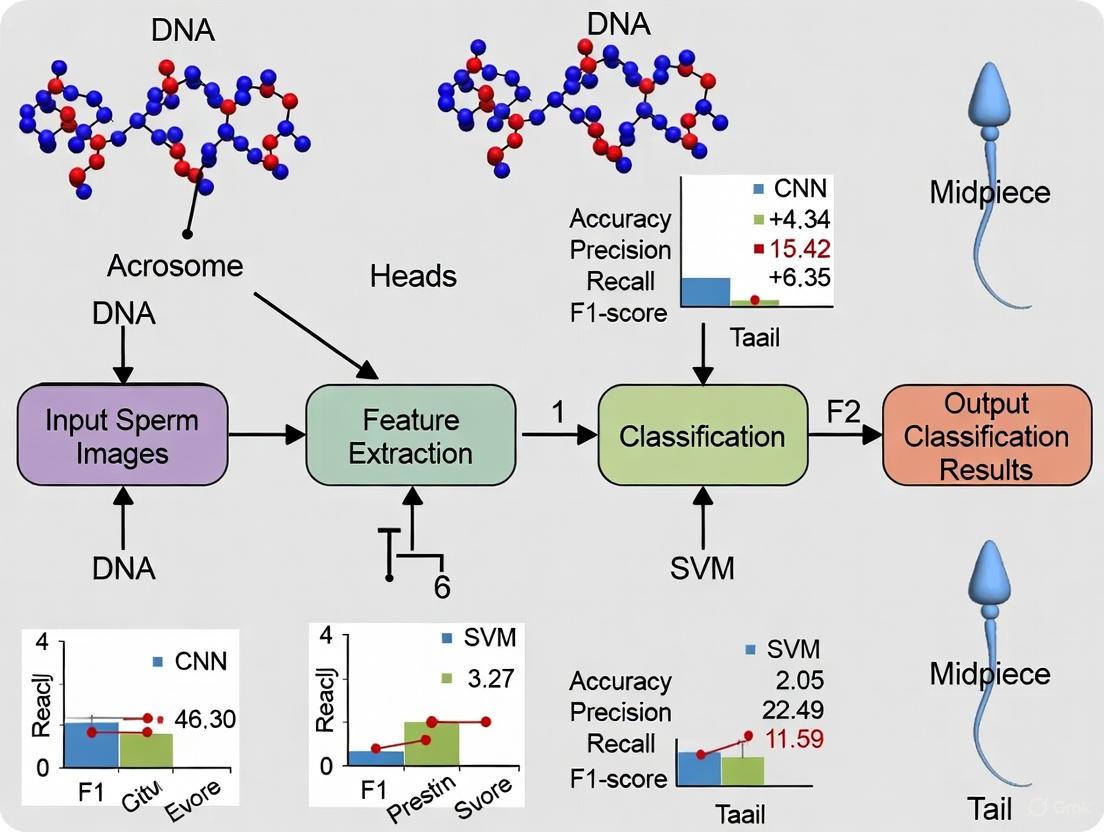
This article provides a comprehensive comparison of Convolutional Neural Networks (CNN) and Support Vector Machines (SVM) for automated sperm morphology classification, a critical task in male fertility diagnostics.
CNN vs. SVM for Sperm Classification: A Comparative Analysis of Deep Learning and Traditional Machine Learning in Reproductive Medicine
Abstract
This article provides a comprehensive comparison of Convolutional Neural Networks (CNN) and Support Vector Machines (SVM) for automated sperm morphology classification, a critical task in male fertility diagnostics. We explore the foundational principles of both algorithms, detail their specific methodological applications in sperm image analysis, and address key challenges such as dataset limitations and model optimization. By synthesizing recent validation studies and performance metrics, this review highlights the emerging superiority of hybrid models that integrate CNN feature extraction with SVM classification. Aimed at researchers and biomedical professionals, this analysis offers actionable insights for developing robust, clinically applicable AI tools in reproductive medicine.
Understanding the Clinical Problem and Algorithmic Foundations of Sperm Classification
The Critical Role of Sperm Morphology in Male Fertility Assessment
Male infertility is a significant global health concern, contributing to approximately 50% of infertility cases among couples worldwide [1] [2]. Sperm morphology analysis serves as a cornerstone in male fertility evaluation, as the shape and structural integrity of sperm cells are strongly correlated with fertilization potential and assisted reproductive technology outcomes [3] [4]. According to World Health Organization standards, normal sperm morphology is characterized by an oval head (length: 4.0-5.5 μm, width: 2.5-3.5 μm), an intact acrosome covering 40-70% of the head, and a single, uniform tail [4].
Traditional manual morphology assessment performed by embryologists suffers from critical limitations including significant inter-observer variability (studies report up to 40% disagreement between expert evaluators), lengthy evaluation times (30-45 minutes per sample), and inconsistent standards across laboratories [3] [4]. This diagnostic variability has driven the development of automated computational approaches, with deep learning and machine learning emerging as transformative technologies for objective, standardized sperm analysis.
This comparison guide examines the evolving landscape of sperm classification methodologies, with particular focus on the performance comparison between Convolutional Neural Networks (CNNs) and Support Vector Machines (SVMs) within the context of male fertility assessment. By synthesizing experimental data from recent studies and detailing essential research protocols, we provide researchers and clinicians with evidence-based insights for selecting appropriate computational approaches in reproductive medicine.
Methodological Evolution in Sperm Morphology Analysis
Traditional Machine Learning: The SVM Era
Traditional machine learning approaches for sperm classification dominated the field before the widespread adoption of deep learning. These methods relied on handcrafted feature extraction, where technicians manually designed and extracted specific morphological descriptors from sperm images.
- Feature Engineering: Critical features included shape-based descriptors (head area, perimeter, eccentricity), textural features, and more abstract mathematical representations such as Zernike moments, Fourier descriptors, and geometric Hu moments [5].
- SVM Classification Framework: The cascade ensemble of SVM (CE-SVM) classifiers represented a sophisticated approach where an initial SVM filtered out amorphous sperm, followed by specialized SVMs for distinguishing between specific morphological categories [5].
- Performance Limitations: These methods were fundamentally constrained by their dependence on manual feature design, which often failed to capture subtle morphological variations crucial for clinical assessment. The CE-SVM approach achieved an average true positive rate of approximately 58-78.5% on benchmark datasets [5].
Deep Learning Revolution: CNN Architectures
Deep learning approaches marked a paradigm shift by automatically learning relevant features directly from raw pixel data, eliminating the need for manual feature engineering.
- End-to-End Learning: CNNs process raw sperm images through multiple convolutional layers that automatically extract hierarchical features, from simple edges in early layers to complex morphological patterns in deeper layers [5] [4].
- Transfer Learning: Researchers successfully adapted pre-trained networks (VGG16, ResNet50) initially trained on ImageNet to sperm classification tasks, significantly reducing computational requirements while maintaining high accuracy [5].
- Architectural Innovations: Modern implementations incorporate attention mechanisms (Convolutional Block Attention Module - CBAM) and deep feature engineering pipelines that combine the strengths of deep learning with classical machine learning [3] [4].
The methodological progression from feature-dependent SVMs to feature-learning CNNs represents a fundamental shift in computational approach, with significant implications for classification performance and clinical applicability.
Performance Comparison: CNN vs. SVM
Quantitative Performance Metrics
Table 1: Comparative Performance of CNN and SVM Approaches on Benchmark Datasets
| Methodology | Dataset | Accuracy/TPR | Key Strengths | Limitations |
|---|---|---|---|---|
| CE-SVM [5] | HuSHeM | 78.5% TPR | Interpretable features | Manual feature engineering |
| VGG16 (Transfer Learning) [5] | HuSHeM | 94.1% TPR | Automated feature extraction | Computational intensity |
| CBAM-ResNet50 + Deep Feature Engineering [3] [4] | SMIDS | 96.08% Accuracy | State-of-the-art performance | Complex implementation |
| CBAM-ResNet50 + Deep Feature Engineering [3] [4] | HuSHeM | 96.77% Accuracy | Superior feature selection | Requires large datasets |
| ResNet50 (Unstained Sperm) [6] | Confocal Microscopy | 93% Accuracy | Works with live, unstained sperm | Specialized equipment needed |
Table 2: Timeline of Performance Evolution (2019-2025)
| Year | Leading Approach | Reported Accuracy | Key Innovation |
|---|---|---|---|
| 2019 | Dictionary Learning (APDL) [5] | 92.3% (HuSHeM) | Class-specific dictionaries |
| 2020 | MobileNet [4] | 87% (SMIDS) | Computational efficiency |
| 2022 | Ensemble CNNs [4] | 98.2% (HuSHeM) | Multiple network combination |
| 2025 | CBAM-ResNet50 + DFE [3] | 96.77% (HuSHeM) | Attention mechanisms + feature engineering |
Critical Performance Insights
The experimental data reveals several key trends in the CNN vs. SVM performance comparison:
- Accuracy Superiority: Modern CNN-based approaches consistently outperform traditional SVM methods by significant margins (approximately 8-18% improvement in accuracy) across multiple benchmark datasets [3] [5] [4].
- Hybrid Advantage: The integration of deep feature engineering with classical machine learning demonstrates particular effectiveness. The combination of CBAM-enhanced ResNet50 features with SVM classification achieved 96.08% accuracy on SMIDS, representing an 8.08% improvement over baseline CNN performance [4].
- Clinical Efficiency: CNN-based processing dramatically reduces analysis time from 30-45 minutes for manual assessment to under 1 minute per sample, enabling potential real-time clinical application [3].
Experimental Protocols and Methodologies
CNN with Deep Feature Engineering Protocol
Table 3: Key Research Reagents and Computational Tools
| Resource | Type | Function | Example Sources |
|---|---|---|---|
| Benchmark Datasets | Data | Model training & validation | HuSHeM [5], SMIDS [3], SCIAN [5] |
| Pre-trained Models | Computational | Transfer learning foundation | VGG16 [5], ResNet50 [3] [4] |
| Attention Modules | Algorithmic | Feature emphasis | CBAM [3] [4] |
| Feature Selection Methods | Analytical | Dimensionality reduction | PCA, Chi-square, Random Forest [3] |
| Classification Algorithms | Computational | Final prediction | SVM (RBF/Linear), k-NN [3] |
The state-of-the-art methodology combining CNN architecture with deep feature engineering follows a structured workflow:
Diagram 1: CNN with Deep Feature Engineering Workflow
Key Experimental Steps:
- Image Preprocessing: Standardize sperm images through resizing, normalization, and augmentation to ensure consistent input dimensions and improve model generalization [3] [4].
- Backbone Feature Extraction: Process images through a pre-trained CNN backbone (ResNet50/Xception) enhanced with Convolutional Block Attention Module (CBAM) to focus on morphologically relevant regions [3].
- Multi-layer Feature Extraction: Extract deep features from multiple network layers (CBAM, Global Average Pooling, Global Max Pooling, pre-final) to capture both high-level and detailed morphological characteristics [4].
- Feature Selection: Apply diverse feature selection methods including Principal Component Analysis, Chi-square test, Random Forest importance, and variance thresholding to reduce dimensionality and retain most discriminative features [3].
- Classification: Implement shallow classifiers (SVM with RBF/Linear kernels, k-Nearest Neighbors) on selected features for final morphology classification [3] [4].
Traditional SVM Classification Protocol
Diagram 2: Traditional SVM Classification Pipeline
Key Experimental Steps:
- Image Preprocessing: Apply wavelet denoising, directional masking, and contrast enhancement to improve image quality for feature extraction [4].
- Manual Feature Engineering: Extract handcrafted features including shape-based descriptors (area, perimeter, eccentricity), textural features, and mathematical representations (Zernike moments, Fourier descriptors, Hu moments) [5].
- Feature Selection: Identify most discriminative features using traditional statistical methods to reduce dimensionality and improve classification efficiency [1].
- Cascade SVM Classification: Implement a two-stage ensemble approach where an initial SVM filters amorphous sperm, followed by specialized SVMs for fine-grained classification between specific morphological categories [5].
Clinical Implications and Research Applications
Diagnostic Advancements
The evolution from SVM to CNN-based sperm classification has produced significant clinical benefits:
- Standardized Assessment: Deep learning models reduce inter-observer variability from >40% to consistent, reproducible measurements, enabling reliable comparisons across laboratories and over time [3] [4].
- Unstained Sperm Analysis: Modern CNN approaches successfully classify live, unstained sperm with 93% accuracy using confocal laser scanning microscopy, preserving sperm viability for subsequent clinical use in assisted reproductive technologies [6].
- Comprehensive Morphological Evaluation: Advanced segmentation models (Mask R-CNN, U-Net, YOLOv8) enable precise multi-part analysis of sperm components (head, acrosome, nucleus, neck, tail), providing detailed morphological insights beyond simple normal/abnormal classification [7].
Operational Efficiency
CNN-based automated analysis generates substantial operational improvements:
- Time Reduction: Processing time decreases from 30-45 minutes for manual assessment to under 1 minute per sample, significantly increasing laboratory throughput [3].
- Real-Time Potential: With prediction times of approximately 0.0056 seconds per image, CNN models enable real-time sperm selection during intracytoplasmic sperm injection procedures [6].
- Resource Optimization: Reduced dependency on highly trained embryologists for routine morphology assessment allows reallocation of expert resources to more complex clinical decisions [1].
Future Directions and Research Opportunities
The integration of CNN and SVM methodologies through deep feature engineering represents a promising hybrid approach that leverages the strengths of both technologies. Future research directions include:
- Explainable AI Integration: Developing Grad-CAM and attention visualization tools to enhance clinical interpretability and build trust among embryologists [3] [4].
- Multi-Modal Learning: Combining bright-field, confocal, and staining-free imaging modalities to improve generalization across diverse clinical settings [6].
- Federated Learning: Addressing data privacy concerns while leveraging diverse datasets from multiple institutions to enhance model robustness [1].
- Real-Time Clinical Implementation: Optimizing computational efficiency for integration into existing clinical workflows and CASA systems [7] [6].
The comparative analysis between CNN and SVM approaches for sperm morphology classification demonstrates a clear evolutionary trajectory in computational reproductive medicine. While traditional SVM methods established the foundation for automated sperm analysis, contemporary CNN architectures with attention mechanisms and deep feature engineering have achieved superior performance, with accuracy rates exceeding 96% on benchmark datasets.
The hybrid approach combining CBAM-enhanced ResNet50 feature extraction with SVM classification represents the current state-of-the-art, delivering approximately 8-10% improvement over baseline CNN performance. This methodology successfully addresses key limitations of traditional manual assessment by providing standardized, objective evaluation while reducing analysis time from 45 minutes to under 1 minute per sample.
For researchers and clinicians, the selection between computational approaches should consider specific application requirements: traditional SVM methods may suffice for limited datasets with clear morphological features, while CNN-based approaches are essential for high-accuracy clinical applications requiring robust performance across diverse sperm morphologies. As the field advances, the integration of explainable AI and multi-modal learning will further enhance the clinical utility and adoption of these transformative technologies in reproductive medicine.
Limitations of Manual Semen Analysis and Subjectivity Challenges
Semen analysis is a foundational investigation in male fertility assessment, with male factors contributing to approximately 50% of all infertility cases [8] [9]. The evaluation of sperm morphology—the size, shape, and structural characteristics of sperm cells—is a critical component of this analysis, as abnormalities are strongly correlated with reduced fertility rates and poor outcomes in assisted reproductive technology (ART) [3] [4]. Historically, this assessment has been performed manually by trained embryologists according to World Health Organization (WHO) guidelines, a process that is inherently subjective and time-intensive [3] [10].
This article explores the significant limitations of conventional manual semen analysis and examines how computational approaches, specifically Convolutional Neural Networks (CNNs) and Support Vector Machines (SVMs), are addressing these challenges. We provide a detailed, data-driven comparison of these methodologies, highlighting their respective performances, experimental protocols, and implications for the future of reproductive medicine.
The Critical Shortcomings of Manual Morphology Assessment
Manual sperm morphology analysis is characterized by several fundamental limitations that impact its diagnostic reliability and clinical utility.
Significant Inter-Observer Variability and Subjectivity
The primary challenge of manual assessment is its lack of objectivity. Studies report diagnostic disagreement of up to 40% between expert evaluators, with kappa values—a statistical measure of inter-rater reliability—as low as 0.05–0.15 [3] [4]. This high degree of variability stems from the subjective interpretation of complex morphological criteria, such as head shape (length: 4.0–5.5 μm, width: 2.5–3.5 μm), acrosome integrity (covering 40–70% of the head), and tail configuration [4]. Consequently, results are heavily influenced by the technician's expertise and training, leading to inconsistent diagnoses and poor reproducibility across different laboratories [1] [10].
Procedural Inefficiency and Labor Intensity
The manual process is exceptionally time-consuming. A reliable morphology assessment requires the examination of at least 200 sperm per sample, a tedious task that typically takes an experienced embryologist 30 to 45 minutes to complete [3] [4]. This labor-intensive process creates bottlenecks in clinical workflows and increases the cost of fertility diagnostics.
Limited Predictive Power for Clinical Outcomes
Perhaps the most significant clinical limitation is the weak correlation between conventional semen parameters and the ultimate outcome: pregnancy. In approximately 25% of infertility cases, conventional semen parameters are considered 'normal,' leading to a diagnosis of 'unexplained infertility' [9]. The WHO manual itself has shifted from using 'reference ranges' to 'decision limits,' acknowledging that semen parameters alone cannot reliably distinguish between fertile and infertile men [9].
Automated Solutions: CNN and SVM Methodologies
To overcome these limitations, researchers have turned to artificial intelligence (AI). The following sections detail the experimental protocols and performance of two prominent machine-learning approaches.
Table 1: Core Architectures of CNN and SVM for Sperm Classification
| Feature | CNN-Based Approach | SVM-Based Approach |
|---|---|---|
| Core Architecture | Deep neural networks with multiple convolutional and pooling layers (e.g., ResNet50 backbone) [3] | Shallow classifier operating on a high-dimensional feature space [3] [4] |
| Feature Extraction | Automatic, hierarchical feature learning from raw pixels [1] | Relies on manually engineered features or features extracted by another network [3] [10] |
| Primary Strength | Superior ability to learn complex, non-linear patterns directly from images [4] | Effectiveness in high-dimensional spaces and with limited data [3] |
| Common Implementation | End-to-end classification or as a feature extractor for another classifier [3] [4] | Often used as the final classifier on top of deep feature embeddings [3] |
Deep Feature Engineering with CNN-SVM Hybrid
A state-of-the-art approach involves a hybrid methodology that leverages the strengths of both CNNs and SVMs. The experimental protocol for one such successful framework is outlined below [3] [4]:
- Step 1: Backbone Feature Extraction: A pre-trained ResNet50 architecture, enhanced with a Convolutional Block Attention Module (CBAM), serves as the core feature extractor. The CBAM allows the network to focus on diagnostically relevant regions of the sperm, such as the head and tail [3] [4].
- Step 2: Multi-Source Feature Pooling: Deep feature embeddings are extracted from four different layers of the network: CBAM, Global Average Pooling (GAP), Global Max Pooling (GMP), and the pre-final layer. This captures information at various levels of abstraction [3].
- Step 3: Feature Selection: Ten distinct feature selection methods, including Principal Component Analysis (PCA), Chi-square test, and Random Forest importance, are applied to reduce dimensionality and retain the most discriminative features [3].
- Step 4: Classification: The refined feature set is fed into a classifier, typically an SVM with an RBF or linear kernel, for the final morphology classification [3] [4].
This workflow was rigorously evaluated on two public datasets, SMIDS (3,000 images) and HuSHeM (216 images), using a 5-fold cross-validation protocol to ensure robust performance metrics [3].
Diagram 1: Workflow of a Hybrid CNN-SVM Model for Sperm Classification. The process integrates deep feature extraction with classical machine learning for final classification.
Conventional ML with Handcrafted Features
In contrast to deep learning, conventional machine learning relies on a fundamentally different protocol, requiring manual, upfront feature engineering [1] [10]:
- Step 1: Image Pre-processing: Techniques like wavelet denoising and directional masking are applied to enhance image quality and prepare it for analysis [4].
- Step 2: Manual Feature Extraction: Experts define and extract specific, handcrafted features from the sperm images. These can include:
- Step 3: Classifier Training: The curated feature set is used to train a shallow classifier, such as an SVM, k-Nearest Neighbors (k-NN), or decision tree, to perform the classification task [1] [10].
This method is fundamentally limited by its dependence on human expertise to identify and quantify relevant features, which may not capture all the subtle, clinically significant patterns in the data [10].
Performance Comparison: Quantitative Results
The following tables summarize the experimental data comparing the performance of different computational approaches against manual analysis and against each other.
Table 2: Performance Comparison Across Different Methodologies on Benchmark Datasets
| Methodology | Dataset | Reported Accuracy | Key Advantages | Key Limitations |
|---|---|---|---|---|
| Manual Analysis | N/A | N/A | Provides overall sample context [9] | 40% inter-observer variability; 30-45 min/sample [3] [4] |
| Conventional ML (SVM on handcrafted features) | HuSHeM | 49% - 90% [10] | Interpretable with engineered features [1] | Relies on manual feature design; poor generalizability [1] [10] |
| Baseline CNN (ResNet50) | SMIDS / HuSHeM | ~88% [4] | Automatic feature learning; high throughput [4] | Requires large datasets; "black-box" nature [1] |
| Hybrid CNN-SVM with Deep Feature Engineering | SMIDS / HuSHeM | 96.08% ± 1.2% / 96.77% ± 0.8% [3] [4] | State-of-the-art accuracy; combines deep learning power with SVM efficacy [3] | Complex multi-stage pipeline; computationally intensive training [3] |
The data demonstrates a clear performance hierarchy. The hybrid CNN-SVM model, utilizing deep feature engineering, achieved the highest accuracy, with a statistically significant improvement of 8.08% on the SMIDS dataset and 10.41% on the HuSHeM dataset over the baseline CNN performance (p < 0.05, McNemar’s test) [3] [4]. This underscores the synergistic effect of combining deep representation learning with robust shallow classifiers.
Table 3: Key Resources for Sperm Morphology Classification Research
| Resource / Reagent | Type / Specification | Primary Function in Research |
|---|---|---|
| Public Datasets | ||
| SMIDS [3] [1] | 3,000 stained sperm images (3 classes) | Benchmarking for classification tasks [3] |
| HuSHeM [3] [1] | 216 sperm head images (publicly available) | Benchmarking for sperm head morphology [3] |
| SVIA Dataset [1] [10] | 125,000+ instances; detection, segmentation, and classification | Training and evaluating complex, multi-task models [1] [10] |
| Software & Algorithms | ||
| ResNet50 Architecture | Deep CNN with residual connections [3] [4] | A robust backbone network for feature extraction. |
| Convolutional Block Attention Module (CBAM) | Lightweight attention module [3] [4] | Enhances CNN by focusing on salient spatial and channel-wise features. |
| Support Vector Machine (SVM) | Classifier with RBF/Linear kernel [3] | Provides high-performance classification on deep feature sets. |
| Principal Component Analysis (PCA) | Linear dimensionality reduction technique [3] | Reduces noise and feature dimensionality prior to classification. |
Diagram 2: Performance Hierarchy of Sperm Classification Methods. The evolution from manual to hybrid AI methods shows a trend towards greater objectivity, automation, and accuracy.
The limitations of manual semen analysis—primarily its subjectivity, inefficiency, and limited predictive power—present a significant challenge in male fertility diagnostics. Computational approaches offer a transformative solution. The experimental data and performance comparisons presented in this guide clearly demonstrate that while conventional SVM-based methods provide a degree of automation, the highest performance is achieved by deep learning-based approaches.
Notably, the hybrid CNN-SVM framework with deep feature engineering has emerged as a state-of-the-art solution, achieving accuracies exceeding 96% on benchmark datasets and significantly reducing analysis time from 45 minutes to under a minute per sample [3]. This represents a paradigm shift towards standardized, objective, and high-throughput sperm morphology assessment, with the potential to greatly enhance diagnostic consistency and ultimately improve patient outcomes in reproductive medicine. Future research will likely focus on improving model interpretability and generalizing these systems for widespread clinical adoption.
In the field of medical image analysis, particularly for sperm morphology classification, two fundamental machine learning approaches are frequently employed: Convolutional Neural Networks (CNNs) for automated feature extraction and Support Vector Machines (SVMs) for classification. CNNs automatically learn hierarchical feature representations directly from raw pixel data, eliminating the need for manual feature engineering. In contrast, SVMs are powerful classifiers that find optimal decision boundaries in high-dimensional feature spaces but traditionally require manually engineered features as input. Within male fertility diagnostics, where sperm morphology analysis is crucial yet plagued by subjectivity and inter-observer variability, both approaches offer distinct advantages and limitations. This guide provides an objective comparison of these technologies, their performance characteristics, and emerging hybrid approaches that combine their strengths for enhanced classification accuracy in biomedical applications.
Performance Comparison: Quantitative Analysis
The table below summarizes key performance metrics from recent studies comparing CNN and SVM approaches for sperm morphology classification across different datasets and experimental conditions.
Table 1: Performance Comparison of CNN, SVM, and Hybrid Approaches for Sperm Morphology Classification
| Study & Methodology | Dataset | Classes | Key Differentiator | Reported Accuracy | Advantages | Limitations |
|---|---|---|---|---|---|---|
| CE-SVM (Traditional) [5] | HuSHeM | 5 WHO categories | Handcrafted shape descriptors + SVM classifier | 78.5% | Interpretable features; mathematical elegance | Limited performance; requires manual feature engineering |
| VGG16 (Deep CNN) [5] | HuSHeM | 5 WHO categories | Transfer learning with end-to-end CNN | 94.1% | Automated feature extraction; superior accuracy | Computationally intensive; requires large datasets |
| CBAM-ResNet50 + SVM (Hybrid) [4] [3] | SMIDSHuSHeM | 3-class4-class | CNN feature extraction + SVM classification | 96.08%96.77% | State-of-the-art accuracy; combines strengths | Complex pipeline; requires tuning of both components |
| CNN-SVM (Alzheimer's Application) [11] | Kaggle MRI | 4 AD stages | CNN features + SVM classifier with focal loss | 98.52% | Handles class imbalance; high accuracy | Domain-specific (neuroimaging) |
| VGG16 Feature Extraction + SVM [12] | Wild Cats | 10 species | CNN features + SVM classifier | 96% | Matches pure CNN performance | General image classification, not medical |
Technical Principles and Experimental Protocols
Convolutional Neural Networks (CNNs) for Automated Feature Extraction
CNNs represent a foundational deep learning architecture specifically designed for processing pixel data. Their core strength lies in automated feature extraction through a hierarchical learning process [5]. In sperm morphology analysis, this means the network learns to identify relevant features—from basic edges and textures in early layers to complex shapes like sperm heads, acrosomes, and tails in deeper layers—directly from input images without human intervention [1] [5].
Key CNN Architectures in Sperm Analysis:
- VGG16: Used with transfer learning, where a network pre-trained on natural images (e.g., ImageNet) is retrained on sperm datasets, achieving high accuracy while avoiding excessive computation [5].
- ResNet50: A deeper architecture that incorporates residual connections to facilitate training of very deep networks, often enhanced with attention mechanisms like CBAM (Convolutional Block Attention Module) to focus on morphologically significant sperm regions [4] [3].
- U-Net: Primarily employed for segmentation tasks, effectively separating sperm components (head, neck, tail) from the background, which is a critical preprocessing step for classification [13].
The experimental protocol for CNN-based classification typically involves: (1) dataset preparation and augmentation; (2) transfer learning using a pre-trained network; (3) end-to-end training with fine-tuning; and (4) performance evaluation [5]. This approach eliminates the need for manual feature engineering but requires substantial computational resources and large, well-annotated datasets [1].
Support Vector Machines (SVMs) for Classification
SVMs are classical machine learning algorithms that excel at finding optimal hyperplanes to separate different classes in a feature space. Their fundamental principle is to maximize the margin between classes, which often leads to strong generalization performance, especially with limited training samples [11] [12].
Traditional SVM Workflow for Sperm Analysis: In conventional sperm morphology analysis, SVMs operate as part of a multi-stage pipeline [5]:
- Manual Feature Extraction: Technicians first extract handcrafted features from sperm images, including shape-based descriptors (area, perimeter, eccentricity), texture features, and more abstract mathematical descriptors (Zernike moments, Fourier descriptors) [5].
- Feature Selection: The most discriminative features are selected to reduce dimensionality and improve model performance.
- SVM Classification: The feature vectors are fed into an SVM classifier, which constructs decision boundaries between different sperm categories (e.g., normal, tapered, pyriform) [5].
Advanced implementations like the Cascade Ensemble SVM (CE-SVM) use a two-stage approach where the first SVM filters out amorphous sperm and the second stage employs specialized SVMs for finer classification [5]. While mathematically elegant, this approach is fundamentally limited by its dependence on manually designed features, which may not capture all morphologically relevant information in sperm images [1] [5].
Emerging Hybrid Frameworks: CNN-SVM Integration
Recent research has demonstrated that hybrid frameworks combining CNN-based feature extraction with SVM classification can leverage the strengths of both approaches [11] [4] [3]. These systems typically employ a two-stage architecture where CNNs automatically extract high-level features from raw images, which are then processed using traditional feature selection techniques and classified using SVMs [4].
Experimental Protocol for Hybrid CNN-SVM Systems:
- Feature Extraction: A pre-trained CNN (e.g., ResNet50 enhanced with CBAM attention module) processes input images to generate deep feature embeddings [4] [3].
- Feature Engineering: Multiple feature vectors are extracted from different network layers (CBAM, Global Average Pooling, Global Max Pooling). Dimensionality reduction techniques like Principal Component Analysis (PCA) are applied to reduce noise and computational complexity [4] [3].
- Classification: The refined feature set is fed into an SVM with RBF or linear kernel for final classification [4].
- Evaluation: The model is validated using k-fold cross-validation, with statistical testing (e.g., McNemar's test) confirming significance of improvements over baseline methods [4] [3].
This hybrid approach has achieved state-of-the-art performance (96.08% on SMIDS dataset, 96.77% on HuSHeM dataset) by combining the representational power of deep learning with the classification efficiency of SVMs [4] [3].
Essential Research Reagents and Materials
The table below catalogues key datasets and computational resources essential for research in automated sperm morphology analysis.
Table 2: Key Research Resources for Sperm Morphology Analysis
| Resource Name | Type | Key Characteristics | Primary Research Application |
|---|---|---|---|
| HuSHeM Dataset [5] [4] | Image Dataset | 216 sperm head images; 4-5 WHO categories | Benchmarking classification algorithms |
| SCIAN-MorphoSpermGS [1] [5] | Image Dataset | 1,854 sperm images; 5-class classification | Training and validation of SVM and CNN models |
| SMIDS [4] [3] | Image Dataset | 3,000 images; 3-class (normal, abnormal, non-sperm) | Evaluating model generalization capability |
| SVIA Dataset [1] [13] | Multimodal Dataset | 125,000 detection instances; 26,000 segmentation masks | Large-scale training for detection and segmentation |
| VISEM-Tracking [1] | Video Dataset | 656,334 annotated objects with tracking data | Sperm motility analysis and dynamic morphology |
| VGG16 [5] [12] | CNN Architecture | Pre-trained on ImageNet; transfer learning | Baseline feature extraction and classification |
| ResNet50 with CBAM [4] [3] | Enhanced CNN | Attention mechanisms; deep feature engineering | State-of-the-art hybrid CNN-SVM frameworks |
Clinical Implications and Future Directions
The integration of CNN and SVM technologies for sperm morphology classification has significant clinical implications. Automated systems can reduce analysis time from 30-45 minutes for manual assessment to under one minute per sample, while simultaneously improving objectivity and standardization across laboratories [4] [3]. This is particularly valuable given reports of up to 40% diagnostic disagreement between human experts [4].
Future research directions include developing more sophisticated attention mechanisms to focus on clinically relevant sperm structures, creating larger and more diverse annotated datasets to improve model generalizability, and optimizing hybrid architectures for real-time analysis during assisted reproductive procedures [1] [4] [13]. As these technologies mature, they hold significant promise for improving diagnostic accuracy, standardizing fertility assessment, and ultimately enhancing patient outcomes in reproductive medicine.
This guide provides an objective comparison of three public datasets—SMIDS, HuSHeM, and SMD/MSS—used for evaluating deep learning models in sperm morphology classification. Focusing on the performance comparison between Convolutional Neural Networks (CNNs) and Support Vector Machines (SVMs), it is designed to assist researchers in selecting appropriate datasets and understanding methodological trade-offs.
Sperm morphology analysis is a critical component of male fertility assessment. The automation of this process using artificial intelligence aims to overcome the limitations of manual analysis, which is subjective, time-consuming, and prone to significant inter-observer variability [1] [14]. The development of robust, publicly available datasets is fundamental to progress in this field. Below is a detailed introduction and comparison of three key datasets.
SMIDS (Sperm Morphology Image Data Set): This dataset contains 3,000 stained sperm images, pre-classified into three categories: abnormal sperm, non-sperm cells, and normal sperm [1] [3]. Its relatively large size and clear class structure make it a popular benchmark for initial model validation and comparison.
HuSHeM (Human Sperm Head Morphology): A widely used benchmark, HuSHeM is a smaller dataset containing 216 high-resolution images of stained sperm heads [3] [1] [15]. It is typically used for a 4-class classification task. Its small size presents a specific challenge for training data-hungry deep-learning models, making it a test for techniques like transfer learning and data augmentation.
SMD/MSS (Sperm Morphology Dataset/Medical School of Sfax): A newer dataset, SMD/MSS starts with 1,000 images of individual spermatozoa acquired using a CASA system [16] [17]. Its key distinction is the use of the modified David classification, which defines 12 detailed classes of morphological defects affecting the head, midpiece, and tail [16]. To address data scarcity, the creators employed data augmentation techniques to expand the dataset to 6,035 images, providing a valuable resource for studying a wider range of sperm anomalies [16].
Table 1: Comparative Overview of Public Sperm Morphology Datasets
| Feature | SMIDS | HuSHeM | SMD/MSS |
|---|---|---|---|
| Total Images | 3,000 [3] | 216 [3] | 1,000 (original), 6,035 (augmented) [16] |
| Classification System | 3-class (Abnormal, Non-sperm, Normal) [3] | 4-class (Head Morphology) [3] | Modified David (12-class) [16] |
| Image Characteristics | Stained [1] | Stained, High-resolution [1] | Bright-field, CASA-acquired [16] |
| Key Differentiator | Larger size for 3-class classification | Fine-grained sperm head classification | Comprehensive defect annotation across entire sperm |
| Primary Use Case | Benchmarking model performance on common classes | Testing model efficiency and transfer learning | Detailed analysis of specific morphological defects |
Experimental Performance: CNN vs. SVM
The choice between end-to-end CNN architectures and hybrid CNN-SVM models is a central research question. The following experimental data and protocols illustrate how this comparison is conducted across the featured datasets.
Quantitative Performance Comparison
Experimental results demonstrate that a hybrid approach, which uses a CNN for feature extraction and a classic SVM for classification, can outperform a standard CNN alone.
Table 2: Experimental Performance of CNN vs. CNN-SVM on Public Datasets
| Dataset | Model Architecture | Test Accuracy | Key Experimental Setup |
|---|---|---|---|
| SMIDS | Baseline CNN | ~88% [4] | 5-fold cross-validation [3] |
| SMIDS | CBAM-ResNet50 + PCA + SVM (RBF) | 96.08% ± 1.2 [3] [4] | Deep Feature Engineering, 5-fold cross-validation [3] |
| HuSHeM | Baseline CNN | ~86.36% [4] | 5-fold cross-validation [3] |
| HuSHeM | CBAM-ResNet50 + PCA + SVM (RBF) | 96.77% ± 0.8 [3] [4] | Deep Feature Engineering, 5-fold cross-validation [3] |
| HuSHeM | DenseNet169 | 97.78% [15] | 70:25:5 data split for training, validation, and test [15] |
| SMD/MSS | CNN | 55% to 92% [16] | 80-20 train-test split, data augmentation [16] |
Detailed Experimental Protocols
The high performance of the top models is achieved through specific, rigorous methodologies.
Protocol for CBAM-ResNet50 with Deep Feature Engineering [3] [4]:
- Backbone and Attention: A ResNet50 architecture is enhanced with a Convolutional Block Attention Module (CBAM). This module sequentially applies channel and spatial attention to feature maps, forcing the model to focus on diagnostically relevant regions like the sperm head and tail.
- Feature Extraction: Instead of using the final classification layer, features are extracted from multiple intermediate layers, including the Global Average Pooling (GAP) and Global Max Pooling (GMP) layers.
- Feature Selection: A suite of feature selection methods, including Principal Component Analysis (PCA), is applied to the high-dimensional deep features to reduce noise and redundancy.
- Classification: The refined feature set is fed into a shallow classifier, such as a Support Vector Machine (SVM) with an RBF kernel, for the final classification. This hybrid approach leverages the feature extraction power of deep learning with the classification efficiency of traditional machine learning.
Protocol for SMD/MSS CNN Model [16]:
- Data Acquisition and Labeling: 1,000 individual sperm images were acquired via an MMC CASA system. Each image was manually classified by three experts based on the modified David classification, with a ground truth file compiled from their consensus.
- Data Augmentation: To combat limited data and class imbalance, the dataset was expanded to 6,035 images using augmentation techniques.
- Pre-processing: Images were resized to 80x80 pixels and converted to grayscale. The dataset was partitioned into training (80%) and testing (20%) sets.
- Training: A Convolutional Neural Network was implemented in Python 3.8 and trained on the augmented dataset.
Workflow and Pathway Visualizations
Deep Feature Engineering for Sperm Classification
SMD/MSS Dataset Creation and Model Training
The Scientist's Toolkit: Key Research Reagents and Materials
The following table details essential components used in the featured experiments, providing a resource for experimental replication and design.
Table 3: Essential Research Reagents and Computational Tools
| Item Name | Function/Description | Example in Context |
|---|---|---|
| CASA System | Computer-Assisted Semen Analysis system for automated image acquisition and initial morphometric analysis. | MMC CASA system used for acquiring images for the SMD/MSS dataset [16]. |
| RAL Diagnostics Stain | A staining kit used to prepare semen smears, enhancing visual contrast for morphological analysis. | Used for staining sperm samples in the SMD/MSS dataset creation [16]. |
| ResNet50 | A deep convolutional neural network architecture with 50 layers, known for its residual connections that ease the training of deep models. | Served as the backbone architecture in the state-of-the-art CBAM-enhanced model [3] [4]. |
| Convolutional Block Attention Module (CBAM) | A lightweight attention module that sequentially infers channel and spatial attention maps, helping the model focus on salient features. | Integrated into ResNet50 to improve feature representation for sperm parts [3] [4]. |
| Principal Component Analysis (PCA) | A classical linear technique for dimensionality reduction, which identifies the most important features in a dataset. | Used in the deep feature engineering pipeline to reduce noise in the high-dimensional features extracted from CBAM-ResNet50 before SVM classification [3] [4]. |
| Support Vector Machine (SVM) | A supervised machine learning model used for classification and regression, effective in high-dimensional spaces. | Used as the final classifier in the hybrid deep feature engineering pipeline, often with an RBF kernel [3] [4]. |
The comparative analysis of SMIDS, HuSHeM, and SMD/MSS reveals a clear trade-off between dataset size, annotation complexity, and model performance. SMIDS and HuSHeM, while smaller, have enabled the development of high-accuracy models (exceeding 96% with advanced architectures) and serve as excellent benchmarks [3] [15]. In contrast, the more complex SMD/MSS dataset, with its 12-class annotation scheme, presents a greater challenge, with reported accuracies ranging from 55% to 92% [16]. This highlights that the "best" dataset is intrinsically linked to the research objective—whether it is benchmarking against state-of-the-art or exploring fine-grained morphological defects.
The empirical evidence strongly supports the thesis that a hybrid CNN-SVM pipeline can surpass the performance of an end-to-end CNN. The standout results on SMIDS and HuSHeM were achieved not by a pure CNN, but by a model where CBAM-ResNet50 acted as a powerful feature extractor and an SVM with an RBF kernel performed the final classification [3] [4]. This synergy combines the hierarchical feature learning capability of deep learning with the robustness and efficiency of classical machine learning for classification, particularly in scenarios with limited data. Future work should focus on applying this hybrid paradigm to more complex datasets like SMD/MSS and continued efforts to create larger, more diverse, and publicly available datasets to further advance the field of automated sperm morphology analysis.
Implementation Strategies: Architectures, Feature Engineering, and Hybrid Models
Convolutional Neural Networks (CNNs) have become the cornerstone of modern image analysis, including specialized medical applications such as sperm morphology classification. This field has transitioned from traditional manual assessments, which are time-intensive and prone to significant inter-observer variability, toward automated deep learning solutions that offer objectivity and high throughput. Within this context, the evolution from established architectures like ResNet50 to more recent developments such as EfficientNetV2 represents a significant advancement in balancing accuracy with computational efficiency. This guide provides a comprehensive comparison of these CNN architectures, framed within sperm classification research where these models are increasingly deployed to achieve diagnostic-grade performance. We examine their architectural principles, practical performance in controlled experiments, and implementation considerations for researchers and developers in the field of reproductive medicine and drug development.
Architectural Evolution: ResNet50 to EfficientNetV2
The transition from ResNet50 to EfficientNetV2 represents a fundamental shift in how neural networks are designed for computer vision tasks, moving from solving specific training problems to holistically optimizing model scaling and training speed.
ResNet50: Enabling Deep Networks
ResNet50, introduced by Microsoft in 2015, revolutionized deep learning by addressing the vanishing gradient problem that plagued very deep networks. Its core innovation is the residual block with skip connections, which allows gradients to flow directly backward through the identity mapping, enabling the training of networks with hundreds of layers that still converge effectively [18] [19]. The "50" in its name refers to its 50-layer depth. This architecture prioritizes depth scaling while maintaining convergence, making it a robust and versatile baseline for many computer vision tasks [19]. Its relative simplicity makes it easily implementable and adaptable for custom use cases.
EfficientNetV2: Compound Scaling and Training Optimization
EfficientNetV2, developed by Google, builds upon the original EfficientNet's compound scaling method which uniformly scales network width, depth, and resolution with a set of fixed coefficients [18]. This approach ensures balanced growth across all dimensions rather than focusing on just one aspect like depth. EfficientNetV2 specifically addresses three observed limitations in earlier models: slow training with large image sizes, computational slowness of depthwise convolutions in early layers, and the sub-optimal practice of equally scaling up every stage [18]. By introducing Fused-MBConv blocks and applying training-aware neural architecture search, EfficientNetV2 achieves superior training speed and parameter efficiency while maintaining high accuracy [18].
Key Architectural Differences
Table 1: Fundamental Architectural Comparison
| Aspect | ResNet50 | EfficientNetV2 |
|---|---|---|
| Core Innovation | Residual blocks with skip connections | Compound scaling + Fused-MBConv blocks |
| Primary Scaling Focus | Depth | Unified width, depth, and resolution |
| Key Components | Basic residual/bottleneck blocks | MBConv and Fused-MBConv blocks |
| Activation Function | Typically ReLU | Swish activation for improved gradient flow |
| Parameter Efficiency | Moderate (~23M parameters) | High (smaller models with comparable accuracy) |
Performance Comparison in Medical Imaging
When evaluated across various medical image classification tasks, including sperm morphology analysis, ResNet50 and EfficientNetV2 demonstrate distinct performance characteristics that make them suitable for different operational constraints.
Quantitative Results Across Domains
Table 2: Performance Metrics Across Medical Applications
| Application Domain | Model | Accuracy | Training Efficiency | Computational Cost |
|---|---|---|---|---|
| Sperm Morphology (SMIDS) | ResNet50 (Baseline) | ~88% [3] | Moderate | Higher (~4B FLOPs) [19] |
| Sperm Morphology (SMIDS) | CBAM-Enhanced ResNet50 + DFE | 96.08% [3] [4] | Slower due to larger parameter count | High (~4B FLOPs) [19] |
| Sperm Morphology (HuSHeM) | CBAM-Enhanced ResNet50 + DFE | 96.77% [4] | Slower | High |
| Brain Tumor Classification | EfficientNetV2 | Superior to ResNet50 [20] | Faster than EfficientNet but slower than ResNet50 [20] | Lower than ResNet50 for comparable accuracy [19] |
| Cancer Image Classification | ResNet50V2 | 91.5% (5 epochs) [21] | Slower, prone to overfitting | Higher |
| Cancer Image Classification | EfficientNetV2 | 66-70% (10 epochs) [21] | Faster training times | Lower computational demand |
In sperm morphology classification specifically, enhanced ResNet50 variants have demonstrated exceptional performance when combined with attention mechanisms and feature engineering. The integration of Convolutional Block Attention Module (CBAM) with ResNet50, followed by deep feature engineering (DFE) pipelines incorporating feature selection methods like Principal Component Analysis (PCA) and classifiers such as Support Vector Machines (SVM), has achieved state-of-the-art accuracy exceeding 96% on benchmark datasets [3] [4]. This represents an approximately 8 percentage point improvement over baseline CNN performance [4].
Efficiency and Deployment Considerations
EfficientNetV2 consistently demonstrates advantages in computational efficiency across studies. It is characterized by significantly lower FLOPs (floating-point operations) and smaller model sizes compared to ResNet50 variants [19]. This makes EfficientNetV2 particularly suitable for resource-constrained environments, including mobile applications and edge computing devices commonly found in clinical settings [19]. In direct comparisons, EfficientNetV2 has shown faster inference times while maintaining competitive accuracy, striking a favorable balance between performance and computational demand [21] [19].
Experimental Protocols for Sperm Classification
Implementing CNN architectures for sperm morphology classification requires careful experimental design to ensure robust and clinically relevant results. Below we outline standardized protocols derived from recent literature.
Dataset Preparation and Augmentation
The MHSMA dataset, containing 1,540 grayscale semen images with dimensions of 128×128 pixels, is commonly used for sperm morphology classification [22]. Images are typically divided into training (approximately 1,000 images), validation (240 images), and test sets (300 images) with balanced representation of positive (normal) and negative (abnormal) samples for different morphological features including vacuole, acrosome, and head defects [22]. To address class imbalance and limited dataset size, data augmentation techniques are routinely applied, including geometric transformations (rotation, flipping), color space adjustments, and noise injection [22] [23]. For the more extensive SVIA dataset, which contains over 125,000 sperm and impurity images, careful curation is required to maintain quality across subsets [23].
Model Training and Optimization
A standard training protocol involves using the Adam optimizer with a learning rate of 0.0001-0.001 and batch sizes of 32 [21] [22]. The loss function is typically binary cross-entropy for two-class classification problems (normal vs. abnormal). Training often employs a two-phase approach: initial freezing of backbone layers while training only the classification head, followed by full fine-tuning of all layers [18]. To mitigate overfitting, especially with limited medical data, regularization techniques including L2 regularization, dropout, and early stopping are implemented. Data augmentation further improves generalization [21].
Hybrid Deep Learning with SVM
The integration of CNNs with SVM classifiers has proven particularly effective for sperm morphology analysis. The experimental workflow involves:
- Feature Extraction: Using CNN backbone (ResNet50 or EfficientNetV2) to extract deep feature representations from the penultimate layer before classification [4].
- Feature Selection: Applying dimensionality reduction techniques such as Principal Component Analysis (PCA), Chi-square tests, or Random Forest importance to identify the most discriminative features [3] [4].
- SVM Classification: Training Support Vector Machines with RBF or linear kernels on the selected features for final classification [4].
- Evaluation: Rigorous validation using 5-fold cross-validation to ensure reliability of results [3].
This hybrid approach leverages the feature learning strengths of deep CNNs with the powerful classification boundaries of SVMs, often yielding superior performance compared to end-to-end CNN classification [4].
CNN-SVM Hybrid Workflow for Sperm Classification
Research Reagent Solutions
Implementing effective sperm classification systems requires both computational resources and specialized biological materials. The following table outlines essential components for establishing a robust research pipeline.
Table 3: Essential Research Materials and Resources
| Resource Category | Specific Examples | Function/Application |
|---|---|---|
| Public Datasets | MHSMA (1,540 images) [22], HuSHeM (216 images) [4], SMIDS (3,000 images) [3], SVIA (125,000+ images) [23] | Model training, benchmarking, and validation |
| Microscopy Equipment | IX70 Olympus microscope, DP71 Olympus camera [22] | High-quality image acquisition at 400x-600x magnification |
| Staining Reagents | Staining kits for semen smears [10] | Enhanced visualization of sperm structures |
| Computational Frameworks | TensorFlow/Keras, PyTorch [21] [18] | Model implementation and training |
| Data Augmentation Tools | Albumentations package [18] | Dataset expansion and regularization |
| Attention Mechanisms | CBAM (Convolutional Block Attention Module) [3] [4] | Enhanced feature focus in deep networks |
| Feature Selection Methods | PCA, Chi-square, Random Forest importance [3] [4] | Dimensionality reduction for hybrid classification |
The comparison between ResNet50 and EfficientNetV2 reveals a nuanced performance landscape where architectural advantages manifest differently across various operational contexts. For sperm morphology classification tasks, ResNet50 variants, particularly when enhanced with attention mechanisms and combined with traditional classifiers like SVM, currently achieve the highest reported accuracy (exceeding 96% on benchmark datasets) [3] [4]. However, EfficientNetV2 offers compelling advantages in training efficiency and computational resource requirements, making it potentially more suitable for deployment in resource-constrained environments or applications requiring real-time analysis [19].
For researchers and clinical developers, selection criteria should include:
- Accuracy-Critical Applications: CBAM-enhanced ResNet50 with deep feature engineering and SVM classification currently delivers state-of-the-art performance [4].
- Resource-Constrained Environments: EfficientNetV2 provides better computational efficiency with minimal accuracy sacrifice [19].
- Clinical Integration: Systems should prioritize not only accuracy but also interpretability through attention visualization and robust performance across diverse patient populations [3] [4].
The integration of CNN architectures with traditional machine learning classifiers like SVM represents a promising direction for medical image analysis, combining the feature learning power of deep networks with the robust classification capabilities of established algorithms. As these technologies continue to evolve, they hold significant potential for standardizing and improving sperm morphology analysis, ultimately enhancing diagnostic accuracy and treatment outcomes in reproductive medicine.
Architectural Evolution toward Hybrid Classification
The Role of Attention Mechanisms (e.g., CBAM) in Enhancing CNN Performance
The application of artificial intelligence in biomedical image analysis has revolutionized diagnostic processes, particularly in specialized fields like reproductive medicine where subjective visual assessment has long been the standard. In sperm morphology classification—a critical component of male fertility assessment—researchers have traditionally relied on manual evaluation by trained embryologists, a process characterized by significant inter-observer variability and time-intensive procedures [4]. The quest for standardization and objectivity initially led to the adoption of traditional machine learning approaches, particularly Support Vector Machines (SVMs), which utilized handcrafted morphological features such as head area, perimeter, and eccentricity for classification [5]. While these methods represented an important step toward automation, their dependency on manually engineered features limited their adaptability and overall performance.
The emergence of Convolutional Neural Networks (CNNs) marked a paradigm shift, enabling end-to-end learning directly from raw pixel data without explicit feature engineering. CNNs demonstrated remarkable capabilities in capturing hierarchical visual patterns, achieving substantial improvements in classification accuracy for sperm morphology analysis [5]. However, even these sophisticated networks lacked a crucial capability: the ability to selectively focus on the most discriminative regions of an image while suppressing less relevant information. This limitation became particularly significant when dealing with subtle morphological distinctions in sperm cells, where specific structural components (e.g., head shape, acrosome integrity, tail defects) carry disproportionate diagnostic importance.
The integration of attention mechanisms represents the latest evolution in this technological progression, addressing the fundamental limitation of uniform feature processing in standard CNNs. Among these approaches, the Convolutional Block Attention Module (CBAM) has emerged as a particularly effective solution, enhancing CNN architectures through sequential channel and spatial attention processes [24] [25]. By enabling networks to adaptively prioritize informative features and spatial locations, CBAM and similar attention mechanisms have demonstrated remarkable performance improvements across various computer vision tasks, including the specialized domain of sperm classification for fertility assessment [4].
Understanding CBAM: Architecture and Mechanisms
Core Conceptual Framework
The Convolutional Block Attention Module (CBAM) is a lightweight, general-purpose attention module that sequentially infers attention maps along two independent dimensions: channel and spatial [25]. This dual-path approach allows convolutional networks to selectively emphasize meaningful features while suppressing less useful ones, effectively addressing the "what" and "where" of feature importance within an image [24]. The modular design enables seamless integration into existing CNN architectures such as ResNet, VGG, and MobileNet with minimal computational overhead, typically being inserted after each convolutional block [25].
CBAM's fundamental innovation lies in its sequential application of channel and spatial attention, which researchers have empirically determined provides superior performance compared to parallel approaches or reversed ordering [25]. This design reflects a biologically-inspired approach to visual processing, mirroring how human visual perception selectively focuses on salient regions while perceiving broader contextual information [24]. The module operates exclusively on the intermediate feature maps, requiring no structural changes to the base network and maintaining end-to-end differentiability for seamless training [25].
Channel Attention Module
The channel attention component of CBAM focuses on "what" is meaningful in an input image by modeling inter-channel dependencies [24] [25]. Given an intermediate feature map F ∈ R^(C×H×W), the module first computes both average-pooled and max-pooled features across the spatial dimensions, generating two different spatial context descriptors: Favg and Fmax [25]. Both descriptors are then forwarded to a shared multi-layer perceptron (MLP) with a bottleneck structure, which reduces channel dimensionality by a reduction ratio r (typically 16), applies ReLU activation, then restores the original dimensionality [25].
The output features from both paths are combined using element-wise summation, followed by a sigmoid activation to generate the final channel attention map M_c ∈ R^(C×1×1) [25]. This process can be mathematically represented as:
M_c(F) = σ(MLP(AvgPool(F)) + MLP(MaxPool(F)))
Where σ denotes the sigmoid function. The resulting attention weights are broadcast along the spatial dimensions and multiplied with the input feature map, enhancing important channels while suppressing less relevant ones [25]. The dual-pooling approach enables the module to capture richer contextual information than single-pooling methods, as max-pooling gathers information about distinctive features while average-pooling captures global spatial context [25].
Spatial Attention Module
Following channel refinement, the spatial attention module addresses "where" to focus by generating a spatial attention map that highlights informative regions [24] [25]. The channel-refined feature map F' = Mc(F) ⊗ F serves as input to this module. The spatial attention mechanism begins by applying both average-pooling and max-pooling operations along the channel axis, generating two 2D spatial maps: F'avg ∈ R^(1×H×W) and F'_max ∈ R^(1×H×W) [25].
These pooled features are concatenated along the channel dimension to form a 2-channel feature map, which is then convolved with a standard 7×7 convolution layer [25]. The convolution operation integrates information across spatial neighborhoods, followed by a sigmoid activation to produce the spatial attention map M_s ∈ R^(1×H×W) [25]. This process can be represented as:
M_s(F') = σ(f^(7×7)([AvgPool(F'); MaxPool(F')]))
Where f^(7×7) denotes a convolution operation with a 7×7 filter and σ represents the sigmoid function. The resulting spatial attention map is multiplied element-wise with the input features, effectively emphasizing important spatial locations while suppressing less relevant regions [25]. The combination of both attention mechanisms in sequence—channel then spatial—creates a complementary effect that significantly enhances the representational power of the base CNN.
Table 1: Components of the Convolutional Block Attention Module
| Module Component | Primary Function | Key Operations | Output Dimension |
|---|---|---|---|
| Channel Attention | Determines "what" features are important | Average pooling, max pooling, shared MLP | R^(C×1×1) |
| Spatial Attention | Determines "where" to focus | Channel-wise average/max pooling, 7×7 convolution | R^(1×H×W) |
| Feature Refinement | Applies attention weights | Element-wise multiplication | R^(C×H×W) (same as input) |
Experimental Comparison: CBAM vs. Traditional Methods in Sperm Classification
Methodological Framework for Performance Evaluation
To objectively evaluate the performance enhancement provided by CBAM-enhanced CNNs compared to traditional methods, we examine rigorous experimental protocols from recent literature on sperm morphology classification. The standard evaluation framework typically involves comparing multiple approaches on benchmark datasets using consistent validation methodologies [4].
Datasets and Preprocessing: Research in this domain primarily utilizes publicly available, expert-annotated sperm image datasets, including the Human Sperm Head Morphology (HuSHeM) dataset and the SMIDS dataset [4]. These collections contain sperm images categorized according to World Health Organization criteria, including normal, tapered, pyriform, small, and amorphous morphological classes [5]. Standard preprocessing typically involves resizing images to dimensions compatible with pre-trained networks (e.g., 224×224 pixels), normalization using ImageNet statistics, and data augmentation techniques such as rotation, flipping, and color jittering to improve model generalization [4].
Baseline Models: Comparative studies typically establish several baseline approaches: (1) Traditional SVM classifiers using handcrafted features (e.g., shape descriptors, Zernike moments, Fourier descriptors) [5]; (2) Standard CNN architectures without attention mechanisms (e.g., VGG16, ResNet50) [5] [4]; and (3) CBAM-enhanced variants of the same CNN architectures [4]. This controlled comparison enables isolated measurement of the attention mechanism's contribution to performance.
Evaluation Metrics: Studies consistently employ standard classification metrics including accuracy, precision, recall, F1-score, and area under the receiver operating characteristic curve (AUC) [4]. Most researchers implement k-fold cross-validation (typically 5-fold) to ensure statistical reliability of results and mitigate variance from random data partitioning [4].
Quantitative Performance Comparison
Recent comprehensive studies directly comparing CBAM-enhanced CNNs against traditional methods for sperm morphology classification reveal consistent and substantial performance improvements. The integration of attention mechanisms demonstrates particularly significant advantages in handling subtle morphological distinctions that challenge both human experts and traditional algorithms.
Table 2: Performance Comparison of Sperm Classification Methods on Benchmark Datasets
| Classification Method | HuSHeM Dataset Accuracy | SMIDS Dataset Accuracy | Key Advantages | Limitations |
|---|---|---|---|---|
| SVM with Handcrafted Features [5] [4] | ~78.5% | ~70-75% (estimated) | Computational efficiency; Interpretability | Limited feature representation; Manual feature engineering |
| Standard CNN (VGG16/ResNet50) [5] [4] | ~86-88% | ~88% | Automatic feature learning; Strong performance | Uniform feature processing; Limited focus mechanism |
| CBAM-Enhanced CNN [4] | 96.77% | 96.08% | Adaptive feature emphasis; Interpretable attention maps | Increased computational complexity; Additional hyperparameters |
The performance advantage of CBAM-enhanced models extends beyond raw accuracy metrics. Research demonstrates that these models achieve significantly higher true positive rates (94.1% on HuSHeM) compared to CE-SVM approaches (78.5% on the same dataset) while maintaining low false positive rates [5]. This improvement translates directly to clinical utility, where both sensitivity and specificity are critical for accurate diagnosis.
Beyond sperm classification specifically, the general effectiveness of CBAM has been extensively validated across diverse vision tasks. When integrated into ResNet50 architectures, CBAM reduces top-1 classification error on ImageNet from 24.56% to 22.66%, outperforming other attention mechanisms including Squeeze-and-Excitation networks [25]. In object detection tasks, CBAM enhancement increases mean Average Precision on MS COCO from 27.0% to 28.1% when added to Faster R-CNN frameworks [25]. These consistent improvements across domains demonstrate the fundamental advantage of CBAM's dual-attention approach.
Visualization and Interpretability Advantages
A critical advantage of CBAM-enhanced networks in medical applications is their inherent interpretability through attention visualization. Techniques such as Grad-CAM can be applied to highlight the spatial regions that most influenced the classification decision, providing clinical validation of the model's focus areas [4]. In sperm morphology analysis, researchers have demonstrated that CBAM attention maps successfully highlight structurally significant regions such as head boundaries, acrosome integrity, and tail connections—precisely the features that embryologists prioritize during manual assessment [4].
This interpretability dimension represents a substantial advancement over traditional SVM approaches, where classification decisions derive from complex combinations of handcrafted features with limited spatial localization capabilities. For clinical adoption, this transparency is essential, as it allows domain experts to verify that models base decisions on biologically relevant features rather than spurious correlations in the data.
The Researcher's Toolkit: Essential Experimental Components
Table 3: Essential Research Reagents and Computational Resources for CBAM-CNN Experiments
| Resource Category | Specific Examples | Function/Purpose | Implementation Considerations |
|---|---|---|---|
| Benchmark Datasets | HuSHeM [5] [4], SCIAN [5], SMIDS [4] | Standardized performance evaluation; Comparative benchmarking | Dataset licensing; Annotation quality; Class distribution balance |
| Base CNN Architectures | ResNet50 [4], VGG16 [5], Xception [4] | Backbone feature extraction; Transfer learning initialization | Computational requirements; Pretrained weight availability; Architecture compatibility |
| Attention Modules | CBAM [25] [4], SE Block [26] | Feature refinement; Adaptive weighting | Integration points; Computational overhead; Hyperparameter tuning |
| Software Frameworks | PyTorch [24] [26], TensorFlow | Model implementation; Training pipeline; Evaluation metrics | GPU acceleration support; Community resources; Customization flexibility |
| Evaluation Metrics | Accuracy, Precision, Recall, F1-Score, AUC [4] | Performance quantification; Method comparison | Statistical significance testing; Clinical relevance; Comprehensive assessment |
The comprehensive experimental evidence demonstrates that CBAM-enhanced CNNs consistently outperform traditional SVM approaches for sperm morphology classification, achieving accuracy improvements of approximately 10-18% on benchmark datasets [4]. This performance advantage stems from CBAM's ability to adaptively emphasize semantically rich features while suppressing noise—a capability that handcrafted feature engineering approaches lack. The sequential channel-spatial attention mechanism provides a computationally efficient yet powerful method for enhancing feature discriminability, particularly valuable for subtle morphological distinctions in biomedical images.
Beyond raw performance metrics, CBAM-enhanced models offer superior interpretability through visualizable attention maps, providing clinical validation of decision rationale [4]. This transparency is essential for clinical adoption, as it enables domain experts to verify that models base decisions on biologically relevant features. Furthermore, the modular nature of CBAM facilitates integration into existing CNN architectures with minimal structural modification, making it practical for implementation in diverse research and clinical settings [25].
Future research directions include exploring optimal CBAM integration strategies across different network depths, adapting attention mechanisms for extremely low-sample regimes common in medical imaging, and developing specialized attention approaches for domain-specific characteristics of sperm morphology [25] [4]. Additionally, the combination of attention mechanisms with emerging transformer architectures presents promising avenues for further performance improvement [25]. As artificial intelligence continues to transform reproductive medicine, attention mechanisms like CBAM represent a significant advancement toward automated, accurate, and interpretable sperm morphology classification systems that can standardize fertility assessment across clinical settings.
Support Vector Machines (SVM) represent a cornerstone of traditional machine learning approaches for medical image classification, including sperm analysis. Within the context of sperm classification research, traditional SVM workflows operate on a fundamentally different principle than modern deep learning approaches. These workflows rely on a two-stage process: first, handcrafted feature extraction where domain experts manually design algorithms to identify and quantify specific sperm characteristics; and second, kernel-based classification where SVMs find optimal boundaries between different sperm classes in the feature space [1] [4].
The persistent relevance of SVM in 2025 stems from several distinct advantages in specific research scenarios. SVMs demonstrate particular efficacy with small to medium-sized datasets, offer greater model interpretability compared to deep neural networks, and provide robust performance with structured/tabular data [27]. Furthermore, their computational efficiency makes them practical when deep learning would be excessive for the classification task at hand. In sperm morphology analysis, these characteristics have maintained SVM as a viable approach, particularly when combined with modern feature engineering techniques [4].
This guide objectively examines the performance, methodologies, and applications of traditional SVM workflows in direct comparison with convolutional neural networks (CNNs) for sperm classification, providing researchers with evidence-based insights for methodological selection.
Performance Comparison: SVM Versus CNN for Sperm Classification
Quantitative comparisons between traditional SVM approaches and modern deep learning methods reveal distinct performance patterns across different sperm analysis tasks. The following tables summarize experimental findings from recent studies.
Table 1: Performance comparison for sperm morphology classification
| Classification Method | Dataset | Accuracy | Key Features/Architecture |
|---|---|---|---|
| SVM with Handcrafted Features [4] | HuSHeM (216 images) | ~86% | Shape-based descriptors, texture analysis |
| SVM with Deep Feature Engineering [4] | HuSHeM (216 images) | 96.77% | CBAM-enhanced ResNet50 features + PCA + SVM RBF |
| CNN (Baseline) [4] | HuSHeM (216 images) | ~88% | End-to-end ResNet50 architecture |
| Deep Feature Engineering [4] | SMIDS (3000 images) | 96.08% | GAP + PCA + SVM RBF kernel |
| Conventional ML (Bayesian) [1] | Not Specified | ~90% | Shape-based morphological labeling |
Table 2: Performance across different medical image classification tasks
| Application Domain | SVM-Based Approach | CNN-Based Approach | Performance Notes |
|---|---|---|---|
| Blastocyst Yield Prediction [28] | N/A | LightGBM, XGBoost, SVM | All ML models outperformed linear regression (R²: 0.673-0.676 vs. 0.587) |
| Alzheimer's Disease Detection [29] | Hybrid Deep Learning + SVM | Custom CNN with Attention | 98.5% accuracy; 15% improvement over state-of-the-art |
| Sperm Motility Classification [30] | N/A | ResNet-50 (DCNN) | MAE: 0.05-0.07; Strong correlation for progressive motility (r=0.88) |
| General Medical Data [31] | TMGWO Hybrid + SVM | Multi-Layer Perceptron | TMGWO-SVM achieved superior results in feature selection and classification |
The performance data indicates a crucial trend: while traditional SVM with handcrafted features achieves respectable results, hybrid approaches that combine deep feature extraction with SVM classification frequently achieve the highest performance [4]. This synergy leverages CNN's powerful feature representation capabilities while maintaining SVM's robust classification properties, particularly beneficial in medical imaging domains with limited datasets.
Experimental Protocols: Methodologies for SVM and CNN Workflows
Traditional SVM with Handcrafted Features
The conventional SVM workflow for sperm classification follows a structured pipeline with distinct stages:
Image Acquisition and Preprocessing: Sperm images are collected using standardized microscopy protocols. Preprocessing may include noise reduction, contrast enhancement, and image normalization to minimize technical variability [4].
Handcrafted Feature Extraction: Domain experts manually design and extract features believed to discriminate between sperm classes:
- Shape-based Descriptors: Quantify head dimensions (length, width), perimeter, area, and ellipticity according to WHO guidelines [1] [4].
- Texture Analysis: Apply algorithms like Local Binary Patterns (LBP) and Histogram of Oriented Gradients (HOG) to characterize acrosome texture and chromatin patterns [32].
- Structural Features: Assess neck and tail abnormalities, vacuole presence, and acrosome coverage (40-70% of head area is normal) [4].
Kernel Selection and Model Training: The selection of an appropriate kernel function is critical for handling non-linear relationships:
- Linear Kernel: Suitable for linearly separable feature spaces.
- Radial Basis Function (RBF) Kernel: Most commonly used for non-linear relationships in sperm image data [4].
- Polynomial Kernel: Captures more complex feature relationships.
Validation: Performance evaluation using cross-validation techniques to ensure generalizability [31].
Modern Deep Learning Approaches
CNN-based workflows for sperm classification employ fundamentally different strategies:
End-to-End CNN Classification: Raw sperm images serve as direct input to convolutional neural networks that automatically learn hierarchical feature representations through multiple layers [30] [4].
Hybrid Deep Feature Engineering: This emerging methodology combines strengths of both approaches:
- Deep Feature Extraction: Use pre-trained CNN architectures (ResNet50, Xception) as feature extractors, often enhanced with attention mechanisms like CBAM [4].
- Feature Optimization: Apply dimensionality reduction techniques (PCA) and feature selection methods (Random Forest importance, Chi-square tests) [4].
- SVM Classification: Implement SVM with optimized kernels on the processed deep features [4].
Validation: Rigorous testing using separate validation sets with metrics including accuracy, precision, recall, and clinical interpretability through visualization techniques like Grad-CAM [4].
Diagram 1: Methodological comparison of SVM, CNN, and hybrid workflows for sperm classification.
Table 3: Key research reagents and computational tools for sperm classification studies
| Resource Category | Specific Tools/Methods | Research Application |
|---|---|---|
| Public Datasets | SMIDS (3000 images, 3-class) [4] | Benchmarking algorithm performance |
| HuSHeM (216 images, 4-class) [4] | Comparative methodology studies | |
| VISEM-Tracking (656k+ annotations) [1] | Large-scale model training | |
| Feature Extraction | LBP/HOG (Handcrafted) [32] | Traditional texture/shape analysis |
| ResNet50/EfficientNet (Deep) [4] | Automated feature learning | |
| CBAM Attention Mechanism [4] | Focus on salient sperm regions | |
| Classification Algorithms | SVM with RBF/Linear Kernels [4] | Robust classification on features |
| k-Nearest Neighbors [4] | Alternative classification method | |
| XGBoost/LightGBM [28] | Gradient boosting for tabular data | |
| Feature Selection | Principal Component Analysis [4] | Dimensionality reduction |
| Chi-square Test [4] | Feature significance analysis | |
| Random Forest Importance [4] | Ensemble-based feature ranking | |
| Evaluation Metrics | Accuracy/Precision/Recall [31] | Standard performance measures |
| Mean Absolute Error [30] | Regression task evaluation | |
| Kappa Coefficient [28] | Inter-rater agreement measurement |
Discussion: Practical Implications for Research Design
The experimental evidence indicates that the choice between traditional SVM workflows and modern deep learning approaches depends heavily on specific research constraints and objectives. Each methodology offers distinct advantages:
Traditional SVM workflows maintain value in resource-constrained environments, with small datasets, or when model interpretability is paramount. The handcrafted feature approach allows researchers to incorporate domain knowledge directly into the model and produces more transparent decision boundaries [27]. However, this methodology requires significant expertise in both sperm morphology and feature engineering, and may fail to capture subtle patterns discernible only through deep learning.
Modern CNN approaches excel in scenarios with sufficient data, computational resources, and when the goal is maximizing predictive accuracy without explicit feature engineering. These methods have demonstrated superior performance in recent studies, particularly for complex classification tasks involving subtle morphological distinctions [30] [4]. The limitation lies in their "black-box" nature, substantial data requirements, and computational intensity.
Hybrid methodologies represent an emerging paradigm that combines the strengths of both approaches. By using CNNs for automated feature extraction from images and SVMs for robust classification, researchers have achieved state-of-the-art performance (96.08-96.77% accuracy) while maintaining some interpretability through feature visualization techniques [4]. This approach is particularly valuable in medical imaging domains like sperm classification where both accuracy and explainability are clinically important.
For research practice, the evidence suggests that traditional SVM with handcrafted features provides a solid baseline, while hybrid approaches typically offer the best performance for sperm classification tasks. The methodological choice should be guided by dataset size, computational resources, and the specific clinical or research question being addressed.
The analysis of sperm morphology is a cornerstone of male fertility assessment, providing critical insights into reproductive health. Traditional manual evaluation, however, is plagued by subjectivity, substantial workload, and significant inter-observer variability [10] [1]. Artificial intelligence approaches have emerged as transformative solutions, with Convolutional Neural Networks (CNN) and Support Vector Machines (SVM) representing two dominant paradigms. CNNs excel at automatically learning hierarchical spatial features from raw pixel data, while SVMs provide robust classification boundaries in high-dimensional spaces. The hybrid approach strategically merges these strengths: utilizing CNN architectures for automated feature extraction from sperm images, followed by SVM classifiers for final morphological categorization. This synergistic combination leverages the powerful representational learning of deep networks with the exceptional generalization capabilities of traditional machine learning, potentially overcoming limitations inherent in using either method independently for complex biomedical image analysis tasks in reproductive biology.
Performance Comparison of CNN, SVM, and Hybrid Approaches
Quantitative Performance Metrics
Table 1: Comparative Performance of Algorithms in Sperm Morphology Classification
| Algorithm/Approach | Reported Accuracy | Precision | Recall/Sensitivity | Dataset/Application Context |
|---|---|---|---|---|
| Standard CNN | 55%-92% [16] | N/R | N/R | Sperm morphology classification on SMD/MSS dataset |
| Standard SVM | 88.59% (AUC) [1] | >90% [1] | N/R | Sperm head classification (normal/abnormal) |
| CNN-SVM Hybrid | 96.20% [33] | 96% [33] | 96% [33] | General image classification benchmark |
| HSHM-CMA (Meta-learning) | 65.83%-81.42% [34] | N/R | N/R | Sperm head morphology across datasets |
| MLFFN-ACO (Hybrid) | 99% [35] [2] | N/R | 100% [35] [2] | Clinical male fertility diagnosis |
N/R = Not explicitly reported in the search results
Table 2: Computational and Implementation Characteristics
| Algorithm/Approach | Training Complexity | Inference Speed | Feature Engineering Requirement | Interpretability |
|---|---|---|---|---|
| Standard CNN | High | Fast | Automatic feature learning | Low (black box) |
| Standard SVM | Moderate | Very fast | Manual feature engineering required | Moderate |
| CNN-SVM Hybrid | High (CNN) + Moderate (SVM) | Fast | Automatic extraction + statistical classification | Moderate |
Contextual Performance Analysis
The performance data reveals a complex landscape where each algorithm demonstrates distinct strengths depending on the application context. Standard CNNs show remarkable versatility in sperm morphology analysis, achieving up to 92% accuracy in optimized conditions [16], though with considerable variability (55%-92%) reflecting sensitivity to dataset quality and training protocols. SVMs deliver consistently strong performance with 88.59% AUC and over 90% precision in sperm head classification [1], showcasing their reliability for specific morphological assessment tasks.
The hybrid CNN-SVM approach achieves an excellent balance with 96.20% accuracy in general classification benchmarks [33], suggesting potential for sperm morphology applications though direct evidence in the provided literature is limited. The remarkably high 99% accuracy and 100% sensitivity of the MLFFN-ACO hybrid model [35] [2] demonstrates the potential of sophisticated hybrid architectures, though this approach integrates different algorithmic components than the standard CNN-SVM pipeline.
Experimental Protocols and Methodologies
CNN-Based Sperm Morphology Classification Protocol
Dataset Preparation and Augmentation: The foundational step involves curating a high-quality dataset of sperm images with expert annotations. The SMD/MSS dataset protocol [16] exemplifies best practices: acquiring 1,000 individual spermatozoa images using an MMC CASA system, followed by expert classification based on modified David criteria encompassing 12 morphological defect classes. To address limited data availability, augmentation techniques expand datasets (e.g., from 1,000 to 6,035 images) through transformations including rotation, scaling, and flipping [16].
Image Pre-processing: Raw sperm images undergo critical preprocessing: noise reduction to address microscope artifacts, normalization to standardize pixel intensities, and resizing to consistent dimensions (e.g., 80×80×1 grayscale) [16]. This step enhances signal quality and ensures compatibility with network architectures.
Network Architecture and Training: A typical CNN architecture for sperm analysis comprises consecutive convolutional layers for hierarchical feature extraction (edges → textures → morphological structures), pooling layers for spatial invariance, and fully connected layers for final classification [16]. The model trains on 80% of the data with validation on a withheld subset, optimizing parameters through backpropagation and gradient descent.
SVM Classification Protocol for Sperm Morphology
Feature Engineering: Traditional SVM pipelines require manual feature extraction, employing shape descriptors (Hu moments, Zernike moments, Fourier descriptors) [1], texture analysis, and grayscale statistics to represent sperm morphological characteristics.
Classifier Training: The SVM algorithm identifies the optimal hyperplane that maximally separates morphological classes (e.g., normal vs. abnormal) in the high-dimensional feature space [1]. Kernel functions (linear, polynomial, radial basis function) transform the feature space to improve separability for complex morphological patterns.
Hybrid CNN-SVM Implementation Framework
Integrated Workflow: The hybrid methodology synthesizes these approaches: the CNN component serves as an automated feature extractor, transforming raw sperm images into rich, hierarchical representations. The final CNN layer's activations feed as input features to the SVM classifier, which then performs the morphological categorization [33].
Research Reagent Solutions and Experimental Materials
Table 3: Essential Research Materials for Sperm Morphology AI Studies
| Category | Specific Materials/Reagents | Research Function | Example Implementation |
|---|---|---|---|
| Sample Collection & Preparation | RAL Diagnostics staining kit [16] | Sperm visualization for microscopy | Enhances morphological features for image acquisition |
| Image Acquisition Systems | MMC CASA (Computer-Assisted Semen Analysis) system [16] | Digital capture of sperm images | Standardized image collection with 100x oil immersion objective |
| Annotation & Validation | Modified David classification criteria [16] | Ground truth establishment | Expert categorization of 12 morphological defect classes |
| Computational Infrastructure | Python 3.8 with deep learning frameworks [16] | Algorithm implementation | CNN development and training pipeline |
| Data Augmentation Tools | Image transformation libraries [16] | Dataset expansion | Rotation, scaling, flipping to enhance dataset diversity |
Technical Implementation and Optimization Strategies
Integrated Research Methodology
Optimization Approaches for Enhanced Performance
Data-Centric Optimization: The foremost strategy involves dataset quality improvement through standardized slide preparation, staining protocols, and multi-expert annotation consensus to minimize subjective bias [10] [1]. Data augmentation techniques significantly expand training datasets, with the SMD/MSS study demonstrating a 6-fold increase from 1,000 to 6,035 images [16].
Algorithmic Enhancements: Advanced meta-learning approaches like HSHM-CMA address generalization challenges through contrastive learning and auxiliary tasks, improving cross-dataset accuracy to 81.42% for sperm head morphology classification [34]. Nature-inspired optimization algorithms such as Ant Colony Optimization (ACO) integrated with neural networks demonstrate potential for hyperparameter tuning and feature selection, achieving exceptional 99% accuracy in fertility diagnostics [35] [2].
Architecture Refinement: For hybrid CNN-SVM systems, strategic decisions include selecting optimal CNN depth (balancing representational power against overfitting), transfer learning from pretrained networks, and SVM kernel selection tailored to the feature distribution characteristics extracted from sperm images.
The hybrid CNN-SVM framework represents a promising methodological synergy for sperm morphology analysis, combining automated feature learning with robust statistical classification. Current evidence suggests that while standard CNNs offer superior feature extraction capabilities and SVMs provide efficient classification with manual features, the integrated approach has potential for enhanced performance balancing accuracy and computational efficiency. Future research directions should focus on developing larger, more diverse publicly available datasets with standardized annotations, exploring domain adaptation techniques for improved generalization across clinical settings, and integrating explainable AI components to enhance clinical trust and adoption. As artificial intelligence continues advancing reproductive medicine, such hybrid methodologies will likely play increasingly pivotal roles in delivering precise, standardized, and clinically actionable sperm morphology assessments.
The analysis of sperm morphology is a cornerstone of male fertility assessment, providing critical diagnostic and prognostic information. Traditional manual analysis, however, is notoriously subjective and time-consuming, exhibiting significant inter-observer variability that can reach up to 40% disagreement between expert evaluators [3]. This lack of standardization and reproducibility has driven the exploration of automated, artificial intelligence-based solutions. Two predominant technological paradigms have emerged: traditional machine learning models, exemplified by Support Vector Machines (SVM), and deep learning approaches, primarily based on Convolutional Neural Networks (CNN) [10].
The core challenge lies in developing a system that is not only accurate but also efficient and clinically viable. While conventional machine learning offers a solid baseline, its dependence on manually engineered features often limits its performance and generalizability [10]. In contrast, deep learning models can automatically learn hierarchical features directly from data but may require sophisticated architectures to achieve optimal performance, especially with limited dataset sizes. This case study examines a novel hybrid framework that integrates a CBAM-enhanced ResNet50 architecture for deep feature extraction with a Support Vector Machine (SVM) classifier for final morphology classification. This approach aims to synergize the powerful representational learning of deep neural networks with the robust classification capabilities of SVM, establishing a new state-of-the-art in automated sperm morphology analysis [3].
Theoretical Foundations and Key Components
The Convolutional Block Attention Module (CBAM)
The Convolutional Block Attention Module (CBAM) is a lightweight yet powerful attention mechanism that sequentially infers attention maps along both the channel and spatial dimensions of intermediate feature maps in a CNN [24]. This dual-path approach allows the network to selectively focus on "what" is important (channel attention) and "where" it is important (spatial attention), leading to more refined and discriminative feature representations.
- Channel Attention Module (CAM): This component focuses on identifying the most informative feature maps by modeling the inter-channel relationships. It generates a channel attention map by exploiting both max-pooled and average-pooled features across spatial dimensions, which are then processed through a shared multi-layer perceptron (MLP). The result is a set of weights that emphasize semantically significant features [24].
- Spatial Attention Module (SAM): Following channel attention, the SAM highlights the most informative regions within each feature map. It generates a spatial attention map by applying convolution operations on concatenated max-pooled and average-pooled features across the channel dimension. This effectively creates a mask that highlights key spatial contexts [24].
The integration of CBAM into a backbone CNN like ResNet50 allows the network to dynamically prioritize informative features and suppress less useful ones, leading to enhanced representational power and better model performance for fine-grained visual tasks like sperm morphology classification [3] [24].
ResNet50 Architecture and Deep Feature Engineering
ResNet50 is a deep convolutional neural network belonging to the Residual Network (ResNet) family, renowned for its use of skip connections or identity mappings. These connections solve the degradation problem in very deep networks by allowing gradients to flow directly through the network, enabling the successful training of architectures with dozens or even hundreds of layers [36]. The "50" in its name denotes that it is 50 layers deep.
In the context of this hybrid framework, ResNet50 serves as a powerful feature extractor. Rather than using its final classification layer, the model is truncated at a convolutional block. The output feature maps from this block are then processed through multiple parallel pathways—including Global Average Pooling (GAP), Global Max Pooling (GMP), and the CBAM and pre-final layers—to generate a rich, multi-faceted feature vector. This process, termed deep feature engineering (DFE), creates a highly discriminative feature set that is subsequently fed into a separate classifier [3].
Support Vector Machine (SVM) Classifier
An SVM is a supervised machine learning algorithm primarily used for classification tasks. Its fundamental objective is to find the optimal hyperplane that separates data points of different classes with the maximum possible margin. The margin is defined as the distance between the hyperplane and the nearest data points from any class, known as support vectors [37]. SVMs are particularly effective in high-dimensional spaces and are known for their robustness and strong generalization performance, especially when paired with non-linear kernels like the Radial Basis Function (RBF) that can handle complex, non-linearly separable data [3] [38].
Experimental Design and Methodology
Datasets and Pre-processing
The performance of the CBAM-enhanced ResNet50 and SVM framework was rigorously evaluated on established public benchmarks to ensure a fair and objective comparison with existing methods. The key datasets utilized are summarized below.
Table 1: Benchmark Datasets for Sperm Morphology Classification
| Dataset Name | Sample Size | Number of Classes | Key Characteristics |
|---|---|---|---|
| SMIDS [3] | 3000 images | 3 | A substantial dataset for 3-class morphology problems. |
| HuSHeM [3] | 216 images | 4 | A standard benchmark with 4 morphological classes. |
| SMD/MSS [16] | 1000 images (extended to 6035 via augmentation) | 12 (based on modified David classification) | Includes comprehensive anomalies of the head, midpiece, and tail. |
A critical challenge in medical image analysis is the limited size of available datasets. To address this, the SMD/MSS study and others employed data augmentation techniques, which artificially expand the training set by applying random but realistic transformations such as rotation, flipping, and scaling to the original images [16]. This practice helps prevent overfitting and improves the model's ability to generalize to new data. Furthermore, standard image pre-processing steps were applied, including resizing images to a uniform dimension and normalizing pixel values to a standard range to facilitate stable and efficient model training [16].
The Hybrid Workflow: From Feature Extraction to Classification
The experimental protocol for the hybrid CBAM-ResNet50-SVM model follows a structured, multi-stage pipeline.
- Backbone Feature Extraction: An input sperm image is first processed through a ResNet50 architecture that has been enhanced with CBAM modules integrated into its convolutional blocks. The CBAM components sequentially refine the intermediate feature maps, emphasizing salient features and locations [3] [24].
- Deep Feature Engineering: The refined feature maps from the network are processed through multiple parallel streams to generate a comprehensive feature vector. This involves:
- Global Average Pooling (GAP) to capture the average response of each feature map.
- Global Max Pooling (GMP) to capture the most active feature presence.
- Features from the CBAM attention modules and the layer preceding the final classification layer (pre-final layer) [3].
- Feature Selection: The high-dimensional feature vector generated from the previous step is subjected to dimensionality reduction and selection techniques to mitigate overfitting and reduce computational complexity. Methods such as Principal Component Analysis (PCA), Chi-square test, and Random Forest importance were employed to select the most discriminative features [3].
- Classification: The optimized feature set is finally used to train a standard SVM classifier with either a Linear or RBF kernel to perform the ultimate morphological classification [3].
The following diagram visualizes the logical flow and data transformation through this hybrid architecture.
Research Reagent Solutions
The development and implementation of high-performance sperm classification models rely on a suite of computational tools and data resources.
Table 2: Essential Research Tools for Sperm Morphology AI
| Tool / Resource | Category | Function in Research |
|---|---|---|
| ResNet50 Architecture [3] [36] | Deep Learning Model | Serves as a robust backbone for hierarchical feature learning from images. |
| Convolutional Block Attention Module (CBAM) [3] [24] | Attention Mechanism | Enhances CNN feature maps by focusing on important channels and spatial regions. |
| Support Vector Machine (SVM) [3] [38] | Classifier | Performs final classification on the engineered deep features. |
| Scikit-learn Library [37] | Software Library | Provides implementations for SVM, PCA, and other machine learning utilities. |
| Python 3.x & PyTorch/TensorFlow [16] [36] | Programming Language & Framework | Provides the core environment for building and training deep learning models. |
| Public Datasets (e.g., SMIDS, HuSHeM) [3] | Data Resource | Standardized benchmarks for training models and comparing performance. |
Performance Analysis and Comparative Results
Quantitative Performance Comparison
The hybrid CBAM-ResNet50-SVM framework was evaluated against baseline models and other state-of-the-art approaches. The results, validated using robust 5-fold cross-validation, demonstrate its superior performance.
Table 3: Classification Accuracy Comparison Across Models and Datasets
| Model / Approach | SMIDS Dataset (Accuracy) | HuSHeM Dataset (Accuracy) |
|---|---|---|
| Baseline CNN [3] | 88.00% | 86.36% |
| Vision Transformer (ViT) [3] | Not Specified | Not Specified |
| Ensemble Methods [3] | Not Specified | Not Specified |
| Proposed CBAM-ResNet50 + DFE + SVM (GAP + PCA + SVM RBF) [3] | 96.08% ± 1.2 | 96.77% ± 0.8 |
The table shows that the proposed hybrid framework achieved a statistically significant improvement of 8.08% on the SMIDS dataset and 10.41% on the HuSHeM dataset over the baseline CNN performance, as confirmed by McNemar's test [3]. This underscores the effectiveness of combining attention mechanisms, deep feature engineering, and SVM classification.
To contextualize this performance within the broader CNN-vs-SVM paradigm, it is useful to consider general findings from the literature. A comparative analysis on standard image datasets revealed that CNNs generally outperform SVM on large-sample datasets, while SVM can offer a competitive, sometimes better, solution for small-sample datasets [38]. The hybrid approach leverages the strength of CNN for feature learning on the available data and the strength of SVM for classification.
Table 4: General CNN vs. SVM Performance on Standard Datasets
| Dataset Type | Dataset Name | SVM Accuracy | CNN Accuracy |
|---|---|---|---|
| Large Sample | MNIST [38] [37] | 88% | 98% |
| Small Sample | COREL1000 [38] | 86% | 83% |
Clinical Impact and Practical Efficacy
Beyond raw accuracy, the implementation of this AI framework has profound practical implications for clinical andrology laboratories.
- Standardization and Objectivity: The model provides a standardized, objective assessment, drastically reducing the diagnostic variability of up to 40% inherent in manual analysis [3] [10].
- Dramatic Time Savings: The automated system can analyze a sample in less than one minute, compared to the 30-45 minutes required by an embryologist for manual assessment [3].
- Improved Reproducibility: The algorithm ensures consistent results across different laboratories and technicians, enhancing the reliability of fertility diagnostics [3] [16].
- Potential for Real-Time Analysis: The efficiency of the system opens the possibility for real-time sperm selection during assisted reproductive procedures, potentially improving treatment outcomes [3].
This case study demonstrates that a hybrid AI framework, which synergistically combines a CBAM-enhanced ResNet50 for deep feature engineering with an SVM for classification, achieves state-of-the-art performance in sperm morphology classification. The model's superiority is evidenced by its high accuracy on benchmark datasets and its significant practical benefits, including unparalleled standardization and efficiency in the diagnostic workflow [3].
The findings also illuminate the broader debate between CNN and SVM for image classification. While pure end-to-end CNNs excel, particularly on large datasets, the hybrid approach proves that SVMs remain powerful and relevant, especially when paired with sophisticated, attention-based deep feature extractors. This suggests that the future of medical image analysis may not lie in a choice between deep learning and traditional machine learning, but in their intelligent integration. Future research should explore the application of this hybrid framework to other fine-grained medical image classification tasks, investigate the integration of additional clinical data points, and continue to refine attention mechanisms for even more precise feature localization.
Overcoming Challenges: Data, Generalization, and Model Performance
Addressing Limited and Imbalanced Datasets with Data Augmentation
In the field of medical image analysis, particularly in specialized domains such as sperm morphology classification, researchers often face the dual challenge of working with limited and imbalanced datasets. These constraints significantly impact the performance and generalizability of machine learning models, making data augmentation an essential preprocessing step. Within this context, a critical question emerges: how do advanced deep learning architectures like Convolutional Neural Networks (CNNs) compare against traditional machine learning approaches such as Support Vector Machines (SVMs) when applied to these challenging datasets? This article provides a comprehensive comparison of CNN and SVM performance for sperm classification research, drawing on recent scientific studies and experimental data to guide researchers, scientists, and drug development professionals in selecting appropriate methodologies for their work.
The fundamental challenge of limited and imbalanced data is particularly pronounced in sperm morphology analysis, where the acquisition of large, well-annotated datasets is constrained by clinical practicality, ethical considerations, and the expertise required for accurate labeling [1]. Studies indicate that class imbalance can lead models to exhibit bias toward majority classes, resulting in poor accuracy for underrepresented classes—a significant concern in medical diagnostics where rare conditions may be clinically important [39]. Data augmentation has emerged as a powerful strategy to mitigate these issues by artificially expanding training datasets through transformations, synthetically generating new samples, and employing advanced techniques such as meta-learning and contrastive learning [40] [41].
Understanding Dataset Challenges in Sperm Morphology Analysis
The Data Scarcity and Imbalance Problem
Sperm morphology analysis represents a particularly challenging application of computer vision in medical diagnostics due to several inherent dataset limitations. According to recent research, the visual analysis of sperm morphology involves high recognition difficulty, with World Health Organization (WHO) standards dividing sperm morphology into the head, neck, and tail, with 26 types of abnormal morphology, requiring the analysis and counting of more than 200 sperms [1]. This complexity creates significant challenges for dataset creation and annotation.
The problem is further compounded by several practical constraints. Many medical institutions still primarily rely on conventional sperm assessment methods, resulting in valuable image data that cannot be systematically saved and leading to data loss [1]. Additionally, sperm may appear intertwined in images, or only partial structures may be displayed due to being at the edges of the image, which affects the accuracy of image acquisition and increases the difficulty of subsequent data analysis [1]. Notably, sperm defect assessment under microscopy requires simultaneous evaluation of head, vacuoles, midpiece, and tail abnormalities, which substantially increases annotation difficulty [1].
Current Datasets in Sperm Morphology Research
Table 1: Publicly Available Sperm Morphology Datasets
| Dataset Name | Sample Size | Characteristics | Annotation Type | Key Features |
|---|---|---|---|---|
| HSMA-DS [1] | 1,457 images | Non-stained, noisy, low resolution | Classification | Images from 235 patients, unstained sperms |
| SCIAN-MorphoSpermGS [1] | 1,854 images | Stained, higher resolution | Classification | Five classes: normal, tapered, pyriform, small, amorphous |
| HuSHeM [1] | 725 images (216 public) | Stained, higher resolution | Classification | Focus on sperm head morphology |
| MHSMA [1] | 1,540 images | Non-stained, noisy, low resolution | Classification | Grayscale sperm head images |
| SMIDS [4] | 3,000 images | Stained | Classification | Three classes: abnormal, non-sperm, normal sperm head |
| VISEM-Tracking [1] | 656,334 annotated objects | Low-resolution, unstained, videos | Detection, tracking, regression | Annotated objects with tracking details |
| 3D-SpermVid [42] | 121 multifocal video-microscopy hyperstacks | 3D+t temporal data | Dynamic analysis | Captures sperm movement in volumetric space |
Recent research has highlighted the critical importance of dataset quality and diversity for ensuring the generalization ability of deep learning models in sperm morphology analysis [1]. More newly studies, such as the work by Chen et al. (2022), have established more comprehensive datasets like SVIA (Sperm Videos and Images Analysis), comprising 125,000 annotated instances for object detection, 26,000 segmentation masks, and 125,880 cropped image objects for classification tasks [1]. Meanwhile, the emerging 3D-SpermVid dataset represents a significant advancement by enabling detailed observation and analysis of 3D sperm flagellar motility patterns over time, offering novel insights into the capacitation process and its implications for fertility [42].
Data Augmentation Strategies for Limited and Imbalanced Data
Fundamental Augmentation Approaches
Data augmentation encompasses a series of techniques that generate high-quality artificial data by manipulating existing data samples, effectively increasing the volume, quality, and diversity of training data [40] [41]. The core premise is to leverage existing data to create modified copies, introducing diversity that bridges the gap between training datasets and real-world applications [40]. This approach is particularly valuable for sperm morphology analysis, where collecting additional real samples is often impractical or expensive.
The evolution of data augmentation techniques has progressed from simple manipulations to sophisticated learned approaches. Early forms of data augmentation included random distortions and patches extracted from images, as demonstrated in LeNet where distorted images were added to the dataset to verify that increasing training set size could effectively reduce test error [40]. AlexNet further advanced this by explicitly employing several data augmentation techniques to reduce overfitting, including extracting patches from images and altering color intensity [40]. Simultaneously, approaches like SMOTE (Synthetic Minority Over-sampling Technique) addressed class imbalance problems by suggesting that oversampling the minority class can achieve better classification performance when categories are not equally represented [40].
Advanced and Modality-Specific Techniques
Table 2: Data Augmentation Techniques for Addressing Data Limitations
| Technique Category | Representative Methods | Key Applications | Advantages | Limitations |
|---|---|---|---|---|
| Basic Image Manipulation | Rotation, scaling, color modification [40] [41] | General image classification | Simple to implement, computationally efficient | May not capture complex variations |
| Oversampling Methods | Random oversampling, SMOTE, ADASYN, Deep SMOTE [39] | Class imbalance scenarios | Effectively addresses minority class underrepresentation | Risk of overfitting if not properly regularized |
| Synthetic Data Generation | Generative Adversarial Networks (GANs) [41] [39] | Medical imaging with severe data limitations | Creates entirely new samples, preserves privacy | Requires significant computational resources |
| Feature Space Augmentation | Noise injection in feature space [39] | Small dataset scenarios | Encourages learning of more separable representations | Can introduce unrealistic variations if poorly calibrated |
| Meta-Learning Approaches | Contrastive Meta-Learning with Auxiliary Tasks [34] | Cross-domain generalization | Learns invariant features across tasks | Complex implementation and training |
| Deep Feature Engineering | PCA, Chi-square, Random Forest feature selection [4] | Sperm morphology classification | Combines deep learning with traditional feature selection | Requires careful feature engineering expertise |
For sperm morphology analysis specifically, recent research has demonstrated the effectiveness of advanced augmentation strategies. The HSHM-CMA (Contrastive Meta-learning with Auxiliary Tasks) algorithm integrates localized contrastive learning in the outer loop of meta-learning to exploit invariant sperm morphology features across domains, improving task convergence and adaptation to new categories [34]. This approach specifically addresses the challenge of cross-domain generalizability that plagues many sperm classification models. Similarly, deep feature engineering approaches have shown remarkable success, with one study combining Convolutional Block Attention Module (CBAM) with ResNet50 architecture and employing multiple feature extraction layers combined with 10 distinct feature selection methods [4].
Comparative Analysis: CNNs vs. SVMs for Sperm Classification
Architectural Fundamentals and Experimental Protocols
CNNs and SVMs approach classification problems through fundamentally different architectural paradigms. CNNs are inspired by the human brain and consist of layers of interconnected nodes (neurons) that process data and learn complex patterns, making them highly flexible and capable of learning non-linear relationships from large datasets [43]. Their structure typically includes an input layer that receives raw data, hidden layers where neurons process data using activation functions to extract complex patterns, and an output layer that produces the final prediction [43]. CNNs are trained using backpropagation, where the model iteratively adjusts its weights based on the error between predicted and actual outputs, using gradient descent to minimize the loss function [43].
In contrast, SVMs are supervised learning algorithms that work by finding the optimal hyperplane that maximizes the margin between different classes [43]. For data that is not linearly separable, SVMs employ a "kernel trick" to map the data into a higher-dimensional space where a hyperplane can separate the classes more effectively [43]. The data points closest to the hyperplane, called support vectors, define the margin, and the algorithm's goal is to maximize this margin while minimizing classification error [43].
Experimental protocols for comparing these approaches typically involve rigorous evaluation on benchmark datasets with cross-validation. For instance, in sperm morphology classification, studies often employ k-fold cross-validation on datasets such as SMIDS (3,000 images, 3-class) and HuSHeM (216 images, 4-class) [4]. Performance is measured using metrics including accuracy, F1-score, precision, and recall, with statistical validation through methods like McNemar's test to confirm significance [4].
Performance Comparison on Sperm Morphology Classification
Table 3: Performance Comparison of CNN and SVM Approaches for Sperm Classification
| Model Architecture | Dataset | Accuracy | Precision | Recall | F1-Score | Key Features |
|---|---|---|---|---|---|---|
| CBAM-enhanced ResNet50 + Deep Feature Engineering [4] | SMIDS | 96.08 ± 1.2% | - | - | - | Attention mechanisms, multiple feature selection methods |
| CBAM-enhanced ResNet50 + Deep Feature Engineering [4] | HuSHeM | 96.77 ± 0.8% | - | - | - | Attention mechanisms, multiple feature selection methods |
| CNN (Baseline) [4] | SMIDS | 88.00% | - | - | - | Standard convolutional neural network |
| SVM (with feature engineering) [33] | Fake News Dataset | 96.58% | 0.96-0.97 | 0.96-0.97 | 0.96-0.97 | RBF kernel, comprehensive feature set |
| CNN (Comparative) [33] | Fake News Dataset | 96.20% | Similar to SVM | Similar to SVM | Similar to SVM | Standard architecture |
| HSHM-CMA (Meta-learning) [34] | Cross-domain HSHM | 65.83%-81.42% | - | - | - | Contrastive meta-learning with auxiliary tasks |
| Conventional ML (Bayesian Density Estimation) [1] | Sperm Heads | ~90% | - | - | - | Shape-based morphological labeling |
Recent research provides compelling evidence regarding the comparative performance of CNNs and SVMs for sperm morphology classification. A comprehensive study implementing deep feature engineering with a CBAM-enhanced ResNet50 backbone combined with SVM classification achieved exceptional performance with test accuracies of 96.08% on the SMIDS dataset and 96.77% on the HuSHeM dataset [4]. This hybrid approach represented significant improvements of 8.08% and 10.41% respectively over baseline CNN performance, demonstrating the synergistic potential of combining deep feature extraction with SVM classification [4].
The comparative advantages of each approach align with their architectural characteristics. SVM models generally demonstrate strong performance on smaller datasets, with one comparative study reporting SVM accuracy of 96.58% compared to CNN accuracy of 96.20% on a classification task [33]. The researchers noted that SVM showed strong recall, F1-score, and precision, all between 0.96 and 0.97, while CNN had similar results in precision and recall, demonstrating it could generalize without overfitting [33]. The study concluded that SVM stood out for being a simpler, faster to train, and easier to interpret model, whereas CNN was better at capturing complex features but required more computational resources [33].
Experimental Protocols and Research Reagent Solutions
Detailed Methodologies for Sperm Classification Experiments
Implementing effective sperm classification models requires careful experimental design and methodology. For CNN-based approaches, recent successful protocols have involved hybrid architectures integrating ResNet50 backbones with attention mechanisms such as Convolutional Block Attention Module (CBAM), enhanced by comprehensive deep feature engineering pipelines [4]. These frameworks typically incorporate multiple feature extraction layers (CBAM, Global Average Pooling, Global Max Pooling, pre-final) combined with feature selection methods including Principal Component Analysis, Chi-square test, Random Forest importance, and variance thresholding [4]. Classification is then performed using Support Vector Machines with RBF/Linear kernels and k-Nearest Neighbors algorithms, with rigorous evaluation using 5-fold cross-validation [4].
For SVM-focused approaches, methodologies typically emphasize careful feature engineering and kernel selection. The experimental pipeline includes shape-based descriptors and other feature engineering techniques for manual extraction of sperm cell features, followed by classifier implementation such as SVM or neural network [1]. One effective approach proposed by Bijar et al. utilized Bayesian Density Estimation-based model achieving 90% accuracy in classifying sperm heads into four morphological categories (normal, tapered, pyriform, and small/amorphous) [1]. The researchers noted that expanding feature extraction to include texture, depth, and grayscale data could further improve performance [1].
Meta-learning approaches for sperm classification employ different experimental protocols. The HSHM-CMA algorithm involves separating meta-training tasks into primary and auxiliary tasks to mitigate gradient conflicts in multi-task learning [34]. This approach integrates localized contrastive learning in the outer loop of meta-learning to exploit invariant sperm morphology features across domains, with evaluation assessing generalization performance using three testing objectives: the same dataset with different HSHM categories, different datasets with the same HSHM categories, and different datasets with different HSHM categories [34].
Research Reagent Solutions for Sperm Imaging and Analysis
Table 4: Essential Research Reagents and Materials for Sperm Imaging Experiments
| Reagent/Material | Function/Application | Specifications/Alternatives | Experimental Considerations |
|---|---|---|---|
| HTF Medium | Sperm incubation and recovery | Used for initial swim-up separation | Maintain at 37°C in humidified chamber with 5% CO₂ [42] |
| Bovine Serum Albumin | Capacitation induction | 5 mg/ml concentration in capacitating media | Essential for hyperactivation studies [42] |
| NaHCO₃ | Capacitation media component | 2 mg/ml concentration in capacitating media | Works with BSA to induce capacitation [42] |
| Non-capacitating Media | Experimental control | 94 mM NaCl, 4 mM KCl, 2 mM CaCl₂, 1 mM MgCl₂, etc. | Provides baseline for motility comparison [42] |
| Water Immersion Objective | High-resolution imaging | 60X, N.A. = 1.00 | Critical for detailed morphological analysis [42] |
| Piezoelectric Device | Z-axis objective displacement | 90 Hz frequency, 20 μm amplitude | Enables 3D multifocal imaging [42] |
| High-Speed Camera | Capturing sperm motility | 5000-8000 fps, 640 × 480 resolution | Essential for dynamic motility analysis [42] |
The experimental workflow for sperm imaging and classification involves several critical stages, each requiring specific reagents and materials. The following diagram illustrates the complete experimental pipeline from sample preparation through to model classification:
Integration of Augmentation Strategies with Classification Models
Strategic Selection Guide: CNNs vs. SVMs
The choice between CNN and SVM approaches for sperm classification with limited and imbalanced datasets depends on multiple factors including dataset size, computational resources, and project requirements. The following diagram illustrates the key decision factors for selecting between these approaches:
Based on experimental results and architectural characteristics, CNNs are generally recommended when dealing with large datasets (thousands of samples), complex morphological patterns that require hierarchical feature learning, and when adequate computational resources (particularly GPUs) are available [4] [43]. The success of CBAM-enhanced ResNet50 architectures in sperm morphology classification, achieving accuracies exceeding 96%, demonstrates the power of CNN-based approaches when sufficient data and computational resources are available [4].
Conversely, SVMs present a compelling alternative when working with small to medium-sized datasets (hundreds of samples), relatively simple morphological patterns that can be separated with appropriate feature engineering, when computational resources are limited, or when model interpretability is a key requirement [33] [43]. The strong performance of SVM (96.58% accuracy) compared to CNN (96.20% accuracy) in classification tasks with efficient training times highlights the continued relevance of SVM approaches in resource-constrained scenarios [33].
Hybrid and Advanced Approaches
Beyond the straightforward CNN vs. SVM dichotomy, recent research has demonstrated the effectiveness of hybrid approaches that leverage the strengths of both methodologies. Deep feature engineering represents an advanced machine learning paradigm that combines the representational power of deep neural networks with classical feature selection and machine learning methods [4]. Unlike end-to-end deep learning approaches, DFE extracts high-dimensional feature representations from intermediate layers of pre-trained networks, applies dimensionality reduction and feature selection techniques, and employs shallow classifiers (including SVMs) for final prediction [4].
Another promising direction is meta-learning, particularly for addressing cross-domain generalization challenges in sperm classification. The HSHM-CMA algorithm enhances generalization by transferring knowledge to new tasks, separating meta-training tasks into primary and auxiliary tasks to mitigate gradient conflicts in multi-task learning [34]. This approach integrates localized contrastive learning in the outer loop of meta-learning to exploit invariant sperm morphology features across domains, achieving accuracies of 65.83%, 81.42%, and 60.13% across three different testing objectives involving same and different datasets with varying HSHM categories [34].
For exceptionally challenging scenarios with extreme class imbalance and limited augmentation possibilities, studies have compared Deep Transfer Learning against Contrastive Learning [44]. Results demonstrate that DTL significantly outperforms CL, achieving higher overall accuracy (81.7% vs. 61.6%), F1-score (79.2% vs. 62.1%), and precision (91.3% vs. 61.0%) on challenging test sets while requiring 40% less training time and 25% fewer parameters [44]. This suggests that transfer learning approaches may be particularly advantageous for sperm classification when data augmentation is constrained by domain-specific patterns.
The comparative analysis of CNNs and SVMs for sperm classification with limited and imbalanced datasets reveals a nuanced landscape where each approach demonstrates distinct advantages under specific conditions. CNN-based architectures, particularly those enhanced with attention mechanisms and deep feature engineering, achieve state-of-the-art performance (exceeding 96% accuracy) when sufficient data and computational resources are available [4]. Their ability to automatically learn hierarchical feature representations makes them exceptionally powerful for capturing subtle morphological variations in sperm cells. However, SVM approaches remain highly competitive, particularly for small to medium-sized datasets, offering strong performance (96.58% accuracy), faster training times, and greater interpretability [33].
The integration of advanced data augmentation strategies is crucial for both approaches, with techniques ranging from basic image manipulations to sophisticated meta-learning methods significantly enhancing model performance and generalizability [40] [34] [41]. The emerging paradigm of hybrid approaches that combine deep feature extraction with traditional classifiers like SVMs demonstrates particular promise, leveraging the complementary strengths of both methodologies [4]. As the field advances, the development of more specialized datasets, particularly those capturing 3D and temporal dynamics [42], will further enhance the capabilities of both CNN and SVM approaches for sperm classification tasks.
For researchers and clinicians working in sperm morphology analysis, the selection between CNN and SVM approaches should be guided by specific project constraints including dataset size, computational resources, accuracy requirements, and interpretability needs. Rather than viewing these approaches as mutually exclusive, the most effective solutions may well incorporate elements of both, leveraging the feature learning capabilities of deep networks with the classification efficiency of support vector machines.
Feature Selection and Dimensionality Reduction Techniques (e.g., PCA)
In the field of male fertility research, the automated classification of sperm morphology represents a significant challenge at the intersection of medical science and artificial intelligence. Traditional manual analysis is subjective and time-consuming, with studies reporting substantial diagnostic disagreement even among trained experts [4] [10]. This comparison guide examines the technical performance of Convolutional Neural Networks (CNNs) and Support Vector Machines (SVMs) for sperm classification, with particular emphasis on the critical role of feature selection and dimensionality reduction techniques in optimizing model efficacy.
The inherent complexity of sperm morphology, encompassing subtle variations in head shape, acrosome integrity, midpiece structure, and tail configuration, creates a high-dimensional feature space that challenges conventional classification approaches [10]. While CNNs excel at automated feature extraction from raw pixel data, their performance can be substantially enhanced through strategic dimensionality reduction. Similarly, SVMs—though computationally efficient—require careful feature engineering to achieve competitive accuracy [4] [45].
This guide provides researchers and drug development professionals with experimentally-validated comparisons of these methodologies, detailing how techniques like Principal Component Analysis (PCA) and deep feature engineering impact classification performance, computational efficiency, and clinical applicability in reproductive medicine.
Technical Performance Comparison
Table 1: Quantitative Performance Comparison of CNN, SVM, and Hybrid Models
| Model Architecture | Dataset | Accuracy (%) | Precision (%) | Recall (%) | F1-Score (%) | Key Techniques |
|---|---|---|---|---|---|---|
| CBAM-ResNet50 + DFE [4] | SMIDS | 96.08 ± 1.2 | 95.9 | 96.1 | 96.0 | Deep Feature Engineering, PCA, SVM-RBF |
| CBAM-ResNet50 + DFE [4] | HuSHeM | 96.77 ± 0.8 | 96.5 | 96.8 | 96.6 | Deep Feature Engineering, PCA, SVM-RBF |
| Custom CNN [16] | SMD/MSS | 55-92 | N/R | N/R | N/R | Data Augmentation, Image Pre-processing |
| SVM (Conventional) [10] | Multiple | ~49-90 | ~88.67 | N/R | N/R | Handcrafted Features, Morphometric Analysis |
| CNN (Baseline) [4] | SMIDS | 88.00 | N/R | N/R | N/R | Transfer Learning, Attention Mechanisms |
| Hybrid CNN-SVM [45] | Facial Expression | 88.94 | 94.42 | 93.25 | 89.85 | CNN Feature Extraction, SVM Classification |
| SVM (Benchmark) [45] | Facial Expression | 76.53 | 77.14 | 85.72 | 80.67 | Traditional Feature Engineering |
Table 2: Dimensionality Reduction Impact on Model Performance
| Technique | Application Context | Performance Impact | Computational Efficiency | Key Findings |
|---|---|---|---|---|
| PCA + SVM [4] | Sperm Morphology | +8.08% accuracy over baseline CNN | High (Rapid inference) | Synergy with deep features for optimal performance |
| PCA + RF [46] | Inverter Fault Detection | 99.23% accuracy | Moderate (36.47s training) | Maintains accuracy with significantly reduced features |
| Autoencoders [46] | Inverter Fault Detection | 99.23% accuracy | Lower (Complex training) | Non-linear feature extraction comparable to PCA |
| Standard Deviation [47] | Hyperspectral Imaging | 97.21% accuracy (vs 99.30% full data) | Very High (97.3% data reduction) | Simplicity and stability for band selection |
| SSRP-T [48] | Sound Classification | 80.69% accuracy | High (Lightweight CNNs) | Outperformed PCA (37.60%) in resource-constrained scenarios |
Experimental Protocols and Methodologies
Deep Feature Engineering with Hybrid Architectures
A 2025 study achieved state-of-the-art performance through a sophisticated hybrid framework combining deep learning with conventional feature selection [4]. The methodology employed a Convolutional Block Attention Module (CBAM) integrated with ResNet50 architecture to enhance feature extraction from sperm images. The subsequent deep feature engineering pipeline incorporated multiple feature extraction layers—including CBAM, Global Average Pooling (GAP), and Global Max Pooling (GMP)—followed by 10 distinct feature selection methods.
Table 3: Research Reagent Solutions for Sperm Morphology Analysis
| Resource/Technique | Specification/Function | Application Context |
|---|---|---|
| MMC CASA System [16] | Computer-assisted semen analysis for image acquisition | Standardized sperm image capture |
| RAL Diagnostics Stain [16] | Staining kit for sperm morphology visualization | Enhanced contrast for structural analysis |
| SMD/MSS Dataset [16] | 6035 augmented sperm images with expert annotations | Model training and validation |
| Modified David Classification [16] | 12-class morphology defect categorization | Ground truth labeling standard |
| SMIDS & HuSHeM Datasets [4] | Public benchmark datasets with 3-class and 4-class labels | Performance benchmarking |
The experimental protocol involved:
- Image Acquisition and Preprocessing: Sperm images were acquired using bright-field microscopy with an oil immersion 100x objective, followed by normalization and resizing to 80×80 pixels with grayscale conversion [16].
- Data Augmentation: The original dataset of 1,000 images was expanded to 6,035 samples using augmentation techniques to balance morphological class representation [16].
- Feature Extraction and Selection: The framework extracted features from multiple network layers, with Principal Component Analysis (PCA) identified as the most effective selection method, reducing dimensionality while preserving discriminative information [4].
- Classification: The reduced feature set was classified using Support Vector Machines with RBF kernels, evaluated through rigorous 5-fold cross-validation [4].
This approach demonstrated that combining the representational power of deep networks with the efficiency of classical feature selection creates a synergistic effect, substantially outperforming end-to-end deep learning models.
Diagram 1: Experimental workflow for hybrid deep feature engineering pipeline
Conventional Machine Learning with Handcrafted Features
Traditional approaches to sperm morphology classification rely on explicitly designed feature extraction algorithms followed by SVM classification. These methods typically involve:
- Morphometric Analysis: Calculation of precise dimensional parameters including head width and length, acrosome coverage percentage, and tail dimensions based on WHO standards [10].
- Shape Descriptors: Extraction of mathematical representations of sperm structures using Hu moments, Zernike moments, and Fourier descriptors to quantify morphological properties [10].
- Texture and Intensity Features: Analysis of staining patterns and grayscale distributions across sperm components.
- Feature Selection and Classification: Application of statistical selection methods to identify the most discriminative features prior to SVM classification.
While these approaches achieved accuracies up to 90% for binary classification of sperm heads, they demonstrated significant limitations in classifying complex anomalies across multiple sperm components (head, midpiece, tail), with one study reporting accuracy as low as 49% for non-normal sperm heads [10].
Comparative Analysis of Architectures
CNN-based Approaches
Convolutional Neural Networks have demonstrated superior performance in sperm morphology classification due to their hierarchical feature learning capability. The integration of attention mechanisms like CBAM enables networks to focus on morphologically significant regions while suppressing irrelevant background information [4]. CNNs automatically learn spatially hierarchical patterns from raw pixel data, eliminating the need for manual feature engineering and capturing subtle morphological variations that might be overlooked by human experts or conventional algorithms.
Advanced CNN architectures for sperm classification incorporate specialized components:
- ResNet50 Backbone: Leverages residual connections to enable training of very deep networks without degradation [4].
- Attention Mechanisms: CBAM sequentially applies channel and spatial attention to emphasize relevant features [4].
- Transfer Learning: Pre-training on large-scale image datasets enhances performance on limited medical data [4].
Despite their advantages, CNNs require substantial computational resources and large, well-annotated datasets to achieve optimal performance, presenting practical challenges in clinical settings with limited resources [16] [10].
SVM-based Approaches
Support Vector Machines operate by constructing optimal hyperplanes to separate different morphological classes in high-dimensional feature spaces. Their performance is heavily dependent on careful feature engineering and selection [10] [45]. When provided with well-designed features, SVMs can achieve robust classification with relatively modest computational requirements, making them suitable for resource-constrained environments.
The limitations of SVM approaches include:
- Dependency on Feature Quality: Performance is bounded by the discriminative power of manually engineered features [10].
- Limited Hierarchical Learning: Inability to automatically learn feature hierarchies from raw data [45].
- Kernel Selection Sensitivity: Performance varies significantly with choice of kernel function and parameters [45].
Diagram 2: Architecture comparison between CNN and SVM approaches
The Role of Dimensionality Reduction
Principal Component Analysis (PCA)
PCA emerges as a particularly effective technique for sperm morphology analysis, serving as a critical bridge between deep feature extraction and final classification. The application of PCA to high-dimensional CNN features provides multiple benefits:
- Noise Reduction: Elimination of redundant and noisy features that may hinder classification accuracy [4].
- Computational Efficiency: Significant reduction in feature dimensions decreases training and inference time [46].
- Improved Generalization: Mitigation of overfitting by focusing on the most discriminative feature components [4] [46].
Experimental results demonstrate that PCA integration with deep CNN features improved baseline accuracy by approximately 8%, achieving state-of-the-art performance of 96.08% on benchmark datasets [4]. This hybrid approach leverages the complementary strengths of deep learning (automatic feature learning) and classical dimensionality reduction (computational efficiency).
Alternative Dimensionality Reduction Techniques
Beyond PCA, several alternative methods show promise for sperm classification tasks:
- Autoencoders: Non-linear feature learning that can capture complex morphological patterns, achieving 99.23% accuracy in comparable diagnostic applications [46].
- Standard Deviation-based Selection: Simple yet effective band selection method demonstrating 97.21% accuracy with 97.3% data reduction in hyperspectral imaging [47].
- Sparse Salient Region Pooling (SSRP): Specialized pooling strategy that outperformed PCA in environmental sound classification tasks (80.69% vs 37.60% accuracy) [48].
The optimal choice of dimensionality reduction technique depends on specific application constraints, with PCA offering the best balance of performance, interpretability, and computational efficiency for most sperm morphology classification scenarios.
The comparative analysis presented in this guide demonstrates that hybrid methodologies combining CNN-based feature extraction with PCA dimensionality reduction and SVM classification currently achieve state-of-the-art performance in sperm morphology analysis. The experimental data reveals that this approach reaches accuracy levels of 96.08-96.77% on benchmark datasets, significantly outperforming both conventional SVM methods with handcrafted features and baseline CNN models without optimized feature selection.
For researchers and clinical professionals, these findings indicate that strategic integration of dimensionality reduction techniques—particularly PCA—plays a crucial role in bridging the representational power of deep learning with the efficiency and robustness of traditional machine learning. This synergy enables the development of automated sperm classification systems that balance diagnostic accuracy, computational practicality, and clinical applicability, ultimately advancing the field of reproductive medicine through more standardized and objective morphology assessment.
Mitigating Overfitting in CNNs and Optimizing SVM Hyperparameters
The classification of human sperm morphology represents a critical diagnostic procedure in male infertility assessment, a global health concern affecting a significant proportion of couples. Traditional manual evaluation methods are notoriously subjective, time-consuming, and prone to inter-observer variability, creating a pressing need for automated, standardized, and accurate computational approaches [5] [16] [49]. Within this specific biomedical imaging context, two dominant machine learning paradigms have emerged: Convolutional Neural Networks (CNNs) and Support Vector Machines (SVMs). Each offers distinct methodologies, advantages, and challenges, particularly concerning the fundamental issues of model generalization (overfitting) and parameter optimization.
CNNs, a class of deep learning models, automatically learn hierarchical feature representations directly from raw pixel data, eliminating the need for manual feature engineering. However, their high capacity and parameter count make them susceptible to overfitting, especially when trained on limited medical datasets [5] [50]. Conversely, SVMs are powerful traditional models that seek an optimal hyperplane to separate data classes. Their performance is highly sensitive to the selection of a few key hyperparameters, namely the regularization parameter C and the kernel coefficient gamma (γ), necessitating sophisticated optimization strategies to achieve peak performance [51] [52]. This article provides a comparative guide for researchers, objectively evaluating the performance, experimental protocols, and mitigation strategies for overfitting and hyperparameter optimization in CNNs and SVMs, with a specific focus on their application in sperm morphology classification.
Performance Comparison: CNNs vs. SVMs in Sperm Classification
To objectively compare the efficacy of CNN and SVM models, the table below summarizes key performance metrics reported in recent studies on sperm morphology classification. These results highlight the impact of different architectures, datasets, and optimization techniques.
Table 1: Comparative Performance of CNN and SVM Models on Sperm Morphology Classification
| Model Type | Specific Model / Approach | Dataset(s) Used | Key Performance Metrics | Reference |
|---|---|---|---|---|
| CNN (Deep Learning) | VGG16 with Transfer Learning | HuSHeM, SCIAN | True Positive Rate: 94.1% (HuSHeM), 62% (SCIAN) | [5] |
| CNN (Deep Learning) | Custom CNN with Data Augmentation | SMD/MSS (Augmented from 1,000 to 6,035 images) | Accuracy: 55% to 92% (range reported) | [16] |
| Ensemble (CNN + SVM) | EfficientNetV2 features + SVM classifier | Hi-LabSpermMorpho (18 classes, 18,456 images) | Accuracy: 67.70% | [49] |
| Advanced CNN | Contrastive Meta-Learning with Auxiliary Tasks (HSHM-CMA) | Multiple HSHM datasets | Accuracy: 65.83%, 81.42%, 60.13% (on different generalization tests) | [34] |
The data reveals that well-designed CNN architectures, particularly those employing transfer learning like VGG16, can achieve very high performance (94.1% true positive rate) on specific datasets such as HuSHeM [5]. Furthermore, hybrid approaches that leverage CNNs for feature extraction and SVMs for classification demonstrate robust performance on more complex, multi-class datasets [49]. The performance of CNNs can be significantly influenced by dataset size and quality, as evidenced by the wide accuracy range (55%-92%) reported when using data augmentation to expand a limited original dataset [16].
Experimental Protocols and Methodologies
Typical CNN Workflow for Sperm Image Classification
A standard experimental protocol for applying CNNs to sperm classification involves transfer learning to mitigate overfitting from limited data. A representative study used the VGG16 network, pre-trained on the ImageNet database, and retrained it on sperm head images from the HuSHeM and SCIAN datasets [5]. The methodology can be broken down into several key stages:
- Data Acquisition and Preparation: Sperm images are acquired using microscopy systems, often from stained semen smears. Each sperm image is cropped and labeled by expert embryologists according to World Health Organization (WHO) categories (e.g., Normal, Tapered, Pyriform, Small, Amorphous) [5] [16].
- Data Preprocessing and Augmentation: Images are resized to match the input dimensions of the pre-trained CNN (e.g., 224x224 pixels for VGG16). To combat overfitting and class imbalance, data augmentation techniques are aggressively applied. These include random rotations, shifts, zooms, flips, and color variations to artificially expand the dataset and force the model to learn more generalized features [16] [50].
- Model Training with Regularization: The pre-trained CNN architecture is modified by replacing its final classification layer with a new one matching the number of sperm morphology classes. The training process often involves two phases:
- Classifier Training: Initially, only the newly added final layers are trained, while the pre-trained "base" is frozen. This allows the model to quickly learn task-specific features without distorting the general-purpose features learned from ImageNet.
- Fine-Tuning: Subsequently, all or some of the earlier layers are "unlocked" and trained with a very low learning rate. This allows the model to subtly adapt its generic features to the specific patterns of sperm morphology. Throughout training, techniques like dropout layers (e.g., rate of 0.5) and L2 weight regularization are used to prevent overfitting [5] [50] [53].
- Evaluation: The model's performance is rigorously evaluated on a held-out test set that was not used during training or validation, using metrics such as accuracy, true positive rate, and F1-score [5].
The following diagram visualizes this workflow and the primary strategies for mitigating overfitting within a CNN pipeline.
SVM Hyperparameter Optimization (HPO) Frameworks
For SVMs, the experimental protocol is dominated by the strategic tuning of hyperparameters. The two most critical hyperparameters for a non-linear SVM with a Radial Basis Function (RBF) kernel are:
- Regularization Parameter (C): Controls the trade-off between achieving a low error on the training data and maintaining a decision boundary that generalizes well. A high value of
Cmay lead to overfitting, while a low value may cause underfitting [51] [52]. - Kernel Coefficient (Gamma, γ): Defines how far the influence of a single training example reaches. A high
gammavalue leads to a complex, tightly fitted decision boundary (risk of overfitting), while a lowgammavalue results in a smoother, more linear boundary (risk of underfitting) [51].
The following diagram illustrates the structured process of optimizing these parameters using modern HPO frameworks.
The process begins by defining the SVM model and the search space for C and gamma. A key choice is the selection of an HPO framework, which can be broadly categorized into metaheuristic approaches (inspired by natural phenomena) and statistical approaches (using probabilistic models) [51]. Studies have shown that advanced statistical methods like the Tree-structured Parzen Estimator (TPE) can achieve robust results across various metrics, offering a good balance between performance and computational time [51]. The outcome of this search is the optimal pair of (C, gamma) hyperparameters, which are then used to train a final model for evaluation on a separate test set.
The development of reliable models for sperm classification depends on a suite of key resources, from benchmark datasets to software libraries. The following table details these essential components.
Table 2: Essential Research Resources for Sperm Morphology Classification Studies
| Resource Name | Type | Primary Function in Research | Example/Reference |
|---|---|---|---|
| HuSHeM Dataset | Public Dataset | Provides a benchmark set of sperm head images for training and evaluating classification algorithms according to WHO criteria. | [5] |
| SCIAN-MorphoGS Dataset | Public Dataset | Serves as a gold-standard dataset with expert annotations, used for baselining and comparing algorithm performance. | [5] |
| SMD/MSS Dataset | Public Dataset | A dataset built using the modified David classification, useful for testing model generalization across different labeling schemes. | [16] |
| Hi-LabSpermMorpho Dataset | Public Dataset | A larger, more comprehensive dataset with 18 distinct morphological classes, enabling development of more robust, multi-class models. | [49] |
| Pre-trained CNN Models (e.g., VGG16) | Model Architecture | Provides a powerful foundation for transfer learning, reducing the need for large, private datasets and extensive computation. | [5] |
| Hyperopt / Optuna | Software Library | Advanced HPO frameworks used to efficiently and automatically find the optimal hyperparameters for machine learning models like SVM. | [51] [52] |
| Data Augmentation Tools (e.g., in Keras/TensorFlow) | Software Function | Generates modified versions of training images to artificially increase dataset size and diversity, crucial for preventing CNN overfitting. | [16] [50] |
The comparative analysis of CNNs and SVMs for sperm morphology classification reveals that the choice of model is highly contextual. CNNs, particularly through transfer learning and rigorous regularization, have demonstrated superior performance, achieving true positive rates as high as 94.1% on specific tasks [5]. Their ability to automatically learn relevant features from raw images is a significant advantage. However, this power comes with a heightened risk of overfitting, which must be aggressively mitigated through a combination of data augmentation, dropout, and other regularization techniques [50] [53].
SVMs, while potentially less complex, remain highly competitive, especially when their key hyperparameters (C and gamma) are meticulously optimized using modern HPO frameworks like TPE or Bayesian Optimization [51] [52]. The performance of an SVM is directly tied to the effectiveness of this tuning process. Furthermore, SVMs find a powerful role in hybrid methodologies, where they act as the final classifier on rich features extracted by a CNN, combining the strengths of both approaches [49].
For researchers in reproductive biology and drug development, the practical implication is that CNNs represent a potent solution when sufficient computational resources and strategies to combat overfitting are available. SVMs, on the other hand, offer a more computationally straightforward, yet powerful, alternative, especially when leveraged with state-of-the-art hyperparameter optimization. The emerging trend of ensemble and hybrid models suggests that the most robust and accurate future systems will likely synthesize concepts from both paradigms, leveraging the feature learning of deep networks with the precise classification power of optimized traditional models.
Ensemble and Multi-Level Fusion Techniques for Improved Robustness
The morphological analysis of sperm cells is a fundamental procedure in diagnosing male infertility, providing critical insights into reproductive health and guiding treatment strategies such as in vitro fertilization (IVF) and intracytoplasmic sperm injection (ICSI) [49]. Traditional manual assessment methods are notoriously subjective, time-consuming, and prone to significant inter-observer variability, creating an pressing need for standardized, automated systems [49] [16] [10]. In response, computer-assisted sperm analysis (CASA) systems were developed, but their widespread adoption has been hampered by high costs, integration difficulties, and a primary focus on motility rather than detailed morphological abnormalities [49] [16].
The field has since witnessed a paradigm shift with the advent of artificial intelligence (AI), particularly through machine learning (ML) and deep learning (DL) techniques. Within this context, a focused debate has emerged regarding the relative merits of traditional machine learning classifiers, such as Support Vector Machines (SVM), and deep learning architectures, specifically Convolutional Neural Networks (CNN), for sperm morphology classification [33] [54]. This guide provides a comprehensive, objective comparison of these approaches, with a particular emphasis on how ensemble and multi-level fusion techniques are being leveraged to synergize their strengths and achieve superior robustness and accuracy in clinical applications.
Performance Comparison: CNN vs. SVM and Fusion Techniques
The performance of CNN, SVM, and their fusion-based hybrids varies significantly across datasets and specific tasks. The table below summarizes key quantitative findings from recent studies to facilitate a direct comparison.
Table 1: Performance Comparison of CNN, SVM, and Fusion Models in Sperm Morphology Classification
| Study / Model | Dataset | Key Methodology | Reported Accuracy | Other Metrics |
|---|---|---|---|---|
| Multi-Level Ensemble (Aktas et al.) [49] [55] | Hi-LabSpermMorpho (18 classes) | Feature-level & decision-level fusion of Multiple EfficientNetV2 models, classified with SVM, RF, and MLP-Attention | 67.70% | Significantly outperformed individual classifiers |
| Multi-Model CNN Fusion [56] | SMIDS | Soft-voting fusion of six custom CNN models | 90.73% | - |
| HuSHeM | Soft-voting fusion of six custom CNN models | 85.18% | - | |
| SCIAN-Morpho | Soft-voting fusion of six custom CNN models | 71.91% | - | |
| SVM (Traditional ML) [10] | Custom (1,400+ cells) | SVM classifier on manually extracted features | - | AUC-ROC: 88.59%, Precision > 90% |
| Bayesian Model (Traditional ML) [10] | Custom | Bayesian Density Estimation with manual feature extraction | ~90% | - |
| Pure CNN [54] | Facial Expression (for reference) | CNN for spatial feature extraction | 88.94% | Precision: 94.42%, Recall: 93.25%, F1: 89.85% |
| Pure SVM [54] | Facial Expression (for reference) | SVM on preprocessed features | 76.53% | Precision: 77.14%, Recall: 85.72%, F1: 80.67% |
Analysis of Comparative Performance
The data reveals that no single model is universally superior; the optimal choice is highly dependent on the application context. Support Vector Machines (SVM) demonstrate strong performance, particularly in scenarios with well-defined, handcrafted features, achieving high precision and robust results with comparatively lower computational resource requirements and faster training times [33] [10] [54]. Their simpler structure also makes them easier to interpret. However, their major limitation is a reliance on manual feature extraction, which can be cumbersome and may fail to capture the full complexity and hierarchical features present in sperm images [10].
In contrast, Convolutional Neural Networks (CNN) excel at automatically learning complex, hierarchical features directly from raw pixel data, eliminating the need for manual feature engineering. This makes them highly effective for complex image analysis tasks, as reflected in their generally higher performance in the studies above [54] [56]. The primary trade-offs are their "black box" nature, which reduces interpretability, and their demand for large computational resources and extensive, high-quality training data [33].
Critically, ensemble and fusion techniques have proven highly effective in mitigating the limitations of individual models. As shown in Table 1, multi-model fusion consistently achieves higher accuracy than individual classifiers [49] [56]. These methods integrate the robust, automatic feature extraction of multiple CNNs and combine them with the powerful classification capabilities of SVM and other classifiers, creating a more generalized and robust system that is less susceptible to overfitting and class imbalance [49].
Detailed Experimental Protocols
To ensure reproducibility and provide a clear understanding of the methodologies behind the performance data, this section details the experimental protocols for key studies.
Protocol 1: Advanced Multi-Level Ensemble Learning
This protocol is based on the study by Aktas et al. (2025), which developed a robust framework for classifying 18 distinct sperm morphology classes [49] [55].
Table 2: Key Research Reagents and Computational Tools
| Reagent / Tool | Function / Description |
|---|---|
| Hi-LabSpermMorpho Dataset | A comprehensive dataset containing 18,456 images across 18 distinct sperm morphology classes, used for training and evaluation. |
| EfficientNetV2 Variants | A family of convolutional neural networks used as backbone architectures for automatic feature extraction from sperm images. |
| Support Vector Machine (SVM) | A powerful machine learning classifier used on fused deep features for robust classification. |
| Random Forest (RF) | An ensemble learning classifier that operates by constructing multiple decision trees. |
| MLP with Attention (MLP-A) | A Multi-Layer Perceptron enhanced with an attention mechanism to weight the importance of different features. |
Workflow Description: The experimental workflow consists of several stages. First, features are automatically extracted from sperm images using multiple pre-trained EfficientNetV2 models. These features are then fused at the feature level to create a comprehensive feature vector that leverages the complementary strengths of each CNN architecture. The fused feature vector is fed into multiple classifiers—SVM, Random Forest, and an MLP with an Attention mechanism—which are trained independently. Finally, decision-level fusion is performed using a soft voting technique, where the probabilistic predictions from all three classifiers are combined to produce the final, robust classification outcome [49].
Protocol 2: Multi-Model CNN Fusion with Voting
This protocol outlines the methodology from the "Multi-model CNN fusion" study, which achieved high accuracy across three public datasets [56].
Workflow Description: This approach focuses on decision-level fusion. Initially, six distinct custom Convolutional Neural Network models are constructed and trained independently on the preprocessed sperm images. Each CNN learns to extract features and produces its own probability distribution over the target morphological classes. The final classification is achieved by fusing the outputs of all six models at the decision level. The study compared two fusion techniques: hard voting, where the class with the most votes wins, and soft voting, where the class probabilities are averaged and the class with the highest average probability is selected. The soft-voting approach was found to yield superior performance, leading to the high accuracies reported in Table 1 [56].
The comparative analysis clearly indicates that the dichotomy between CNN and SVM is evolving into a synergistic partnership. While CNNs provide an unparalleled ability to automatically learn complex morphological features from sperm images, and SVMs offer a robust and efficient classification mechanism, it is the strategic combination of these and other models through ensemble and multi-level fusion techniques that delivers the highest robustness and accuracy. Future research in automated sperm morphology classification will likely continue to refine these fusion paradigms, with growing emphasis on intermediate fusion strategies [57] [58], explainable AI (XAI) for model interpretability [59], and the development of larger, more standardized public datasets to further enhance model generalizability and clinical adoption.
Benchmarking Performance: Accuracy, Clinical Utility, and Future Directions
The assessment of sperm morphology is a critical component in diagnosing male infertility and selecting viable sperm for assisted reproductive technologies (ART) such as in vitro fertilization (IVF) and intracytoplasmic sperm injection (ICSI) [49]. Traditional manual evaluation methods are highly subjective and time-consuming, leading to significant inter-observer variability that can impact diagnostic consistency [3]. To address these challenges, automated approaches using machine learning (ML) have emerged as powerful tools for objective analysis. Among these, Convolutional Neural Networks (CNN) and Support Vector Machines (SVM) represent two fundamentally different approaches with distinct strengths and limitations [60].
CNNs are deep learning architectures capable of automatically learning hierarchical feature representations directly from raw pixel data, making them exceptionally well-suited for image classification tasks [49]. In contrast, SVMs are traditional machine learning models that operate on carefully engineered features, requiring domain expertise for effective feature selection but often providing robust performance with smaller datasets [60]. Evaluating the performance of these competing methodologies requires a standardized set of quantitative metrics that can objectively measure their classification accuracy and error rates.
The most relevant metrics for this comparative analysis include Accuracy, which measures the overall correctness of the model; Sensitivity (or Recall), which quantifies the model's ability to correctly identify positive cases; and Mean Absolute Error (MAE), which represents the average magnitude of prediction errors without considering their direction [61]. Understanding these metrics and their appropriate applications is essential for researchers and clinicians seeking to implement automated sperm classification systems in both clinical and research settings.
Metric Definitions and Computational Foundations
Accuracy
Accuracy is a fundamental classification metric that measures the overall proportion of correct predictions made by a model out of all predictions. It is calculated as the sum of true positives and true negatives divided by the total number of predictions [61]. While accuracy provides an intuitive overall performance measure, it can be misleading in cases of class imbalance, where one class significantly outnumbers others. In such scenarios, a model may achieve high accuracy by simply predicting the majority class, while performing poorly on minority classes that may be of clinical importance [61].
Sensitivity (Recall)
Sensitivity, also known as recall, measures a model's ability to correctly identify positive cases from all actual positive instances in the data [61]. It is particularly crucial in medical applications where missing a positive case (false negative) could have serious clinical consequences. In the context of sperm morphology classification, high sensitivity ensures that abnormal sperm cells are correctly identified rather than being misclassified as normal, which could potentially impact fertilization success or genetic outcomes.
Mean Absolute Error (MAE)
MAE is a regression metric that calculates the average magnitude of absolute differences between predicted and actual values, without considering the direction of errors [62]. It provides a linear score where all individual differences are weighted equally in the average. MAE is especially useful for regression tasks such as predicting sperm motility percentages, where it quantifies the average deviation from the true motility values in clinically interpretable units [63]. Unlike Mean Squared Error (MSE), MAE does not excessively penalize larger errors, making it more robust to outliers [61].
Comparative Performance: CNN vs. SVM in Sperm Classification
Quantitative Performance Comparison
Table 1: Performance comparison of CNN and SVM approaches for sperm classification tasks
| Study & Approach | Dataset | Classes | Accuracy | Sensitivity | MAE | Key Features |
|---|---|---|---|---|---|---|
| Ensemble CNN with feature fusion [49] | Hi-LabSpermMorpho | 18 | 67.70% | - | - | Multiple EfficientNetV2 variants with feature-level and decision-level fusion |
| CBAM-enhanced ResNet50 with SVM [3] | SMIDS | 3 | 96.08% | - | - | Deep feature engineering with attention mechanisms |
| CBAM-enhanced ResNet50 with SVM [3] | HuSHeM | 4 | 96.77% | - | - | Hybrid architecture with multiple feature extraction layers |
| Quantitative Phase Imaging with DNN [64] | Phase maps of stressed sperm | 4 | 85.6% | 85.5% | - | Digital holographic microscopy with deep neural networks |
| Linear Support Vector Regressor [63] | Visem (motility prediction) | - | - | - | 7.31 | Unsupervised tracking with displacement features |
Table 2: Advantages and limitations of CNN and SVM for sperm classification
| Aspect | CNN | SVM |
|---|---|---|
| Feature Engineering | Automatic feature learning from raw data | Requires manual feature engineering and selection |
| Data Requirements | Performs better with larger datasets (>10,000 samples) | Effective with smaller datasets (hundreds to thousands of samples) |
| Computational Resources | Higher requirements for training and inference | Lower computational demands during inference |
| Interpretability | Lower; "black-box" nature | Higher; decision boundaries can be visualized |
| Performance on Imbalanced Data | Requires specialized techniques (attention mechanisms, weighted loss) | Can handle imbalanced data with appropriate kernel and class weights |
| Handling Complex Morphologies | Superior with ensemble and attention mechanisms [49] [3] | Limited by quality of engineered features |
Critical Analysis of Performance Differences
The performance disparity between CNN and SVM approaches reflects their fundamental architectural differences. CNN-based methods, particularly those employing ensemble strategies and attention mechanisms, demonstrate superior performance in handling complex morphological patterns across multiple sperm components (head, mid-piece, tail) [49]. The ensemble framework combining multiple EfficientNetV2 variants with feature-level and decision-level fusion achieved 67.70% accuracy on a challenging 18-class dataset, significantly outperforming individual classifiers [49]. This approach effectively mitigates class imbalance and enhances model generalizability through complementary feature representations.
The exceptional performance of CBAM-enhanced ResNet50 with SVM classifiers (96.08% on SMIDS, 96.77% on HuSHeM) demonstrates the power of combining deep feature extraction with traditional machine learning [3]. This hybrid approach leverages CNN's strength in automated feature learning while utilizing SVM's robustness in classification, particularly when enhanced with attention mechanisms that focus on clinically relevant morphological features. The integration of Convolutional Block Attention Module (CBAM) allows the model to emphasize important spatial and channel-wise features, improving both performance and interpretability through Grad-CAM visualizations [3].
For regression tasks such as motility prediction, SVM-based approaches have demonstrated competitive performance. The linear Support Vector Regressor applied to sperm motility prediction achieved an MAE of 7.31, significantly improving upon previous methods with an MAE of 8.83 [63]. This demonstrates SVM's continued relevance for specific sperm quality assessment tasks, particularly when combined with effective feature quantization and selection methods.
Experimental Protocols and Methodologies
CNN Ensemble Framework for Sperm Morphology Classification
Table 3: Key research reagents and computational resources
| Resource | Type | Function/Application |
|---|---|---|
| Hi-LabSpermMorpho Dataset [49] | Biomedical Image Dataset | 18,456 images across 18 morphology classes for model training and validation |
| SMIDS Dataset [3] | Biomedical Image Dataset | 3,000 images across 3 morphology classes for benchmark evaluation |
| HuSHeM Dataset [3] | Biomedical Image Dataset | 216 images across 4 morphology classes for benchmark evaluation |
| EfficientNetV2 variants [49] | Deep Learning Architecture | Multiple CNN backbones for feature extraction in ensemble framework |
| CBAM-enhanced ResNet50 [3] | Deep Learning Architecture | Attention-based feature extraction with global average and max pooling |
| Support Vector Machine (SVM) | Classifier | Final classification using deep features with RBF and linear kernels |
Experimental Workflow: The ensemble CNN methodology involves a multi-stage process beginning with dataset preparation and preprocessing [49]. The Hi-LabSpermMorpho dataset containing 18 distinct sperm morphology classes and 18,456 image samples is partitioned into training, validation, and test sets. Multiple EfficientNetV2 variants are employed as feature extractors, leveraging transfer learning from pre-trained weights. Feature-level fusion combines extracted features from multiple networks, creating enriched feature representations that capture complementary morphological characteristics. The fused features are then classified using Support Vector Machines (SVM), Random Forest (RF), and Multi-Layer Perceptron with Attention (MLP-A) mechanisms. Decision-level fusion is subsequently applied via soft voting to combine predictions from multiple classifiers, enhancing robustness and accuracy. The model is evaluated using 5-fold cross-validation to ensure reliability of performance metrics [49].
SVM with Engineered Features for Motility Prediction
Experimental Workflow: The SVM approach for sperm motility prediction employs a distinctly different methodology focused on feature engineering [63]. The process begins with video acquisition of semen samples from the Visem dataset, containing multiple frames for motility assessment. Unsupervised sperm tracking algorithms are applied to extract movement trajectories across consecutive frames. Two different feature extraction methods are employed: custom movement statistics (velocity, linearity, oscillation) and displacement features capturing trajectory patterns. Feature quantization aggregates and reduces the dimensionality of displacement features to create a compact representation. A linear Support Vector Regressor is then trained on these engineered features to predict the percentage (0-100) of progressive, non-progressive, and immotile spermatozoa. The model is evaluated using train-test splits with MAE as the primary performance metric, achieving a reduction from 8.83 to 7.31 compared to previous methods [63].
The comparative analysis of CNN and SVM performance in sperm classification reveals a nuanced landscape where algorithm selection depends heavily on specific research goals, data characteristics, and computational resources. CNN-based approaches, particularly those employing ensemble strategies and attention mechanisms, demonstrate superior capability in handling complex morphological classification tasks with high-dimensional image data [49] [3]. The ability to automatically learn relevant features without manual engineering makes CNNs particularly valuable for discovering novel morphological patterns that may not be captured by predefined feature sets.
SVM-based methods maintain relevance for specific applications such as motility prediction, where engineered features effectively capture motion characteristics, and for scenarios with limited data where deep learning approaches may overfit [63]. The hybrid approach combining CNN feature extraction with SVM classification represents a promising direction, leveraging the strengths of both methodologies [3].
For researchers and clinicians implementing these technologies, the selection of evaluation metrics should align with clinical priorities. Accuracy provides an overall performance measure but should be interpreted alongside sensitivity, particularly for detecting abnormal morphologies with clinical significance. MAE offers intuitive interpretation for regression tasks such as motility prediction, enabling clear communication of expected error margins in clinical settings.
Future research directions should focus on developing standardized evaluation benchmarks specific to sperm morphology classification, enhancing model interpretability for clinical adoption, and addressing class imbalance challenges prevalent in medical datasets. The integration of multimodal data, including clinical patient factors alongside morphological features, may further improve predictive performance and clinical utility in real-world reproductive medicine applications.
In the field of sperm morphology analysis, a critical tool for diagnosing male infertility, the quest for automated, accurate, and objective classification systems is paramount. Traditional manual methods are plagued by subjectivity and significant inter-observer variability [49] [10]. This has accelerated the adoption of artificial intelligence (AI), primarily through Convolutional Neural Networks (CNNs) and Support Vector Machines (SVMs), each offering distinct advantages and limitations. More recently, hybrid models that strategically combine these approaches have emerged, promising enhanced performance by leveraging their complementary strengths. This guide provides a direct performance comparison of these three methodologies—standalone CNNs, standalone SVMs, and CNN-SVM hybrid models—within the context of sperm classification research. It synthesizes recent experimental data, details core methodologies, and offers resources to inform the decisions of researchers and development professionals in reproductive medicine.
Performance Data at a Glance
The following tables summarize key quantitative findings from recent studies, facilitating a direct comparison of the models across different tasks and datasets.
Table 1: Performance Comparison of Models in Sperm Morphology Analysis
| Model Type | Specific Model / Approach | Task / Dataset | Key Performance Metrics |
|---|---|---|---|
| Standalone SVM | SVM classifier [65] | Sperm morphology classification (1,400 sperm cells) | AUC: 88.59% |
| Standalone CNN | Multiple EfficientNetV2 variants [49] | Sperm morphology (Hi-LabSpermMorpho dataset, 18 classes) | Accuracy: Lower than hybrid (Baseline for comparison) |
| Hybrid Model | Ensemble (EfficientNetV2 + SVM/RF/MLP-Attention) [49] | Sperm morphology (Hi-LabSpermMorpho dataset, 18 classes) | Accuracy: 67.70% (significantly outperformed individual classifiers) |
| Deep Learning | YOLOv7 [66] | Bovine sperm morphology detection (277 images) | mAP@50: 0.73, Precision: 0.75, Recall: 0.71 |
Table 2: Performance of Models in Broader Biomedical Applications
| Model Type | Specific Model / Approach | Application / Dataset | Key Performance Metrics |
|---|---|---|---|
| Standalone SVM | SVM with linear kernel [33] | Fake news detection (Kaggle dataset) | Accuracy: 96.58%, Precision: ~0.97, Recall: ~0.97 |
| Standalone CNN | 1D CNN [67] | Human Activity Recognition (UCI HAR dataset) | Accuracy: 96.44% |
| Hybrid Model | Hybrid CNN-SVM [11] | Alzheimer's Disease Classification (Kaggle MRI dataset) | Accuracy: 98.52%, Inference Time: ~0.059s per sample |
| Hybrid Model | DeepF-SVM (1D CNN + SVM) [67] | Human Activity Recognition (UCI HAR dataset) | Accuracy: 96.44% (outperformed standalone CNN & SVM) |
Detailed Experimental Protocols
Understanding the methodology behind these performance figures is crucial for evaluating and replicating the results.
Standalone CNN Protocol
A prominent study on sperm morphology classification utilized a multi-CNN ensemble as a sophisticated standalone benchmark. The protocol involved several advanced stages [49]:
- Feature Extraction: Multiple variants of the EfficientNetV2 architecture were used as core feature extractors. This model family is known for its training efficiency and state-of-the-art performance.
- Feature Fusion: A feature-level fusion technique was employed to combine the feature maps extracted from the different EfficientNetV2 models. This approach aims to create a richer and more robust feature representation by leveraging the complementary strengths of each network.
- Classification: The fused features were then fed into multiple classifiers, including Support Vector Machines (SVM), Random Forest (RF), and a Multi-Layer Perceptron with Attention (MLP-A). In this context, the CNN ensemble acts as a powerful feature generator for the classifiers.
- Decision Fusion: Finally, a decision-level fusion (specifically, soft voting) was applied to aggregate the predictions from the multiple classifiers, further enhancing the model's robustness and accuracy on the complex 18-class Hi-LabSpermMorpho dataset [49].
Standalone SVM Protocol
The protocol for a standalone SVM in biomedical image analysis typically follows a more traditional machine learning pipeline, which is highly dependent on human expertise [10]:
- Manual Feature Engineering: This is the most critical and time-consuming step. Instead of learned features, experts manually define and extract relevant characteristics from the preprocessed sperm images. Commonly used features include:
- Model Training: The curated set of manual features is used to train the SVM classifier. The SVM works by finding the optimal hyperplane that separates different classes of sperm (e.g., normal vs. abnormal) in a high-dimensional space [65].
- Performance Evaluation: One study reported an AUC of 88.59% for classifying sperm heads as "good" or "bad" using this approach on a dataset of over 1,400 human sperm cells [65].
Hybrid CNN-SVM Protocol
The hybrid model seeks to merge the strengths of the two standalone approaches, creating an automated yet powerful pipeline. The "DeepF-SVM" framework, used in other domains like human activity recognition and Alzheimer's disease classification, is a prime example [67] [11]:
- Deep Feature Extraction: A CNN (e.g., a 1D CNN for sensor data or a 2D CNN for images) is first trained on the raw data. However, instead of using the final output layer, the deep features are extracted from the penultimate layer of the network. These features are high-level, discriminative, and learned automatically [67].
- SVM Classification: The extracted deep features are then used as the input for a Support Vector Machine (SVM) with a non-linear kernel (e.g., Radial Basis Function). The SVM replaces the standard softmax classifier typically found at the end of a CNN [11].
- Rationale: This hybrid architecture leverages the CNN's superior ability to automatically learn optimal features from complex data, while exploiting the SVM's renowned effectiveness in constructing optimal decision boundaries, especially in high-dimensional feature spaces. This combination has been shown to improve generalization and can reduce the number of hyperparameters that need to be tuned compared to an end-to-end CNN [11].
The workflow below visualizes this hybrid process for sperm image analysis.
The Scientist's Toolkit: Essential Research Reagents & Materials
Building an effective automated sperm classification system requires both biological and computational components. The table below details key solutions and their functions based on the cited research.
Table 3: Key Reagents and Materials for Automated Sperm Morphology Analysis
| Item Name | Function / Application | Relevant Study |
|---|---|---|
| Hi-LabSpermMorpho Dataset | A comprehensive dataset with 18,456 images across 18 distinct sperm morphology classes, used for training and evaluating complex models. | [49] |
| Optixcell Extender | A commercial semen extender used to dilute and preserve bull sperm samples during processing for morphological analysis. | [66] |
| Trumorph System | A specialized system for dye-free fixation of sperm samples using controlled pressure and temperature, standardizing slide preparation. | [66] |
| EfficientNetV2 Models | A family of state-of-the-art convolutional neural networks used for high-performance feature extraction from sperm images. | [49] |
| YOLOv7 Framework | An object detection model used for real-time identification and classification of sperm and their abnormalities in microscopic images. | [66] |
| Roboflow Software | A platform used for annotating and preprocessing sperm image datasets, which is crucial for training supervised deep learning models. | [66] |
The empirical data and methodological comparisons presented in this guide reveal a clear performance hierarchy. Standalone SVMs, while interpretable and effective with well-engineered features, are limited by their dependence on manual feature extraction, which is time-consuming and requires deep domain expertise [10]. Standalone CNNs overcome this limitation by automatically learning features directly from data, making them powerful tools for complex image analysis, as evidenced by their use in state-of-the-art ensembles [49].
However, the highest performance in sperm morphology classification and other biomedical tasks is consistently achieved by hybrid CNN-SVM models [49] [67] [11]. These models synergize the superior, automated feature learning capability of CNNs with the strong, efficient classification power of SVMs. This combination results in a system that is not only more accurate but can also be more robust and generalize better to new data. For researchers and developers aiming to build the most precise and reliable diagnostic tools for male infertility, the hybrid approach currently represents the most promising path forward.
Performance Comparison: CNN vs. SVM in Sperm Morphology Analysis
The comparative performance of Convolutional Neural Networks (CNNs) and Support Vector Machines (SVMs) for sperm classification is well-documented across multiple studies. The table below summarizes key experimental findings, demonstrating that CNNs generally achieve higher accuracy, particularly when using transfer learning or hybrid approaches.
| Study & Dataset | Methodology | Key Performance Metrics | Clinical & Research Implications |
|---|---|---|---|
| Multi-Level Ensemble (Hi-LabSpermMorpho Dataset) [49] | Feature-level fusion of multiple EfficientNetV2 models + Decision-level fusion (SVM, RF, MLP-Attention) | Accuracy: 67.70% (18-class classification) | Mitigates class imbalance; enhances generalizability for robust clinical decision-support. |
| VGG16 Transfer Learning (HuSHeM Dataset) [5] | CNN (VGG16 with transfer learning & fine-tuning) | True Positive Rate: 94.1% | High accuracy without manual feature extraction; enables standardization and high-throughput analysis. |
| VGG16 Transfer Learning (SCIAN Dataset) [5] | CNN (VGG16 with transfer learning & fine-tuning) | True Positive Rate: 62% | Matches performance of traditional methods (CE-SVM) on more challenging datasets. |
| Cascade Ensemble SVM (SCIAN Dataset) [5] | Traditional SVM with manual feature extraction | True Positive Rate: 58% | Performance is limited by reliance on manually engineered features. |
| Hybrid CNN-SVM for Heart Failure Detection [68] | 1D-CNN for feature extraction + SVM classification layer | Accuracy, Sensitivity, Specificity: >99% | Demonstrates the potential of hybrid architectures to leverage strengths of both CNNs and SVMs. |
Detailed Experimental Protocols
Protocol 1: CNN with Transfer Learning for Sperm Head Classification
This protocol, derived from a study achieving a 94.1% true positive rate, details the use of a pre-trained CNN adapted for sperm classification [5].
- Dataset Preparation: The methodology utilizes two publicly available datasets: the Human Sperm Head Morphology (HuSHeM) dataset and the SCIAN-MorphoSpermGS dataset. Images are resized and preprocessed to match the input requirements of the pre-trained network.
- Model Architecture & Training: The VGG16 architecture, pre-trained on the ImageNet dataset, serves as the base model. The final fully-connected layers are replaced with a new classifier designed for the specific sperm morphology categories (e.g., Normal, Tapered, Pyriform). Training is conducted in two phases:
- Classifier Training: Only the newly added layers are trained for approximately 100 epochs.
- Fine-Tuning: Earlier layers of the network are "unlocked" and the entire network is retrained with a very low learning rate for another 100 epochs to adapt the pre-learned features to the specific domain of sperm images.
- Performance Validation: Model performance is evaluated on a held-out test set from the respective datasets, reporting the average true positive rate for each sperm class.
Protocol 2: Multi-Level Ensemble with Feature and Decision Fusion
This advanced protocol employs a sophisticated ensemble to address the complex challenge of multi-class sperm morphology classification [49].
- Dataset: The model is trained and evaluated on the Hi-LabSpermMorpho dataset, which contains 18,456 image samples across 18 distinct sperm morphology classes.
- Feature Extraction and Fusion: Multiple variants of the EfficientNetV2 CNN architecture are used as feature extractors. The features extracted from these models are then combined using a feature-level fusion strategy to create a rich, multi-source feature representation.
- Classification and Decision Fusion: The fused feature set is fed into multiple machine learning classifiers, including Support Vector Machines (SVM), Random Forest (RF), and a Multi-Layer Perceptron with an Attention mechanism (MLP-A). The final classification decision is made through decision-level fusion via soft voting, which aggregates the predictions of all individual classifiers to enhance robustness and accuracy.
Protocol 3: Traditional SVM with Handcrafted Features
This protocol outlines the conventional approach to sperm classification, which relies heavily on expert knowledge for feature design [5].
- Feature Engineering: Shape-based descriptors are manually extracted from each sperm head image. These can include intuitive measures (e.g., area, perimeter, eccentricity) and more abstract mathematical descriptors (e.g., Zernike moments, Fourier descriptors).
- Classifier Training: A Cascade Ensemble of SVM (CE-SVM) classifiers is often employed. This is a two-stage process where the first SVM filters out one class (e.g., amorphous sperm), and a second, specialized SVM confirms the classification among the remaining categories.
- Performance Limitations: The performance of this method is intrinsically limited by the quality and comprehensiveness of the handcrafted features, which may not capture all relevant morphological nuances.
The Scientist's Toolkit: Research Reagent Solutions
The following table catalogues essential computational tools and datasets used in automated sperm morphology analysis research.
| Tool/Resource Name | Type | Primary Function in Research |
|---|---|---|
| HuSHeM Dataset [5] | Image Dataset | Provides a benchmark of stained, high-resolution human sperm head images for training and validating classification algorithms. |
| SCIAN-MorphoSpermGS [5] | Image Dataset | Serves as a gold-standard dataset with expert-annotated sperm images for comparative performance analysis of different methods. |
| Hi-LabSpermMorpho Dataset [49] | Image Dataset | A large, modern dataset with 18 morphological classes, designed to develop and test comprehensive classification systems. |
| VISEM-Tracking [1] | Multimodal Dataset | Provides video data and tracking annotations, supporting research on sperm motility in addition to morphology. |
| VGG16 [5] | Pre-trained CNN Model | A deep convolutional network architecture commonly used as a base for transfer learning, due to its strong performance on image tasks. |
| EfficientNetV2 [49] | Pre-trained CNN Model | A family of modern, efficient CNN models used for feature extraction in advanced ensemble methods. |
| Support Vector Machine (SVM) [49] [5] | Classifier | A robust classification algorithm used either with handcrafted features or as a final classifier on top of deep-learned features. |
Workflow Visualization: Deep Learning for Sperm Classification
The diagram below illustrates the logical workflow and data flow for a hybrid deep learning system designed for sperm morphology classification, integrating elements from the cited experimental protocols.
Statistical Validation and Significance Testing of Model Outcomes
The comparative analysis of Convolutional Neural Networks (CNNs) and Support Vector Machines (SVMs) represents a critical frontier in the development of automated sperm morphology classification systems. Within male fertility assessment, sperm morphology evaluation remains a cornerstone diagnostic procedure, yet traditional manual methods suffer from significant subjectivity, with reported inter-observer variability as high as 40% among expert embryologists [4]. The automation of this process through machine learning promises to standardize diagnostics, reduce evaluation time from 30-45 minutes to under one minute per sample, and enhance reproducibility across laboratories [4]. This guide provides a comprehensive objective comparison between CNN and SVM methodologies, focusing specifically on their application within sperm classification research, with particular emphasis on statistical validation protocols necessary for robust scientific conclusion.
The fundamental distinction between these approaches lies in their feature processing methodology: CNNs autonomously learn hierarchical feature representations directly from raw pixel data, while SVMs typically operate on carefully engineered features, requiring domain expertise for optimal performance. However, this distinction has blurred with the emergence of hybrid architectures that leverage CNN-derived features fed into SVM classifiers, achieving state-of-the-art performance in recent studies [49] [4]. The validation of these models requires specialized statistical approaches that account for the unique challenges of biological image data, including class imbalance, limited dataset sizes, and the need for clinical interpretability.
Performance Comparison Tables
Quantitative Performance Metrics Across Studies
Table 1: Comparative performance of CNN, SVM, and hybrid approaches on sperm morphology classification
| Study & Methodology | Dataset | Classes | Accuracy | True Positive Rate/Sensitivity | F1-Score | Statistical Validation |
|---|---|---|---|---|---|---|
| CNN-SVM Hybrid Ensemble [49] | Hi-LabSpermMorpho | 18 | 67.70% | - | - | Feature-level & decision-level fusion |
| CBAM-ResNet50 + SVM [4] | SMIDS | 3 | 96.08% | - | - | 5-fold CV, McNemar's test |
| CBAM-ResNet50 + SVM [4] | HuSHeM | 4 | 96.77% | - | - | 5-fold CV, McNemar's test |
| VGG16 Transfer Learning [5] | HuSHeM | 5 | - | 94.10% | - | - |
| VGG16 Transfer Learning [5] | SCIAN | 5 | - | 62.00% | - | - |
| Deep CNN (Boar Sperm) [69] | Proprietary | Multiple | - | - | 96.73-99.31%* | *Varies by magnification |
Table 2: Advantages and limitations of different methodological approaches
| Methodology | Key Advantages | Key Limitations | Computational Requirements | Interpretability |
|---|---|---|---|---|
| Pure CNN | End-to-end feature learning; Superior with large datasets | Requires substantial data; Prone to overfitting with small datasets | High (GPU-intensive) | Low (black box) |
| Pure SVM | Effective with small datasets; Less prone to overfitting | Requires manual feature engineering; Limited complex pattern recognition | Moderate | Medium |
| CNN-SVM Hybrid | Leverages CNN features with SVM generalization; Often state-of-the-art | Complex pipeline; Additional hyperparameter tuning | High | Medium |
| Traditional ML [10] | Interpretable; Low computational needs | Limited performance; Dependent on feature engineering | Low | High |
Detailed Experimental Protocols
Hybrid CNN-SVM Ensemble Framework
The most advanced methodologies for sperm morphology classification have converged on ensemble approaches that combine multiple CNN architectures with traditional classifiers. The protocol from [49] demonstrates a sophisticated multi-level fusion framework:
Feature Extraction Phase: Multiple EfficientNetV2 variants serve as parallel feature extractors. Features are extracted from the penultimate layers of each network, capturing high-level visual representations of sperm morphology. These features include both spatial information about sperm head shape, acrosome integrity, neck structure, and tail configuration, as well as texture representations that may indicate subtle pathological variations [49] [4].
Feature-Level Fusion: The extracted features from multiple CNNs are concatenated into a unified high-dimensional feature space. This combined representation leverages complementary strengths from different architectural inductive biases, capturing a more comprehensive set of discriminative characteristics than any single network could achieve independently.
Classification Phase: The fused features are processed through multiple classification heads including Support Vector Machines with both linear and RBF kernels, Random Forest classifiers, and Multi-Layer Perceptrons enhanced with attention mechanisms (MLP-A). Each classifier produces independent probability estimates for the morphological classes [49].
Decision-Level Fusion: A soft voting mechanism aggregates predictions from all classifiers, weighting each based on its validated performance. This ensemble approach significantly enhances robustness and reduces variance, particularly for imbalanced classes where individual classifiers might struggle with consistency [49].
Deep Feature Engineering with Attention Mechanisms
The protocol from [4] introduces Convolutional Block Attention Modules (CBAM) to enhance feature discrimination:
Backbone Architecture: ResNet50 serves as the foundational feature extractor, pre-trained on ImageNet to leverage transfer learning. The architecture is modified to include CBAM modules that sequentially apply channel-wise and spatial attention mechanisms, forcing the network to focus on morphologically relevant regions such as head shape anomalies, acrosome defects, and tail abnormalities [4].
Multi-Source Feature Extraction: Features are simultaneously extracted from four distinct network locations: (1) CBAM attention weights, (2) Global Average Pooling (GAP) layer, (3) Global Max Pooling (GMP) layer, and (4) pre-final fully connected layer. This multi-perspective approach captures both detailed local features and global contextual information.
Feature Selection Pipeline: Ten distinct feature selection methods are applied including Principal Component Analysis (PCA), Chi-square tests, Random Forest importance scoring, and variance thresholding. The intersection of top-performing features across multiple selection methods is retained to create an optimized feature subset [4].
Classification with SVM: The refined feature set serves as input to SVM classifiers with both linear and RBF kernels. Bayesian optimization is employed for hyperparameter tuning, focusing particularly on regularization parameters and kernel coefficients to maximize generalization performance [4].
Statistical Validation Methods
Significance Testing Frameworks
Robust statistical validation is essential for meaningful comparison of machine learning models in scientific contexts. The naive application of standard statistical tests can lead to misleading conclusions due to violations of key assumptions, particularly when dealing with cross-validated performance estimates [70].
McNemar's Test: This non-parametric test is particularly valuable for comparing classifier performance when computational constraints limit the number of model evaluations possible. The test operates on the paired predictions of two classifiers, tabulating their agreement and disagreement patterns in a 2×2 contingency table. The null hypothesis states that both classifiers have the same error rate, with rejection indicating a statistically significant performance difference. McNemar's test is especially suitable for large models like deep neural networks that require extensive training time [70].
5×2 Cross-Validation with Paired t-Test: This resampling method addresses the dependency issues inherent in standard k-fold cross-validation by performing five repetitions of 2-fold cross-validation. In each repetition, the dataset is randomly divided into two equal subsets, with each model trained on one subset and tested on the other, then vice-versa. A modified paired t-statistic is computed that accounts for the reduced degrees of freedom resulting from the dependencies between training folds. This approach provides a better calibrated Type I error rate while maintaining reasonable statistical power [70].
Performance Metrics for Comprehensive Evaluation: Beyond simple accuracy, a suite of evaluation metrics provides a more nuanced performance assessment. For binary and multi-class classification, sensitivity (true positive rate), specificity (true negative rate), precision (positive predictive value), and F1-score (harmonic mean of precision and recall) offer complementary insights [71]. The Area Under the ROC Curve (AUC) provides a threshold-independent measure of overall discriminative ability, while Matthews Correlation Coefficient (MCC) and Cohen's Kappa (κ) account for class imbalance in their performance assessment [71].
Experimental Design Considerations
Proper experimental design is crucial for obtaining statistically valid comparisons between CNN and SVM approaches:
Dataset Stratification: Given the frequent class imbalance in sperm morphology datasets (with normal sperm typically underrepresented), stratified sampling techniques must be employed during data splitting to maintain consistent class distributions across training, validation, and test sets [49].
Multiple Random Seeds: To account for the stochasticity inherent in both CNN training (random weight initialization, mini-batch selection) and SVM training (particularly with stochastic optimization algorithms), multiple runs with different random seeds are essential for obtaining stable performance estimates [70].
Corrected Resampling Tests: Standard paired t-tests applied to k-fold cross-validation results produce optimistically biased p-values due to violation of the independence assumption. Corrected tests like the 5×2 cv t-test or repeated stratified k-fold with appropriate variance adjustment should be employed to maintain the nominal Type I error rate [70].
Visualization of Methodological Approaches
Figure 1: Hybrid CNN-SVM workflow for sperm morphology classification
Research Reagent Solutions
Table 3: Essential research reagents and computational resources for sperm morphology analysis
| Resource Category | Specific Examples | Function/Application | Considerations |
|---|---|---|---|
| Public Datasets | HuSHeM [5], SCIAN-SpermMorphoGS [5], SMIDS [4], Hi-LabSpermMorpho [49] | Benchmarking algorithm performance; Training deep learning models | Variable image quality; Different annotation protocols; Class distribution differences |
| Image Acquisition | Bright-field microscopy (60x-100x) [69], Image-based flow cytometry [69], Standardized staining protocols | Consistent image quality; Reduction of technical variability | Magnification affects resolution; Staining consistency critical for comparison |
| Computational Frameworks | TensorFlow, PyTorch, Keras, Scikit-learn [49] [4] | Implementing CNN and SVM algorithms; Feature engineering | GPU acceleration essential for deep learning; Compatibility between frameworks |
| Data Augmentation | Rotation, flipping, color adjustment, elastic deformations [49] | Addressing class imbalance; Improving model generalization | Must preserve morphological characteristics; Biological plausibility of transformations |
| Evaluation Metrics | Accuracy, Sensitivity, Specificity, F1-score, AUC-ROC, MCC, Cohen's Kappa [71] | Comprehensive performance assessment; Statistical validation | Metric selection depends on class balance; Clinical relevance varies |
| Statistical Validation Tools | McNemar's test, 5×2 cross-validation, Bootstrapping, Confidence interval estimation [70] | Determining significance of performance differences | Appropriate test selection critical; Multiple comparison corrections needed |
The comprehensive comparison of CNN and SVM methodologies for sperm morphology classification reveals a complex performance landscape where hybrid architectures consistently achieve state-of-the-art results. The statistical validation frameworks presented provide researchers with rigorous methodologies for comparing algorithmic approaches, with McNemar's test and 5×2 cross-validation emerging as particularly appropriate for the computational constraints and data dependencies common in this domain.
The integration of attention mechanisms with deep feature engineering, as demonstrated in recent studies, points toward increasingly interpretable yet highly accurate classification systems. As these technologies transition toward clinical implementation, the standardization of evaluation protocols and statistical validation will become increasingly critical for establishing reliability and reproducibility across laboratories. Future research directions should focus on expanding and standardizing benchmark datasets, developing domain-specific data augmentation techniques that preserve morphological integrity, and creating more sophisticated fusion strategies that optimally leverage the complementary strengths of deep feature learning and traditional classification paradigms.
Conclusion
The comparative analysis confirms that while standalone CNNs and SVMs have distinct strengths, hybrid models leveraging CNN-based deep feature extraction with SVM classifiers represent the most promising path forward for sperm classification. These architectures have demonstrated state-of-the-art performance, with one study reporting 96.08% accuracy on the SMIDS dataset—a significant improvement over baseline models. The clinical translation of these AI tools promises to standardize fertility diagnostics, reduce analysis time from 45 minutes to under a minute, and improve lab reproducibility. Future research should focus on developing larger, more diverse clinical datasets, enhancing model interpretability for clinical adoption, and exploring real-time integration into assisted reproductive workflows to ultimately improve patient care and treatment outcomes in reproductive medicine.
References
- 1. Deep learning-based approach for sperm morphology analysis [https://pmc.ncbi.nlm.nih.gov/articles/PMC12538767/]
- 2. Enhancing the precision of male fertility diagnostics ... [https://www.nature.com/articles/s41598-025-25052-x]
- 3. Deep feature engineering for accurate sperm morphology ... [https://pubmed.ncbi.nlm.nih.gov/40929291/]
- 4. Deep feature engineering for accurate sperm morphology ... [https://journals.plos.org/plosone/article?id=10.1371/journal.pone.0330914]
- 5. Deep learning for the classification of human sperm [https://www.sciencedirect.com/science/article/abs/pii/S0010482519302112]
- 6. Artificial intelligence model for the assessment of unstained ... [https://pmc.ncbi.nlm.nih.gov/articles/PMC12060770/]
- 7. Deep Learning Models for Multi-Part Morphological ... [https://pmc.ncbi.nlm.nih.gov/articles/PMC12115634/]
- 8. Semen Analysis - StatPearls - NCBI Bookshelf - NIH [https://www.ncbi.nlm.nih.gov/books/NBK564369/]
- 9. Still counting sperm? Why novel, truly informative ... [https://link.springer.com/article/10.1007/s12020-025-04453-y]
- 10. Deep learning-based approach for sperm morphology analysis [https://bmcurol.biomedcentral.com/articles/10.1186/s12894-025-01946-w]
- 11. Hybrid CNN And SVM Model for Alzheimer's Disease ... [https://www.sciencedirect.com/science/article/pii/S016786552500385X]
- 12. Image Classification Comparison Using Neural Network and ... [https://international.arimsi.or.id/index.php/IJAMC/article/view/29]
- 13. Deep Learning Models for Multi-Part Morphological ... [https://www.mdpi.com/1424-8220/25/10/3093]
- 14. Revolutionizing Sperm Analysis with AI: A Review of ... [https://www.mdpi.com/2079-3197/13/6/132]
- 15. Classification of Human Sperm Based on Morphology ... [https://www.atlantis-press.com/proceedings/icasmi-24/126011712]
- 16. Deep-learning based model for sperm morphology ... [https://pmc.ncbi.nlm.nih.gov/articles/PMC12599357/]
- 17. Deep-learning based model for sperm morphology ... [https://pubmed.ncbi.nlm.nih.gov/41203404/]
- 18. Image classification: ResNet vs EfficientNet vs... | Medium [https://medium.com/@enrico.randellini/image-classification-resnet-vs-efficientnet-vs-efficientnet-v2-vs-compact-convolutional-c205838bbf49]
- 19. EfficientNet vs ResNet: Technical Comparison for ... [https://neuronix.us/?p=48]
- 20. Classification of Brain Tumors using Hybrid Deep Learning ... [https://ui.adsabs.harvard.edu/abs/2025arXiv250801350N/abstract]
- 21. EfficientNetV2 vs. ResNet50V2: Which Model Excels in ... [https://medium.com/mindful-data-science/efficientnetv2-vs-resnet50v2-which-model-excels-in-cancer-image-classification-38521d55706e]
- 22. Prolificacy Assessment of Spermatozoan via State-of-the- ... [https://pmc.ncbi.nlm.nih.gov/articles/PMC8920051/]
- 23. Deep learning methods for noisy sperm image ... [https://www.sciencedirect.com/science/article/pii/S2667102623000347]
- 24. Attention Mechanisms in Computer Vision: CBAM [https://www.digitalocean.com/community/tutorials/attention-mechanisms-in-computer-vision-cbam]
- 25. CBAM: Convolutional Block Attention [https://www.emergentmind.com/topics/convolutional-block-attention-modules-cbam]
- 26. A Comprehensive Guide to Attention Mechanisms in CNNs [https://medium.com/@simonyihunie/a-comprehensive-guide-to-attention-mechanisms-in-cnns-from-intuition-to-implementation-7a40df01a118]
- 27. SVM in 2025: Old School or Still Cool? | by The Visionary ... [https://medium.com/@thevisionaryvectorsblog/svm-in-2025-old-school-or-still-cool-baf7a3db95ef]
- 28. Development and validation of machine learning models ... [https://www.nature.com/articles/s41598-025-06998-4]
- 29. Attention-driven hybrid deep learning and SVM model for ... [https://pmc.ncbi.nlm.nih.gov/articles/PMC12210430/]
- 30. Sperm motility assessed by deep convolutional neural ... [https://www.nature.com/articles/s41598-023-41871-2]
- 31. Optimizing high dimensional data classification with a ... [https://www.nature.com/articles/s41598-025-08699-4]
- 32. Feature Extraction with Handcrafted Methods and ... [https://www.mdpi.com/2076-3417/12/17/8455]
- 33. Comparative of Convolutional Neural Network and Support ... [https://www.sciencedirect.com/science/article/pii/S1877050925026833]
- 34. A generalized classification of human sperm head ... [https://www.sciencedirect.com/science/article/pii/S0925231225011269]
- 35. Enhancing the precision of male fertility diagnostics ... [https://pmc.ncbi.nlm.nih.gov/articles/PMC12559441/]
- 36. Deep-Learning Model of ResNet Combined with CBAM for ... [https://www.mdpi.com/1648-9144/59/6/1088]
- 37. Comparing SVM and CNN in Recognizing Handwritten Digits [https://peyrone.medium.com/comparing-svm-and-cnn-in-recognizing-handwritten-digits-an-overview-5ef06b20194e]
- 38. Comparative analysis of image classification algorithms ... [https://www.sciencedirect.com/science/article/abs/pii/S0167865520302981]
- 39. Impact of imbalanced features on large datasets [https://www.frontiersin.org/journals/big-data/articles/10.3389/fdata.2025.1455442/full]
- 40. A Comprehensive Survey on Data Augmentation [https://arxiv.org/html/2405.09591v3]
- 41. Data augmentation: A comprehensive survey of modern ... [https://www.sciencedirect.com/science/article/pii/S2590005622000911]
- 42. 3D+t Multifocal Imaging Dataset of Human Sperm [https://www.nature.com/articles/s41597-025-05177-4]
- 43. Neural Networks vs. Support Vector Machines (SVM) [https://medium.com/@hassaanidrees7/neural-networks-vs-support-vector-machines-svm-which-model-should-you-choose-115ad3758c1a]
- 44. Comparison of Deep Transfer Learning Against ... [https://www.mdpi.com/1424-8220/25/10/3048]
- 45. of Convolutional Neural Performance ( Comparison )... Networks CNN [https://ejournal.uniramalang.ac.id/g-tech/article/view/7384]
- 46. A Comparative Study of Dimensionality Reduction Methods ... [https://www.mdpi.com/2079-9292/14/14/2916]
- 47. Dimensionality reduction in hyperspectral imaging using ... [https://www.nature.com/articles/s41598-025-21738-4]
- 48. Investigation of Feature Selection and Pooling Methods for ... [https://arxiv.org/html/2511.09802v1]
- 49. Advanced Multi-Level Ensemble Learning Approaches for ... [https://pmc.ncbi.nlm.nih.gov/articles/PMC12192502/]
- 50. How to avoid overfitting in CNN? [https://stackoverflow.com/questions/62136364/how-to-avoid-overfitting-in-cnn]
- 51. Optimizing SVM hyperparameters for satellite imagery ... [https://link.springer.com/article/10.1007/s41060-025-00762-7]
- 52. Support Vector Machines with Hyperparameter ... [https://www.mdpi.com/2079-9292/14/11/2173]
- 53. HyperParameter Tuning: Fixing Overfitting in Neural ... [https://www.geeksforgeeks.org/machine-learning/hyperparameter-tuning-fixing-overfitting-in-neural-networks/]
- 54. Performance Comparison of Convolutional Neural ... [https://ejournal.uniramalang.ac.id/g-tech/article/view/7384?articlesBySimilarityPage=3]
- 55. Advanced Multi-Level Ensemble Learning Approaches for ... [https://pubmed.ncbi.nlm.nih.gov/40564884/]
- 56. Multi-model CNN fusion for sperm morphology analysis [https://www.sciencedirect.com/science/article/abs/pii/S0010482521005849]
- 57. A systematic review of intermediate fusion in multimodal ... [https://www.sciencedirect.com/science/article/pii/S0262885625000976]
- 58. Fusion-driven multimodal learning for biomedical time series ... [https://pmc.ncbi.nlm.nih.gov/articles/PMC12484004/]
- 59. Multi-stage knowledge distillation with layer fusion-based ... [https://www.nature.com/articles/s41598-025-23403-2]
- 60. Comparative Analysis of SVM and CNN for Hyperspectral ... [https://eartharxiv.org/repository/view/7538/]
- 61. Evaluation Metrics in Machine Learning [https://www.geeksforgeeks.org/machine-learning/metrics-for-machine-learning-model/]
- 62. Mean Absolute Error Explained: Measuring Model Accuracy [https://www.datacamp.com/tutorial/mean-absolute-error]
- 63. A machine learning framework for automatic prediction of ... [https://www.sciencedirect.com/science/article/pii/S2589004222009166]
- 64. High spatially sensitive quantitative phase imaging ... [https://www.nature.com/articles/s41598-020-69857-4]
- 65. Artificial intelligence (AI) approaches to male infertility in IVF [https://pmc.ncbi.nlm.nih.gov/articles/PMC11971770/]
- 66. Design and Implementation of a Deep Learning System to ... [https://pmc.ncbi.nlm.nih.gov/articles/PMC12567593/]
- 67. DeepF-SVM: A new hybrid deep learning model for ... [https://link.springer.com/article/10.1007/s10586-025-05636-y]
- 68. CNN and SVM-Based Models for the Detection of Heart ... [https://pmc.ncbi.nlm.nih.gov/articles/PMC9735725/]
- 69. Deep learning classification method for boar sperm ... [https://pmc.ncbi.nlm.nih.gov/articles/PMC12368927/]
- 70. Statistical Significance Tests for Comparing Machine ... [https://www.machinelearningmastery.com/statistical-significance-tests-for-comparing-machine-learning-algorithms/]
- 71. Evaluation metrics and statistical tests for machine learning [https://www.nature.com/articles/s41598-024-56706-x]