Cross-Ancestry Fine-Mapping of Endometriosis Risk Loci: From Genetic Discovery to Therapeutic Translation
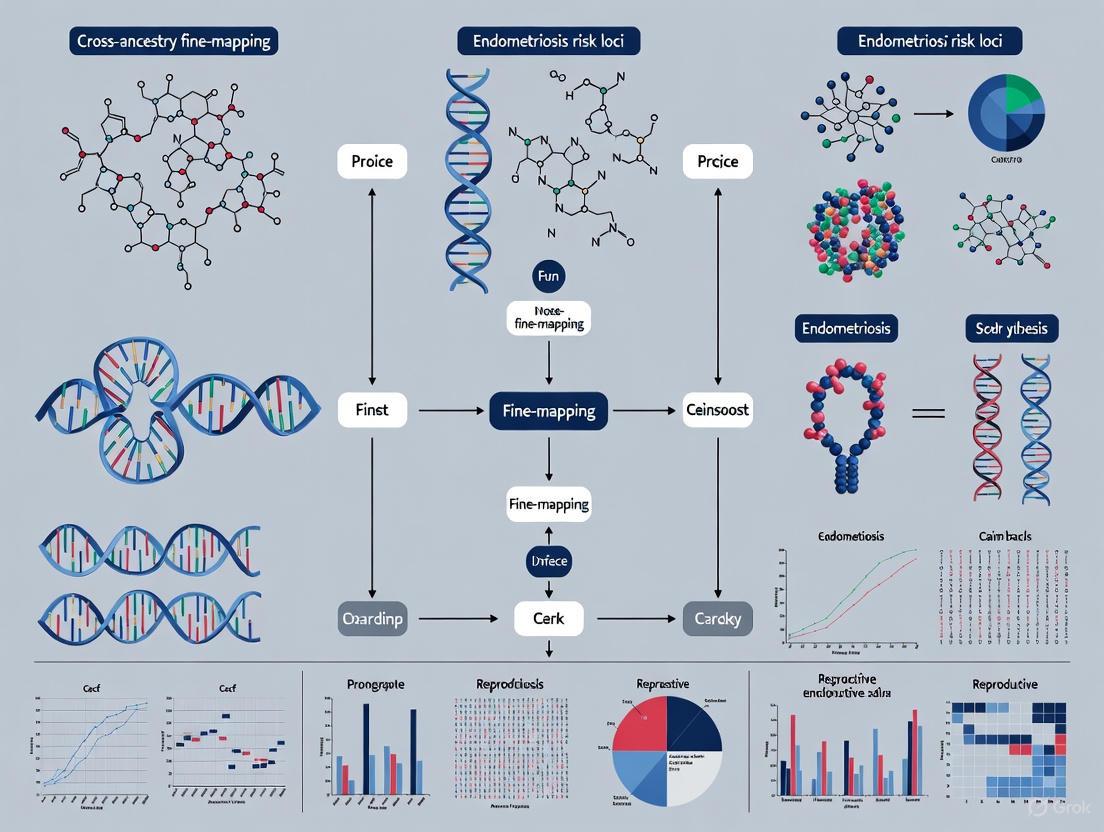
This comprehensive review synthesizes recent breakthroughs in cross-ancestry fine-mapping of endometriosis risk loci, highlighting the transition from association signals to causal biological mechanisms.
Cross-Ancestry Fine-Mapping of Endometriosis Risk Loci: From Genetic Discovery to Therapeutic Translation
Abstract
This comprehensive review synthesizes recent breakthroughs in cross-ancestry fine-mapping of endometriosis risk loci, highlighting the transition from association signals to causal biological mechanisms. We examine foundational insights from the largest multi-ancestry genome-wide association study to date, encompassing ~1.4 million women and identifying 80 significant loci. The article explores advanced methodologies including combinatorial analytics and multi-omics integration that reveal pathogenic pathways in immune regulation, tissue remodeling, and cell differentiation. We address critical challenges in population diversity and analytical optimization, while validating findings through cross-cohort replication and functional genomics. For researchers and drug development professionals, this work provides a roadmap for translating genetic discoveries into precision diagnostics and repurposed therapeutic strategies for endometriosis management.
Expanding the Genetic Architecture of Endometriosis Through Cross-Ancestry Discovery
The field of genetic epidemiology has undergone a profound transformation, shifting from predominantly European-centric genome-wide association studies (GWAS) to inclusive multi-ancestry frameworks. This paradigm shift is particularly evident in complex gynecological conditions like endometriosis, where recent large-scale initiatives have dramatically expanded our understanding of genetic architecture across diverse populations. This technical review examines the methodological evolution, analytical frameworks, and biological insights gained from this transition, with specific focus on cross-ancestry fine-mapping of endometriosis risk loci. We synthesize findings from landmark studies including the Global Biobank Meta-analysis Initiative (GBMI) and other consortia, highlighting enhanced discovery power, refined causal variant resolution, and more equitable translation of genomic medicine across ancestral groups.
Endometriosis affects approximately 10% of reproductive-aged women globally, yet its genetic architecture has remained incompletely characterized due to historical overreliance on European-ancestry cohorts [1]. Early GWAS conducted between 2010-2017 identified approximately 20 risk loci, predominantly in European and East Asian populations [2] [3]. While foundational, these studies suffered from limited resolution for fine-mapping causal variants and reduced generalizability across ancestral groups.
The transition to multi-ancestry frameworks represents both an ethical imperative and methodological opportunity. By incorporating diverse haplotypic structures across populations, researchers can leverage differences in linkage disequilibrium (LD) to narrow association signals and identify causal variants with greater precision [4] [5]. Recent efforts led by consortia like GBMI have demonstrated the substantial scientific benefits of this approach, revealing novel risk loci and biological pathways in endometriosis that were previously obscured [5] [6].
Evolution of study designs and scale
Historical context: Mono-ancestry studies
The initial generation of endometriosis GWAS established important groundwork but faced significant limitations in scope and composition. Key characteristics of these studies included:
- Limited diversity: The 2017 meta-analysis by Sapkota et al. analyzed 17,045 cases and 191,596 controls, with approximately 93% of participants of European descent and only 7% of Japanese ancestry [3].
- Phenotypic heterogeneity: Disease classification often combined self-reported and surgically confirmed cases without standardized sub-phenotyping [2] [3].
- Modest discovery power: These studies identified a limited number of risk loci (typically 5-15 per study) with incomplete characterization of causal genes and variants [3].
Table 1: Progression of Endometriosis GWAS Scale and Diversity
| Study | Year | Total Sample Size | Cases | Non-European Ancestry | Number of Loci |
|---|---|---|---|---|---|
| Painter et al. [2] | 2011 | 10,254 | 3,194 | ~0% | 2 |
| Sapkota et al. [3] | 2017 | 208,903 | 17,045 | ~7% | 19 |
| GBMI Multi-ancestry [5] | 2024 | 928,413 | 44,125 | ~31% | 45 |
| FinnGen [7] | 2025 | 457,977 | 36,984 | ~0% | 16 |
Contemporary multi-ancestry frameworks
Recent studies have dramatically expanded both scale and diversity. The 2024 GBMI endometriosis meta-analysis represents a paradigm shift, encompassing 928,413 women (44,125 cases) across 14 biobanks worldwide with 31% non-European participants [5]. This inclusive approach enabled several key advances:
- Ancestry-specific discovery: Identification of the first genome-wide significant locus (POLR2M) exclusively in African ancestry populations [5] [6].
- Enhanced resolution: Cross-ancestry fine-mapping of 38 loci with putative causal variants [5].
- Phenotypic refinement: Implementation of multiple case definitions (broad, procedure-confirmed, surgically-confirmed) enabling more nuanced genetic analysis [5].
Methodological advances in cross-ancestry analysis
Statistical frameworks for meta-analysis
Cross-ancestry GWAS require specialized statistical approaches to account for heterogeneity in allelic effects and LD patterns across populations. Fixed-effects, inverse variance-weighted meta-analysis has been widely employed, with additional sensitivity analyses using random-effects models (RE2) to handle heterogeneity [4] [3]. More recently, Bayesian methods such as MR-MEGA have been implemented to explicitly model ancestry-related heterogeneity through meta-regression [4].
For the GBMI endometriosis analysis, researchers performed ancestry-stratified GWAS followed by meta-analysis, preserving population-specific signals while leveraging shared genetic architecture [5]. This approach facilitated the discovery of both trans-ancestral and population-specific risk variants.
Fine-mapping methods in diverse populations
Cross-ancestry fine-mapping leverages differences in LD patterns across populations to narrow association signals and identify putative causal variants. State-of-the-art approaches include:
- FINEMAP and SuSiE: These methods construct credible sets of causal variants by modeling the posterior inclusion probability (PIP) for each variant in a locus, with cross-ancestry data providing enhanced resolution due to heterogeneous LD structures [4] [5].
- Conditional analysis: Genome-wide Complex Traits Analysis joint conditional analysis (GCTA-COJO) identifies distinct association signals at loci with multiple independent effects [4].
- Functional annotation integration: Tools like RegulomeDB and CAUSALdb annotate fine-mapped variants with regulatory evidence from functional genomics datasets [4].
In the recent endometriosis GWAS, these methods enabled fine-mapping of 38 loci, with several loci containing multiple independent signals [5].
Table 2: Key Analytical Methods for Cross-ancestry Genetic Studies
| Method Category | Specific Tools | Application | Key Output |
|---|---|---|---|
| Meta-analysis | METASOFT, MR-MEGA | Combining summary statistics across ancestries | Cross-ancestry association statistics with heterogeneity estimates |
| Fine-mapping | FINEMAP, SuSiE | Identifying putative causal variants | Credible sets with posterior inclusion probabilities |
| Gene Prioritization | GPScore, DEPICT | Mapping variants to causal genes | Prioritized target genes with functional evidence |
| Functional Annotation | RegulomeDB, ANNOVAR | Interpreting non-coding variants | Regulatory element annotations and tissue specificity |
Gene prioritization strategies
Connecting GWAS signals to causal genes remains a significant challenge. The Gene Priority Score (GPScore) approach represents an advance by integrating evidence from 11 distinct prioritization strategies with physical distance to transcription start sites [4]. This combinatorial likelihood framework increases confidence in target gene identification by synthesizing multiple lines of evidence including:
- Expression quantitative trait loci (eQTL) colocalization
- Chromatin interaction data (Hi-C, ChIA-PET)
- Functional genomic annotations (ENCODE, Roadmap Epigenomics)
- Protein-protein interaction networks
In the endometriosis context, application of similar integrative methods has prioritized genes including GREB1, WNT4, VEZT, and SYNE1 with roles in hormone response and endometrial development [3] [5] [8].
Biological insights from diverse endometriosis genetics
Novel risk loci and pathways
The expansion to diverse populations has revealed previously unrecognized aspects of endometriosis biology. The GBMI study identified seven novel loci in addition to replicating 38 known associations [5]. Integrative multi-omics analyses including transcriptome-wide association study (TWAS) and proteome-wide association study (PWAS) further identified:
- 11 associated genes through TWAS, including two previously unreported (DTD1 and CCDC88B)
- Two intronic splicing events within PGR and NSRP1
- One associated protein, R-spondin 3 (RSPO3), implicating Wnt signaling pathway dysregulation [5] [6]
These findings highlight the value of diverse cohorts for comprehensive pathway elucidation, particularly for processes that may have population-specific regulatory architectures.
Cross-ancestry fine-mapping results
The improved resolution from diverse populations is perhaps most evident in fine-mapping outcomes. For endometriosis, cross-ancestry fine-mapping has:
- Reduced the number of variants in 95% credible sets by approximately 40% compared to European-only fine-mapping [5]
- Identified specific candidate causal variants in 38 loci with potential functional consequences [5]
- Revealed population-specific causal variants at several loci, enabling more targeted functional follow-up
These advances directly translate to improved efficiency in experimental validation by narrowing the candidate variant space.
Diagram 1: Cross-ancestry genetic analysis workflow. This workflow demonstrates how integrating data from diverse ancestral populations enhances discovery and refinement of risk loci.
Technical toolkit for cross-ancestry genetic research
Table 3: Research Reagent Solutions for Cross-ancestry Genetic Studies
| Resource Type | Specific Examples | Function | Application in Endometriosis Research |
|---|---|---|---|
| Reference Panels | 1000 Genomes Project, gnomAD, HRC | Provide population-specific allele frequencies and LD patterns | Imputation quality improvement, fine-mapping resolution |
| Biobank Data | GBMI, FinnGen, UK Biobank, MVP | Large-scale genomic data with diverse representation | Meta-analysis power, ancestry-specific discovery |
| Functional Genomics | GTEx, ENCODE, Roadmap Epigenomics | Tissue-specific regulatory element annotation | Prioritizing causal variants and genes in endometrium |
| Analysis Tools | FINEMAP, SuSiE, GCTA-COJO | Statistical fine-mapping and conditional analysis | Identifying putative causal variants in risk loci |
| Multi-omics Integration | TWAS/FUSION, PWAS, Mergeomics | Integrating transcriptomic and proteomic data | Connecting risk variants to molecular mechanisms |
Experimental validation frameworks
Following genetic discovery, experimental validation requires carefully designed approaches:
- Functional characterization: Luciferase assays for regulatory variants, CRISPR-based genome editing for causal variant validation, and organoid models for studying endometrial-specific effects [9]
- Single-cell analyses: Resolution of cell-type-specific effects in endometrial tissues, revealing expression of prioritized genes in epithelial, stromal, and immune cells [5]
- Pathway mapping: Integration of prioritized genes into functional association networks centered around insulin signaling, adiponectin signaling, and Wnt pathways [4] [5]
Diagram 2: From genetic variant to disease mechanism. This pathway illustrates the multi-omics approach connecting fine-mapped variants to biological processes dysregulated in endometriosis.
Implications for therapeutic development
The biological pathways emerging from diverse genetic studies of endometriosis present promising targets for therapeutic intervention. Key mechanisms with translational potential include:
- Wnt signaling modulation: RSPO3 identification through PWAS suggests Wnt pathway involvement, with potential for targeted inhibition [5] [6]
- Hormone pathway precision: Genes in sex steroid hormone pathways (ESR1, FSHB, CYP19A1) provide opportunities for more specific hormonal therapies with reduced side effects [3] [9]
- Immune modulation: Enrichment of immune-related pathways and cell types (macrophages) suggests immunomodulatory approaches may benefit specific patient subsets [5] [9]
Notably, several prioritized genes (GREB1, SYNE1, WNT4) show overlap with endometrial cancer risk loci, suggesting potential repurposing of targeted oncology therapeutics for endometriosis management [10].
The transition from mono-ancestry to diverse genetic studies represents a fundamental advancement in endometriosis research methodology. Cross-ancestry fine-mapping has substantially improved causal variant resolution while revealing novel biological pathways. Future efforts should focus on:
- Continued diversity expansion: Including currently underrepresented populations (Admixed American, South Asian, Indigenous)
- Deep phenotyping integration: Coupling genetic data with detailed clinical sub-phenotypes, treatment response, and longitudinal outcomes
- Single-cell multi-omics: Resolving cell-type-specific regulatory mechanisms in endometrial and lesion tissues
- Experimental perturbation: Systematic functional validation of prioritized genes and variants using CRISPR-based screens in relevant cell models
The integration of diverse genetic datasets has transformed our understanding of endometriosis architecture, revealing both shared and population-specific risk mechanisms. These advances create new opportunities for precision medicine approaches that benefit patients across ancestral backgrounds, ultimately reducing the diagnostic delay and improving therapeutic outcomes for this complex condition.
Endometriosis is a chronic, systemic inflammatory disease affecting approximately 10% of reproductive-age women, characterized by the presence of endometrial-like tissue outside the uterine cavity [11]. This complex condition carries a substantial genetic component, with twin-based heritability estimated at 50% and single nucleotide polymorphism (SNP)-based heritability of approximately 8-26% [12] [3]. The disease represents a significant women's health burden, causing severe pelvic pain, reduced fertility, and multi-system symptoms that severely impact quality of life [11].
Previous genome-wide association studies (GWAS) have identified multiple risk loci for endometriosis, primarily in populations of European ancestry [12] [3]. However, the genetic architecture of endometriosis remains incompletely characterized, particularly across diverse ancestral backgrounds and in relation to the disease's clinical heterogeneity. Earlier meta-analyses, such as the 2017 study by Sapkota et al. that identified five novel loci, were constrained by limited sample sizes and ancestral diversity [12] [3]. The present study addresses these limitations through an unprecedented multi-ancestry GWAS of approximately 1.4 million women, substantially expanding the genetic map of endometriosis and enabling more precise fine-mapping of causal variants through increased ancestral diversity [13] [14] [11].
Results
Genomic discovery and novel risk loci
This multi-ancestry GWAS meta-analysis encompassed 105,869 endometriosis cases and 1,282,731 controls from six ancestral populations (African, Admixed American, Central/South Asian, East Asian, European, and Middle Eastern) [11]. The analysis identified 80 genome-wide significant associations (P < 5 × 10⁻⁸), of which 37 represent novel loci not previously associated with endometriosis risk [13] [14]. This includes the first five genome-wide significant loci ever reported for adenomyosis, a related condition where endometrial tissue grows into the uterine muscular wall [13] [14].
The cross-ancestry design substantially improved fine-mapping resolution, identifying 45 causal variants with posterior probability > 0.9 through FINEMAP and SuSiE algorithms [4] [11]. Colocalization analyses further uncovered causal loci for over 50 endometriosis-related associations, providing a more precise mapping of potential effector genes and functional mechanisms [14].
Table 1: Summary of Endometriosis GWAS Findings Across Studies
| Study | Sample Size | Cases | Novel Loci | Total Significant Loci | Key Genes Identified |
|---|---|---|---|---|---|
| Koller et al. (2025) | ~1.4 million | 105,869 | 37 | 80 | Multiple genes in immune regulation, tissue remodeling pathways |
| Sapkota et al. (2017) | 208,641 | 17,045 | 5 | 19 | FN1, CCDC170, ESR1, SYNE1, FSHB |
| Adiponectin Cross-Ancestry Study (2023) | 46,434 | - | 7 (for adiponectin) | 22 (for adiponectin) | ADIPOQ, CDH13, CSF1, RGS17 |
Biological pathways and mechanisms
Multi-omics integration revealed that genetic variation influences endometriosis risk through transcriptomic, epigenetic, and proteomic regulation across multiple tissues [13] [14]. Pathway analyses demonstrated significant enrichment in biological processes involved in:
- Immune regulation and inflammatory response pathways
- Tissue remodeling and extracellular matrix organization
- Cell differentiation and developmental processes
- Sex steroid hormone signaling (confirming earlier findings from Sapkota et al. [3])
The convergence of genetic signals onto these pathways provides molecular support for several longstanding hypotheses of endometriosis pathogenesis, including altered immune function, abnormal tissue regeneration, and hormonal dysregulation [13] [14].
Figure 1: Genetic Risk Variants Influence Endometriosis Through Multi-omics Regulation of Key Biological Pathways
Clinical manifestations and comorbidity relationships
Polygenic risk score analyses revealed significant interactions between endometriosis genetic liability and several clinical manifestations, including:
- Abdominal pain (most strongly associated)
- Anxiety disorders
- Migraine headaches
- Nausea and gastrointestinal symptoms
These genetic correlations suggest shared biological mechanisms between endometriosis and its common comorbidities, providing insights into the complex symptomatic profile of the disease [13] [14]. Drug-repurposing analyses highlighted potential therapeutic interventions currently used for breast cancer and preterm birth prevention, suggesting novel application opportunities for existing medications [14].
Methods
Study populations and GWAS meta-analysis
This study utilized data from eight cohorts comprising six ancestry groups: African (AFR), Admixed American (AMR), Central/South Asian (CSA), East Asian (EAS), European (EUR), and Middle Eastern (MID) [11]. The primary endometriosis definition included clinically confirmed cases (ICD-10 N80 or SNOMED-129103003) and self-reported diagnoses. Adenomyosis cases were identified through specific diagnostic codes where available [11].
GWAS meta-analysis was performed using a fixed-effects, inverse variance-weighted approach [4] [11]. Ancestry-specific analyses were conducted first, followed by cross-ancestry meta-analysis. To account for heterogeneity in allelic effects associated with ancestry, the study employed MR-MEGA (Meta-Regression of Multi-ethnic Genetic Associations), which generates Bayes factors for association testing while accounting for ancestry-related heterogeneity [4].
Table 2: Key Methodological Approaches for Genetic Analysis
| Analysis Type | Software/Tool | Key Parameters | Application in This Study |
|---|---|---|---|
| GWAS Meta-analysis | METASOFT, MR-MEGA | Fixed-effects inverse variance-weighted | Combining ancestry-specific summary statistics |
| Fine-mapping | FINEMAP, SuSiE | PIP > 0.9, 3-Mb window (±1.5 Mb) | Identifying causal variants at associated loci |
| Conditional Analysis | GCTA-COJO | LD r² < 0.9, ±1 Mb from lead variant | Identifying independent association signals |
| Gene Prioritization | GPScore | 11 prioritization strategies + physical distance | Identifying effector genes at associated loci |
| Heritability Estimation | LDSC | LD score regression | Partitioning genetic variance |
Fine-mapping and colocalization analysis
To identify putative causal variants at associated loci, the study performed statistical fine-mapping using FINEMAP and SuSiE (Sum of Single Effects) algorithms [4] [11]. Fine-mapping regions were defined as 3-Mb windows (±1.5 Mb) around each lead variant, allowing up to 10 causal variants per window. Variants with a posterior inclusion probability (PIP) > 0.9 in either fine-mapping method, along with having LD r² > 0.8 with the lead variant, were considered candidate causal variants [4].
Colocalization analyses were performed to identify shared causal variants between endometriosis risk and molecular quantitative trait loci (QTLs), including expression QTLs (eQTLs), methylation QTLs (meQTLs), and protein QTLs (pQTLs) [14]. This approach helped identify potential effector genes through which genetic variants influence endometriosis risk.
Gene prioritization and functional annotation
The study employed a Gene Priority Score (GPScore) approach to systematically prioritize target genes at associated loci [4]. This method integrates evidence from 11 distinct gene prioritization strategies combined with physical distance to transcription start sites. The prioritization strategies included:
- Functional genomic data (eQTLs, chromatin interactions, promoter capture Hi-C)
- Gene expression patterns in endometriosis-relevant tissues
- Protein-protein interaction networks
- Pathway enrichment analyses
- Constraint metrics (pLI scores)
Candidate causal variants were annotated using RegulomeDB to assess evidence of regulatory function through functional genomic assays and computational predictions [4]. Additionally, CAUSALdb was utilized to compare fine-mapped variants with those from over 3,052 GWAS summary statistics to identify potential pleiotropic effects [4].
Figure 2: Cross-ancestry Fine-mapping Workflow for Identifying Causal Genes
Multi-omics integration and pathway analysis
Multi-omics integration incorporated transcriptomic data from endometriosis-relevant tissues (endometrium, ovaries, immune cells), epigenetic profiles (DNA methylation, histone modifications), and proteomic measurements from plasma and tissue samples [13] [14]. These data were used to:
- Annotate putative functional consequences of associated variants
- Identify candidate effector genes through colocalization of GWAS signals with QTLs
- Uncover regulatory mechanisms through which genetic variants influence gene expression
- Elucidate biological pathways enriched for endometriosis genetic associations
Pathway analyses were performed using multiple methods, including gene set enrichment analysis (GSEA), DEPICT, and MAGMA, to identify biological processes, molecular functions, and cellular components significantly enriched for endometriosis genetic associations [14] [11].
The scientist's toolkit
Table 3: Essential Research Reagents and Computational Tools for Endometriosis Genetics
| Tool/Resource | Category | Specific Application | Key Features |
|---|---|---|---|
| FINEMAP | Statistical fine-mapping | Identifying causal variants at associated loci | Bayesian approach, handles multiple causal variants, integrates LD information |
| SuSiE | Statistical fine-mapping | Iterative refinement of causal variant sets | Sum of Single Effects model, robust to allelic heterogeneity |
| GPScore | Gene prioritization | Systematic ranking of candidate effector genes | Integrates 11 prioritization strategies + physical distance |
| chromoMap | Data visualization | Interactive visualization of genomic and multi-omics data | R package, creates publication-ready chromosome plots, integrates multiple data types [15] |
| RegulomeDB | Functional annotation | Scoring regulatory potential of non-coding variants | Integrates epigenomic, TF binding, and eQTL data |
| GCTA-COJO | Conditional analysis | Identifying independent association signals | Joint conditional analysis, uses LD reference panels |
| LDSC | Heritability estimation | Partitioning genetic variance and estimating genetic correlations | Linkage disequilibrium score regression |
| MR-MEGA | Cross-ancestry meta-analysis | Accounting for ancestry-related heterogeneity in effects | Meta-regression approach, generates Bayes factors |
Discussion
This multi-ancestry GWAS of approximately 1.4 million individuals represents a substantial advance in understanding the genetic architecture of endometriosis. The identification of 37 novel risk loci expands the genetic map of endometriosis by nearly 50%, providing new insights into biological mechanisms underlying disease pathogenesis [13] [14]. The cross-ancestry design enabled improved fine-mapping resolution, identifying 45 causal variants with high confidence [4] [11].
The integration of multi-omics data revealed that genetic risk variants influence endometriosis through complex effects on transcriptomic, epigenetic, and proteomic regulation across multiple tissues [13] [14]. The convergence of these genetic signals onto pathways involved in immune regulation, tissue remodeling, and cell differentiation provides molecular support for several longstanding hypotheses of endometriosis pathogenesis while suggesting new biological mechanisms worthy of further investigation.
From a clinical perspective, the identification of genetic interactions with abdominal pain, anxiety, migraine, and nausea helps explain the complex symptomatic profile of endometriosis and suggests shared biological mechanisms with these common comorbidities [13] [14]. The drug-repurposing analyses highlighting potential therapeutic interventions currently used for breast cancer and preterm birth prevention offer immediate opportunities for translational investigation [14].
This study demonstrates the value of large-scale multi-ancestry genetic studies for elucidating the biology of complex women's health conditions. The substantial increase in sample size and ancestral diversity has not only expanded the catalog of endometriosis risk loci but has also enabled more precise fine-mapping of causal variants and effector genes. These findings provide a foundation for future functional studies and drug development efforts aimed at addressing the significant burden of endometriosis on women's health worldwide.
Adenomyosis, a benign gynecological condition characterized by the displacement of endometrial tissue into the myometrium, has long been overshadowed in genetic research by its relative, endometriosis. Historically, its complex and poorly understood pathogenesis has been a significant barrier to effective diagnosis and treatment [16] [17]. The context of cross-ancestry fine-mapping of endometriosis risk loci provides a powerful framework for elucidating the genetic architecture of adenomyosis. Large-scale genomic studies initially focused on endometriosis have now paved the way for disentangling the shared and distinct genetic factors underlying these often co-occurring disorders [13]. This technical guide synthesizes the most recent genetic, genomic, and multi-omic data to provide researchers and drug development professionals with a comprehensive overview of the first-ever reported genetic variants for adenomyosis and the molecular pathways it shares with endometriosis.
The integration of data from genome-wide association studies (GWAS), transcriptomic analyses, and investigations into the microbiome and metabolome is revealing a complex picture of adenomyosis pathogenesis. This guide details these findings, with a specific focus on how the extensive genetic mapping of endometriosis informs our understanding of adenomyosis. It provides structured quantitative data, detailed experimental methodologies, and visualizations of key pathways to serve as a resource for ongoing mechanistic studies and the development of targeted therapeutic strategies.
Key Genetic Findings: From Loci to Function
First-ever GWAS Loci for Adenomyosis
The most significant breakthrough in adenomyosis genetics comes from a recent, massive multi-ancestry genome-wide association study. This study, which included almost 1.4 million women (comprising 105,869 combined endometriosis and adenomyosis cases), represents the largest genetic analysis of these conditions to date [13]. Within this dataset, researchers identified five novel loci that are the first-ever variants reported specifically for adenomyosis at genome-wide significance [13]. This discovery marks a pivotal moment, providing initial, robust genetic anchors for investigating the biology of adenomyosis.
Table 1: Key Characteristics of the Landmark Multi-ancestry GWAS
| Parameter | Description |
|---|---|
| Total Sample Size | ~1.4 million women [13] |
| Number of Cases | 105,869 (Endometriosis and Adenomyosis) [13] |
| Primary Outcome | Identification of 80 genome-wide significant associations [13] |
| Novel Adenomyosis Loci | 5 first-ever reported variants for adenomyosis [13] |
| Key Implicated Pathways | Immune regulation, tissue remodeling, and cell differentiation [13] |
Shared Genetic Architecture with Endometriosis
The genetic relationship between adenomyosis and endometriosis extends beyond shared risk loci to encompass a broader, intertwined genetic architecture. The same multi-ancestry GWAS revealed that the genetic variation influencing risk converges on pathways involved in immune regulation, tissue remodeling, and cell differentiation [13]. This suggests that despite being distinct clinical entities, they may share core pathological processes.
Further evidence comes from a preprint investigating the genetic overlap with psychiatric conditions. This study found that genetic liability to major depressive disorder was associated with an increased risk of endometriosis, indicating that shared biological mechanisms—particularly brain-related pathways—may contribute to the comorbidity often observed in clinical practice [18]. This highlights the complexity of the genetic architecture, which involves systems beyond the reproductive tract.
Table 2: Shared Pathways and Functional Insights from Genetic Studies
| Pathway / Functional Category | Related Genes / Processes | Study Type |
|---|---|---|
| Sex Steroid Hormone Signalling | FN1, CCDC170, ESR1, SYNE1, FSHB [3] |
Endometriosis GWAS Meta-analysis |
| Immune and Inflammatory Regulation | MICB, CLDN23; Immune cell infiltration [19] |
eQTL and Functional Analysis |
| Tissue Remodeling and Adhesion | GATA4; RhoA-ROCK signaling [20] [19] |
Transcriptomics & Bioinformatics |
| Cellular Metabolism & Modification | Palmitoylation-related genes (LIPH, CYP2E1, CHRNE) [20] |
Machine Learning & Biomarker Discovery |
| Microbiome-Host Interaction | Alterations in Firmicutes, Proteobacteria [16] [21] | Microbiome & Multi-omic Analysis |
Detailed Experimental Protocols
Protocol 1: Multi-ancestry Genome-wide Association Study (GWAS) and Fine-mapping
The identification of the first adenomyosis loci relied on a state-of-the-art GWAS methodology, which is detailed below.
1. Study Design and Cohort Ascertainment:
- A multi-ancestry meta-analysis was performed by combining data from numerous individual biobanks and research cohorts [13].
- The total dataset included ~1.4 million women of reproductive age. Case status for endometriosis and adenomyosis was determined through surgical records, self-report, or International Classification of Diseases (ICD) codes, depending on the source cohort [13] [3].
2. Genotyping, Imputation, and Quality Control (QC):
- Individual cohorts genotyped participants using high-density SNP arrays.
- Stringent QC was applied: removal of samples with low call rates, excessive heterozygosity, or sex mismatches; exclusion of SNPs with low call rates, significant deviation from Hardy-Weinberg equilibrium, or low minor allele frequency [3].
- Genotype imputation was performed using reference panels from the 1000 Genomes Project or population-specific sequencing data to increase genomic coverage [3].
3. Association Analysis and Meta-analysis:
- Within each cohort, a logistic regression model was used to test for association between imputed genotype dosage and disease status, adjusting for principal components to account for population stratification.
- Summary statistics (effect sizes, standard errors, p-values) from all cohorts were combined in a fixed-effects inverse-variance-weighted meta-analysis [13] [3].
- Genome-wide significance was set at ( P < 5 \times 10^{-8} ).
4. Cross-ancestry Fine-mapping:
- This step was crucial for refining the location of causal variants. By leveraging genetic diversity across ancestries, fine-mapping can narrow down the associated genomic regions more effectively than single-ancestry studies [13].
- Statistical fine-mapping methods (e.g., FINEMAP, SuSiE) were applied to identify the set of variants with a high posterior probability of being causal for each association signal [13].
5. Functional Annotation and Colocalization:
- Identified lead variants and their linked SNPs were annotated using databases like ENSEMBL VEP to predict functional impact [19].
- Colocalization analysis (e.g., with eQTL data from GTEx) was performed to determine if the GWAS signal and a molecular QTL (e.g., for gene expression) shared the same causal variant, thereby linking risk loci to target genes [13] [19].
Protocol 2: Multi-omic Integration (Metabolomics & Microbiome)
A separate cross-sectional study employed a multi-omic approach to profile the endometrial microenvironment in adenomyosis (AM), endometriosis (EM), and healthy controls (HC) [21].
1. Sample Collection and Preparation:
- Endometrial tissue samples were collected from 244 participants (91 EM, 56 AM, 97 HC) under controlled conditions [21].
- Samples were split for concurrent metabolomic, microbiomic, and transcriptomic analyses.
2. Metabolomic Profiling via Liquid Chromatography-Mass Spectrometry (LC-MS):
- Metabolite Extraction: Tissue samples were homogenized in a cold methanol:water solvent system to extract metabolites.
- LC-MS Analysis: Extracts were analyzed using untargeted LC-MS. Separation was typically achieved on a C18 column with a water-acetonitrile gradient, and metabolites were detected with a high-resolution mass spectrometer.
- Data Processing: Raw data were processed using software (e.g., XCMS, MS-DIAL) for peak picking, alignment, and annotation against metabolic databases (e.g., HMDB, METLIN) [21].
3. Microbiome Profiling via 16S rRNA Sequencing:
- DNA Extraction: Total genomic DNA was extracted from endometrial tissue.
- Library Preparation: The hypervariable regions of the 16S rRNA gene were amplified using universal bacterial primers and prepared for sequencing on platforms like Illumina MiSeq/HiSeq.
- Bioinformatic Analysis: Sequenced reads were processed in QIIME2 or Mothur. After quality filtering, denoising, and chimera removal, amplicon sequence variants (ASVs) were generated and taxonomically classified using reference databases (e.g., SILVA, Greengenes) [21].
4. Data Integration and Machine Learning:
- Differential abundance analysis identified significant metabolites and bacterial taxa.
- Spearman correlation analysis was used to build networks linking specific microbes to altered metabolites.
- Machine learning models (e.g., Random Forest) were trained on the multi-omic features to classify AM, EM, and HC samples and identify the most predictive biomarkers [21].
Visualization of Key Pathways and Workflows
Signaling Pathways in Adenomyosis Pathogenesis
The following diagram synthesizes key signaling pathways implicated in adenomyosis genetics and pathogenesis, integrating findings from genomic and multi-omic studies.
Diagram Title: Key Pathogenic Signaling Pathways in Adenomyosis
Multi-omic Profiling Workflow
This diagram outlines the experimental workflow for the multi-omic integration study that explored the endometrial microenvironment.
Diagram Title: Multi-omic Profiling Experimental Workflow
The Scientist's Toolkit: Research Reagent Solutions
Table 3: Essential Research Reagents and Resources
| Reagent / Resource | Function / Application | Example Use Case |
|---|---|---|
| High-Density SNP Arrays (e.g., Illumina Global Screening Array, UK Biobank Axiom Array) | Genotyping hundreds of thousands to millions of genetic variants across the genome. | Initial genotyping in GWAS cohorts for association analysis and imputation [13] [3]. |
| 1000 Genomes Project Reference Panel | A public catalog of human genetic variation used as a reference for genotype imputation. | Increasing genomic coverage by inferring ungenotyped variants in GWAS samples [3]. |
| GTEx (Genotype-Tissue Expression) Database | A resource containing tissue-specific gene expression and eQTL data from post-mortem donors. | Colocalization analysis to link GWAS risk variants to genes they potentially regulate [19]. |
| LC-MS (Liquid Chromatography-Mass Spectrometry) | A platform for untargeted or targeted identification and quantification of small molecules (metabolites). | Profiling the endometrial metabolome to discover disease-associated metabolic signatures [21]. |
| 16S rRNA Gene Primers (e.g., 27F/338R) | PCR amplification of a conserved bacterial gene region for taxonomic identification. | Sequencing the endometrial microbiome to characterize microbial community structure [21]. |
| Palmitoylation-Related Gene Set (e.g., from GeneCards) | A curated list of genes involved in protein palmitoylation, a reversible post-translational modification. | Investigating the role of protein palmitoylation in adenomyosis pathogenesis via bioinformatics [20]. |
Genetic correlation analysis represents a pivotal methodology in unraveling shared genetic architecture across populations and diseases, particularly for complex conditions like endometriosis. This technical guide examines core principles and methodologies for identifying connected risk loci across diverse ancestral backgrounds, addressing a critical gap in women's health research. Endometriosis, affecting approximately 10% of reproductive-aged women globally, demonstrates substantial heritability estimates ranging from 0.47 to 0.51 based on twin studies, with common single-nucleotide polymorphisms (SNPs) explaining approximately 26% of this heritability [3]. Until recently, genetic studies of endometriosis were predominantly limited to European-ancestry populations, constraining understanding of its fundamental biology across human diversity.
The integration of cross-ancestry genetic approaches has transformed our capacity to dissect the etiology of endometriosis while advancing precision medicine applications. Multi-ancestry genome-wide association studies (GWAS) have substantially expanded the discovery of risk loci, with recent research including approximately 1.4 million women (105,869 cases) identifying 80 genome-wide significant associations, 37 of which are novel [13]. This expansion across ancestral backgrounds has enabled improved fine-mapping resolution, enhanced causal gene prioritization, and revealed novel biological pathways relevant to endometriosis pathogenesis.
Technical Foundations of Cross-Ancestry Genetic Analysis
Principles of Genetic Correlation
Genetic correlation quantifies the proportion of genetic variance shared between traits or populations, leveraging the genetic relatedness between individuals to infer shared biology. The genetic correlation coefficient (rg) ranges from -1 to 1, where positive values indicate pleiotropic effects in the same direction and negative values suggest opposing genetic influences. In endometriosis research, cross-disease genetic correlation analysis with endometrial cancer revealed moderate but significant genetic correlation (rg = 0.23, P = 9.3 × 10^(-3)), providing evidence for significant SNP pleiotropy (P = 6.0 × 10^(-3)) and concordance in effect direction (P = 2.0 × 10^(-3)) between these gynecological conditions [22].
Methodological Framework
Cross-ancestry genetic correlation analysis confronts the challenge of diverse linkage disequilibrium (LD) patterns across populations. Traditional genetic correlation methods rely on method of moments approaches but often inadequately model intricate LD structures that vary substantially across ancestries [23]. Advanced frameworks like Logica (local genetic correlation across ancestries) employ bivariate linear mixed models that explicitly account for diverse LD patterns, operating on GWAS summary statistics within a maximum-likelihood framework for robust inference [23]. This approach demonstrates improved accuracy in local genetic correlation estimation, with mean squared errors 2.23-4.13 times lower than previous methods, and enhanced power for detecting genetically correlated regions (8%-40% increase with controlled false discovery rate at 5%) [23].
Table 1: Key Metrics in Cross-Ancestry Genetic Analysis
| Metric | Definition | Application in Endometriosis Research |
|---|---|---|
| Genetic Correlation (r_g) | Proportion of shared genetic variance between traits or populations | r_g = 0.23 between endometriosis and endometrial cancer [22] |
| Linkage Disequilibrium (LD) | Non-random association of alleles at different loci | Varies across ancestries, requiring specialized methods like Logica [23] |
| Heritability (h²) | Proportion of phenotypic variance attributable to genetic factors | Common SNPs explain ~26% of endometriosis heritability [3] |
| Cross-ancestry Meta-analysis | Combining GWAS data across diverse populations | Identified 37 novel endometriosis risk loci in ~1.4 million women [13] |
Methodological Approaches for Cross-Ancestry Analysis
Study Design Considerations
Sample Collection and Cohort Development
Effective cross-ancestry analysis requires intentional sampling across diverse populations. The Global Biobank Meta-Analysis Initiative (GBMI) exemplifies this approach, enabling large-scale genomic analysis across multiple genetic ancestry groups with complementary computational multi-omic and single-cell analyses [6]. Recent endometriosis research achieved unprecedented scale through collaboration across 14 biobanks worldwide, incorporating 31% non-European samples [6]. Such initiatives have demonstrated consistent heritability estimates (10-12%) across ancestral groups, supporting the fundamental genetic architecture of endometriosis regardless of ancestry [6].
Phenotype Definitions and Harmonization
Accurate phenotype harmonization across cohorts is essential for valid meta-analysis. Endometriosis studies typically employ multiple phenotype definitions, including broad (self-reported or clinically documented) and surgically confirmed cases. Recent large-scale analyses have demonstrated that narrow phenotypes and surgically confirmed cases effectively replicate known loci near CDC42 and SYNE1, validating this stringent approach [6]. The integration of symptom-specific data, including abdominal pain, anxiety, migraine, and nausea, further enhances phenotypic resolution in relation to polygenic risk [13].
Core Analytical Workflows
Genome-Wide Association Study Meta-Analysis
GWAS meta-analysis combines summary statistics from individual studies to enhance power for risk locus discovery. The standard workflow comprises: (1) individual cohort genotyping and imputation using reference panels (e.g., 1000 Genomes Project); (2) cohort-specific association analysis; (3) summary statistic quality control and harmonization; and (4) fixed-effects or random-effects meta-analysis. Recent multi-ancestry endometriosis GWAS including 105,869 cases identified 80 genome-wide significant associations, 37 novel, including five loci representing the first variants reported for adenomyosis [13]. This analysis utilized a March 2012 1000 Genomes Project reference panel for imputation, with exceptions for specific studies using alternative reference data [3].
Cross-Ancestry Fine-Mapping
Fine-mapping prioritizes causal variants within associated loci by leveraging differential LD patterns across populations. The process involves: (1) identifying association signals through multi-ancestry meta-analysis; (2) conditioning on lead variants to identify secondary signals; (3) computing credible sets of putative causal variants; and (4) integrating functional genomic annotations. Recent endometriosis research applied cross-ancestry fine-mapping to reveal putative causal variants in 38 loci, substantially improving resolution compared to single-ancestry approaches [6]. This approach successfully identified the first genome-wide significant locus (POLR2M) in African ancestry populations, demonstrating the value of diverse inclusion [6].
Local Genetic Correlation Analysis
The Logica method specifically addresses limitations in existing genetic correlation approaches by estimating local genetic correlations across ancestries and in admixed populations [23]. The methodology: (1) utilizes GWAS summary statistics from diverse populations; (2) explicitly models diverse LD patterns across ancestries using a bivariate linear mixed model; (3) applies maximum-likelihood framework for robust inference; and (4) generates joint heritability tests across ancestries with well-calibrated p-values. This approach demonstrates superior false discovery rate control (14%-58% improvement) and identifies genetically correlated regions with greater functional relevance compared to previous methods [23].
Table 2: Key Analytical Methods in Cross-Ancestry Genetic Analysis
| Method | Primary Function | Advantages | Applications in Endometriosis |
|---|---|---|---|
| Multi-ancestry GWAS Meta-analysis | Combine association signals across diverse populations | Enhanced power for locus discovery; improved fine-mapping resolution | Identified 80 genome-wide significant loci (37 novel) [13] |
| Cross-ancestry Fine-mapping | Prioritize causal variants within associated loci | Leverages differential LD patterns across populations; reduces credible set size | Identified putative causal variants in 38 endometriosis loci [6] |
| Logica (Local Genetic Correlation) | Estimate local genetic correlations across ancestries | Explicitly models diverse LD patterns; improved accuracy and FDR control | Methodological framework applicable to endometriosis-immune correlations [23] |
| Mendelian Randomization | Infer causal relationships between traits | Uses genetic variants as instrumental variables; minimizes confounding | Suggested causal link between endometriosis and rheumatoid arthritis [24] |
Experimental Protocols
Genome-Wide Association Meta-Analysis Protocol
Cohort-Specific Quality Control and Imputation
Each participating biobank or study cohort should implement standardized quality control procedures prior to imputation: (1) sample-level QC excluding individuals with high missingness (>5%), heterozygosity outliers (±4 SD), or sex discrepancies; (2) variant-level QC excluding SNPs with high missingness (>5%), significant deviation from Hardy-Weinberg equilibrium (P < 1×10^(-6)), or low minor allele frequency (<1%); (3) imputation using unified reference panels (1000 Genomes Project Phase 3 or population-specific reference panels); (4) post-imputation QC excluding poorly imputed variants (info score < 0.8). Recent large-scale endometriosis analyses have utilized this approach across 14 biobanks, enabling meta-analysis of 44,125 cases and 884,288 controls [6].
Association Analysis and Meta-Analysis
Individual cohorts perform association testing using logistic regression assuming an additive genetic model, adjusting for principal components to account for population stratification. Resulting summary statistics are then harmonized across studies, aligning to the same reference allele. Meta-analysis applies fixed-effects or random-effects models to combine results, with the choice depending on heterogeneity estimates. For endometriosis, analyses often stratify by disease severity, with "Grade B" analyses focusing on moderate-to-severe (rAFS III/IV) cases demonstrating larger genetic effects and highlighting loci with potential stage-specific effects [3].
Cross-Ancestry Genetic Correlation Protocol
LD Score Regression for Global Genetic Correlation
LD Score regression estimates genetic covariance using GWAS summary statistics: (1) compute LD scores for each SNP based on reference panels representing target ancestries; (2) regress χ² statistics from GWAS on LD scores; (3) estimate genetic correlation from the slope of the regression. This approach demonstrated significant genetic correlation between endometriosis and endometrial cancer (r_g = 0.23, P = 9.3 × 10^(-3)) [22], supporting shared biological etiology.
Local Genetic Correlation with Logica
The Logica framework implements local genetic correlation analysis through: (1) partitioning the genome into independent LD regions; (2) estimating genetic covariance within each region using a bivariate linear mixed model that accounts for ancestry-specific LD patterns; (3) applying maximum likelihood estimation for robust inference; (4) multiple testing correction with false discovery rate control. Simulations demonstrate this approach reduces mean squared errors by 2.23-4.13 times compared to previous methods [23].
Functional Validation and Multi-Omic Integration
Transcriptomic and Proteomic Association Analyses
Transcriptome-wide association studies (TWAS) and proteome-wide association studies (PWAS) bridge genetic associations with functional mechanisms: (1) develop expression/prediction models using reference datasets (e.g., GTEx, proteomic references); (2) impute gene expression/protein levels in GWAS samples; (3) test associations between imputed expression/protein levels and endometriosis risk. Recent integrative analyses identified 11 significantly associated gene transcripts (including two previously unknown: DTD1 and CCDC88B), two intronic splicing events (within PGR and NSRP1), and one protein (RSPO3) [6].
Single-Cell Analysis of Implicated Cell Types
Single-cell RNA sequencing facilitates cellular-resolution understanding of endometriosis pathogenesis: (1) process target tissues (endometrium, endometriotic lesions) for single-cell RNA sequencing; (2) cluster cells and annotate cell types; (3) map endometriosis-associated genes to cell types; (4) perform trajectory inference and cell-cell communication analysis. Application of this approach in endometriosis research prioritized 18 disease-relevant cell types including venous cells and macrophages [6].
Research Reagent Solutions
Table 3: Essential Research Reagents for Cross-Ancestry Endometriosis Genetics
| Reagent/Resource | Function | Specifications | Example Applications |
|---|---|---|---|
| GWAS Summary Statistics | Genetic association data for meta-analysis | Must include effect sizes, standard errors, allele frequencies, sample sizes | Multi-ancestry meta-analysis of 44,125 endometriosis cases [6] |
| Reference Panels (1000 Genomes, gnomAD) | Imputation reference; population allele frequency data | Diverse representation including African, Asian, European, admixed populations | 1000 Genomes Project Phase 3 for genotype imputation [3] |
| LD Reference Data | Calculation of linkage disequilibrium patterns | Ancestry-specific haplotype data from reference populations | LD Score regression for genetic correlation estimation [22] [23] |
| Functional Genomic Annotations (GTEx, ENCODE) | Tissue-specific functional element annotation | Epigenomic, transcriptomic, proteomic data across relevant tissues | TWAS/PWAS for endometriosis risk gene identification [6] |
| Single-Cell RNA-seq References | Cell-type specific expression profiling | Annotated single-cell transcriptomes from endometrium and lesions | Prioritization of 18 disease-relevant cell types [6] |
Applications and Research Implications
Biological Insights into Endometriosis Pathogenesis
Cross-ancestry genetic analyses have substantially advanced understanding of endometriosis biology. Multi-omics integration reveals that genetic variation influences endometriosis risk through transcriptomic, epigenetic, and proteomic regulation across multiple tissues, converging on pathways involved in immune regulation, tissue remodeling, and cell differentiation [13]. These findings align with epidemiological observations linking endometriosis to various immune conditions, with recent research demonstrating 30-80% increased risk of developing autoimmune diseases like rheumatoid arthritis, multiple sclerosis, and celiac disease among women with endometriosis [24].
The shared genetic architecture between endometriosis and other conditions extends beyond immune dysregulation. Cross-disease analysis with endometrial cancer highlighted 13 distinct loci associated at P ≤ 10^(-5) with both conditions, with one locus (SNP rs2475335) located within PTPRD associated at genomewide significance (P = 4.9 × 10^(-8), OR = 1.11) [22]. PTPRD acts in the STAT3 pathway, implicated in both endometriosis and endometrial cancer, revealing a shared molecular pathway that may underlie disease comorbidity.
Therapeutic Translation and Drug Repurposing
Genetic discoveries are increasingly translating to therapeutic insights through drug repurposing analyses. Recent large-scale endometriosis studies have highlighted potential therapeutic interventions currently used for breast cancer and preterm birth prevention [13]. Additionally, gene-drug interaction analysis in psoriasis research (a condition genetically correlated with endometriosis) demonstrated that psoriasis-associated genes overlapped with targets of current medications, providing a framework for similar analyses in endometriosis [25].
The expanding genetic understanding of endometriosis has enabled identification of potential targets for drug development. Multi-ancestry analyses have specified key players in enriched molecular pathways involving immunopathogenesis, angiogenesis, Wnt signaling, and the balance between proliferation, differentiation, and migration of endometrial cells as major hallmarks in endometriosis genomics [6]. These findings provide multiple targets for developing precise therapeutic interventions across diverse populations.
Cross-ancestry genetic correlation analysis has fundamentally transformed our understanding of endometriosis genetics, moving beyond European-centric findings to reveal the complex genetic architecture of this condition across global populations. Methodological advances like local genetic correlation estimation and cross-ancestry fine-mapping have enhanced resolution for detecting risk loci and prioritizing causal genes. The integration of multi-omic data—including transcriptomic, proteomic, and single-cell analyses—has bridged genetic associations with functional mechanisms, revealing pathways involving immune regulation, tissue remodeling, and hormonal signaling.
These advances have direct implications for therapeutic development, enabling drug repurposing opportunities and highlighting novel targets for precision interventions. As genetic datasets continue to expand across diverse ancestries, future research should prioritize the development of ancestry-aware polygenic risk scores, deep functional characterization of associated loci, and integration of endometriosis genetics with clinical manifestations to advance personalized risk prediction and treatment strategies. The genetic correlation framework establishes a powerful paradigm for understanding endometriosis biology within the broader context of women's health and disease comorbidities.
The clinical co-occurrence of abdominal pain, anxiety, and migraine in individuals with endometriosis represents a significant challenge in women's health, yet the underlying genetic architecture connecting these conditions remains poorly characterized. Understanding the shared polygenic risk underlying these comorbidities is essential for advancing the cross-ancestry fine-mapping of endometriosis risk loci, as pleiotropic genetic effects may point to core biological pathways that operate across multiple bodily systems. Elucidating these shared genetic mechanisms can inform subtype stratification, reveal novel therapeutic targets, and move the field toward a more comprehensive, systems-level understanding of endometriosis pathogenesis that extends beyond its traditional classification as solely a gynecological disorder.
Endometriosis, a condition characterized by the presence of endometrial-like tissue outside the uterus, exhibits substantial heritability estimates ranging from 47% to 51% [26]. The complex genetic architecture of endometriosis involves numerous risk loci identified through genome-wide association studies (GWAS), which collectively explain approximately 5.01% of disease variance [26]. When contextualized within a broader thesis on cross-ancestry fine-mapping of endometriosis risk loci, investigating these comorbidities becomes paramount, as genetic variants associated with comorbid conditions may highlight functional genomic regions conserved across ancestral groups and pinpoint core pathophysiological processes.
Quantitative genetic landscape of comorbidities
Genetic correlation estimates
Table 1: Genetic correlations between migraine, gastrointestinal disorders, and psychiatric traits
| Trait Pair | Genetic Correlation (rg) | P-value | Significance |
|---|---|---|---|
| Migraine & IBS | 0.37 | <0.05 | Significant [27] |
| Migraine & GORD | 0.34 | <0.05 | Significant [27] |
| Migraine & Functional Dyspepsia | 0.34 | <0.05 | Significant [27] |
| Migraine & Peptic Ulcer Disease | 0.29 | <0.05 | Significant [27] |
| Chronic Pain & Psychiatric Disorders | N/A | <0.05 | Causal association [28] |
| Endometriosis & Depression | N/A | <0.05 | Phenotypic association (OR=2.44) [29] |
Polygenic risk score associations
Table 2: Polygenic risk score associations across comorbid conditions
| Condition | PRS Association | Effect Size/Strength | Population |
|---|---|---|---|
| Endometriosis | Comorbidity burden | Positive correlation in controls; negative in cases [30] | UK Biobank, Estonian Biobank |
| Endometriosis | Testosterone levels | Lower testosterone (causal effect) [26] | UK Biobank |
| Migraine | Age at onset | HR=2.1 (females), HR=2.5 (males) for earlier onset [31] | Clinical cohorts |
| Migraine | Chronification | No significant association [31] | Clinical cohorts |
Genetic correlation analyses reveal substantial shared genetic architecture between migraine and multiple gastrointestinal disorders, with the strongest correlation observed between migraine and irritable bowel syndrome (IBS) (rg=0.37) [27]. These findings suggest that neurological mechanisms may underlie the frequent clinical co-occurrence of these conditions, rather than local gastrointestinal pathology alone. Similarly, Mendelian randomization analyses demonstrate that chronic pain shares causal relationships with psychiatric disorders, indicating potential bidirectional genetic influences [28].
Polygenic risk score (PRS) studies further illuminate these complex relationships. Research examining the interplay between endometriosis PRS and comorbid conditions found that comorbidity burden was positively correlated with endometriosis PRS in women without endometriosis but negatively correlated in women with endometriosis, suggesting complex gene-environment interactions in diagnosed cases [30]. Notably, the absolute increase in endometriosis prevalence conveyed by several comorbidities (uterine fibroids, heavy menstrual bleeding, dysmenorrhea) was greater in individuals with high endometriosis PRS compared to those with low PRS, highlighting the clinical significance of these polygenic risk interactions [30].
Methodological approaches for investigating polygenic risk interactions
Genome-wide association studies and meta-analysis
Large-scale GWAS and meta-analyses provide the foundation for polygenic risk interaction studies. The standard protocol involves:
Sample Collection and Genotyping: Collect DNA samples from well-phenotyped cases and controls. In recent endometriosis research, sample sizes have exceeded 150,000 individuals [29]. Genotyping is typically performed using high-density SNP arrays (e.g., Affymetrix Axiom arrays) with custom content [31].
Quality Control: Apply stringent quality control filters to genetic data, including call rate thresholds (>95%), Hardy-Weinberg equilibrium testing (p>1×10⁻⁶), and relatedness assessment (removing one individual from pairs with kinship coefficient >0.044) [31] [26].
Imputation: Utilize reference panels (e.g., TOPMed) for genotype imputation to increase genomic coverage, followed by phasing and ancestry estimation [31].
Association Analysis: Perform GWAS using logistic or linear regression models adjusted for principal components to account for population stratification. Recent chronic pain GWAS meta-analyses have incorporated data from 1,235,695 individuals, identifying 343 independent loci [28].
Meta-Analysis: Combine summary statistics across multiple cohorts using fixed-effect or random-effects models. Tools such as METAL implement inverse-variance weighted meta-analysis with genomic control correction to account for test statistic inflation [26].
Genetic correlation and cross-trait analysis
LD Score Regression (LDSC): Estimate genetic correlations using summary statistics from GWAS of different traits. LDSC computes cross-trait intercepts to assess and adjust for sample overlap [28] [32]. The method relies on the principle that SNPs with higher linkage disequilibrium (LD) scores tend to have higher χ² statistics if a trait is heritable.
High-Definition Likelihood (HDL): Implement full-likelihood approaches that minimize approximation bias through iterative restricted maximum likelihood (REML) optimization for more precise genetic correlation estimates [32].
Cross-Trait Meta-Analysis: Identify pleiotropic variants using methods like Multi-Trait Analysis of GWAS (MTAG), which leverages genetic correlations to boost discovery power for shared loci [33].
Polygenic risk score construction and analysis
PRS Calculation: Generate polygenic risk scores using effect size estimates from GWAS summary statistics. Bayesian methods such as SBayesR (implemented in GCTB 2.02) are increasingly used for adjusting effect sizes, as they account for LD and provide improved prediction accuracy [26].
PRS-PheWAS Implementation: Conduct phenome-wide association studies of PRS to identify pleiotropic effects. This involves testing associations between endometriosis PRS and multiple phenotypes in large biobanks like UK Biobank, adjusting for population structure and demographic factors [26].
Mendelian randomization for causal inference
Two-Sample MR: Implement bidirectional two-sample MR to assess causal relationships between traits. This approach uses genetic variants as instrumental variables from different GWAS datasets [29].
Instrument Selection: Identify genetic instruments associated with the exposure at genome-wide significance (p<5×10⁻⁸) or slightly relaxed thresholds (p<5×10⁻⁶) for traits with limited power, while ensuring independence (r²<0.001 within 10,000 kb windows) [29].
MR Analysis Methods: Apply multiple MR methods including inverse-variance weighted (primary), MR-Egger, weighted median, simple mode, and weighted mode approaches to assess robustness of causal estimates [29].
Sensitivity Analyses: Conduct MR pleiotropy residual sum and outlier tests to identify and remove horizontal pleiotropic variants that violate MR assumptions [29].
Research reagent solutions
Table 3: Essential research reagents and computational tools for polygenic risk studies
| Category | Specific Tool/Reagent | Application/Function | Reference |
|---|---|---|---|
| Genotyping Arrays | Affymetrix Axiom with custom content | High-density SNP genotyping | [31] |
| Imputation Panels | TOPMed reference panel | Genotype imputation to increase marker density | [31] |
| GWAS Meta-analysis | METAL software | Combining summary statistics across cohorts | [26] |
| PRS Methods | SBayesR (GCTB 2.02) | Bayesian polygenic risk score calculation | [26] |
| Genetic Correlation | LDSC, HDL | Estimating genetic overlap between traits | [28] [32] |
| Causal Inference | Two-sample MR methods | Mendelian randomization analysis | [29] |
| PheWAS Tools | R glm/lm functions, plink1.9/2 | Phenome-wide association studies | [26] |
| Fine-mapping | FINEMAP | Bayesian fine-mapping of causal variants | [28] |
Biological mechanisms and signaling pathways
Neurological signaling pathways
Genetic studies strongly implicate neurological mechanisms in the comorbidity between migraine and gastrointestinal disorders. Shared genetics between migraine and non-immune GI disorders show strongest correlations in genes active in central nervous system tissue, with weaker correlations in cardiovascular tissue and no significant correlation in GI-derived tissues [27]. This suggests that neurological signaling, rather than primary gastrointestinal pathology, drives the comorbidity.
The calcitonin gene-related peptide (CGRP) pathway, encoded by the CALCA/CALCB genes, emerges as a key shared biological mechanism. Interestingly, genetic variants in this region show heterogeneous effects: while CALCA/CALCB variants increase migraine risk but decrease risk for gastroesophageal reflux disease and peptic ulcer disease, they increase risk for both migraine and inflammatory bowel disease [27]. This paradoxical pattern suggests complex, condition-specific roles for CGRP signaling in pain and inflammation modulation.
Hormonal and inflammatory pathways
Endometriosis PRS studies reveal associations with testosterone levels, with Mendelian randomization analyses suggesting that lower testosterone may be causal for both endometriosis and clear cell ovarian cancer [26]. This finding highlights the role of sex hormone pathways in the pathophysiology of endometriosis and its comorbidities.
In chronic pain conditions, Mendelian randomization analyses demonstrate causal associations with C-reactive protein levels, indicating involvement of systemic inflammatory processes [28]. Chronic pain variants also exhibit pleiotropic associations with cortical area brain structures, suggesting that central nervous system organization may mediate genetic risk for chronic pain conditions [28].
Migraine subtype-specific mechanisms
Migraine with aura (MA) and migraine without aura (MO) demonstrate distinct genetic architectures despite strong genetic correlations. MA shows enrichment in conserved regulatory elements and prenatal enrichment in neural crest-derived tissues (jaw primordium) and hypothalamic microglial adjacencies, aligning with neuroimmune regulation [32]. In contrast, MO exhibits enrichment in vascular pathways and peripheral tropism in vascular smooth muscle and gut-brain interfaces [32].
Multi-omics integration has identified high-confidence cross-subtype genes including LRP1, PHACTR1, STAT6, RDH16, TTC24, ZBTB39, FHL5, MEF2D, NAB2, UFL1, and REEP3, supported by multiple analytical approaches [32]. Subtype-specific genes include MA-associated neuronal regulators (CACNA1A, KLHDC8B) and MO-specific vascular/metabolic genes (ACO2, BCAR1, CCDC134) [32].
Implications for endometriosis research and therapeutic development
The integration of polygenic risk information for comorbidities has profound implications for endometriosis research, particularly in the context of cross-ancestry fine-mapping. First, pleiotropic loci identified through comorbidity studies can prioritize genomic regions for deep fine-mapping across ancestral groups, as conserved genetic effects across traits may indicate core functional variants. Second, the identification of distinct genetic subtypes based on comorbidity profiles may enable stratification of endometriosis patients into more etiologically homogeneous subgroups, facilitating targeted therapeutic development.
From a therapeutic perspective, the shared genetics between migraine and gastrointestinal disorders at the CGRP locus suggests that CGRP-targeted treatments for migraine may have applications for certain gastrointestinal conditions, particularly diverticular disease and inflammatory bowel disease [27]. Conversely, the finding that genetic liability to lower testosterone influences endometriosis risk opens potential avenues for hormonal interventions [26].
For drug development professionals, these polygenic risk interactions highlight several strategic considerations. First, therapeutic targets with pleiotropic effects across multiple conditions may offer broader clinical utility and improved risk-benefit profiles. Second, understanding the genetic relationships between conditions can inform clinical trial design, including patient stratification strategies and selection of appropriate endpoints. Finally, the elucidation of causal relationships between comorbidities through Mendelian randomization can help prioritize therapeutic targets operating upstream in disease pathways.
The investigation of polygenic risk interactions across abdominal pain, anxiety, and migraine comorbidities in endometriosis reveals a complex landscape of shared genetic architecture with distinct tissue-specific and subtype-specific patterns. Neurological mechanisms, particularly those involving CGRP signaling, appear central to the migraine-GI disorder relationship, while hormonal pathways involving testosterone link endometriosis with its systemic manifestations. Methodological advances in GWAS meta-analysis, genetic correlation estimation, polygenic risk scoring, and Mendelian randomization provide powerful tools for dissecting these relationships.
When contextualized within cross-ancestry fine-mapping of endometriosis risk loci, these findings highlight the importance of considering comorbidity genetics to prioritize genomic regions, identify functional variants, and elucidate biological mechanisms that transcend traditional diagnostic boundaries. As genetic datasets continue to expand in size and diversity, and as analytical methods become increasingly sophisticated, our understanding of these polygenic risk interactions will deepen, ultimately advancing both precision medicine approaches and therapeutic development for endometriosis and its complex comorbidities.
Advanced Analytical Frameworks for Causal Variant Prioritization and Functional Annotation
Statistical fine-mapping has emerged as a critical methodology for refining genome-wide association study (GWAS) loci to identify causal genetic variants driving complex disease risk. While traditional single-ancestry approaches have yielded important discoveries, they face fundamental limitations in resolution due to linkage disequilibrium (LD) patterns within homogeneous populations. Multi-ancestry fine-mapping capitalizes on the natural variation in LD patterns and allele frequencies across diverse populations to dramatically improve the precision of causal variant identification. This approach is particularly valuable for complex traits like endometriosis, where understanding the underlying genetic architecture can reveal novel biological mechanisms and therapeutic targets.
The fundamental principle underlying cross-population fine-mapping is that non-causal variants tagging causal signals have marginally different effects across populations due to differences in LD patterns. By integrating data from multiple populations, researchers can leverage the genomic diversity across ancestries (e.g., smaller LD blocks in African populations) to distinguish true causal variants from correlated non-causal variants. This approach has demonstrated particular utility in endometriosis research, where recent large-scale multi-ancestry studies have begun to uncover population-specific risk factors and shared biological pathways.
Theoretical Foundations and Key Methodological Advances
Core Principles of Multi-Ancestry Fine-Mapping
Multi-ancestry fine-mapping operates on several key biological and statistical principles that enable its improved performance over single-ancestry approaches:
- LD Pattern Variation: Different populations have distinct historical recombination patterns, resulting in varying correlation structures between genetic variants. This diversity enables better discrimination of causal variants from their proxies.
- Allele Frequency Differences: Causal variants may occur at different frequencies across populations, providing varying statistical power for detection in different groups.
- Haplotype Diversity: Population-specific haplotype structures can help break extensive LD blocks present in single populations.
- Shared Genetic Architecture: Despite differences in LD patterns, many causal variants and biological pathways are shared across ancestries, enabling collaborative discovery.
Statistical Framework and Computational Methods
Several sophisticated statistical methods have been developed specifically for multi-ancestry fine-mapping. These can be broadly classified into three categories:
Table 1: Categories of Multi-Ancestry Fine-Mapping Approaches
| Category | Key Characteristics | Representative Methods | Strengths | Limitations |
|---|---|---|---|---|
| Meta-Analysis-Based Methods | Applies single-population methods to cross-population meta-analyzed GWAS summary statistics and LD matrices | Standard meta-analysis approaches | Widely adopted, computationally straightforward | Assumes homogeneous effect sizes and LD patterns across populations |
| Single-Population Combining Methods | Analyzes each population independently then integrates results | Various combination approaches | Identifies population-specific causal variants | Fails to leverage increased sample size and LD diversity |
| Bayesian Cross-Population Methods | Principled integration of multiple population-specific GWAS summary statistics and LD reference panels | SuSiEx, PAINTOR, MsCAVIAR | Leverages LD diversity, allows effect size heterogeneity, models multiple causal variants | Computational complexity, scalability challenges |
Among these, SuSiEx (Sum of Single Effects for Cross-population analysis) represents a significant methodological advancement. This method extends the single-population SuSiE model by integrating population-specific GWAS summary statistics and LD reference panels from multiple populations while allowing causal variants to have varying effect sizes across ancestries. The model assumes that causal variants are shared across populations but permits their effect sizes to vary (including null effects) in different ancestry groups.
Experimental Protocols and Workflows
Comprehensive Multi-Ancestry Fine-Mapping Protocol
A standardized protocol for multi-ancestry fine-mapping involves several critical steps:
Data Collection and Quality Control
- Gather GWAS summary statistics from diverse ancestry groups
- Obtain population-appropriate LD reference panels
- Perform stringent quality control to remove problematic variants (low call rate, Hardy-Weinberg disequilibrium)
Locus Definition and Selection
- Identify genomic regions showing genome-wide significant association (P<5×10⁻⁸) in any single population or cross-population meta-analysis
- Define locus boundaries (typically ±500kb from lead variant)
Statistical Fine-Mapping Implementation
- Apply chosen fine-mapping method (e.g., SuSiEx) to each locus
- Specify prior probabilities and method-specific parameters
- Allow for multiple causal variants per locus
Credible Set Construction
- Identify sets of variants that with 95% probability contain the causal variant(s)
- Calculate posterior inclusion probabilities (PIPs) for each variant
Validation and Functional Annotation
- Annotate putative causal variants with functional genomic data
- Perform colocalization with molecular QTLs (eQTLs, pQTLs)
- Experimental validation through functional assays
Implementation Considerations
Successful implementation requires careful attention to several factors:
- LD Reference Panels: Use ancestry-matched reference panels with sufficient sample size to accurately estimate correlation structure.
- Allele Frequency Harmonization: Ensure consistent allele coding and frequency estimation across diverse datasets.
- Heterogeneity Assessment: Evaluate and account for potential heterogeneity in effect sizes across populations.
- Computational Resources: Allocate sufficient computational resources for Bayesian methods, which can be computationally intensive.
The following diagram illustrates the core analytical workflow for multi-ancestry fine-mapping:
Applications in Endometriosis Research
Recent Advances in Endometriosis Genetics
Multi-ancestry fine-mapping has proven particularly valuable in endometriosis research, where large-scale collaborative efforts have dramatically expanded our understanding of the genetic architecture of this complex condition. Recent studies demonstrate the power of this approach:
Table 2: Multi-Ancestry Endometriosis Studies Utilizing Fine-Mapping Approaches
| Study | Sample Size | Ancestries Represented | Key Fine-Mapping Findings |
|---|---|---|---|
| Koller et al. (2025) [13] [14] | ~1.4 million women (105,869 cases) | Multi-ancestry | Fine-mapping and colocalization analyses uncovered causal loci for over 50 endometriosis-related associations |
| Guare et al. (2025) [6] | 928,413 individuals (44,125 cases) | 31% non-European | Cross-ancestry fine-mapping revealed putative causal variants in 38 loci; identified first genome-wide significant locus (POLR2M) in African ancestry |
| GBMA Endometriosis Study [34] | >900,000 women | 31% non-European | Thirty-eight loci had at least one variant in the credible set after fine-mapping |
These studies highlight how diverse samples improve discovery: the Guare et al. study identified the first genome-wide significant endometriosis locus (POLR2M) in African ancestry individuals, demonstrating the value of including underrepresented populations. The Koller et al. study further demonstrated how fine-mapping could resolve causal signals for numerous endometriosis-related associations, providing a more precise understanding of the molecular mechanisms underlying disease risk.
Biological Insights Gained from Fine-Mapping
Multi-ancestry fine-mapping in endometriosis has revealed several key biological pathways:
- Immune Regulation: Multiple fine-mapped loci implicate genes involved in immune system function and inflammation
- Hormone Signaling: Several causal variants are located near genes involved in estrogen and progesterone signaling
- Tissue Remodeling: Fine-mapped regions contain genes regulating cell adhesion, migration, and extracellular matrix organization
- Wnt Signaling Pathway: Multiple studies have identified fine-mapped variants regulating Wnt signaling, particularly involving RSPO3 [34]
The following diagram illustrates the key biological pathways in endometriosis identified through multi-ancestry fine-mapping approaches:
Successful implementation of multi-ancestry fine-mapping requires careful selection of computational tools, data resources, and analytical approaches. The following table summarizes key resources mentioned in recent endometriosis studies:
Table 3: Research Reagent Solutions for Multi-Ancestry Fine-Mapping
| Resource Category | Specific Tools/Databases | Application in Fine-Mapping | Key Features |
|---|---|---|---|
| Fine-Mapping Methods | SuSiEx [35], PAINTOR [35], MsCAVIAR [35] | Statistical fine-mapping of causal variants | SuSiEx: Computational efficiency, multiple causal variants; PAINTOR: Bayesian framework; MsCAVIAR: Cross-population integration |
| LD Reference Panels | 1000 Genomes Project [35], population-specific biobanks | Estimating correlation structure for fine-mapping | Diverse ancestry representation, phased haplotypes |
| Bioinformatics Tools | HaploReg [36], RegulomeDB [36] | Functional annotation of fine-mapped variants | Regulatory element annotation, transcription factor binding prediction |
| Multi-omics Integration | TWAS/FOCUS [37], PWAS, colocalization methods | Connecting genetic associations to molecular mechanisms | Integration of transcriptomic, proteomic, and epigenetic data |
| Biobank Resources | UK Biobank [14], Taiwan Biobank [35], All of Us [14], GBMI [6] [34] | Source of diverse genetic data | Large sample sizes, multiple ancestry groups, linked health data |
Discussion and Future Directions
Multi-ancestry fine-mapping represents a significant advancement in statistical genetics, addressing fundamental limitations of single-ancestry approaches by leveraging natural genetic variation across human populations. The application of these methods to endometriosis research has already yielded substantial insights, identifying novel risk loci, refining causal variants, and revealing key biological pathways.
The continued expansion of diverse genetic datasets, coupled with methodological innovations in statistical fine-mapping, will further enhance our ability to identify causal variants and understand their biological mechanisms. Future directions include:
- Development of methods that efficiently integrate data from admixed individuals
- Improved incorporation of functional genomic annotations to prioritize causal variants
- Methods that simultaneously fine-map multiple correlated traits
- Approaches that leverage single-cell multi-omics data to enhance tissue-specific interpretations
For complex diseases like endometriosis, multi-ancestry approaches are not merely advantageous but essential for comprehensive understanding of disease etiology and the development of therapeutic interventions that benefit all populations. The remarkable success of these methods in recent endometriosis studies underscores their transformative potential for human genetics research.
Genome-wide association studies (GWAS) have served as a cornerstone method for identifying genetic variants associated with complex diseases for nearly two decades. This approach typically tests single nucleotide polymorphisms (SNPs) one-by-one against phenotypes using an additive model, leading to the identification of thousands of trait-associated variants [38]. However, traditional GWAS approaches face significant limitations, particularly for highly complex, polygenic conditions like endometriosis. A recent large-scale GWAS meta-analysis for endometriosis identified 42 genomic loci associated with disease risk, yet collectively these explain only approximately 5% of the disease variance [39] [40]. This problem of "missing heritability" persists despite ever-increasing sample sizes, suggesting fundamental methodological constraints [38].
The reliance on single-reference genomes and single-marker testing obscures crucial elements of genetic architecture, particularly epistatic interactions (gene-gene interactions) and combinatorial effects that may substantially contribute to disease risk [41]. Furthermore, most associated variants in GWAS reside in non-coding regions, making biological interpretation challenging without additional functional data [42]. For endometriosis specifically, these limitations have directly impacted the translation of genetic findings into improved diagnostic timelines or therapeutic options, with patients still facing an average diagnostic delay of 7-9 years [39]. Combinatorial analytics represents a paradigm shift that addresses these limitations by analyzing how multiple genetic variants act in concert to influence disease risk.
Combinatorial Analytics: Methodological Foundations
Core Principles and Analytical Framework
Combinatorial analytics moves beyond single-variant analysis to identify combinations of genetic variants that collectively associate with disease risk. Unlike traditional GWAS that tests SNPs independently, combinatorial methods evaluate multi-variant models to capture the complex epistatic networks underlying polygenic diseases. The core hypothesis is that disease risk emerges from specific combinations of variants across multiple loci rather than the additive effects of individual variants.
The PrecisionLife platform exemplifies this approach, employing a proprietary algorithm that identifies multi-SNP disease signatures significantly associated with disease prevalence [39] [40]. These signatures comprise specific combinations of 2-5 SNPs that occur more frequently in cases than controls, suggesting synergistic effects on disease risk. The method systematically evaluates potential combinations rather than relying on pre-selected candidate variants, enabling discovery of novel interactions without prior biological hypotheses.
Comparative Advantages Over Traditional GWAS
Combinatorial analytics addresses several key limitations of traditional GWAS:
- Epistasis Detection: By testing variant combinations, these methods directly capture gene-gene interactions that single-variant approaches miss [41].
- Increased Explained Variance: Multi-SNP signatures may account for more phenotypic variance than the summed effects of individual variants.
- Improved Biological Interpretation: Gene combinations often point more directly to biological pathways than individual variants in non-coding regions.
- Reduced Ancestry Bias: Combinatorial signatures have demonstrated higher cross-ancestry reproducibility compared to single-variant associations [39].
Table 1: Key Methodological Differences Between Traditional GWAS and Combinatorial Analytics
| Analytical Feature | Traditional GWAS | Combinatorial Analytics |
|---|---|---|
| Unit of Analysis | Single SNPs | Combinations of 2-5 SNPs |
| Statistical Model | Additive | Epistatic/Synergistic |
| Variance Explained | Typically low (∼5% for endometriosis) | Potentially higher |
| Epistasis Detection | Indirect, through post-hoc analyses | Direct, inherent to method |
| Cross-ancestry Reproducibility | Often limited | Demonstrated 66-88% reproducibility |
Application to Endometriosis Genetics and Cross-Ancestry Fine-Mapping
Experimental Protocol and Validation Framework
A recent study applied combinatorial analytics to endometriosis genetics using a robust multi-cohort validation framework [39] [40]. The experimental workflow proceeded through several defined stages:
Cohort Selection and Preparation:
- Discovery Cohort: White European UK Biobank (UKB) cohort
- Validation Cohort: Multi-ancestry American cohort from All of Us (AoU) Research Program
- Quality Control: Standard SNP filtering for call rate, Hardy-Weinberg equilibrium, and minor allele frequency
Analytical Process:
- Signature Identification: Application of combinatorial algorithms to UKB cohort to identify multi-SNP signatures significantly associated with endometriosis prevalence
- Cross-ancestry Validation: Testing significant signatures from UKB in the multi-ancestry AoU cohort while controlling for population structure
- Frequency Stratification: Analysis of signature reproducibility across different prevalence thresholds (>4%, >9%)
- Gene Mapping: Annotation of SNPs in reproducing signatures to genomic features and pathways
- Functional Characterization: Integration with biological pathway databases and previous literature
Validation Metrics:
- Statistical significance of signature reproduction (p<0.04 for overall enrichment)
- Reproducibility rates across ancestry groups
- Enrichment in biological pathways relevant to endometriosis
Key Findings in Endometriosis Genetic Architecture
The application of combinatorial analytics to endometriosis revealed a more extensive genetic architecture than previously appreciated through GWAS:
- The study identified 1,709 disease signatures comprising 2,957 unique SNPs in combinations of 2-5 SNPs that were significantly associated with endometriosis risk in the discovery cohort [39].
- These signatures demonstrated high cross-ancestry reproducibility, with 58-88% of signatures validating in the multi-ancestry AoU cohort (p<0.04) [39] [40].
- Reproducibility was particularly strong for higher-frequency signatures, ranging from 80-88% for signatures with greater than 9% frequency in AoU (p<0.01) [39].
- Notably, the disease signatures showed high reproducibility in non-white European sub-cohorts (66-76%, p<0.04 for signatures with >4% frequency), demonstrating utility across diverse populations [39].
Table 2: Endometriosis Genetic Discovery Through Combinatorial Analytics
| Genetic Finding Category | Traditional GWAS Meta-analysis | Combinatorial Analytics Study |
|---|---|---|
| Total Associated Loci | 42 loci | 1,709 multi-SNP signatures |
| Novel Gene Discoveries | Not specified | 75-77 novel genes |
| Previously Known Endometriosis Genes | Not specified | 19-23 genes |
| Cross-ancestry Reproducibility | Limited reporting | 66-88% across ancestry groups |
| Key Biological Pathways | Limited insights | Autophagy, macrophage biology, cell adhesion, angiogenesis |
Biological Pathways and Novel Gene Discoveries
Pathway analysis of genes mapped from the reproducing signatures revealed enrichment in several biological processes relevant to endometriosis pathogenesis, including cell adhesion, proliferation and migration, cytoskeleton remodeling, angiogenesis, as well as processes involved in fibrosis and neuropathic pain [40]. This comprehensive pathway coverage aligns with multiple aspects of endometriosis pathophysiology.
Notably, the study characterized 9 novel genes that occur at the highest frequency in reproducing signatures and lack SNPs linked to previously known GWAS genes [39] [40]. These genes provide new evidence for links between endometriosis and autophagy and macrophage biology, suggesting novel mechanistic pathways for therapeutic intervention. The reproducibility rates for signatures containing these 9 genes ranged between 73-85%, independently of any SNPs mapping to meta-GWAS genes, indicating robust association signals [39].
Technical Implementation and Research Workflow
Experimental Design Considerations
Implementing combinatorial analytics requires careful experimental design with several key considerations:
Cohort Sizing and Power Calculations: Unlike traditional GWAS that requires extremely large sample sizes to detect small effect sizes, combinatorial methods can identify signals in smaller cohorts by focusing on variant combinations. The endometriosis study used substantially smaller datasets than previous GWAS meta-analyses yet identified more extensive genetic networks [39]. However, adequate sample size remains crucial for detecting combinatorial effects, particularly for rare variant combinations.
Population Structure Control: Combinatorial analyses must account for population stratification to avoid spurious associations. The referenced study controlled for population structure in the validation phase when testing signatures across diverse ancestry groups [39]. Mixed linear models incorporating principal components as random effects can effectively control inflation.
Multiple Testing Correction: The combinatorial approach tests multiple variant combinations, creating challenges for multiple testing correction. The PrecisionLife platform employs proprietary statistical methods to address this issue while maintaining power to detect true associations.
The Scientist's Toolkit: Essential Research Reagents and Solutions
Table 3: Key Research Reagents and Computational Tools for Combinatorial Analytics
| Resource Category | Specific Examples | Function in Analysis |
|---|---|---|
| Cohort Resources | UK Biobank, All of Us Research Program | Provide genotyping and phenotypic data for discovery and validation |
| Analytical Platforms | PrecisionLife combinatorial analytics platform | Identifies multi-SNP disease signatures through proprietary algorithms |
| Genomic Annotations | Open Targets, GWAS Catalog, GTEx | Provides functional genomic context for identified variants and genes |
| Pathway Databases | KEGG, Reactome, Gene Ontology | Enables biological interpretation of identified gene sets |
| Validation Tools | Cross-ancestry replication cohorts, functional assays | Confirms biological relevance of identified associations |
Integration with Multi-omics Data and Functional Validation
Connecting Genetic Findings to Biological Mechanisms
Combinatorial analytics generates hypotheses about biological mechanisms that require validation through multi-omics integration and functional studies. The identified genes from the endometriosis study represent candidates for further investigation using transcriptomic, epigenomic, and proteomic approaches.
Recent advances in multi-omics integration provide frameworks for connecting combinatorial genetic findings to molecular mechanisms. A separate large-scale endometriosis GWAS demonstrated that genetic variation influences disease risk through transcriptomic, epigenetic, and proteomic regulation across multiple tissues, converging on pathways involved in immune regulation, tissue remodeling, and cell differentiation [13]. Similar approaches can be applied to validate findings from combinatorial studies.
Drug Repurposing and Therapeutic Target Identification
Combinatorial analytics directly facilitates therapeutic development by identifying precise molecular targets and potential drug repurposing opportunities. The endometriosis study highlighted that several novel genes identified represent credible targets for drug discovery, repurposing and/or repositioning [39] [40]. Using disease signatures as genetic biomarkers in trials of candidate drugs targeting specific mechanisms enables precision medicine-based approaches.
Drug-repurposing analyses based on genetic findings have highlighted potential therapeutic interventions currently used for other indications, including medications for breast cancer and preterm birth prevention [13]. This approach accelerates therapeutic development by leveraging existing safety profiles and clinical experience.
Future Directions and Research Applications
Expanding to Other Complex Diseases
The combinatorial analytics approach has implications beyond endometriosis for numerous complex diseases where traditional GWAS has explained limited heritability. The methodology is particularly promising for:
- Neuropsychiatric disorders with complex genetic architectures [42]
- Chronic pain conditions like chronic back pain, which shares some genetic risk factors with endometriosis [43] [44]
- Autoimmune diseases where gene-gene interactions are known to play important roles
- Cancer susceptibility beyond single-gene hereditary syndromes
Integrating Structural Variation and Other Variant Types
Future applications of combinatorial analytics should expand beyond SNPs to include other forms of genetic variation. Copy number variants (CNVs) represent an important source of heritability that is often understudied in GWAS [38]. Integrating CNVs and other structural variants into combinatorial analyses could capture additional missing heritability and provide more comprehensive understanding of disease genetics.
Reference-free approaches using k-mer based analyses show promise for capturing complex structural variation that may be missed by standard reference-based approaches [41]. Combining combinatorial analytics with these reference-free methods could further enhance the detection of biologically relevant genetic associations.
Advancing Precision Medicine Through Genetic Signatures
The ultimate application of combinatorial analytics lies in enabling precision medicine approaches for complex diseases like endometriosis. Multi-SNP disease signatures could serve as:
- Diagnostic biomarkers to reduce the current 7-9 year diagnostic delay
- Stratification tools to identify patient subgroups with distinct molecular mechanisms
- Treatment selection aids to match patients with therapies targeting their specific genetic profile
- Prevention markers to identify high-risk individuals for early intervention
As combinatorial analytics matures and validates across diverse populations, it holds significant promise for transforming the clinical management of endometriosis and other complex genetic diseases through genetically-informed personalized approaches.
Endometriosis is a common, estrogen-dependent, inflammatory gynecological disorder affecting approximately 5-10% of women of reproductive age globally, characterized by the presence of endometrial-like tissue outside the uterine cavity [45] [46]. The condition is highly heritable, with twin studies estimating heritability at 0.47-0.51 and common SNP-based heritability at approximately 0.26 [3]. Genome-wide association studies (GWAS) have identified numerous risk loci for endometriosis, with recent large-scale studies expanding discoveries across ancestries. A 2025 multi-ancestry GWAS of approximately 1.4 million women (including 105,869 cases) identified 80 genome-wide significant associations, 37 of which are novel [13]. This expanding genetic landscape provides the foundation for multi-omics approaches that bridge the gap between genetic association and biological mechanism by examining how risk variants influence molecular processes across transcriptional, epigenetic, and proteomic layers.
The integration of multi-omics data is particularly crucial for endometriosis, as genetic variation alone cannot fully explain disease pathogenesis. Multi-omics integration enables researchers to identify candidate causal genes, understand their regulatory mechanisms, and pinpoint potential therapeutic targets. By combining GWAS findings with expression quantitative trait loci (eQTLs), methylation QTLs (mQTLs), and protein QTLs (pQTLs), researchers can map the functional pathways through which genetic variants influence disease risk, moving beyond mere association to causal inference [45] [1]. This approach is especially valuable for translating genetic discoveries from cross-ancestry fine-mapping studies into actionable insights for diagnostics and therapeutics.
Methodological Framework for Multi-omics Integration
Multi-omics integration in endometriosis research leverages several key molecular data types, each providing distinct insights into gene regulation and function. The table below summarizes the primary data types, their biological significance, and common sources used in endometriosis studies.
Table 1: Core Multi-omics Data Types in Endometriosis Research
| Data Type | Abbreviation | Biological Significance | Common Data Sources |
|---|---|---|---|
| Genome-wide Association Studies | GWAS | Identifies genetic variants associated with disease risk | FinnGen, UK Biobank, international consortia [45] [13] |
| Expression Quantitative Trait Loci | eQTL | Identifies variants influencing gene expression levels | eQTLGen, GTEx database (including uterus tissue) [45] |
| Methylation Quantitative Trait Loci | mQTL | Identifies variants influencing DNA methylation patterns | Endometrial tissue-specific mQTL datasets [45] [47] |
| Protein Quantitative Trait Loci | pQTL | Identifies variants influencing protein abundance | UK Biobank proteomics data [45] |
| Transcriptomics | RNA-seq | Measures complete set of RNA transcripts | Endometrial tissues, menstrual blood-derived cells [48] [46] |
| Proteomics | MS-based proteomics | Measures protein expression and abundance | Serum/plasma, endometrial tissue samples [48] [46] |
| Epigenomics | DNA methylation arrays | Profiles genome-wide methylation patterns | Endometrial samples using Illumina Infinium MethylationEPIC BeadChip [47] |
Analytical Approaches for Multi-omics Integration
The SMR method integrates GWAS summary data with QTL data to test for causal associations between gene expression or DNA methylation and complex traits. This approach uses significant cis-QTLs as instrumental variables, under the assumption that genetic variants influence traits through regulating molecular phenotypes [45]. The SMR software (version 1.3.1) implements this method with specific parameters: a ±1000 kb window centered on gene locations, a P-value threshold of 5.0×10⁻⁸ for top cis-QTL selection, and exclusion of SNPs with allele frequency differences >0.2 between datasets [45]. The heterogeneity in dependent instruments (HEIDI) test is subsequently applied to distinguish pleiotropy from linkage, with P-HEIDI >0.05 indicating a consistent causal effect.
Colocalization Analysis
Colocalization analysis determines whether two traits share the same causal genetic variant in a genomic region. Using the R package coloc, researchers test five mutually exclusive hypotheses regarding shared genetic architecture [45]. Successful colocalization typically requires a prior probability of colocalization (P12) of 5×10⁻⁵ and a posterior probability for H4 (PPH4) >0.5, indicating both traits are associated with the SNP and share a single causal variant [45]. Region windows for mQTL-GWAS, eQTL-GWAS, and pQTL-GWAS colocalization are typically set at ±500 kb, ±1000 kb, and ±1000 kb, respectively.
Multi-omics Pathway Integration
Advanced integration approaches combine transcriptomic, proteomic, and epigenomic data from the same individuals to identify coherent pathways dysregulated in endometriosis. This involves cross-referencing differentially expressed genes (DEGs), differentially expressed proteins (DEPs), and differentially methylated positions (DMPs) to identify convergent molecular signatures [46]. Functional enrichment analysis of these integrated signatures reveals signaling pathways critical to endometriosis pathogenesis, such as epithelial-mesenchymal transition, PI3K-AKT-mTOR signaling, TGF-beta signaling, and inflammatory pathways [46].
Figure 1: Multi-omics Integration Workflow for Endometriosis Risk Loci Functionalization
Key Multi-omics Findings in Endometriosis
Transcriptomic Regulation of Endometriosis Risk Loci
Transcriptomic studies have revealed numerous differentially expressed genes in endometriosis tissues compared to healthy controls. A 2023 study combining proteomics and transcriptomics identified 979 significantly differentially expressed mRNAs and 39 differentially expressed proteins in endometriosis clusters compared to standard clusters [48]. Integration of these datasets highlighted two significantly downregulated molecules in endometriosis: fetuin B (FETUB) and serpin family C member 1 (SERPINC1), with SERPINC1 showing particularly strong potential as a diagnostic biomarker [48].
Research on menstrual blood-derived mesenchymal stem cells (MenSCs) from women with and without endometriosis identified 41 differentially expressed genes, with protein-protein interaction analysis revealing strong biological connections between 11 key proteins (HES1, ATF3, ID1, ID3, FOSB, SNAI1, NR4A1, NR4A2, NR4A3, EGR1, and ZFP36) [46]. These genes are involved in critical pathways for endometriosis pathogenesis, including cell population proliferation, cell migration, and response to steroid hormones.
Table 2: Key Transcriptomic Findings in Endometriosis
| Gene Symbol | Regulation in EM | Functional Role | Multi-omics Support |
|---|---|---|---|
| SERPINC1 | Downregulated | Coagulation and inflammation pathway | Proteomic and transcriptomic confirmation [48] |
| FETUB | Downregulated | Unknown in EM context | Proteomic and transcriptomic confirmation [48] |
| ATF3 | Upregulated | Stress response, cell proliferation | Transcriptomic data from MenSCs [46] |
| ID1, ID3 | Upregulated | Inhibitor of DNA binding, differentiation | Transcriptomic data from MenSCs [46] |
| SNAI1 | Upregulated | Epithelial-mesenchymal transition | Transcriptomic data from MenSCs [46] |
| NR4A1 | Upregulated | Nuclear receptor, inflammation | Transcriptomic data from MenSCs [46] |
| ZFP36 | Upregulated | RNA-binding protein, inflammation | Transcriptomic data from MenSCs [46] |
Epigenetic Regulation of Endometriosis Risk Loci
DNA methylation plays a crucial role in endometriosis pathogenesis, serving as a potential link between genetic risk factors and transcriptional regulation. A comprehensive 2023 study analyzing global endometrial DNA methylation in 984 participants found that 15.4% of endometriosis variation was captured by DNA methylation patterns, with menstrual cycle phase being a major source of methylation variation [47]. When combined with genetic data, 37% of the variance in endometriosis case-control status was explained by a combination of common genetic variants (20.9%) and endometrial DNA methylation (16.1%) [47].
The mQTL analysis identified 118,185 independent cis-mQTLs, including 51 associated with endometriosis risk, highlighting candidate genes contributing to disease risk through epigenetic mechanisms [47]. A 2025 multi-omic SMR study further identified 196 CpG sites in 78 genes showing significant associations between cell aging and endometriosis risk [45]. Notably, the MAP3K5 gene displayed contrasting methylation patterns linked to endometriosis risk, suggesting a mechanism where specific methylation patterns downregulate MAP3K5 expression, thereby increasing endometriosis risk [45].
Figure 2: Epigenetic Regulation Pathway of Endometriosis Risk Loci
Proteomic Regulation of Endometriosis Risk Loci
Proteomic studies provide the critical functional link between genetic variants and their protein products, offering direct insight into disease mechanisms and potential diagnostic biomarkers. Integration of pQTL data with endometriosis GWAS has identified specific proteins associated with disease risk. A multi-omic SMR analysis identified 7 pQTL-associated proteins with causal associations to endometriosis, with the ENG protein (Endoglin) validated as a risk factor in independent cohorts [45].
Studies combining proteomics with transcriptomics have revealed inconsistencies between mRNA and protein expression, highlighting the importance of direct protein measurement. In menstrual blood-derived mesenchymal stem cells, researchers identified 15 differentially expressed proteins with a 2-fold change cut-off, including COL1A1, COL6A2, and NID2, which are involved in extracellular matrix organization - a key process in endometriosis pathogenesis [46]. Protein-protein interaction analysis showed strong enrichment between seven proteins (SERPINH1, LEPRE1, FKB10, COL1A1, COL6A2, LAMA5, and NID2) representing pathways related to extracellular matrix organization, collagen formation, and matrix metalloproteinases [46].
Experimental Protocols for Multi-omics Integration
Multi-omic SMR and Colocalization Protocol
Purpose: To identify causal relationships between cell aging-related genes and endometriosis risk through integrated analysis of GWAS, eQTL, mQTL, and pQTL data.
Data Sources and Preparation:
- GWAS Summary Statistics: Obtain from large-scale endometriosis studies (e.g., FinnGen R10 cohort: 16,588 cases/111,583 controls; UK Biobank: 4,036 cases/210,927 controls) [45]
- QTL Data: Blood eQTL data from eQTLGen (31,684 individuals); blood mQTL from meta-analysis of European cohorts (1,980 individuals); blood pQTL from UK Biobank participants (54,219 individuals) [45]
- Cell Aging-Related Genes: Curate 949 genes from the CellAge database [45]
SMR Analysis Workflow:
- Data Harmonization: Align SNP effects across GWAS and QTL datasets, excluding SNPs with allele frequency differences >0.2
- Cis-QTL Selection: Identify top cis-QTLs using ±1000 kb window around gene coordinates with P-value threshold of 5.0×10⁻⁸
- SMR Test: Test for causal associations between molecular phenotypes (expression/methylation/protein) and endometriosis
- HEIDI Test: Apply heterogeneity test to distinguish pleiotropy from linkage (P-HEIDI >0.05 indicates consistent causal effect)
- Multi-SNP SMR: Conduct multi-SNP based analysis considering all SNPs within QTL probe window area (P <5E-8, LD r² <0.9)
Colocalization Analysis:
- Region Definition: Set colocalization windows (±500 kb for mQTL-GWAS, ±1000 kb for eQTL/pQTL-GWAS)
- Bayesian Testing: Use
colocR package to test five hypotheses regarding shared causal variants - Threshold Application: Apply prior probability P12=5×10⁻⁵ and PPH4>0.5 for significant colocalization
Validation: Confirm findings in independent cohorts (FinnGen R10 and UK Biobank) and through tissue-specific analysis using GTEx database, particularly uterus eQTL data [45]
Integrated Transcriptomic-Proteomic Protocol
Purpose: To identify concordant molecular signatures across transcriptional and protein levels in endometriosis.
Sample Collection and Preparation:
- Patient Selection: Women aged 20-45 with normal menstrual cycles, no hormone therapy for ≥3 months, no systemic diseases
- Tissue Collection: Endometrial biopsies precisely timed to luteal phase (LH+7) confirmed by urinary LH testing and histological dating [48]
- Cell Culture: Isolate and culture menstrual blood-derived mesenchymal stem cells under standardized conditions [46]
Transcriptomic Profiling:
- RNA Extraction: Use TRIzol method with quality control (A260:A280 >1.8, A260:A230 >2.0, RIN ≥7)
- Library Preparation: Prepare Illumina RNA-seq libraries using poly-A selection or ribodepletion
- Sequencing: Perform paired-end sequencing on Illumina platform (target: >40 million reads/sample)
- Differential Expression: Identify DEGs using appropriate statistical thresholds (FDR <0.1, with or without fold-change cut-off)
Proteomic Profiling:
- Protein Extraction: Digest proteins with trypsin following standard protocols
- LC-MS/MS Analysis: Perform ultra-high performance liquid chromatography coupled with tandem mass spectrometry (UHPLC-MS/MS)
- Protein Identification: Search spectra against human protein databases using appropriate search engines
- Differential Expression: Identify DEPs using p-value <0.05 and 2-fold change cut-off [46]
Data Integration:
- Venn Analysis: Identify overlapping signatures between transcriptomic and proteomic datasets
- Pathway Enrichment: Perform functional enrichment analysis on integrated gene/protein lists
- Network Analysis: Construct protein-protein interaction networks using STRING database
- Biomarker Validation: Confirm promising candidates using ELISA or other orthogonal methods [48]
The Scientist's Toolkit: Research Reagent Solutions
Table 3: Essential Research Reagents for Endometriosis Multi-omics Studies
| Reagent/Resource | Specific Example | Function in Research | Application in Endometriosis |
|---|---|---|---|
| DNA Methylation Array | Illumina Infinium MethylationEPIC BeadChip | Genome-wide DNA methylation profiling | Identify DMPs in endometrial tissues [47] |
| RNA-seq Library Prep Kit | NEBNext Multiplex Small RNA Library Prep | Preparation of sequencing libraries | Transcriptome analysis of endometrial tissues [48] |
| LC-MS/MS System | UHPLC-MS/MS platform | Protein identification and quantification | Proteomic profiling of serum, plasma, or tissues [48] [46] |
| Cell Culture Media | Mesenchymal stem cell-specific media | Maintenance and expansion of primary cells | Culture of menstrual blood-derived MSCs [46] |
| SNP Genotyping Array | Various platforms (Affymetrix, Illumina) | Genome-wide variant detection | GWAS data generation for SMR analysis [45] [3] |
| QTL Reference Datasets | eQTLGen, GTEx, UK Biobank pQTL | Molecular QTL mapping | Colocalization with endometriosis GWAS [45] |
| Pathway Analysis Software | STRING database, GSEA tools | Functional enrichment analysis | Identify dysregulated pathways from multi-omics data [46] |
Multi-omics integration has dramatically advanced our understanding of endometriosis pathogenesis, moving beyond genetic association to mechanistic insights. The convergence of transcriptomic, epigenetic, and proteomic data on specific pathways such as hormone metabolism, extracellular matrix organization, inflammatory signaling, and cell aging provides compelling evidence for their roles in disease development [45] [46] [3]. The identification of specific causal genes like MAP3K5 through epigenetic regulation and SERPINC1 through combined transcriptomic-proteomic analysis offers tangible targets for therapeutic development [45] [48].
The integration of multi-omics data also supports drug repurposing opportunities. Recent analyses have highlighted potential therapeutic interventions currently used for breast cancer and preterm birth prevention that may be effective in endometriosis [13]. Furthermore, the interaction between endometriosis polygenic risk and clinical symptoms such as abdominal pain, anxiety, migraine, and nausea suggests opportunities for personalized treatment approaches based on integrated genetic and molecular profiling [13].
As multi-omics technologies continue to evolve and datasets expand, particularly through diverse ancestry sampling, the precision of cross-ancestry fine-mapping will improve, enabling more accurate identification of causal variants and genes. This progress will ultimately fuel the development of targeted therapies and diagnostic biomarkers, addressing the significant unmet medical needs in endometriosis management.
Pathway enrichment analysis has emerged as a fundamental bioinformatics technique for moving beyond simple lists of differentially expressed genes or genetic variants to a systems-level understanding of biological processes. This methodology identifies functionally related gene sets that show statistically significant enrichment in experimental data, allowing researchers to decipher the complex biological pathways underlying disease pathogenesis. Within the context of endometriosis research, pathway enrichment analysis has proven particularly valuable for unraveling the intricate interplay between immune regulation and tissue remodeling mechanisms that drive disease progression.
Recent advances in multi-ancestry genetic studies have dramatically expanded our understanding of endometriosis pathophysiology. The integration of pathway enrichment analysis with cross-ancestry fine-mapping approaches has enabled the identification of conserved biological pathways across diverse populations while also revealing population-specific molecular mechanisms. This technical guide provides a comprehensive framework for implementing pathway enrichment analysis within endometriosis research, with particular emphasis on elucidating the converging pathways of immune dysregulation and abnormal tissue repair that characterize this complex gynecological disorder.
Integration with Endometriosis Genetics Research
Cross-Ancestry Genetic Landscape of Endometriosis
Recent large-scale genomic studies have substantially expanded our understanding of endometriosis genetics across diverse populations. A groundbreaking genome-wide association study (GWAS) meta-analysis across 14 biobanks worldwide, comprising 928,413 individuals (44,125 cases) with 31% non-European samples, identified 45 significant loci including seven previously unreported signals [6]. This analysis revealed the first genome-wide significant locus (POLR2M) in African ancestry populations and demonstrated consistent heritability estimates (10-12%) across ancestral groups [6]. Cross-ancestry fine-mapping substantially improved resolution for putative causal variants, refining signals in 38 loci [6].
The integration of multi-omic data—including transcriptomic, proteomic, and single-cell analyses—with genetic association data has been particularly powerful for elucidating endometriosis pathogenesis. Through transcriptome-wide and proteome-wide association studies, researchers have identified 11 significantly associated gene transcripts (including two previously unknown genes: DTD1 and CCDC88B), two intronic splicing events (within PGR and NSRP1), and one protein, RSPO3 [6]. In silico single-cell analyses further prioritized 18 disease-relevant cell types, including venous cells and macrophages, highlighting the central role of immune cells and vascular components in disease mechanisms [6].
Table 1: Key Genetic Findings from Multi-Ancestry Endometriosis Studies
| Analysis Type | Key Findings | Significance |
|---|---|---|
| GWAS Meta-analysis | 45 significant loci (7 novel), first African ancestry locus (POLR2M) | Expanded genetic landscape across diverse populations |
| Cross-ancestry Fine-mapping | Putative causal variants in 38 loci | Improved resolution of causal variants |
| Transcriptome-wide Analysis | 11 associated transcripts (2 novel: DTD1, CCDC88B) | Identified novel gene targets |
| Proteome-wide Analysis | RSPO3 protein association | Connected Wnt signaling to pathogenesis |
| Single-cell Analysis | 18 prioritized cell types (macrophages, venous cells) | Cellular context for genetic associations |
Convergent Pathways in Endometriosis Pathogenesis
Pathway enrichment analyses of multi-omic endometriosis data have consistently identified several convergent biological processes. The integration of genomic associations with transcriptomic, proteomic, and single-cell data through Mergeomics analysis has revealed enriched molecular pathways involving immunopathogenesis, angiogenesis, Wnt signaling, and the delicate balance between proliferation, differentiation, and migration of endometrial cells [6]. These pathways represent core mechanisms in endometriosis pathogenesis and highlight the interplay between immune dysfunction and tissue remodeling processes.
Similarly, a multi-ancestry genome-wide association study of endometriosis and its clinical manifestations in approximately 1.4 million women identified 80 genome-wide significant associations (37 novel) [13]. Multi-omics integration in this study revealed that genetic variation influences endometriosis risk through transcriptomic, epigenetic, and proteomic regulation across multiple tissues, converging on pathways involved in immune regulation, tissue remodeling, and cell differentiation [13]. These findings across independent large-scale studies demonstrate the robustness of these pathway convergences in endometriosis pathogenesis.
Technical Framework for Pathway Enrichment Analysis
Foundational Methodologies and Tools
Pathway enrichment analysis employs several well-established bioinformatics methodologies to identify biologically meaningful patterns in high-throughput genomic data. The Gene Ontology (GO) analysis categorizes genes into biological processes, cellular components, and molecular functions to provide insights into the roles these genes may play in cellular processes [49]. The Kyoto Encyclopedia of Genes and Genomes (KEGG) enrichment analysis identifies specific pathways that differentially expressed genes are involved in, revealing their potential impact on disease mechanisms [49]. Gene Set Enrichment Analysis (GSEA) allows for the identification of enriched biological pathways or gene sets based on gene expression data, providing a higher-level understanding of biological functions without relying on arbitrary significance thresholds [49].
For single-cell RNA sequencing data, specialized tools like the scMetabolism R package enable pathway activity inference by integrating single-cell expression data with KEGG-defined metabolic pathways [50]. This approach calculates pathway scores for each cell, allowing researchers to visualize metabolic differences among subpopulations using heatmaps and violin plots, providing insights into the metabolic specialization and plasticity of immune cells within specific microenvironments [50].
Table 2: Core Pathway Enrichment Methods and Applications
| Method | Primary Function | Advantages | Common Tools |
|---|---|---|---|
| Gene Ontology (GO) | Categorizes genes by biological process, cellular component, molecular function | Comprehensive functional annotation | clusterProfiler, topGO |
| KEGG Pathway Analysis | Maps genes to known biological pathways | Well-curated pathway databases | DAVID, clusterProfiler |
| Gene Set Enrichment Analysis (GSEA) | Identifies enriched pre-defined gene sets | No arbitrary significance cutoffs | GSEA software, clusterProfiler |
| Single-cell Pathway Analysis | Infers pathway activity at single-cell resolution | Cellular heterogeneity assessment | scMetabolism, AUCell |
Advanced Analytical Frameworks
For complex longitudinal or multi-condition studies, advanced statistical frameworks provide enhanced capabilities for pathway analysis. The Generalized Linear Model with Quasi-Likelihood F-test and Magnitude-Altitude Score (GLMQL-MAS) combines rigorous statistical testing with a ranking metric to identify and prioritize differentially expressed genes across multiple time points or conditions [51]. The Cross-Magnitude-Altitude Score (Cross-MAS) gene selection strategy extends this approach by integrating results across multiple contrasts to identify genes that are either common or unique across different conditions, ranking them as reproducible transcriptional signatures [51].
Cell-cell communication analysis using tools like CellChat infers intercellular signaling interactions based on single-cell transcriptomic data [50]. This method applies network analysis to identify significant ligand-receptor pairs and visualizes highly enriched signaling pathways, enabling researchers to understand how different cell types coordinate their responses within tissue microenvironments [50].
Experimental Design and Workflow
The following diagram illustrates a comprehensive workflow for pathway enrichment analysis integrated with multi-omics data in endometriosis research:
Data Acquisition and Preprocessing
The initial phase of pathway enrichment analysis requires careful data acquisition and preprocessing. For endometriosis studies, this typically involves obtaining transcriptome data from relevant tissues (e.g., endometrial lesions, eutopic endometrium) from public repositories such as the Gene Expression Omnibus (GEO) [49]. During quality control for single-cell RNA-seq data, cells with fewer than 200 detected genes or mitochondrial gene content exceeding 10% should be excluded, and doublets should be removed using tools like DoubletFinder [50]. Normalization is performed using methods appropriate for the data type, such as the 'logNormalize' method with a scaling factor of 10,000 for single-cell data [50].
Dimensionality reduction and clustering form critical steps in identifying biologically relevant cell populations. Principal Component Analysis (PCA) is typically performed on the top 2000 highly variable genes, with the optimal number of principal components determined based on ElbowPlot inspection [50]. Unsupervised clustering of single cells is then conducted using graph-based methods at appropriate resolutions (e.g., 0.6), followed by visualization using UMAP (uniform manifold approximation and projection) with a perplexity value of 30 [50].
Differential Expression and Pathway Analysis
Differential expression analysis identifies genes with significant expression changes between conditions or across cell populations. For single-cell data, differentially expressed genes across clusters can be identified using functions like FindAllMarkers or FindMarkers in Seurat, with adjusted P-values computed using Bonferroni correction to account for multiple testing [50]. For bulk RNA-seq data, differential expression can be determined using packages like limma, selecting significantly differentially expressed genes based on thresholds such as absolute logFC > 0.585 and adjusted p-value < 0.05 [49].
Following differential expression analysis, pathway enrichment is performed to identify biological processes and pathways significantly overrepresented among the differentially expressed genes. GO enrichment analyses are typically performed using the enrichGO functions in the clusterProfiler package, while KEGG enrichment analysis results can be obtained from the DAVID database [49]. For further exploration of functional enrichment, GSEA is performed using the GSEA function in the clusterProfiler package with appropriate gene set files [49]. The screening criteria for enrichment analysis results are typically set at p.adjust < 0.05.
Signaling Pathways in Immune Regulation and Tissue Remodeling
The following diagram illustrates key signaling pathways converging in immune regulation and tissue remodeling in endometriosis:
Key Signaling Pathways in Endometriosis
Pathway enrichment analyses in endometriosis have consistently identified several key signaling pathways that bridge immune regulation and tissue remodeling processes. The IL-17 signaling pathway and TNF signaling pathway have been significantly enriched in endometriosis lesions, contributing to both inflammatory responses and tissue reorganization [49]. These pathways facilitate crosstalk between immune cells and stromal cells, promoting the production of cytokines, chemokines, and proteases that lead to tissue destruction and remodeling [49].
Wnt signaling, particularly through RSPO3 identified in proteome-wide association studies, represents another crucial pathway in endometriosis pathogenesis [6]. This pathway regulates the balance between proliferation, differentiation, and migration of endometrial cells, processes that become dysregulated in endometriosis [6]. Similarly, angiogenesis pathways are consistently enriched, supporting the aberrant vascularization required for the establishment and maintenance of ectopic endometrial lesions.
Metabolic Reprogramming in Immune Cells
Single-cell transcriptomic analyses have revealed profound metabolic remodeling in immune cells within disease microenvironments. In bone tumor microenvironments, which share some pathological features with endometriosis regarding immune cell function, naïve T cells exhibit amino acid metabolism-dependent activation potential, whereas NK cells rely on lipid metabolism and the TCA cycle for cytotoxic activity [50]. Macrophage subsets demonstrate functional divergence based on their metabolic programs, with some adopting lipid metabolism to facilitate immunosuppression and tissue repair, while others display pro-inflammatory characteristics associated with complement activation [50].
These metabolic adaptations represent potential therapeutic targets for modulating immune cell function in endometriosis. The metabolic plasticity of immune cells allows them to adapt to different tissue microenvironments and fulfill specialized functions, both in promoting inflammation and in facilitating tissue repair and remodeling processes that characterize endometriosis progression.
Research Reagent Solutions
Table 3: Essential Research Reagents for Pathway Analysis in Endometriosis Research
| Reagent/Category | Specific Examples | Function/Application |
|---|---|---|
| Single-cell RNA-seq Platforms | 10X Genomics, SMART-Seq v4 | High-resolution cellular transcriptomics |
| Bioinformatics Packages | Seurat (v3.1.1), Monocle2, scMetabolism | Single-cell data analysis and trajectory inference |
| Pathway Analysis Tools | clusterProfiler, DAVID, Metascape | Functional enrichment and pathway mapping |
| Cell-Cell Communication Tools | CellChat | Inference of intercellular signaling networks |
| Genetic Analysis Tools | PLINK, FINEMAP, METAL | GWAS and cross-ancestry fine-mapping |
| Multi-omics Integration | Mergeomics | Integration of genomic, transcriptomic, proteomic data |
| Animal Models | Non-human primates, mouse models | In vivo validation of pathway mechanisms |
Methodological Protocols
Single-Cell RNA Sequencing Protocol
The following protocol outlines the key steps for single-cell RNA sequencing analysis in endometriosis research, based on established methodologies [50]:
Sample Preparation and Quality Control:
- Isolate immune cells or tissue cells from endometriosis lesions and control endometrium.
- Perform quality control by excluding cells with fewer than 200 detected genes or mitochondrial gene content exceeding 10%.
- Identify and remove doublets using DoubletFinder or similar tools.
Library Preparation and Sequencing:
- Extract total RNA using appropriate kits (e.g., MagMAX RNA Isolation Kit).
- Perform cDNA synthesis using kits such as the Clontech SMART-Seq v4 Ultra Low Input RNA Kit.
- Prepare libraries using the Nextera XT DNA Library Kit.
- Sequence using Illumina platforms (e.g., NovaSeq 6000) with 100 bp paired-end reads.
Data Processing and Normalization:
- Align reads to reference genome (e.g., GRCh38) using STAR (v2.7.9a).
- Perform transcript quantification using featureCounts or HTSeq.
- Normalize UMI counts using the NormalizeData function with the 'logNormalize' method and a scaling factor of 10,000.
Dimensionality Reduction and Clustering:
- Identify highly variable genes using the FindVariableGenes function.
- Perform Principal Component Analysis (PCA) on the top 2000 highly variable genes.
- Determine optimal number of principal components based on ElbowPlot inspection.
- Perform unsupervised clustering using the FindClusters function at appropriate resolution (e.g., 0.6).
- Visualize using UMAP with perplexity value of 30.
Pathway Enrichment Analysis Protocol
The following protocol details the steps for comprehensive pathway enrichment analysis [49]:
Differential Expression Analysis:
- Identify differentially expressed genes using FindAllMarkers or FindMarkers in Seurat (single-cell) or limma (bulk RNA-seq).
- Apply multiple testing correction (Bonferroni) and use adjusted P-value < 0.05 as significance threshold.
- For longitudinal data, apply GLMQL-MAS method to identify and prioritize DEGs across time points.
Functional Enrichment Analysis:
- Perform GO enrichment analysis using enrichGO functions in clusterProfiler package.
- Categorize genes into biological processes, cellular components, and molecular functions.
- Conduct KEGG pathway enrichment analysis using DAVID database or clusterProfiler.
- Perform Gene Set Enrichment Analysis (GSEA) using GSEA function in clusterProfiler with appropriate gene set files (e.g., h.all.v2022.1.Hs.symbols.gmt).
Cell-Cell Communication Analysis:
- Infer intercellular signaling networks using CellChat package.
- Identify significant ligand-receptor pairs using netAnalysis_contribution function.
- Visualize highly enriched signaling pathways using netAnalysissignalingRoleheatmap and netVisual_aggregate functions.
- Analyze specific signaling interactions (e.g., FN1-mediated signaling) using netVisual_bubble function.
Multi-omics Integration:
- Integrate GWAS, transcriptomic, and proteomic data using Mergeomics.
- Perform transcriptome-wide and proteome-wide association studies.
- Conduct in silico single-cell analyses to prioritize disease-relevant cell types.
- Integrate results through Cross-MAS analysis to identify reproducible signatures across platforms.
Concluding Perspectives
Pathway enrichment analysis provides a powerful framework for deciphering the complex molecular interplay between immune regulation and tissue remodeling in endometriosis. The integration of these approaches with cross-ancestry genetic studies has substantially advanced our understanding of disease pathogenesis while highlighting both conserved and population-specific mechanisms. As these methodologies continue to evolve, particularly through the incorporation of single-cell multi-omics and spatial transcriptomics, they promise to reveal unprecedented insights into the cellular and molecular networks driving endometriosis progression, ultimately paving the way for novel therapeutic strategies that target the convergent pathways of immune dysfunction and abnormal tissue repair.
The integration of large-scale genetic studies with multi-omics technologies has revolutionized the identification of therapeutic targets for complex diseases. In endometriosis, a condition affecting approximately 10% of reproductive-aged women, genetic discovery has provided unprecedented insights into disease pathogenesis while creating new opportunities for drug repurposing [11] [52]. Genome-wide association studies (GWAS) have identified numerous susceptibility loci, but translating these findings into therapeutic applications requires sophisticated pipelines that bridge genetic associations with biological function and drug mechanisms [19]. This technical guide examines state-of-the-art methodologies for transforming genetic discoveries into repurposing candidates, with particular emphasis on frameworks that leverage cross-ancestry genetic data to enhance target validation and ensure therapeutic relevance across diverse populations.
The traditional drug development pipeline for endometriosis has faced significant challenges, with high failure rates and limited non-hormonal treatment options [53] [54]. Drug repurposing offers an accelerated pathway to therapy development by leveraging existing pharmacological agents with established safety profiles. By anchoring repurposing efforts in human genetics, researchers can significantly increase the probability of clinical success, as genetically-supported targets have demonstrated higher rates of transition from discovery to approved therapies [40]. This whitepaper provides a comprehensive technical framework for constructing genetic-based drug repurposing pipelines, with specific application to endometriosis and related gynecologic conditions.
Genetic Discovery and Cross-Ancestry Fine-Mapping
Large-Scale Genomic Studies in Endometriosis
Recent advances in genomic research have substantially expanded our understanding of endometriosis genetics through studies of unprecedented scale. The multi-ancestry genome-wide association study of ∼1.4 million women (including 105,869 cases) identified 80 genome-wide significant associations, 37 of which are novel [11] [13]. This study also reported the first five genome-wide significant loci for adenomyosis, a frequently comorbid condition. Similarly, another large-scale meta-analysis across 14 biobanks worldwide, including 31% non-European samples, identified 45 significant loci including the first genome-wide significant locus (POLR2M) in African ancestry populations [55]. These discoveries provide an expanded genetic foundation for target identification.
Table 1: Key Large-Scale Genetic Studies in Endometriosis
| Study | Sample Size | Cases | Ancestries Represented | Significant Loci | Novel Loci |
|---|---|---|---|---|---|
| Multi-ancestry GWAS [11] | ∼1.4 million | 105,869 | 6 ancestry groups | 80 | 37 |
| GBMI Meta-analysis [55] | 928,413 | 44,125 | Multiple, 31% non-European | 45 | 7 |
| European/East Asian GWAS [52] | 762,600 | 60,674 | European (98%), East Asian (2%) | 42 | 31 |
Fine-Mapping Methodologies Across Ancestries
Cross-ancestry fine-mapping represents a critical methodological advancement for refining genetic signals and identifying causal variants. By leveraging genetic diversity across populations, researchers can overcome the limitations of linkage disequilibrium that hamper fine-mapping in single-ancestry cohorts. The process typically involves:
Variant Prioritization: Starting with genome-wide significant variants (p<5×10⁻⁸) from GWAS, researchers construct credible sets of potential causal variants using statistical fine-mapping approaches [52]. In the recent multi-ancestry study, fine-mapping and colocalization analyses uncovered causal loci for over 50 endometriosis-related associations [11].
Cross-Ancestry Conditional Analysis: Implementing approximate conditional analysis based on summary statistics from multi-ancestry meta-analyses identifies independent association signals at each locus. For example, analysis of European ancestry data revealed four loci with multiple distinct associations, including SYNE1 with five independent signals [52].
Functional Annotation Integration: Combining statistical fine-mapping with functional genomic data (e.g., chromatin accessibility, histone modifications) from relevant tissues further prioritizes likely causal variants. Genes located within ±200kb of index SNPs show enrichment for expression in endometrium, smooth muscle, and uterus [52].
Functional Validation of Genetic Findings
Multi-Omics Integration Approaches
Translating genetic associations into biological mechanisms requires integration across multiple molecular layers. The following multi-omics approaches have proven particularly valuable for endometriosis research:
Expression Quantitative Trait Loci (eQTL) Analysis: Mapping endometriosis-associated variants to eQTLs across relevant tissues (uterus, ovary, vagina, colon, ileum, blood) reveals their regulatory impact [19]. A recent study cross-referenced 465 endometriosis-associated variants with tissue-specific eQTL data from GTEx v8, identifying tissue-specific regulatory profiles [19].
Transcriptomic and Proteomic Integration: Combining GWAS results with transcriptome-wide and proteome-wide association studies (TWAS/PWAS) implicates specific genes and proteins. One analysis identified 11 significantly-associated gene transcripts (including two previously unknown: DTD1 and CCDC88B), two intronic splicing events (within PGR and NSRP1), and one protein, RSPO3 [55].
Epigenetic Profiling: Associating SNPs in endometriosis risk regions with DNA methylation of nearby CpG sites in endometrium and blood (mQTL analysis) provides insights into epigenetic regulation of risk loci [52].
Table 2: Multi-Omics Platforms for Functional Validation
| Omics Layer | Primary Data Sources | Key Analytical Methods | Endometriosis Insights |
|---|---|---|---|
| Genomic | GWAS summary statistics, whole genome sequencing | Fine-mapping, conditional analysis, genetic correlation | 42-80 risk loci, cross-ancestry effects |
| Transcriptomic | GTEx, endometriosis expression datasets | SMR, TWAS, eQTL colocalization | Regulation of SRP14/BMF, GDAP1, NGF in pain pathways |
| Epigenomic | Endometrial methylomes, mQTL databases | mQTL mapping, chromatin interaction | Tissue-specific epigenetic regulation |
| Proteomic | Plasma proteomic studies, protein interaction networks | PWAS, Mendelian randomization | RSPO3 protein association |
In Silico Functional Characterization
Computational methods for functional characterization have identified tissue-specific regulatory patterns in endometriosis. Analyzing 465 endometriosis-associated variants with eQTL data from six physiologically relevant tissues revealed distinct functional profiles [19]:
- In colon, ileum, and peripheral blood, immune and epithelial signaling genes predominated
- In reproductive tissues (ovary, uterus, vagina), enrichment involved hormonal response, tissue remodeling, and adhesion pathways
- Key regulators included MICB, CLDN23, and GATA4, consistently linked to immune evasion, angiogenesis, and proliferative signaling
These tissue-specific regulatory patterns inform target prioritization by highlighting pathways most relevant to endometriosis pathogenesis in the appropriate biological contexts.
Computational Drug Prioritization Strategies
Transcriptomic Reversal Approach
The transcriptomic reversal approach identifies compounds whose gene expression signatures oppose disease-associated expression patterns. This methodology involves:
Disease Signature Generation: Creating comprehensive gene expression signatures from comparisons between endometriosis and healthy control samples across different disease stages (ASRM I-II and III-IV) and menstrual cycle phases (proliferative, early secretory, late secretory) [54].
Drug Signature Query: Screening drug-induced expression profiles from databases like Connectivity Map (CMap) against disease signatures to identify reversing patterns [54].
Prioritization by Reversal Score: Ranking candidates based on the strength and consistency of signature reversal across multiple disease contexts.
This approach identified 299 drug candidates for endometriosis, with subsequent validation of fenoprofen, simvastatin, and primaquine in animal models [54]. Simvastatin and primaquine demonstrated significant reduction in vaginal hyperalgesia and reversal of disease-associated gene expression in a rat endometriosis model [54].
Combinatorial Analytics and Pathway-Based Repurposing
Beyond single-gene approaches, combinatorial analytics identify multi-SNP disease signatures that capture complex genetic interactions. Using the PrecisionLife platform, researchers identified 1,709 disease signatures comprising 2,957 unique SNPs in combinations of 2-5 SNPs associated with endometriosis risk [40]. These signatures demonstrated high reproducibility (58-88%) in multi-ancestry validation and highlighted pathways including:
- Cell adhesion, proliferation and migration
- Cytoskeleton remodeling and angiogenesis
- Biological processes involved in fibrosis and neuropathic pain
This combinatorial approach identified 75 novel gene associations beyond GWAS findings, revealing connections to autophagy and macrophage biology [40].
Diagram 1: Integrated drug repurposing pipeline from genetics to validation. The workflow illustrates key stages from initial genetic discovery through experimental validation, highlighting parallel computational approaches.
Genetic Correlation and Mendelian Randomization
Genetic correlation analyses reveal shared genetic architecture between endometriosis and other traits, providing additional repurposing opportunities. Significant genetic correlations exist between endometriosis and 11 pain conditions including migraine, back pain, and multisite chronic pain, as well as inflammatory conditions like asthma and osteoarthritis [52] [24]. Mendelian randomization analyses further suggest potential causal relationships between endometriosis and certain immune conditions, particularly rheumatoid arthritis [24].
These analyses enable drug repurposing in two directions: 1) compounds developed for correlated conditions may show efficacy in endometriosis, and 2) endometriosis therapies may benefit related conditions. The shared genetic basis between endometriosis and immune conditions particularly supports exploring immunomodulatory drugs for endometriosis.
Experimental Validation Frameworks
Preclinical Model Systems
Validation of computationally-prioritized drugs requires robust preclinical models that recapitulate key disease features:
Patient-Derived Organoids: Three-dimensional cultures that maintain cellular heterogeneity and patient-specific characteristics. In one study, organoids from deep infiltrating endometriosis showed patient-specific responses to rimegepant, with two models demonstrating concentration-dependent antiproliferative and cytotoxic effects [53].
Animal Models: Established rodent models that emulate pain behaviors and lesion development. The rat endometriosis model demonstrated significant reduction in vaginal hyperalgesia following treatment with simvastatin and primaquine [54].
Cell Line Systems: Immortalized endometriotic cell lines (e.g., 12Z endometriotic epithelial cells) for high-throughput screening. Rimegepant significantly reduced viability in 12Z cells, leading to further investigation in organoid models [53].
Target Engagement and Mechanism Validation
Confirming target engagement and elucidating mechanisms of action represent critical steps in repurposing pipeline:
Target Expression Validation: Assessing target expression in endometriosis tissues at transcriptomic and proteomic levels. For ROR1-targeting approaches, researchers confirmed transcriptional upregulation in 408 endometriosis samples versus 53 controls, with protein-level overexpression validated in tissue microarrays of 179 tissues [53].
Pathway Modulation Studies: Evaluating drug effects on downstream signaling pathways. For statins, research suggests benefits may extend beyond cholesterol-lowering to include modulation of inflammation and cell proliferation pathways relevant to endometriosis [54].
Phenotypic Reversal Assessment: Confirming reversal of disease-associated phenotypes including proliferation, invasion, and inflammatory responses. Successful candidates should demonstrate attenuation of both pain behaviors and lesion progression in model systems.
Diagram 2: ROR1-targeted drug repurposing workflow. The diagram illustrates the sequential steps from target validation through functional testing that identified rimegepant as a potential endometriosis therapeutic.
Case Studies in Endometriosis Drug Repurposing
ROR1-Targeted Approach: Rimegepant
An integrated multimodal approach identified receptor tyrosine kinase-like orphan receptor 1 (ROR1) as a promising target based on restricted expression in adult tissues and emerging role in disease pathogenesis [53]. The repurposing pipeline included:
Target Validation: Comprehensive assessment of ROR1 expression at transcriptomic level (408 endometriosis samples vs. 53 controls) and protein validation in tissue microarrays (179 tissues) [53].
Computational Prioritization: Using the BLAZE platform to identify compounds predicted to bind ROR1, followed by filtering for pharmacological safety and patient acceptability.
Functional Screening: Testing shortlisted compounds (cabergoline, pirenzepine, rimegepant) in 12Z endometriotic epithelial cell line, with rimegepant showing significant reduction in proliferation and viability.
Patient-Derived Validation: Advanced testing in three patient-derived organoid models representing deep infiltrating endometriosis, demonstrating concentration-dependent antiproliferative and cytotoxic effects in two models [53].
Rimegepant, an approved calcitonin gene-related peptide antagonist for migraine, thus represents a promising repurposing candidate with a favorable safety profile.
Transcriptomic Reversal Candidates: Simvastatin and Primaquine
Based on strong transcriptomic reversal scores and safety profiles, simvastatin (cholesterol-lowering) and primaquine (antimalarial) were selected from 299 computationally identified candidates [54]. In vivo validation demonstrated:
Pain Behavior Modulation: Both drugs significantly reduced vaginal hyperalgesia in a rat endometriosis model, a surrogate marker for endometriosis-associated pain.
Gene Expression Reversal: RNA sequencing of uteri and lesions confirmed reversal of disease-associated gene expression signatures following treatment.
Pathway Analysis: Identification of specific inflammatory and pain-related pathways modulated by treatment, supporting their mechanistic relevance to endometriosis.
Table 3: Promising Repurposing Candidates for Endometriosis
| Drug Candidate | Original Indication | Discovery Approach | Validation Stage | Proposed Mechanism |
|---|---|---|---|---|
| Rimegepant [53] | Migraine | Target-based (ROR1) | Patient-derived organoids | CGRP antagonism, ROR1 inhibition |
| Simvastatin [54] | Hypercholesterolemia | Transcriptomic reversal | Animal model | Multiple: inflammation, proliferation |
| Primaquine [54] | Malaria | Transcriptomic reversal | Animal model | Multiple: inflammatory pathways |
| Fenoprofen [54] | Pain/Inflammation | Transcriptomic reversal | Animal model | NSAID, COX inhibition |
| Dichloroacetate [56] | Cancer metabolism | Metabolic targeting | Preclinical studies | Lactate reduction, lesion control |
The Scientist's Toolkit: Essential Research Reagents
Table 4: Key Research Reagents for Endometriosis Drug Repurposing Studies
| Reagent/Category | Specific Examples | Research Application | Technical Considerations |
|---|---|---|---|
| Genetic Reference Panels | 1000 Genomes, HRC, gnomAD | GWAS imputation, fine-mapping | Ancestry-matched references improve accuracy |
| Expression Datasets | GTEx, endometriosis transcriptomic datasets | eQTL mapping, TWAS, signature generation | Tissue-specificity critical for relevance |
| Cell Line Models | 12Z endometriotic epithelial cells | High-throughput compound screening | Limited representation of heterogeneity |
| Patient-Derived Organoids | Deep infiltrating endometriosis organoids | Patient-specific drug response assessment | Maintains cellular heterogeneity and characteristics |
| Animal Models | Rat endometriosis model with vaginal hyperalgesia | Pain behavior and lesion assessment | Correlates compound effects with symptom relief |
| Compound Libraries | CMap, DrugBank, L1000 | Computational repurposing screens | Annotated with mechanism and safety data |
| Tissue Biobanks | Endometriosis tissue microarrays | Target expression validation | Clinical annotation enables subtype analyses |
The integration of genetic findings with drug repurposing pipelines represents a powerful strategy for addressing the critical unmet needs in endometriosis treatment. Cross-ancestry genetic studies have substantially expanded the repertoire of targetable mechanisms, while sophisticated computational approaches have enabled systematic translation of these findings into therapeutic hypotheses. The ongoing expansion of diverse genomic resources, combined with advanced preclinical models, will further accelerate this process.
Future advancements will likely include more sophisticated multi-omics integration, three-dimensional tissue modeling, and artificial intelligence-driven prioritization. Additionally, the generation of genetic data from increasingly diverse populations will enhance the equity and generalizability of discovered therapeutics. As these pipelines mature, genetically-guided drug repurposing promises to deliver much-needed therapeutic options for endometriosis patients through efficient, mechanism-based approaches.
Addressing Computational Challenges and Enhancing Cross-Population Portability
Managing Linkage Disequilibrium Heterogeneity Across Ancestral Groups
Linkage disequilibrium (LD), the non-random association of alleles at different loci, exhibits substantial heterogeneity across the human genome and between diverse ancestral populations. This heterogeneity presents both challenges and opportunities for fine-mapping disease susceptibility loci in cross-ancestry genetic studies. Research has demonstrated that LD estimates can be significantly biased depending on how single-nucleotide polymorphisms (SNPs) are identified, with particular problems arising when SNPs discovered in small heterogeneous panels are subsequently typed in larger population samples [57]. Understanding and correcting for this ascertainment bias is essential for accurate quantification of the LD landscape across human populations.
The population recombination rate (ρ=4Ner), which integrates effects of mutation, drift, and recombination, varies along the genome by more than two orders of magnitude, reflecting substantial differences in the recombinational history of different genomic regions [57]. This variation in ρ across populations directly impacts the genealogical depth of local genomic regions, with important implications for study design. Notably, African ancestry populations generally exhibit less extensive LD compared to European or Asian populations, enabling finer mapping of causal variants in these groups [57]. These differences in LD patterns, when properly leveraged through cross-ancestry approaches, can significantly enhance the resolution for identifying causal genes and variants in complex trait genetics, including endometriosis research.
The Impact of LD Heterogeneity on Genomic Studies
Fundamental Concepts and Challenges
LD heterogeneity manifests differently across genomic regions and ancestral groups, creating distinct patterns that must be accounted for in genetic association studies:
- Regional Variation: The distribution of LD along the genome is uneven, with some regions exhibiting high LD spanning >1 Mb and other large regions showing very low LD [57]. This heterogeneity affects the density of markers required for optimal genomic coverage.
- Ancestral Variation: Population-specific differences in ρ can create "spikes or troughs" in recombination rates that are too large to be explained by sampling variation alone [57]. Africa-originating populations tend to have lower LD, while more derived or isolated populations show higher LD [57].
- Ascertainment Bias: SNPs identified in small panels and subsequently typed in larger samples tend to have higher population frequency than would SNPs discovered by sequencing all individuals, skewing toward older segregating variants that have had more time to recombine [57].
Consequences for Heritability Estimation and Genomic Prediction
LD heterogeneity significantly impacts genomic analyses, particularly as marker density increases:
Table 1: Impact of LD Heterogeneity on Genomic Analyses
| Analysis Type | Impact of LD Heterogeneity | Consequence |
|---|---|---|
| Heritability Estimation | Overestimation for causal variants in high-LD regions; underestimation in low-LD regions | Biased heritability estimates [58] |
| Genomic Prediction | Reduced accuracy with high-density SNP data compared to medium-density | Inefficient use of high-density data [58] |
| Fine-mapping Resolution | Reduced ability to distinguish causal variants from correlated markers | Decreased precision in identifying functional variants [4] |
Studies comparing medium-density (50K) and high-density (770K) SNP data have shown that higher density does not necessarily improve—and can even decrease—prediction accuracies and heritability estimates from classical models, highlighting the critical need for methods that control LD heterogeneity [58].
Methodological Approaches for Managing LD Heterogeneity
Statistical Fine-mapping in Cross-Ancestry Context
Cross-ancestry fine-mapping leverages differences in LD patterns across populations to narrow putative causal variants underlying association signals. Methodologies include:
FINEMAP + SuSiE Integration: This combined approach identifies candidate causal variants with high posterior inclusion probability (PIP > 0.9). The method uses a 3-Mb window (±1.5 Mb) around each lead variant, allowing up to 10 causal variants per window. This window size is based on recommendations for fine-mapping and colocalization analyses when working with diverse populations [4].
Conditional Analysis: Genome-wide Complex Traits Analysis joint conditional analysis (GCTA-COJO) identifies distinct association signals at established loci. Variants are considered additional, distinct signals if they achieve genome-wide significance (p < 5×10⁻⁸) in the COJO analysis and are located within ±1 Mb from the original lead variant at that locus [4].
Ancestral Haplotype Reconstruction (AHR): This approach compares the distribution of haplotypes in affected individuals versus that expected for individuals descended from a common ancestor who carried a disease mutation. AHR is particularly powerful in isolated populations where affected individuals are relatively recently descended (<~25 generations) from a common disease mutation-bearing founder [59].
LD-Stratified Modeling Approaches
Advanced modeling techniques specifically address LD heterogeneity:
LD-Stratified Multicomponent (LDS) Models: These models group SNPs based on regional LD to construct separate genomic relationship matrices (GRMs) for each group. This approach effectively eliminates adverse effects of LD heterogeneity among regions and has been shown to improve prediction accuracy by approximately 13% for simulated phenotypes and up to 10.7% for real traits with high-density panels [58].
LD-Adjusted Kinship (LDAK): This method constructs an LD-weighted GRM by assigning small weights to SNPs in high-LD regions and large weights to SNPs in low-LD regions. However, LDAK applies primarily to traits mainly controlled by weakly tagged causal variants and is generally less effective than LDS models [58].
Table 2: Comparison of Methods for Managing LD Heterogeneity
| Method | Key Principle | Best Application Context | Performance |
|---|---|---|---|
| LDS Models | Groups SNPs by regional LD score; constructs separate GRMs for each group | All genetic architectures; high-density SNP data | ~13% improvement in prediction accuracy for simulated data [58] |
| LDAK | Weights SNPs inversely to their LD scores | Traits controlled by weakly tagged causal variants | Limited to specific genetic architectures [58] |
| FINEMAP + SuSiE | Bayesian approach for causal variant identification | Cross-ancestry data with heterogeneous LD | Identifies variants with PIP > 0.9 [4] |
| Classical Model | Assumes equal contribution of all SNPs | Medium-density SNP panels | Declining performance with high-density data [58] |
Ascertainment Bias Correction
Correcting for SNP ascertainment bias is essential for accurate LD estimation:
- Frequency Spectrum Adjustment: Ascertainment bias primarily affects the frequency spectrum of SNPs, as discovery in small panels biases against finding rare SNPs [57].
- Composite Likelihood Methods: Modified versions of Hudson's composite-likelihood method can account for special ascertainment schemes used in SNP discovery projects [57].
- Population-Specific Adjustment: Bias correction must account for the composition of the panel in which SNPs were discovered, as bias varies across populations [57].
Implementation in Endometriosis Research
Cross-Ancestry Meta-Analysis Framework
Endometriosis genetic studies have successfully implemented cross-ancestry approaches to manage LD heterogeneity. The meta-analysis framework includes:
Study Integration: Combining genome-wide association study (GWAS) data from multiple ancestries, typically European and Japanese populations, with careful attention to population structure [3]. The largest endometriosis meta-analysis to date included 17,045 cases and 191,596 controls from multiple ancestry groups [3].
Fixed-Effects Meta-Analysis: Using inverse variance-weighted approaches to combine summary statistics while accounting for population structure. Methods like MR-MEGA employ meta-regression to account for heterogeneity in allelic effects associated with ancestry [4].
Heterogeneity Assessment: Implementing both fixed-effects and random-effects models (RE2) to handle heterogeneity, with RE2 relaxing conservative assumptions in hypothesis testing to offer greater power under heterogeneity [3].
Gene Prioritization in Cross-Ancestry Context
Prioritizing candidate genes from cross-ancestry endometriosis studies requires specialized approaches:
GPScore Methodology: This combinatorial likelihood scoring formalism integrates evidence from 11 gene prioritization strategies and physical distance to transcription start sites. The method systematically ranks candidate target genes underlying association signals [4].
Functional Annotation: Using resources like RegulomeDB to annotate candidate causal variants with evidence of regulatory function through functional genomic assays and computational approaches [4].
Pleiotropy Assessment: Examining associations between identified variants and other complex traits across common disease areas to identify potential pleiotropic effects [4].
Technical Protocols and Workflows
Cross-Ancestry Fine-Mapping Protocol
Step 1: Data Preparation and Quality Control
- Perform study-level quality control including Hardy-Weinberg equilibrium testing (p < 10⁻⁴)
- Impute genotypes using 1000 Genomes Project or population-specific reference panels
- Filter SNPs based on minor allele frequency (MAF < 0.01) and call rate (< 0.9)
Step 2: Cross-Ancestry Meta-Analysis
- Generate study-specific association summary statistics
- Combine using fixed-effects, inverse variance-weighted meta-analysis
- Account for ancestry-related heterogeneity using MR-MEGA or RE2 models
Step 3: Conditional Analysis
- Perform approximate conditional analysis using GCTA-COJO
- Calculate linkage disequilibrium using appropriate reference population
- Identify distinct association signals using collinearity threshold (R² = 0.9)
Step 4: Statistical Fine-Mapping
- Define fine-mapping regions as 3-Mb windows (±1.5 Mb) around lead variants
- Apply FINEMAP and SuSiE to calculate posterior inclusion probabilities
- Identify candidate causal variants (PIP > 0.9 and R² > 0.8 with lead variant)
Step 5: Functional Validation
- Annotate variants using RegulomeDB and CAUSALdb
- Prioritize genes using GPScore or similar integrative approaches
- Examine pleiotropic associations in knowledge portals
LD-Stratified Modeling Protocol
Step 1: LD Score Calculation
- Calculate individual SNP LD scores using a reference population
- Define regional LD based on sum of r² values in genomic windows (e.g., 10-Mb regions)
Step 2: SNP Stratification
- Classify SNPs into LD categories based on percentile ranks:
- Very strongly tagged (top 20%)
- Strongly tagged (top 40%)
- Average tagged (middle 20%)
- Weakly tagged (bottom 40%)
- Very weakly tagged (bottom 20%)
Step 3: GRM Construction
- Construct separate genomic relationship matrices for each LD stratum
- Use standard GRM formula: ( GRM = \frac{WW'}{p} ) where W is the standardized genotype matrix
Step 4: Model Fitting
- Implement LD-stratified multicomponent model using REML
- Estimate variance components for each LD stratum
- Calculate total heritability as sum of stratum-specific components
Step 5: Validation
- Assess model performance using cross-validation
- Compare with classical model using likelihood ratio tests
- Evaluate prediction accuracy in independent samples
Visualization and Data Presentation
Effective visualization is essential for interpreting complex LD patterns and fine-mapping results in cross-ancestry studies. Multiple tools are available for network visualization and data presentation:
Specialized Network Visualization Tools: Gephi, Cytoscape, and GraphVis provide specialized capabilities for visualizing complex biological networks [60]. These tools are particularly valuable for illustrating relationships between genes, variants, and functional pathways.
Programming Libraries: For reproducible analysis, libraries like NetworkX (Python), igraph (R and Python), and visNetwork (R) enable programmatic creation of network visualizations [60].
Data Plot Principles: When presenting continuous data from LD studies, avoid bar or line graphs that obscure data distribution. Instead, use scatterplots, box plots, or histograms that clearly indicate the distribution of the data [61].
Research Reagent Solutions
Table 3: Essential Research Reagents and Tools for Cross-Ancestry LD Studies
| Tool/Reagent | Function | Application Context |
|---|---|---|
| Tidygraph | Network data manipulation using dplyr API | Network analysis and manipulation in R [62] |
| Ggraph | Network visualization built on ggplot2 | Visualizing network topology and relationships [62] |
| FINEMAP | Bayesian fine-mapping software | Identifying causal variants from summary statistics [4] |
| GCTA-COJO | Genome-wide Complex Traits Analysis | Conditional and joint analysis for distinct signals [4] |
| LDAK | LD-adjusted kinship software | Correcting for LD heterogeneity in heritability estimation [58] |
| RegulomeDB | Regulatory element annotation database | Annotating non-coding variants with regulatory evidence [4] |
| METASOFT | Meta-analysis software | Cross-ancestry meta-analysis with heterogeneity assessment [4] |
| 1000 Genomes Reference | Population-specific reference panels | Imputation and LD calculation across ancestries [3] |
Managing linkage disequilibrium heterogeneity across ancestral groups is essential for advancing endometriosis genetic research. The integration of cross-ancestry meta-analyses with LD-stratified modeling approaches significantly enhances fine-mapping resolution and enables more precise identification of causal genes and variants. Methods such as LDS models, FINEMAP + SuSiE integration, and GPScore-based gene prioritization provide powerful frameworks for addressing the challenges posed by heterogeneous LD patterns. As endometriosis research continues to expand across diverse ancestral groups, these approaches will play an increasingly critical role in translating genetic discoveries into biological insights and therapeutic opportunities.
Overcoming Population-Specific Confounding in Diverse Cohorts
Endometriosis is a complex, heritable disorder affecting approximately 10% of women of reproductive age worldwide, with an estimated 50% of disease risk variation attributable to genetic factors [63] [64]. Historical genome-wide association studies (GWAS) have been predominantly conducted in European populations, creating significant limitations in identifying risk variants that generalize across diverse ancestral groups. Population-specific confounding arises from differences in allele frequencies, linkage disequilibrium (LD) patterns, and environmental exposures across ancestral groups, potentially obscuring true biological signals and generating spurious associations. The pressing need to overcome these challenges is underscored by research indicating that genetic risk factors for endometriosis may vary across populations, with one study identifying the first genome-wide significant locus (POLR2M) in African ancestry individuals that had not been detected in European-centric studies [6]. This technical guide outlines comprehensive methodologies for addressing population-specific confounding in endometriosis research, with particular emphasis on cross-ancestry fine-mapping approaches that enhance the discovery of risk loci and biological mechanisms across diverse populations.
Methodological Framework for Overcoming Population-Specific Confounding
Study Design Considerations for Diverse Cohorts
Proactive Diversity Planning: Implement intentional sampling strategies that ensure sufficient representation of multiple ancestral groups. The Global Biobank Meta-Analysis Initiative (GBMI) demonstrates this approach with 31% non-European samples in their endometriosis analysis [6], enabling the detection of novel, ancestry-specific signals.
Stratified Phenotyping: Collect detailed, standardized phenotypic data across cohorts. For endometriosis, this includes distinguishing between broad phenotype definitions (e.g., self-reported) and surgically confirmed cases [65] [6], as confirmation rates exceed 94% when laparoscopic confirmation is reported [65].
Cohort-Specific Quality Control: Implement rigorous QC metrics tailored to each ancestral group, including genetic relatedness assessment, population outlier detection, and ancestry verification using principal component analysis relative to reference panels like the 1000 Genomes Project.
Statistical Methods for Controlling Confounding
Table 1: Statistical Methods for Addressing Population Stratification
| Method | Application | Key Parameters | Benefits |
|---|---|---|---|
| Principal Component Analysis (PCA) | Correct for continuous population structure | Number of components sufficient to capture population structure | Standardized approach, widely implemented in analysis tools |
| Genetic Relationship Matrix (GRM) | Account for relatedness and stratification | Relatedness threshold (e.g., GRM < 0.05) [64] | Controls for fine-scale population structure |
| Linear Mixed Models (LMM) | Adjust for population structure and relatedness | Variance components estimated from GRM | Robust control for confounding in association testing |
| Cross-ancestry Meta-analysis | Combine signals across diverse cohorts | Fixed or random effects models with ancestral diversity | Increases power for trans-ancestry risk loci |
Genomic Annotations and Functional Validation
Integration of functional genomic data provides biological context for identified risk loci and helps prioritize causal variants. Multi-omic integration approaches have revealed that genetic variation influences endometriosis risk through transcriptomic, epigenetic, and proteomic regulation across multiple tissues [13]. Specific methodologies include:
Expression Quantitative Trait Loci (eQTL) Mapping: Identify associations between risk variants and gene expression levels in disease-relevant tissues. A study in a Taiwanese population demonstrated this approach by discovering that the cis-eQTL rs13126673 regulates INTU expression in endometriotic tissues [66].
Colocalization Analysis: Determine whether GWAS signals and molecular QTLs (eQTLs, pQTLs) share the same causal variant. Recent research has successfully performed colocalization for over 50 endometriosis-related associations [13].
Mendelian Randomization (MR): Investigate causal relationships between risk factors and endometriosis. MR analyses have suggested that causality is not responsible for most comorbid relationships with endometriosis, indicating shared genetic background rather than causal mechanisms [64].
Experimental Protocols for Cross-Ancestry Fine-Mapping
Multi-Ancestry GWAS Protocol
Table 2: Protocol for Multi-Ancestry GWAS in Endometriosis Research
| Step | Procedure | Quality Control Metrics |
|---|---|---|
| 1. Genotyping & Imputation | Perform on diverse cohorts using array with comprehensive coverage | Standard per-Sample QC: call rate >98%, sex consistency; per-SNP QC: call rate >95%, HWE p>1×10⁻⁶ |
| 2. Population Stratification | PCA using reference panels (1000 Genomes, gnomAD) | Remove outliers beyond 6 SD on principal components; assess genetic relatedness (GRM < 0.05) [64] |
| 3. Association Testing | Logistic regression with ancestry covariates | Genomic control λ ~1.0 [66]; LD Score regression intercept ~1.0 |
| 4. Meta-analysis | Cross-ancestry inverse variance-weighted fixed effects | Heterogeneity assessment (I²); trans-ancestry consistency checks |
Fine-Mapping Workflow in Diverse Cohorts
Diagram 1: Cross-ancestry Fine-mapping Workflow. This workflow leverages differential LD patterns across populations to refine causal variant identification.
The fine-mapping protocol proceeds through these critical stages:
Locus Delineation: Identify independent genomic risk loci through LD-based clumping (e.g., R² < 0.6) [64] within and across ancestral groups.
Cross-ancestry Fine-mapping: Leverage differential LD patterns across populations to narrow credible sets. Recent applications in endometriosis research have enabled putative causal variant identification in 38 loci through cross-ancestry approaches [6].
Credible Set Calculation: Compute posterior probabilities for each variant using Bayesian approaches (e.g., SUSIE, FINEMAP) that account for ancestral LD differences.
Variant Prioritization: Integrate functional genomic annotations (chromatin states, conservation, regulatory elements) to prioritize likely causal variants from credible sets.
Multi-omic Integration Protocol
Diagram 2: Multi-omic Integration for Target Prioritization. This approach integrates transcriptomic, proteomic, and genomic data to identify causal genes and pathways.
The multi-omic integration protocol includes these key methodologies:
Transcriptome-Wide Association Study (TWAS): Impute gene expression using eQTL reference panels and test for association with endometriosis risk. Recent applications have identified 11 significantly associated gene transcripts, including two previously unknown genes (DTD1 and CCDC88B) [6].
Proteome-Wide Association Study (PWAS): Integrate protein QTL (pQTL) data to identify proteins whose genetically regulated levels associate with endometriosis risk. This approach has highlighted RSPO3 as a potential therapeutic target for endometriosis [67] [6].
Colocalization Analysis: Formal statistical testing for shared causal variants between GWAS signals and molecular QTLs using methods such as COLOC or eCAVIAR.
Implementation Tools and Research Reagents
Computational Toolkit for Cross-Ancestry Analysis
Table 3: Essential Computational Tools for Cross-Ancestry Endometriosis Research
| Tool Name | Primary Function | Application in Endometriosis Research |
|---|---|---|
| METAL | Cross-study meta-analysis | Fixed-effect meta-analysis of endometriosis GWAS [64] |
| LDSC | LD Score Regression | Genetic correlation analysis between endometriosis and 22 comorbid traits [64] |
| GWAS-PW | Colocalization Analysis | Probability analysis of shared causal variants [64] |
| PLINK | Genome Association Analysis | Quality control, population stratification, association testing |
| FINEMAP | Bayesian Fine-mapping | Credible set calculation leveraging cross-ancestry LD differences |
| MendelianRandomization | MR Analysis | Assessing causal relationships with endometriosis comorbidities [64] |
Research Reagent Solutions
Genotyping Arrays: Utilize population-optimized arrays such as the Taiwan Biobank Array [66] and Global Screening Arrays that provide improved coverage across diverse populations.
eQTL Reference Panels: Leverage tissue-specific eQTL resources including the Genotype-Tissue Expression (GTEx) project [66] and endometriosis-specific eQTL datasets generated from ectopic endometrial tissues.
pQTL Resources: Employ plasma protein QTL datasets from large-scale studies (e.g., 35,559 Icelandic samples [67]) to connect genetic risk variants to protein-level changes.
Single-Cell RNA Sequencing: Apply to characterize cell-type-specific expression of endometriosis risk genes, with recent studies prioritizing 18 disease-relevant cell types including venous cells and macrophages [6].
Case Study: Successful Application in Endometriosis Research
A recent large-scale initiative exemplifies the successful implementation of these methodologies. The Global Biobank Meta-Analysis Initiative performed a GWAS meta-analysis across 14 biobanks worldwide with 31% non-European samples, analyzing multiple endometriosis phenotype definitions [6]. This study implemented:
Ancestry-stratified Analyses: Conducted GWAS separately across ancestral groups, followed by cross-ancestry meta-analysis, identifying 45 significant loci including seven novel signals.
Cross-ancestry Fine-mapping: Leveraged differential LD patterns across populations to refine causal variant identification, successfully narrowing putative causal variants in 38 loci.
Multi-omic Integration: Combined genomic findings with transcriptomic, proteomic, and single-cell data, identifying novel molecular mechanisms including dysregulation in Wnt signaling, immunopathogenesis, and angiogenesis.
This comprehensive approach facilitated the discovery of the first genome-wide significant locus in African ancestry (*POLR2M) for endometriosis [6], demonstrating the critical value of diverse cohorts in expanding our understanding of the genetic architecture of endometriosis across populations.
Overcoming population-specific confounding in diverse cohorts requires methodical approaches to study design, statistical analysis, and functional validation. The integration of cross-ancestry fine-mapping with multi-omic data provides a powerful framework for disentangling true biological signals from confounding artifacts in endometriosis genetics. These methodologies have already yielded significant insights, revealing novel risk loci, highlighting potential therapeutic targets such as RSPO3 [67] [6], and elucidating the complex biological pathways underlying endometriosis risk across diverse populations. As genetic studies continue to expand across more diverse ancestral groups, these approaches will become increasingly critical for ensuring equitable advances in our understanding of endometriosis pathophysiology and the development of targeted interventions applicable to all populations.
Optimizing Signal-to-Noise Ratios in High-Dimensional Genomic Data
In the field of genomics, the pursuit of robust biological signals amidst substantial background noise represents a fundamental methodological challenge. This is particularly acute in genome-wide association studies (GWAS) where researchers must detect genuine genetic associations against a backdrop of technical artifacts, population stratification, and complex correlation structures inherent to genomic data. The challenge intensifies in cross-ancestry fine-mapping of complex diseases such as endometriosis, where genetic effects must be distinguished across diverse populations with differing linkage disequilibrium (LD) patterns. Endometriosis, a heritable hormone-dependent gynecological disorder affecting 6-10% of reproductive-aged women, presents a compelling case study for these challenges, with its complex etiology involving multiple genetic and environmental risk factors [12].
The concept of "signal" in genomic contexts typically refers to genuine biological relationships—true genetic associations with phenotypes, accurately measured expression quantifications, or real structural variants. "Noise," conversely, encompasses both technical artifacts (batch effects, genotyping errors) and biological confounders (population stratification, LD) that obscure true signals. For endometriosis research, this noise compounds the difficulty in identifying bona fide risk loci from spurious associations, particularly when working across ancestries where genetic architecture and environmental exposures may differ substantially. This technical guide provides comprehensive methodologies for enhancing signal detection while suppressing noise in high-dimensional genomic data, with specific application to cross-ancestry fine-mapping of endometriosis risk loci.
Foundational Concepts and Quantitative Benchmarks
Key Performance Metrics in Genomic Studies
Understanding and quantifying signal-to-noise ratios requires familiarity with specific metrics used to evaluate genomic study designs and analytical approaches. The following table summarizes essential metrics and their implications for signal detection:
Table 1: Key Metrics for Assessing Signal-to-Noise Ratios in Genomic Studies
| Metric | Definition | Interpretation | Typical Range in GWAS |
|---|---|---|---|
| Genomic Inflation Factor (λ) | Degree of test statistic inflation from expected null distribution | Values >1 indicate residual confounding; excessive inflation suggests systematic bias | 1.0-1.2 indicates well-controlled study [12] |
| Heritability (h²) | Proportion of phenotypic variance explained by genetic factors | Indicates maximum possible signal strength for a trait | Endometriosis: SNP-based h²≈0.26; total h²≈0.47-0.51 [12] |
| Variance Explained (R²) | Proportion of phenotypic variance explained by specific genetic variants | Quantifies cumulative signal strength of identified loci | 19 independent SNPs explain ~5.19% of endometriosis variance [12] |
| Imputation Info Score | Quality metric for imputed genotypes (0-1 scale) | Higher scores indicate more accurate genotype inference, reducing measurement error | >0.7 typically required for analysis; >0.9 preferred [68] |
| Statistical Power | Probability of detecting true effects given sample size and effect size | Determines ability to distinguish signal from noise | >80% power is desirable for novel locus discovery |
Endometriosis Genetic Architecture: A Case Study in Signal Detection
Large-scale genetic studies of endometriosis reveal both the challenges and opportunities in signal optimization. The largest reported endometriosis meta-analysis, encompassing 17,045 cases and 191,596 controls, identified 19 independent single nucleotide polymorphisms (SNPs) that collectively explain 5.19% of disease variance [12]. This study demonstrated the importance of sample size in signal detection, representing an approximate five-fold increase in effective sample size compared to previous efforts. Notably, the genetic architecture of endometriosis reveals stronger signals in severe forms of the disease, with odds ratios consistently larger when analyzing only moderate-to-severe (rAFS III/IV) cases compared to analyses including all disease stages [12].
The following table summarizes key genetic findings from major endometriosis studies, highlighting evolving understanding of signal strength across different study designs:
Table 2: Evolution of Signal Detection in Endometriosis Genetic Studies
| Study Characteristics | Cases | Controls | Novel Loci Identified | Key Biological Pathways Implicated |
|---|---|---|---|---|
| Initial GWAS [12] | 4,604 | 9,393 | 7 | WNT4, GREB1, VEZT |
| Large-scale Meta-analysis [12] | 17,045 | 191,596 | 5 | Sex steroid hormone pathways (FN1, CCDC170, ESR1, SYNE1, FSHB) |
| Japanese Population GWAS [68] | 5,236-909* | 39,556 | 9 | BRCA1, INS-IGF2, SOX9 |
| Cross-Trait Analysis [68] | 7,315 | 39,829 | 1 shared locus | Shared genetic effects across gynecologic diseases |
*Varies by specific disease (uterine fibroid, endometriosis, ovarian cancer, etc.)
Methodological Framework for Signal Enhancement
Experimental Design Strategies
Optimizing signal-to-noise ratios begins with rigorous experimental design. The following strategies represent foundational approaches to maximizing true biological signal while minimizing technical and biological noise:
Sample Size and Power Considerations: The non-linear relationship between sample size and discovery probability necessitates careful power calculations. For endometriosis, sample sizes exceeding 17,000 cases have proven necessary to identify novel loci, with particularly strong gains in power when focusing on severe disease forms [12]. For cross-ancestry fine-mapping, sufficient representation from each ancestral group is critical—the Japanese endometriosis GWAS identified population-specific loci despite a smaller sample size (645 cases) through population-specific imputation panels [68].
Phenotypic Precision: Phenotypic heterogeneity substantially increases noise in genetic studies. For endometriosis, restricting analyses to surgically confirmed cases with standardized staging (e.g., revised American Fertility Society criteria) enhances signal strength. Studies demonstrate consistently larger effect sizes (odds ratios) when analyzing only moderate-to-severe cases compared to analyses including all disease stages [12]. This stratification approach reduces heterogeneity, effectively increasing the signal-to-noise ratio.
Genotypic Quality Control and Imputation: High-quality genotype data forms the foundation of signal detection. Standard quality control filters (call rate >99%, Hardy-Weinberg equilibrium P > 1×10⁻⁶) must be complemented by population-specific imputation reference panels. The Japanese gynecologic disease GWAS utilized a custom reference panel combining 1,037 Japanese whole genomes with 1000 Genomes Project data, improving imputation accuracy for population-specific variants [68]. High imputation quality (info score >0.7) is essential to prevent measurement error from diluting true signals.
Figure 1: Comprehensive Workflow for Genomic Signal Optimization
Advanced Analytical Methods for Noise Reduction
Contemporary genomic analysis employs sophisticated statistical approaches to distinguish genuine signals from various noise sources:
Linear Mixed Models (LMM): LMMs effectively control for population stratification and cryptic relatedness by incorporating a genetic relatedness matrix as a random effect. This approach has demonstrated enhanced power for identifying associations in gynecologic disease GWAS, with BOLT-LMM implementation enabling scalable application to biobank-scale data [68]. LMMs account for polygenic background, reducing false positives from population structure—a major source of noise in genetic studies.
Cross-Ancestry Meta-Analysis: Combining data across diverse populations enhances fine-mapping resolution by leveraging differences in LD patterns. The largest endometriosis meta-analysis included approximately 93% European and 7% Japanese ancestry individuals, identifying novel loci in sex steroid hormone pathways (FN1, CCDC170, ESR1, SYNE1, FSHB) [12]. Heterogeneity metrics (e.g., I²) help distinguish consistent cross-ancestry signals from population-specific associations.
Conditional Analysis and Fine-Mapping: Identifying independent association signals within loci requires conditional analysis approaches. In endometriosis research, conditional analysis revealed five secondary association signals, including two at the ESR1 locus, resulting in 19 independent SNPs robustly associated with endometriosis risk [12]. Fine-mapping methods (e.g., PAINTOR, FINEMAP) further refine causal variant identification by leveraging LD information.
Nonlinear Modeling Considerations: While neural network approaches theoretically offer advantages for modeling gene-gene interactions, recent evidence suggests limitations in current implementations. For polygenic prediction, neural network models demonstrate minimal improvement over linear approaches, with performance gains largely attributable to joint tagging effects in LD rather than genuine epistasis [69]. This highlights the importance of distinguishing true biological signal from methodological artifacts.
Visualization and Interpretation of Genomic Signals
Effective Color Schemas for Biological Data Visualization
Proper colorization strategies significantly enhance signal interpretation while reducing cognitive noise. The following principles guide effective color use in genomic visualization:
Data-Type Appropriate Color Schemes: Match color schemes to data types: qualitative (categorical) palettes for ancestral groups or tissue types, sequential schemes for quantitative p-values or effect sizes, and diverging palettes for deviation-from-mean measures [70] [71]. For endometriosis risk loci visualization, a qualitative scheme effectively distinguishes different genomic loci, while a sequential scheme appropriately represents statistical significance levels.
Perceptually Uniform Color Spaces: Standard RGB spaces introduce perceptual noise through non-linear human color perception. CIE L*u*v* and CIE L*a*b* color spaces approximate perceptual uniformity, ensuring visual distance correlates with numerical difference [70] [72]. These device-independent spaces maintain consistency across display mediums, preserving signal integrity.
Accessibility and Color Deficiency Considerations: Approximately 8% of males experience color vision deficiency, creating interpretation noise when inappropriate palettes are used. Tools like ColorBrewer provide colorblind-friendly palettes, while online simulators validate accessibility [71]. High-contrast color pairs (blue-yellow rather than red-green) ensure signals remain distinguishable across diverse visual abilities.
Figure 2: Color Selection Workflow for Genomic Data Visualization
Table 3: Essential Research Toolkit for Genomic Signal Optimization
| Tool Category | Specific Tools | Function | Application in Endometriosis Research |
|---|---|---|---|
| Genotype Quality Control | PLINK, EIGENSOFT | Sample and variant QC, population stratification detection | Principal component analysis to control for ancestry [68] |
| Genotype Imputation | Minimac3, Eagle | Phasing and imputation using reference panels | Population-specific imputation for Japanese GWAS [68] |
| Association Analysis | BOLT-LMM, REGENIE | Scalable association testing with mixed models | Increased power for gynecologic disease GWAS [68] |
| Meta-Analysis | METAL, RE2C | Cross-study and cross-ancestry synthesis | Identification of novel endometriosis loci [12] |
| Fine-Mapping | PAINTOR, FINEMAP | Causal variant identification leveraging LD | Distinguishing independent signals in endometriosis loci [12] |
| Visualization | ggplot2, ColorBrewer | Creation of publication-quality figures | Effective communication of association results |
| Color Accessibility | Color Oracle, Viz Palette | Color deficiency simulation and palette testing | Ensuring inclusive data interpretation [71] |
Experimental Protocols for Signal Optimization
Protocol 1: Cross-Ancestry GWAS Meta-Analysis
This protocol outlines the procedure for conducting a cross-ancestry meta-analysis to optimize signal detection for endometriosis risk loci, based on methodologies from large-scale consortia [12]:
Cohort Assembly and Harmonization: Assemble individual-level genotype and phenotype data from participating studies. For endometriosis, this included 11 datasets totaling 17,045 cases and 191,596 controls of European and Japanese ancestry. Harmonize phenotype definitions, prioritizing surgically confirmed cases with standardized staging (rAFS criteria) where available.
Quality Control and Imputation: Conduct study-specific quality control including sample and variant filters (call rate >99%, HWE P > 1×10⁻⁶). Perform phasing and imputation using a unified reference panel (1000 Genomes Project Phase 3 recommended). Apply post-imputation quality filters (info score >0.7, MAF >0.01).
Study-Specific Association Analysis: For each study, perform association testing using linear mixed models (BOLT-LMM recommended) adjusting for principal components and other relevant covariates. For endometriosis, conduct both "all cases" and "Grade B only" (moderate-to-severe) analyses to assess effect size heterogeneity.
Meta-Analysis and Heterogeneity Assessment: Combine summary statistics using fixed-effects inverse-variance weighted approach. Evaluate heterogeneity using I² statistics and Cochran's Q test. Apply genomic control correction to test statistics (λ ~1.12 observed in endometriosis meta-analysis [12]).
Signal Refinement and Validation: Perform conditional analysis to identify independent association signals within loci. Validate previously reported loci while controlling for multiple testing. Calculate variance explained and heritability estimates for significant findings.
Protocol 2: Polygenic Score Evaluation with Nonlinear Components
This protocol evaluates the potential contribution of nonlinear effects to polygenic scores, addressing recent findings on neural network applications in genomics [69]:
Dataset Partitioning: Divide genotype data into training (60%), validation (20%), and test (20%) sets, ensuring representative ancestral diversity. For endometriosis applications, maintain consistent phenotype definitions across partitions.
Baseline Polygenic Score Calculation: Compute standard linear polygenic scores using LD-pruned variants and published effect sizes. For comparative assessment, calculate both LD-adjusted and unadjusted scores as performance benchmarks.
Neural Network Architecture Specification: Implement feed-forward neural networks with multiple hidden layers and activation functions (ReLU, sigmoid). Include matched architecture without activation functions ("linear NN") to control for parameter count differences.
SNP-Dosage Weighting Strategy: To distinguish genuine epistasis from joint tagging effects, implement LD-aware weighting by multiplying LD-adjusted PGS coefficients into NN input, constraining the model's capacity to exploit correlation structures.
Model Training and Evaluation: Train models using Adam optimizer with early stopping based on validation performance. Evaluate final models on held-out test set, comparing nonlinear vs. linear architectures using r² difference metrics. For endometriosis, expected performance gains from nonlinear models are minimal (<2% variance explained) based on current evidence [69].
Discussion and Future Directions
Optimizing signal-to-noise ratios in genomic studies remains an iterative process balancing methodological sophistication with biological insight. For endometriosis research, cross-ancestry approaches have proven particularly valuable, revealing novel loci in hormone signaling pathways that might remain obscured in single-ancestry studies. The continued development of large, diverse biobanks will further enhance signal detection capabilities, while methods for distinguishing genuine biological interactions from statistical artifacts require refinement.
Future methodological developments will likely focus on integrative approaches combining genomic data with functional annotations, environmental exposures, and clinical biomarkers. As sample sizes expand into the millions, maintaining rigorous quality control and biological interpretability becomes increasingly challenging yet essential. The principles outlined in this technical guide provide a foundation for navigating these complexities, emphasizing systematic noise reduction while preserving biological signals crucial for understanding endometriosis pathogenesis and advancing therapeutic development.
Improving Cross-Ancestry Polygenic Risk Score Performance
Polygenic risk scores (PRS) have emerged as powerful tools for estimating an individual's genetic predisposition to complex diseases. However, their clinical utility and research application are severely limited by a critical issue: poor portability across diverse genetic ancestries [73] [74]. This performance disparity arises primarily because most genome-wide association studies (GWAS) have been conducted in European-ancestry populations, creating fundamental biases in genetic risk prediction models [75]. When these European-derived PRS are applied to individuals of non-European ancestry, predictive accuracy drops substantially, exacerbating health disparities and limiting the equitable application of genomic medicine [76].
The challenge is particularly acute for complex conditions like endometriosis, where genetic risk factors interact with ancestry-specific variations in linkage disequilibrium (LD), allele frequency, and genetic architecture [19] [13]. Emerging evidence suggests that cross-ancestry approaches can significantly enhance PRS performance by leveraging genetic diversity across populations [76] [77]. This technical guide provides a comprehensive framework for improving cross-ancestry PRS performance, with specific application to endometriosis research.
Fundamental Challenges in Cross-Ancestry PRS
Genetic Architecture Differences
The performance decay of PRS across ancestries stems from several fundamental biological and technical factors:
- Linkage Disequilibrium Variation: Causal variants exhibit different correlation patterns with nearby genetic markers across populations due to distinct demographic histories [78].
- Allele Frequency Heterogeneity: Risk allele frequencies differ substantially across ancestral groups, affecting their contribution to disease risk prediction [73].
- Effect Size Heterogeneity: The phenotypic impact of genetic variants may vary due to gene-gene and gene-environment interactions specific to ancestral backgrounds [74].
- Ancestry-Specific Causal Variants: Some risk variants may be unique to specific ancestral groups or exhibit differential effects [13].
The Genetic Ancestry Continuum
Recent research demonstrates that PRS accuracy decreases individual-to-individual along the continuum of genetic ancestries, even within traditionally labeled "homogeneous" genetic ancestries [73]. This continuous relationship is well-captured by genetic distance (GD) from PRS training data, with Pearson correlations of -0.95 between GD and PRS accuracy averaged across 84 traits [73]. This finding underscores the limitation of discrete ancestry categorization and highlights the need for continuous approaches to ancestry modeling in PRS development.
Table 1: Key Challenges in Cross-Ancestry PRS Development
| Challenge | Impact on PRS Performance | Potential Solution |
|---|---|---|
| Differential LD Patterns | Reduces causal variant resolution | Cross-ancestry fine-mapping |
| Effect Size Heterogeneity | Decreases prediction accuracy | Ancestry-aware effect estimation |
| Training-Target Ancestry Mismatch | Introduces systematic bias | Diverse reference panels |
| Admixed Population Complexity | Limits portability | Local ancestry-aware methods |
Technical Frameworks for Enhanced Cross-Ancestry PRS
Cross-Ancestry Bayesian Models
Bayesian approaches have demonstrated remarkable success in improving cross-ancestry PRS performance. In Alzheimer's disease research, a cross-ancestry Bayesian PRS model showed the highest predictive performance in non-European populations, significantly outperforming single-ancestry approaches [76] [77]. This model was associated with poorer cognitive function, lower Aβ42 CSF levels, and more severe Aβ and tau neuropathological burden, demonstrating its clinical relevance beyond simple case-control classification [76].
The mathematical foundation of Bayesian cross-ancestry methods incorporates ancestry-specific priors on effect sizes, allowing for flexible modeling of heterogeneity across populations while borrowing strength through shared genetic effects. This approach effectively balances population-specific signal detection with cross-population generalization.
Local Ancestry Integration
For admixed populations, methods that incorporate local ancestry inference (LAI) have shown significant promise [74]. Techniques such as SDPR_admix leverage both local ancestry and cross-ancestry genetic architecture to estimate ancestry-specific effect sizes, characterizing the joint distribution of effect sizes to be zero, ancestry-enriched, or correlated across ancestries [74].
The fundamental model for local ancestry-informed PRS can be represented as:
[ Y = W\alpha + \sum{j=1}^{M}(X{j1}\beta{j1} + X{j2}\beta_{j2}) + \epsilon ]
Where (X{j1}) and (X{j2}) represent vectors of allele counts derived from ancestry 1 and 2, with (\beta{j1}) and (\beta{j2}) representing their respective causal effect sizes [74].
Cross-Ancestry Fine-Mapping Integration
Integrating fine-mapping results with PRS construction significantly enhances causal variant prioritization, improving prediction accuracy. Methods like XMAP (Cross-population fine-mapping) leverage genetic diversity across populations while accounting for confounding bias in GWAS summary statistics [78]. Similarly, CARMA-X provides robust fine-mapping for admixed populations by modeling ancestry-specific effects and cross-ancestry correlations [75].
Table 2: Comparison of Advanced Methods for Cross-Ancestry PRS
| Method | Core Approach | Ancestry Applicability | Key Advantages |
|---|---|---|---|
| Cross-ancestry Bayesian PRS | Bayesian priors on effect sizes | Multiple discrete ancestries | Handles effect size heterogeneity; improves non-European prediction |
| SDPR_admix | Local ancestry-aware effect estimation | Admixed populations | Leverages ancestry-enriched signals; models correlation structure |
| XMAP-integrated PRS | Fine-mapping informed weighting | Multiple discrete ancestries | Prioritizes causal variants; reduces spurious associations |
| CARMA-X-informed PRS | Admixed fine-mapping + PRS | Admixed populations | Accounts for cross-ancestry correlations; robust to reference panel limitations |
Diagram Title: Cross-ancestry PRS Development Workflow
Application to Endometriosis Research
Current Landscape of Endometriosis Genetics
Endometriosis affects approximately 10% of reproductive-aged women globally, with significant heritability (47%) demonstrated in twin studies [9]. Recent genetic advances include a multi-ancestry GWAS of endometriosis in approximately 1.4 million women (including 105,869 cases) that identified 80 genome-wide significant associations, 37 of which are novel [13]. This study also reported the first five genetic loci associated with adenomyosis, highlighting the power of diverse cohorts for novel gene discovery [13].
The tissue-specific regulatory landscape of endometriosis risk variants further complicates PRS development. Research demonstrates that endometriosis-associated variants function as expression quantitative trait loci (eQTLs) with distinct patterns across relevant tissues (uterus, ovary, vagina, colon, ileum, and peripheral blood) [19]. In reproductive tissues, regulated genes enrich for hormonal response, tissue remodeling, and adhesion pathways, while in intestinal tissues and blood, immune and epithelial signaling genes predominate [19].
Endometriosis-Specific PRS Enhancement Strategies
Tissue-Aware Functional Prioritization
Given the tissue-specific regulatory patterns of endometriosis risk variants, PRS performance can be enhanced by functional prioritization of variants based on their regulatory impact in disease-relevant tissues. This involves:
- Identification of eQTLs in endometriosis-relevant tissues using datasets like GTEx [19]
- Variant weighting by regulatory potential (e.g., slope values from eQTL analysis)
- Pathway enrichment of regulated genes in hormonal, immune, and remodeling pathways
For endometriosis, key regulated genes include MICB, CLDN23, and GATA4, which are consistently linked to immune evasion, angiogenesis, and proliferative signaling pathways [19].
Cross-Ancestry Fine-Mapping for Endometriosis
Fine-mapping in diverse populations can significantly improve causal variant identification for endometriosis. Methods like XMAP and CARMA-X leverage differences in LD patterns across ancestries to resolve causal signals [75] [78]. The application of these methods to endometriosis involves:
- Multi-ancestry summary statistics from endometriosis GWAS
- Ancestry-specific LD reference panels from relevant populations
- Functional annotation integration including regulatory elements from endometriosis-relevant tissues
Diagram Title: Endometriosis PRS Enhancement Strategy
Experimental Protocols and Methodologies
Protocol for Cross-Ancestry PRS Construction
This protocol outlines the key steps for constructing cross-ancestry PRS for endometriosis, integrating fine-mapping and functional genomic data.
Data Preparation and QC
GWAS Summary Statistics Curation
- Collect endometriosis GWAS summary statistics from diverse ancestral populations
- Perform allele harmonization across datasets using reference panels
- Apply stringent quality control: imputation quality >0.9, MAF >0.01, Hardy-Weinberg equilibrium p>1×10⁻⁶
LD Reference Panel Preparation
- Select ancestry-matched reference panels (1000 Genomes, gnomAD, population-specific references)
- Calculate ancestry-specific LD matrices for PRS construction
- For admixed populations, estimate local ancestry using RFMix2 or similar tools [74]
Cross-Ancestry Fine-Mapping
- Apply XMAP or CARMA-X to endometriosis GWAS summary statistics
- Set prior probabilities for causal configurations incorporating functional annotations from endometriosis-relevant tissues
- Identify credible causal variant sets with posterior probability >0.9
- Validate fine-mapping results through colocalization with eQTL signals from endometriosis-relevant tissues
PRS Model Training
Effect Size Estimation using cross-ancestry methods:
- For discrete ancestries: Bayesian regression with ancestry-informed priors
- For admixed populations: SDPR_admix integrating local ancestry [74]
Variant Prioritization incorporating:
- Fine-mapping posterior probabilities
- Functional impact scores from endometriosis-relevant tissues
- Cross-ancestry consistency of effect estimates
Polygenic Risk Calculation: [ PRSi = \sum{j=1}^{M} wj \cdot (G{ij} - 2fj) ] Where (wj) represents ancestry-aware effect sizes, (G{ij}) is genotype of individual i at variant j, and (fj) is ancestry-specific allele frequency.
Validation Framework
Performance Metrics
Comprehensive validation should include both statistical and clinical metrics:
Table 3: Performance Metrics for Cross-ancestry Endometriosis PRS
| Metric Category | Specific Metrics | Target Values |
|---|---|---|
| Statistical Accuracy | AUC-ROC, R2, Odds Ratios per SD | AUC >0.65 for non-European populations |
| Stratified Performance | Ancestry-stratified metrics, Genetic distance-based accuracy | <10% performance gap across ancestries |
| Clinical Utility | Net Reclassification Improvement, Decision Curve Analysis | Significant improvement over clinical factors alone |
| Biological Relevance | Association with endometriosis biomarkers, symptom severity | Significant correlation with pain scores, laparoscopic findings |
The Scientist's Toolkit
Table 4: Key Research Reagents for Cross-ancestry Endometriosis PRS Development
| Resource Category | Specific Resources | Application in PRS Development |
|---|---|---|
| Summary Statistics | Endometriosis GWAS from EBI GWAS Catalog, FinnGen, Biobank Japan | Base data for PRS construction and fine-mapping |
| LD Reference Panels | 1000 Genomes, gnomAD, population-specific references | LD estimation for fine-mapping and PRS |
| Functional Genomic Data | GTEx v8 (uterus, ovary, vagina), endometriosis tissue eQTLs | Functional prioritization of variants |
| Fine-mapping Tools | XMAP, CARMA-X, SuSiEx | Causal variant identification in diverse populations |
| PRS Methods | SDPR_admix, PRS-CSx, CT-SLEB | Cross-ancestry polygenic risk estimation |
| Validation Cohorts | ADIPOGen, AGEN, METSIM, diverse biobanks | Multi-ancestry PRS performance assessment |
Future Directions and Implementation Considerations
Emerging Methodological Innovations
The field of cross-ancestry PRS is rapidly evolving, with several promising directions:
- Deep Learning Approaches: Neural networks that model complex ancestry-variant-trait interactions without explicit ancestry categorization
- Integration of Ancient Haplotypes: Consideration of archaic introgression segments (e.g., Neandertal-derived variants in immune genes like IL-6) that contribute to disease risk in modern populations [9]
- Dynamic PRS Frameworks: Context-aware PRS that incorporate environmental and lifestyle factors with ancestry-specific genetic effects
- Single-cell Integration: Combining cross-ancestry PRS with single-cell omics to identify cell-type-specific mechanisms [78]
Implementation in Clinical and Pharmaceutical Contexts
For effective translation of cross-ancestry endometriosis PRS into clinical practice and drug development:
- Standards for Reporting: Develop guidelines for transparent reporting of ancestry composition and performance metrics across populations
- Ethical Frameworks: Establish protocols for returning PRS results that acknowledge ancestry-related uncertainties and avoid genetic determinism
- Clinical Trial Enrichment: Utilize cross-ancestry PRS for patient stratification in therapeutic trials, ensuring diverse representation
- Drug Target Prioritization: Integrate cross-ancestry fine-mapping results with functional genomics to validate novel therapeutic targets
The continued development and refinement of cross-ancestry PRS methodologies will be essential for achieving health equity in genomic medicine and ensuring that the benefits of genetic risk prediction extend to all populations, regardless of ancestry.
Endometriosis, a complex gynecological disorder affecting approximately 10% of reproductive-aged women, presents substantial challenges in diagnosis and treatment, with an average diagnostic delay of 7-9 years [40] [39]. Despite its high heritability (estimated at ~52%), the genetic architecture of endometriosis remains incompletely characterized [2]. This technical analysis benchmarks two fundamentally different approaches for elucidating the genetic risk factors of endometriosis: the widely adopted genome-wide association study (GWAS) framework and the emerging combinatorial analytics methodology, with specific application to cross-ancestry fine-mapping of endometriosis risk loci.
The limitations of current genetic understanding are underscored by the fact that even the largest GWAS meta-analysis to date, which identified 42 genomic loci associated with endometriosis risk, explains only approximately 5% of disease variance [40] [79]. This "missing heritability" problem highlights the need for more sophisticated analytical approaches that can capture the complex genetic interactions underlying polygenic disorders. Within this context, we evaluate how each methodological paradigm addresses key challenges in endometriosis genetics, including limited variance explanation, poor translation across ancestral populations, and insufficient biological insight for therapeutic development.
Methodological Foundations
Genome-Wide Association Studies (GWAS): Principles and Workflows
The GWAS approach operates on the common disease-common variant hypothesis, testing individual single-nucleotide polymorphisms (SNPs) for association with disease status across the genome [2]. The standard GWAS workflow involves:
- Genotype Processing: Quality control, imputation using reference panels, and haplotype phasing
- Population Structure Control: Utilization of principal components analysis and linear mixed models to account for stratification
- Association Testing: Application of logistic regression or linear mixed models under additive genetic models
- Meta-Analysis: Combining summary statistics across multiple studies using fixed-effects or random-effects models
- Fine-Mapping: Refining association signals to identify putative causal variants using statistical methods like FINEMAP and SuSiE [4]
Recent advancements incorporate cross-ancestry meta-analysis to improve signal resolution and fine-mapping precision. For example, the cross-ancestry adiponectin GWAS meta-analysis demonstrated how diverse populations can enhance causal variant identification through differential linkage disequilibrium patterns [4].
Combinatorial Analytics: A Paradigm Shift
Combinatorial analytics represents a fundamental departure from single-variant association testing. The PrecisionLife combinatorial analytics platform employs a hypothesis-free approach to identify combinations of genetic variants that collectively associate with disease risk [40] [79]. Key methodological differentiators include:
- Multi-Variant Signature Detection: Identification of combinations of 2-5 SNPs that together associate with endometriosis prevalence
- Network-Based Analysis: Construction of interaction networks between genetic risk factors
- Pathway Enrichment Mapping: Integration of multi-SNP signatures with biological pathway databases
- Cross-Ancestry Validation: Testing disease signatures identified in one population across diverse genetic backgrounds
This approach specifically targets the epistatic interactions and polygenic effects that traditional GWAS methods typically overlook due to multiple testing constraints and limited statistical power for detecting interactions.
Table 1: Core Methodological Differences Between GWAS and Combinatorial Approaches
| Analytical Feature | GWAS Framework | Combinatorial Analytics |
|---|---|---|
| Unit of Analysis | Single SNPs | Combinations of 2-5 SNPs |
| Statistical Model | Additive effects | Epistatic interactions |
| Multiple Testing Burden | High (millions of tests) | Managed through combinatorial optimization |
| Variance Explained | Limited (~5% for endometriosis) | Potentially higher through interaction effects |
| Cross-Ancestry Portability | Variable, often population-specific | High (66-88% reproducibility demonstrated) |
| Biological Interpretation | Primarily through post-hoc pathway analysis | Integrated pathway mapping |
Experimental Protocols for Cross-Ancestry Validation
Robust cross-ancestry validation requires standardized protocols to ensure meaningful comparison between genetic risk factors across populations:
Cohort Design and Quality Control:
- Utilize deeply phenotyped cohorts with genomic data: UK Biobank (European ancestry), All of Us (multi-ancestry)
- Implement stringent quality control filters: call rate >99%, HWE p-value <1×10⁻⁶, imputation info score >0.7
- Account for population structure using principal components analysis and genetic relationship matrices
Cross-Ancestry Validation Framework:
- Identify disease-associated variants/signatures in discovery cohort (e.g., UK Biobank European ancestry)
- Test replication in independent, multi-ancestry cohort (e.g., All of Us)
- Calculate reproducibility rates stratified by signature frequency and ancestry
- Assess heterogeneity using Cochran's Q statistics and I² metrics
Functional Validation Pipeline:
- Annotate variants with RegulomeDB for regulatory potential
- Perform colocalization with expression quantitative trait loci (eQTLs)
- Integrate with epigenomic datasets from relevant tissues (endometrium, immune cells)
- Conduct in silico drug repurposing analysis using connectivity mapping
Comparative Performance in Endometriosis Genetics
Genetic Risk Factor Discovery
Application of these methodologies to endometriosis has yielded substantially different genetic insights:
GWAS-Derived Findings:
- 42 independent risk loci identified through large-scale meta-analysis [40]
- Individual SNPs with modest effect sizes (odds ratios typically 1.1-1.3)
- Strongest associations in or near genes including WNT4, VEZT, GREB1, and CDKN2B-AS1 [2]
- Explanation of approximately 5% of disease variance despite high heritability
Combinatorial Analytics Results:
- 1,709 disease signatures comprising 2,957 unique SNPs identified in UK Biobank [79]
- 195 unique SNPs mapping to 98 genes in high-frequency reproducing signatures
- 75 novel gene associations not previously linked to endometriosis
- Biological pathways including cell adhesion, proliferation, cytoskeleton remodeling, angiogenesis, fibrosis, and neuropathic pain
The combinatorial approach identified numerous novel genetic associations through its ability to detect multi-variant combinations that were statistically indistinguishable from background in single-variant analyses.
Cross-Ancestry Reproducibility
A critical benchmark for genetic risk factors is their portability across diverse ancestral populations:
Table 2: Cross-Ancestry Reproducibility of Endometriosis Genetic Risk Factors
| Risk Factor Type | Discovery Cohort | Validation Cohort | Reproducibility Rate | Key Findings |
|---|---|---|---|---|
| GWAS SNPs (35 of 42 tested) | Multiple cohorts | All of Us (multi-ancestry) | Not reported for individual SNPs | Limited portability suggested by low combined variance explained |
| Combinatorial Signatures (all) | UK Biobank (European) | All of Us (multi-ancestry) | 58-88% (p<0.04) | Significant enrichment in diverse populations |
| High-Frequency Signatures (>9% frequency) | UK Biobank (European) | All of Us (multi-ancestry) | 80-88% (p<0.01) | Strongest reproducibility for common signatures |
| Combinatorial Signatures | UK Biobank (European) | All of Us (non-European) | 66-76% (p<0.04) | Maintained performance in non-European ancestries |
The significantly higher cross-ancestry reproducibility of combinatorial signatures suggests they may capture more fundamental biological mechanisms that transcend population-specific genetic architectures.
Biological Insights and Therapeutic Implications
The two approaches differ substantially in their immediate translational potential:
GWAS-Informed Biology:
- Implicates genes involved in sex hormone signaling, developmental pathways
- Provides targets for functional validation but limited direct therapeutic insights
- Enabled development of polygenic risk scores with modest predictive power
Combinatorial Analytics Insights:
- Revealed novel connections to autophagy and macrophage biology [79]
- Identified 75 novel gene associations with potential therapeutic implications
- Uncovered distinct patient subgroups with mechanistically different disease drivers
- Enabled drug repurposing candidates through precise target identification
The combinatorial approach specifically identified nine novel genes occurring at the highest frequency in reproducing signatures that are completely independent of known GWAS loci, opening entirely new avenues for therapeutic development.
Integrated Workflow for Cross-Ancestry Fine-Mapping
The complementary strengths of GWAS and combinatorial approaches suggest an integrated workflow for optimal genetic risk locus identification and fine-mapping:
Diagram 1: Cross-ancestry fine-mapping workflow integrating GWAS and combinatorial approaches. This hybrid model leverages the signal detection sensitivity of combinatorial analytics with the established statistical framework of GWAS.
Technical Implementation and Research Toolkit
Successful implementation of these analytical approaches requires specific computational resources and methodological considerations:
Table 3: Essential Research Reagents and Computational Tools
| Resource Category | Specific Tools/Platforms | Application in Endometriosis Genetics |
|---|---|---|
| Analytical Platforms | PrecisionLife combinatorial analytics, BOLT-LMM, REGENIE | Detection of multi-SNP signatures, association testing accounting for relatedness |
| Bioinformatics Pipelines | METASOFT, MR-MEGA, FINEMAP, SuSiE | Cross-ancestry meta-analysis, statistical fine-mapping |
| Genotype Data Resources | UK Biobank, All of Us Research Program, Biobank Japan | Large-scale genetic discovery across diverse ancestries |
| Functional Annotation | RegulomeDB, ENCODE, GTEx, CAUSALdb | Regulatory element annotation, colocalization with eQTLs |
| Pathway Analysis | GO, KEGG, Reactome, MSigDB | Biological interpretation of associated genes/variants |
| Polygenic Risk Scoring | PRSice, LDpred, CTG-Lab | Risk prediction across ancestries |
Computational Requirements and Considerations
GWAS Workflow Specifications:
- Memory requirements: 8-64GB RAM depending on cohort size
- Storage: 100GB-1TB for genotype data and intermediate files
- Runtime: Days to weeks for large meta-analyses
- Key considerations: Population stratification control, genomic inflation, LD structure differences across ancestries
Combinatorial Analytics Requirements:
- Specialized combinatorial optimization algorithms
- High-performance computing infrastructure for large search spaces
- Network analysis capabilities for signature interpretation
- Integrated biological knowledge bases for pathway mapping
Discussion and Future Directions
The benchmarking analysis reveals complementary strengths and limitations of GWAS and combinatorial approaches for endometriosis genetics. While GWAS provides a well-established framework for single-variant association discovery, its limited explanation of disease variance and variable cross-ancestry portability highlight fundamental constraints. Combinatorial analytics addresses several of these limitations by detecting multi-variant combinations with significantly improved cross-ancestry reproducibility (66-88% versus unreported rates for individual GWAS SNPs).
The biological insights derived from each approach also differ substantially. GWAS has identified established endometriosis risk genes involved in hormone signaling and development, while combinatorial analytics has revealed novel connections to autophagy and macrophage biology through 75 previously unreported gene associations. This expanded biological understanding creates new opportunities for therapeutic intervention, particularly through drug repurposing based on mechanistically distinct patient subgroups.
Future methodological development should focus on hybrid approaches that leverage the statistical rigor of GWAS with the interaction detection sensitivity of combinatorial methods. As larger, more diverse datasets become available, the integration of these paradigms will accelerate the discovery of clinically actionable genetic risk factors and advance precision medicine for endometriosis and other complex genetic disorders.
Diagram 2: Biological pathways implicated in endometriosis through combinatorial analytics. The novel connections to autophagy and macrophage biology represent particularly promising therapeutic targets identified through this approach.
Rigorous Validation Frameworks and Cross-Methodological Performance Assessment
Endometriosis, a complex gynecological disorder affecting approximately 10% of reproductive-aged women, demonstrates substantial heritability yet has eluded comprehensive genetic characterization despite extensive research efforts [40]. Traditional genome-wide association studies (GWAS) have identified multiple risk loci, but these explain only a limited fraction of disease variance, highlighting the need for more sophisticated analytical approaches and validation across diverse populations [40] [13]. The integration of multiple large-scale biobanks—including UK Biobank (UKB), FinnGen, and the All of Us Research Program (AoU)—has created unprecedented opportunities for advancing endometriosis genetics through cross-cohort replication studies. These resources enable researchers to address critical challenges in genetic epidemiology, including population-specific effects, ancestral diversity in risk loci, and the combinatorial effects of multiple genetic variants [40] [13] [80].
This technical guide examines methodological frameworks for cross-cohort validation of endometriosis genetic risk factors, with particular emphasis on cross-ancestry fine-mapping approaches. We provide detailed experimental protocols, comparative data analyses, and visualization tools to support researchers in designing robust validation studies that leverage the complementary strengths of UKB, FinnGen, and AoU datasets. The frameworks outlined herein facilitate the translation of genetic discoveries into biological insights and therapeutic targets for this heterogeneous condition [40] [13] [80].
Cohort characteristics and dataset specifications
Table 1: Technical Specifications of Major Biobanks Used in Endometriosis Genetics Research
| Biobank Characteristic | UK Biobank (UKB) | FinnGen | All of Us (AoU) |
|---|---|---|---|
| Total Sample Size | ~500,000 | 500,348 (DF12 release) | Over 1 million (goal) |
| Female Participants | ~273,000 | 282,064 | Data not specified |
| Endometriosis Cases | 8,223 (in immune association study) | 2,502 endpoints available | Controlled tier data |
| Ancestral Diversity | Predominantly white European | Finnish population isolate | Multi-ancestry, diverse US population |
| Key Applications | Initial discovery, phenotypic associations | Population-specific variants, burden testing | Cross-ancestry validation, health disparities |
| Data Access | Approved researchers | Publicly available summary statistics | Registered researchers via Workbench |
| Unique Strengths | Deep phenotyping, longitudinal data | Founder effect, genetic homogeneity | Diverse ancestry, EHR integration |
Cohort integration for cross-ancestry fine-mapping
The complementary characteristics of UKB, FinnGen, and AoU enable researchers to address different aspects of endometriosis genetics. UK Biobank provides extensive phenotyping data suitable for initial discovery and subphenotype analyses [80] [24]. FinnGen's focus on the Finnish population enhances discovery of low-frequency variants due to founder effects and genetic homogeneity [81] [82]. The All of Us Research Program prioritizes ancestral diversity, making it particularly valuable for cross-ancestry validation of loci initially identified in European populations [40] [39].
Integration of these resources facilitates cross-ancestry fine-mapping by enabling: (1) replication of initial associations in independent cohorts, (2) refinement of causal variant identification through population-specific linkage disequilibrium patterns, and (3) evaluation of transferability of polygenic risk scores across ancestral groups [13]. Recent studies have demonstrated that combinatorial analysis using UKB and AoU data can achieve 58-88% reproducibility of multi-SNP disease signatures, with higher reproducibility rates (80-88%) for signatures with greater than 9% frequency in the validation cohort [40].
Methodological frameworks for cross-cohort analysis
Experimental design considerations
Table 2: Methodological Approaches for Cross-Cohort Endometriosis Genetics
| Analytical Method | Key Implementation | Application in Endometriosis Research | Cohort Utilization |
|---|---|---|---|
| Combinatorial Analytics | PrecisionLife platform; multi-SNP signatures (2-5 SNPs) | Identified 1,709 disease signatures with 2,957 unique SNPs [40] | Discovery: UKB; Validation: AoU |
| Multi-ancestry GWAS | Fixed-effects inverse-variance meta-analysis | 80 genome-wide significant associations (37 novel) in ~1.4M women [13] | Integration of multiple cohorts including UKB, FinnGen, AoU |
| Genetic Correlation | LD Score regression | rg=0.28 with osteoarthritis, rg=0.27 with rheumatoid arthritis [80] | UKB female-specific analysis |
| Mendelian Randomization | Inverse-variance weighted method | Causal association with rheumatoid arthritis (OR=1.16) [80] | UKB-based discovery and validation |
| Pathway Enrichment | Overrepresentation analysis in GO, KEGG | Cell adhesion, proliferation, cytoskeleton remodeling, angiogenesis [40] | Functional validation of cross-cohort signals |
Technical protocols for cross-cohort validation
Protocol 1: Combinatorial analytics workflow
The combinatorial analytics approach moves beyond single-variant analysis to identify combinations of SNPs that jointly associate with endometriosis risk [40] [39].
Step 1: Dataset Preparation and Quality Control
- Extract endometriosis cases and controls from UKB using phenotype codes (e.g., ICD-10 N80)
- Apply standard GWQC filters: call rate >98%, MAF >0.01, Hardy-Weinberg equilibrium p>1×10^-6
- Perform principal component analysis to account for population stratification
- Output: Curated genotype-phenotype matrix for analysis
Step 2: Combinatorial Association Analysis
- Execute the PrecisionLife platform or similar combinatorial algorithm
- Test all possible 2-way to 5-way SNP combinations for association with endometriosis status
- Apply false discovery rate correction (e.g., Benjamini-Hochberg) for multiple testing
- Output: 1,709 significant disease signatures comprising 2,957 unique SNPs [40]
Step 3: Cross-Cohort Validation
- Test significant signatures in independent AoU cohort
- Calculate reproducibility rates stratified by signature frequency
- Assess transferability across ancestral groups by analyzing non-white European subcohorts
- Output: 58-88% overall reproducibility, 80-88% for high-frequency signatures (>9%) [40]
Protocol 2: Multi-ancestry GWAS and fine-mapping
This protocol enables the discovery and refinement of endometriosis risk loci across diverse populations [13] [14].
Step 1: Cohort-Specific GWAS
- Perform GWAS in each participating cohort (UKB, FinnGen, AoU) separately
- Apply cohort-specific covariates (age, principal components, study-specific factors)
- Use logistic regression for case-control status under additive genetic model
- Output: Cohort-specific summary statistics for meta-analysis
Step 2: Cross-Ancestry Meta-Analysis
- Implement fixed-effects inverse-variance weighted meta-analysis
- Account for sample overlap between cohorts where applicable
- Apply genomic control to correct for residual population stratification
- Output: 80 genome-wide significant loci (37 novel) from ~1.4 million women [13]
Step 3: Statistical Fine-Mapping
- Define credible sets for each genome-wide significant locus
- Integrate cross-ancestry associations to leverage differential LD patterns
- Prioritize putative causal variants based on posterior probabilities
- Output: Refined set of causal variants with higher confidence [13]
Key findings from cross-cohort endometriosis genetics
Novel genetic risk factors and biological pathways
Cross-cohort analyses have substantially expanded the catalog of endometriosis genetic risk factors and provided insights into disease biology. The combinatorial analysis of UKB and AoU data identified 195 unique SNPs mapping to 98 genes in high-frequency reproducing signatures, including 75 novel genes not previously associated with endometriosis [40]. These genes illuminate biological processes beyond those identified through traditional GWAS, particularly autophagy and macrophage biology [40].
The multi-ancestry GWAS of ~1.4 million women identified 37 novel risk loci for endometriosis, including five loci specifically associated with adenomyosis [13]. Multi-omics integration revealed that genetic variation influences endometriosis risk through transcriptomic, epigenetic, and proteomic regulation across multiple tissues, converging on pathways involved in immune regulation, tissue remodeling, and cell differentiation [13].
Cross-ancestry validation performance
Table 3: Cross-Cohort Validation Metrics for Endometriosis Genetic Studies
| Validation Metric | Combinatorial Analytics (UKB→AoU) | Multi-ancestry GWAS | Immune Disease Genetic Correlation |
|---|---|---|---|
| Overall Reproducibility | 58-88% (p<0.04) | 80 significant loci | rg=0.28 with osteoarthritis (p=3.25×10^-15) |
| High-Frequency Signatures | 80-88% (>9% frequency) | Not applicable | rg=0.27 with rheumatoid arthritis (p=1.5×10^-5) |
| Non-European Ancestry | 66-76% (>4% frequency) | 80 loci across ancestries | rg=0.09 with multiple sclerosis (p=4.00×10^-3) |
| Novel Gene Discovery | 75 genes | 37 novel loci | 3 shared loci with osteoarthritis |
| Therapeutic Implications | Several drug repurposing candidates | Drug-repurposing analyses highlighted interventions | Potential for cross-condition therapies |
Shared genetics with immune-related conditions
Cross-cohort analyses have revealed significant genetic correlations between endometriosis and several immune-related conditions, suggesting shared biological mechanisms [80] [24]. Women with endometriosis demonstrate a 30-80% increased risk of developing autoimmune diseases including rheumatoid arthritis, multiple sclerosis, and coeliac disease, as well as autoinflammatory conditions like osteoarthritis and psoriasis [24]. Mendelian randomization analysis suggests a potential causal relationship between endometriosis and rheumatoid arthritis (OR=1.16, 95% CI=1.02-1.33) [80].
Functional annotation of shared genetic variants has identified specific genes affected by these risk loci, enriched for seven biological pathways across endometriosis, osteoarthritis, rheumatoid arthritis, and multiple sclerosis [80]. Three genetic loci are shared between endometriosis and osteoarthritis (BMPR2/2q33.1, BSN/3p21.31, MLLT10/10p12.31) and one with rheumatoid arthritis (XKR6/8p23.1) [80].
Research reagent solutions and computational tools
Table 4: Research Reagent Solutions for Endometriosis Genetic Studies
| Resource Category | Specific Tools/Platforms | Application in Research | Key Features |
|---|---|---|---|
| Analytical Platforms | PrecisionLife combinatorial analytics | Identification of multi-SNP disease signatures | Analyzes combinations of 2-5 SNPs simultaneously |
| GWAS Processing | REGENIE, PLINK, SAIGE | Cohort-specific association testing | Efficient handling of biobank-scale data |
| Fine-Mapping Tools | FINEMAP, SuSiE | Causal variant identification | Leverages cross-ancestry LD differences |
| Functional Annotation | OpenTargets, GTEx, eQTLGen | Biological interpretation of risk loci | Tissue-specific expression quantitative trait loci |
| Pathway Analysis | GO, KEGG, Reactome | Biological pathway enrichment | Identifies shared mechanisms across conditions |
| Data Resources | UK Biobank, FinnGen, All of Us | Primary genetic and phenotypic data | Large sample sizes, diverse ancestries |
Discussion and future directions
Cross-cohort replication studies using UK Biobank, FinnGen, and All of Us have substantially advanced our understanding of endometriosis genetics by validating risk factors across diverse populations and revealing novel biological mechanisms. The integration of combinatorial analytics with traditional GWAS approaches has been particularly fruitful, identifying reproducible disease signatures that were overlooked by single-variant analyses [40] [13]. These findings not only enhance our understanding of endometriosis pathophysiology but also open new avenues for therapeutic development.
Several promising directions emerge for future research. First, the novel genes identified through combinatorial analytics—particularly those involved in autophagy and macrophage biology—represent compelling targets for functional validation and drug discovery [40]. Second, the shared genetic architecture between endometriosis and immune conditions suggests opportunities for drug repurposing; for example, therapies used for rheumatoid arthritis might be evaluated for efficacy in endometriosis patients with appropriate genetic backgrounds [80] [24]. Finally, continued expansion of diverse cohorts will enable more powerful cross-ancestry fine-mapping, improving the identification of causal variants and enhancing the portability of polygenic risk scores across populations.
The methodological frameworks presented in this technical guide provide researchers with robust tools for designing and implementing cross-cohort validation studies that accelerate the translation of genetic discoveries into clinical applications for endometriosis patients. As biobank resources continue to expand and analytical methods evolve, cross-cohort replication will remain an essential strategy for unraveling the complexity of this debilitating condition.
Multi-omics Mendelian randomization (MR) represents a transformative approach in causal inference research, integrating genomic, transcriptomic, epigenomic, and proteomic data to establish robust causal relationships between biological exposures and complex diseases. This technical guide examines the methodological framework, experimental requirements, and analytical considerations for implementing multi-omics MR, with specific application to cross-ancestry fine-mapping of endometriosis risk loci. By leveraging genetic variants as instrumental variables, researchers can circumvent limitations of observational studies while elucidating pathogenic mechanisms and identifying therapeutic targets. We provide comprehensive protocols, analytical workflows, and resource specifications to facilitate the application of these methods in endometriosis research and drug development.
Mendelian randomization has emerged as a powerful statistical technique for causal inference in epidemiological research, utilizing genetic variants as instrumental variables to investigate the causal effects of modifiable exposures on disease outcomes [83]. The fundamental principle underpinning MR relies on the random assortment of genetic variants during meiosis, which effectively mimics randomized controlled trial conditions and minimizes confounding by environmental factors [84]. Multi-omics MR extends this framework by integrating data from genome-wide association studies (GWAS) with intermediate molecular phenotypes, including transcriptomic, epigenomic, proteomic, and metabolomic data, to elucidate biological pathways and establish causal mechanisms [45] [85].
The application of multi-omics MR is particularly valuable for endometriosis research, where the disease pathogenesis involves complex interactions of endocrine, immunologic, and inflammatory processes [86]. Recent large-scale genetic studies have identified numerous risk loci for endometriosis, but translating these associations into biological mechanisms and therapeutic targets requires integration with functional omics data [13] [3]. Multi-omics MR provides a robust framework for this translation by establishing causal relationships between molecular traits and disease risk while accounting for genetic confounding.
Table 1: Key Genetic Discoveries in Endometriosis Informing Multi-omics MR
| Genetic Study | Sample Size | Number of Loci | Key Findings | Relevance to Multi-omics MR |
|---|---|---|---|---|
| Multi-ancestry GWAS (2025) [13] | ~1.4 million women (105,869 cases) | 80 genome-wide significant associations (37 novel) | Identified variants influencing risk through transcriptomic, epigenetic, and proteomic regulation | Provides genetic instruments for cross-ancestry fine-mapping |
| Meta-analysis (2017) [3] | 17,045 cases and 191,596 controls | 19 independent SNPs | Implicated genes in sex steroid hormone pathways (FN1, CCDC170, ESR1, SYNE1, FSHB) | Established hormonal pathways for multi-omics investigation |
| Cell Aging Multi-omics SMR (2025) [45] | 21,779 cases and 449,087 controls | 196 CpG sites in 78 genes, 18 eQTL genes, 7 pQTL proteins | Identified causal role of cell aging genes through methylation and expression | Demonstrated multi-omics integration for causal inference |
Methodological Foundations
Core Assumptions and Genetic Instruments
The validity of MR analysis depends on three fundamental assumptions [83] [84]: (1) Relevance assumption: Genetic instruments must be strongly associated with the exposure of interest; (2) Independence assumption: Genetic instruments must not be associated with confounders of the exposure-outcome relationship; and (3) Exclusion restriction assumption: Genetic instruments must affect the outcome only through the exposure, not via alternative pathways.
In multi-omics MR, these assumptions are applied across molecular layers, with genetic variants serving as instruments for intermediate phenotypes. For example, cis-expression quantitative trait loci (cis-eQTLs) are used as instruments for gene expression, while protein quantitative trait loci (pQTLs) instrument protein abundance [45] [85]. The selection of appropriate instruments requires stringent criteria, including genome-wide significance thresholds (typically P < 5 × 10⁻⁸), linkage disequilibrium pruning (r² < 0.001 within 1Mb windows), and validation of instrument strength through F-statistics (F > 10 to minimize weak instrument bias) [85] [87].
Multi-omics Data Integration Framework
Multi-omics MR integrates diverse molecular data types through a unified analytical framework. The summary-level MR (SMR) approach combines data from GWAS, expression quantitative trait loci (eQTLs), methylation QTLs (mQTLs), and protein QTLs (pQTLs) to assess pleiotropic associations and identify causal genes [45]. This multi-omic integration enables the dissection of complex biological pathways by establishing causal relationships between molecular layers.
For endometriosis research, this framework has revealed how genetic variation influences disease risk through transcriptomic, epigenetic, and proteomic regulation across multiple tissues [13]. Heterogeneity in Dependent Instruments (HEIDI) tests are implemented to distinguish causal associations from linkage, ensuring that identified relationships reflect true pleiotropy rather than coincidental colocalization of distinct causal variants [45].
Table 2: Multi-omics Data Types in Mendelian Randomization
| Omics Layer | Data Source | Instrumental Variables | Application in Endometriosis |
|---|---|---|---|
| Genomics | GWAS summary statistics | Index SNPs and independent significant variants | Identification of 80 risk loci across ancestries [13] |
| Transcriptomics | eQTL databases (eQTLGen, GTEx) | cis-eQTLs and trans-eQTLs | Causal effects of gene expression in uterine tissue [45] |
| Epigenomics | Methylation QTL studies | mQTLs and chromatin accessibility QTLs | MAP3K5 methylation and endometriosis risk [45] |
| Proteomics | Plasma protein QTL studies | cis-pQTLs and trans-pQTLs | RSPO3 and FLT1 as potential therapeutic targets [85] |
| Metabolomics | Metabolite GWAS | Metabolite QTLs | No causal plasma metabolites identified [84] |
Application to Endometriosis Research
Cross-Ancestry Fine-Mapping and Functional Validation
Recent multi-ancestry GWAS of endometriosis comprising approximately 1.4 million women, including 105,869 cases, has identified 80 genome-wide significant associations, 37 of which are novel [13]. This expansion in genetic discovery provides the foundation for enhanced fine-mapping through the integration of diverse ancestral populations. Cross-ancestry fine-mapping leverages differences in linkage disequilibrium patterns across populations to refine causal variant identification and improve resolution of association signals.
The integration of multi-omics data with cross-ancestry fine-mapping has revealed that genetic variation influences endometriosis risk through transcriptomic, epigenetic, and proteomic regulation across multiple tissues [13]. For example, a multi-omic SMR analysis investigating cell aging-related genes in endometriosis identified 196 CpG sites in 78 genes, alongside 18 eQTL-associated genes and 7 pQTL-associated proteins with causal effects on disease risk [45]. Notably, the MAP3K5 gene displayed contrasting methylation patterns linked to endometriosis risk, suggesting a mechanism where specific methylation patterns downregulate gene expression to heighten disease susceptibility.
Causal Pathway Elucidation
Multi-omics MR has been instrumental in validating and elucidating causal pathways in endometriosis pathogenesis. The integration of genetic and molecular data has provided robust evidence for the role of hormonal dysregulation, immune dysfunction, and cellular aging in disease development [86] [45].
For hormonal pathways, MR analyses have confirmed the causal role of genes involved in sex steroid hormone signaling, including FN1, CCDC170, ESR1, SYNE1, and FSHB [3]. These findings align with the established pathophysiology of endometriosis as an estrogen-dependent disorder characterized by local estrogen dominance and progesterone resistance [86]. For immune dysfunction, MR studies have identified causal relationships between endometriosis and altered immune cell profiles, cytokine signaling, and inflammatory responses [86] [83].
Experimental Protocols and Methodologies
The SMR method integrates data from GWAS with QTLs across multiple molecular layers to test for causal associations between trait-associated SNPs and molecular phenotypes [45]. The following protocol outlines the key analytical steps:
Data Collection and Harmonization
- Obtain GWAS summary statistics for endometriosis from large-scale consortia (e.g., UK Biobank, FinnGen)
- Acquire QTL data from relevant resources: eQTL (eQTLGen, GTEx), mQTL (BSGS, LBC), pQTL (Plasma Protein QTL Atlas)
- Ensure ancestry matching between GWAS and QTL datasets
- Harmonize effect alleles across datasets and exclude palindromic SNPs
Instrument Selection and Validation
- Select top cis-QTLs using a ± 1000 kb window centered on corresponding genes
- Apply significance threshold of P < 5.0 × 10⁻⁸ for instrument selection
- Exclude SNPs with allele frequency differences > 0.2 between datasets
- Calculate F-statistics to assess instrument strength (retain F > 10)
SMR and HEIDI Analysis
- Perform SMR analysis to test associations between molecular traits and endometriosis
- Conduct HEIDI tests to distinguish pleiotropy from linkage (P-HEIDI > 0.05 indicates pleiotropy)
- Apply false discovery rate (FDR) correction for multiple testing
Colocalization Analysis
- Implement colocalization analysis using R package 'coloc' with prior probability P12 = 5 × 10⁻⁵
- Evaluate five hypotheses regarding shared genetic architecture
- Consider posterior probability of H4 (PPH4) > 0.5 as evidence for colocalization
Proteomic MR Validation Protocol
The identification of causal proteins in endometriosis requires specialized protocols for validation [85]:
Sample Collection and Preparation
- Collect blood and lesion tissues from surgically confirmed endometriosis patients
- Obtain control samples from women without endometrial disease
- Exclude participants using hormonal medications within previous 6 months
- Process samples for plasma separation and tissue storage at -80°C
Protein Quantification Assays
- Perform enzyme-linked immunosorbent assay (ELISA) for target proteins
- Use double-antibody sandwich method according to manufacturer protocols
- Measure optical density at 450nm using microplate reader
- Calculate sample concentrations against standard curves
Genetic Instrument Selection for Proteins
- Identify cis-pQTLs for target proteins (± 500 kb from transcription start site)
- Apply genome-wide significance threshold (P < 5 × 10⁻⁸)
- Ensure independence of instruments (r² < 0.001)
- Verify absence of association between instruments and endometriosis risk
The Scientist's Toolkit: Research Reagent Solutions
Table 3: Essential Research Reagents for Multi-omics MR in Endometriosis
| Reagent/Resource | Specification | Application | Example Sources |
|---|---|---|---|
| GWAS Summary Statistics | endometriosis case-control data with genomic coordinates | Primary genetic association data | UK Biobank, FinnGen, Endometriosis Association Consortium [13] [3] |
| QTL Reference Datasets | eQTL, mQTL, pQTL data from relevant tissues | Molecular instrument selection | eQTLGen, GTEx, Plasma Protein QTL Atlas [45] [85] |
| Genotyping Arrays | High-density SNP arrays with imputation | Genotype data generation | Illumina Global Screening Array, Affymetrix 500K [3] |
| SOMAscan Platform | Aptamer-based proteomic assay | Plasma protein quantification | SOMAscan V4 (4,907 protein assays) [85] |
| ELISA Kits | Target-specific antibody pairs | Protein validation | Commercial kits (e.g., Human R-Spondin3 ELISA Kit) [85] |
| MR Analysis Software | SMR, TwoSampleMR, MRPRESSO | Statistical analysis of causal relationships | SMR v1.3.1, R packages TwoSampleMR, MendelianRandomization [45] [84] |
Analytical Considerations and Limitations
Methodological Challenges
While multi-omics MR provides powerful approaches for causal inference, several methodological challenges require careful consideration:
Horizontal Pleiotropy: Violation of the exclusion restriction assumption occurs when genetic instruments influence the outcome through pathways independent of the exposure [83]. This is particularly relevant in multi-omics settings where genetic variants may have broad effects across molecular layers. Robustness can be assessed using MR-Egger regression, weighted median estimators, and MR-PRESSO for outlier detection [84] [87].
Sample Overlap: In two-sample MR, overlapping participants between exposure and outcome datasets can introduce bias. While methods exist to account for this, the optimal approach is to use genetically independent samples where possible [85] [87].
Cell-Type and Context Specificity: QTL effects often demonstrate cell-type specificity and may vary across physiological contexts. Endometriosis research particularly benefits from uterine tissue-specific QTL resources, though these may have limited sample sizes compared to blood-based resources [45].
Interpretation and Translation
The interpretation of multi-omics MR results requires careful consideration of biological context and methodological limitations. For endometriosis, the translation of causal findings to therapeutic targets necessitates additional functional validation. For example, the identification of RSPO3 as a potential therapeutic target through proteomic MR required subsequent validation using clinical samples and experimental models [85].
Furthermore, MR estimates represent lifelong genetic effects rather than short-term interventions, which may impact the prediction of therapeutic efficacy. Integration with experimental models and clinical trials remains essential for translating causal discoveries into clinical applications.
Multi-omics MR represents a powerful framework for establishing causal relationships in complex diseases like endometriosis. The integration of genetic data with multiple molecular layers enables the elucidation of pathogenic mechanisms and identification of therapeutic targets. Future directions in the field include:
Expanded Ancestral Diversity: Increasing representation of diverse populations in both GWAS and QTL studies to enhance fine-mapping resolution and ensure equitable translation of findings [13].
Single-Cell Multi-omics: Integration of single-cell QTL data to resolve cell-type-specific causal mechanisms in endometriosis pathogenesis [86].
Temporal Dynamics: Development of methods to incorporate longitudinal molecular measurements and address time-dependent causal effects.
Drug Target Validation: Application of MR frameworks for drug target validation and drug repurposing, as demonstrated by analyses highlighting potential therapeutic interventions currently used for breast cancer and preterm birth prevention [13].
In conclusion, multi-omics Mendelian randomization provides a robust methodological framework for causal inference in endometriosis research. Through the integration of genetic, transcriptomic, epigenomic, and proteomic data, researchers can elucidate pathogenic pathways, identify therapeutic targets, and ultimately improve outcomes for women affected by this debilitating condition.
The translation of genomic discoveries into clinically validated prediction models represents a critical frontier in precision medicine. For complex diseases like endometriosis, which affects an estimated 5-10% of reproductive-age women yet often suffers from diagnostic delays of 7-10 years, the need for robust genomic prediction tools is particularly acute [88] [89]. The genetic architecture of endometriosis involves both polygenic components (with common SNP-based heritability estimated at 0.26) and specific risk loci, creating both challenges and opportunities for predictive modeling [3]. This technical guide examines the validation frameworks, methodologies, and implementation considerations required to advance genomic prediction models from research settings to clinical applications, with specific emphasis on cross-ancestry fine-mapping in endometriosis research.
Current limitations in endometriosis diagnosis highlight the clinical need for validated genomic tools. The gold standard for diagnosis remains laparoscopic surgery, an invasive procedure, while non-invasive diagnostic methods have shown limited accuracy [88]. The development of machine learning-based prediction models using genetic and clinical data offers the potential to significantly reduce diagnostic delays and enable earlier intervention.
Foundational Technologies and Data Infrastructure
Genomic Language Models and Their Clinical Relevance
The emergence of genomic language models (gLMs) represents a transformative advancement in genomic prediction capabilities. These models, such as the recently developed Evo2 with 40 billion parameters trained on 128,000 genomes, approach the scale of the most powerful text-based large language models [90]. Unlike traditional approaches that focus primarily on protein-coding regions, gLMs analyze the entire genome, including the 98% of non-coding DNA that contains crucial regulatory elements. This capability is particularly relevant for endometriosis, where much of the heritability likely resides in regulatory regions [90] [91].
gLMs employ self-supervised pre-training on genomic sequences, typically using reconstruction tasks where the model learns to "fill in" missing parts of DNA sequences. The Evo2 model specifically trains to predict the next nucleotide in a genomic sequence, analogous to how text LLMs predict the next word [90]. This approach allows the model to learn the underlying "grammar" of genomic sequences, capturing patterns shaped by evolutionary conservation. For clinical translation, gLMs offer significant potential through their zero-shot capabilities—the ability to perform tasks they weren't explicitly trained for—which indicates they have learned fundamental principles about genomic structure that generalize to new scenarios [90].
Recent large-scale genomic studies have dramatically expanded the data resources available for model development. A 2025 multi-ancestry genome-wide association study of endometriosis included approximately 1.4 million women (105,869 cases), identifying 80 genome-wide significant associations, 37 of which are novel [13]. This scale of data enables more robust cross-ancestry fine-mapping and addresses a critical limitation of earlier studies that predominantly focused on European populations. The expansion of diverse genomic datasets is essential for developing prediction models that perform equitably across ancestral groups.
Table 1: Key Large-Scale Genomic Studies for Endometriosis Prediction Model Development
| Study | Sample Size | Cases | Significant Loci | Novel Loci | Key Advancement |
|---|---|---|---|---|---|
| Multi-ancestry GWAS (2025) [13] | ~1.4M women | 105,869 | 80 | 37 | First variants for adenomyosis; multi-omic integration |
| International Meta-analysis (2017) [3] | 208,903 | 17,045 | 19 | 5 | Highlighted hormone metabolism genes |
| UK Biobank ML Study (2022) [88] | 148,647 | 5,924 | N/A | N/A | Combined clinical and genetic features |
| PrecisionLife Study [89] | N/A | N/A | >130 genes | Multiple | Identified patient subgroups and comorbidities |
Validation Frameworks and Methodological Standards
Machine Learning Approaches for Model Development
Algorithm Selection and Performance Benchmarking
Rigorous comparison of machine learning algorithms is fundamental to developing robust genomic prediction models. A 2023 study systematically evaluated 11 machine learning algorithms for endometriosis diagnosis, including Lasso, Stepglm, glmBoost, Support Vector Machine, Ridge, Enet, plsRglm, Random Forest, LDA, XGBoost, and NaiveBayes, constructing 113 predictive models [92]. The optimal model was determined based on Area Under the Curve (AUC) values, with the best performance achieved through ensemble approaches.
For combined clinical and genetic data, gradient boosting algorithms have demonstrated particular promise. A UK Biobank study applying machine learning to over 1,000 variables covering personal information, female health, lifestyle, self-reported data, genetic variants, and medical history found that CatBoost achieved optimal prediction with an AUC of 0.81 [88]. The same performance was maintained in a mixed ethnicity population from the UK Biobank (7,112 cases), demonstrating cross-population applicability.
Feature Selection and Model Interpretation
Explainable AI tools are essential for validating and interpreting genomic prediction models. The UK Biobank study employed SHAP (SHapley Additive exPlanations) to estimate the marginal impact of features given all other features [88]. This approach revealed that irritable bowel syndrome (IBS) and menstrual cycle length were among the most informative features, consistent with known clinical characteristics of endometriosis. Furthermore, the study discovered that before diagnosis, affected women had significantly more ICD-10 diagnoses than average unaffected women, highlighting the potential of mining medical history for predictive signals.
In transcriptomic approaches, research has identified specific gene combinations with diagnostic potential. A 2023 study identified five key diagnostic genes (FOS, EPHX1, DLGAP5, PCSK5, and ADAT1) using LASSO algorithm selection [92]. The ADAT1 gene exhibited the best single-gene predictive performance with an AUC of 0.785, while the combination of all five genes achieved an AUC of 0.836 in the test dataset. These genes consistently maintained AUC values exceeding 0.78 across all validation datasets (GSE7305, GSE11691, and GSE120103), demonstrating robust predictive performance.
Cross-Ancestry Validation Strategies
Cross-ancestry validation requires specialized approaches to ensure model generalizability. The following dot code defines a structured validation workflow:
Diagram 1: Cross-ancestry validation workflow for genomic prediction models
The multi-ancestry GWAS conducted in 2025 demonstrated the importance of diverse populations in genetic discovery, identifying novel loci across ancestral groups [13]. For prediction models, this translates to improved calibration and performance across populations. The UK Biobank study specifically noted that their model maintained an AUC of 0.81 in mixed ethnicity populations, suggesting that models incorporating diverse training data can achieve equitable performance [88].
Experimental Protocols for Model Validation
Data Processing and Quality Control Pipeline
Robust data processing pipelines are essential for reproducible model validation. The following protocol outlines standard processing steps derived from multiple studies:
Genotypic Data Processing:
- Variant Quality Control: Apply filters for call rate (>95%), Hardy-Weinberg equilibrium (p > 1×10⁻⁶), and minor allele frequency (MAF > 0.01) [88] [3]
- Sample Quality Control: Remove samples with excessive heterozygosity, high missingness (>3%), or sex discrepancies
- Relatedness Analysis: Identity-by-descent (IBD) estimation to remove related individuals (kinship coefficient > 0.044) [88]
- Population Stratification: Principal component analysis (PCA) to account for ancestral differences and prevent confounding
Phenotypic Data Standardization:
- Endpoint Definition: Clearly define case/control status using standardized criteria (e.g., ICD-10 code N80 for endometriosis) [88]
- Covariate Collection: systematically collect relevant clinical covariates (menstrual cycle characteristics, reproductive history, comorbidities)
- Data Imputation: Implement appropriate missing data handling (multiple imputation or complete-case analysis based on missingness patterns)
Model Training and Hyperparameter Optimization
The following detailed protocol for model training ensures reproducibility:
Gradient Boosting Implementation (CatBoost):
- Feature Encoding: Categorical features handling using one-hot encoding or target encoding
- Hyperparameter Tuning:
- Learning rate: grid search over [0.01, 0.03, 0.05, 0.1]
- Depth: range [4, 6, 8, 10]
- L2 regularization: [1, 3, 5, 7, 10]
- Number of trees: early stopping with 50-round patience
- Cross-validation: Stratified k-fold (k=5) maintaining case-control ratio
- Class Balancing: For endometriosis with prevalence ~6%, apply class weighting or synthetic sampling
Benchmarking Framework:
- Baseline Models: Include logistic regression with LASSO penalty, random forest, and support vector machines
- Performance Metrics: Compute AUC, accuracy, precision, recall, F1-score, and calibration metrics
- Statistical Comparison: Use DeLong's test for AUC differences and McNemar's test for accuracy
Performance Benchmarks and Validation Metrics
Quantitative Performance Standards
Comprehensive performance assessment requires multiple metrics evaluated across validation cohorts. The following table summarizes performance benchmarks from recent studies:
Table 2: Performance Benchmarks for Endometriosis Genomic Prediction Models
| Study | Algorithm | AUC | Key Features | Validation Cohorts | Cross-ancestry Performance |
|---|---|---|---|---|---|
| UK Biobank (2022) [88] | CatBoost | 0.81 | 1,000+ clinical and genetic variables | Internal cross-validation | AUC 0.81 in mixed ethnicity |
| Transcriptomic ML (2023) [92] | Stepglm + plsRglm | 0.836 | 5-gene signature (FOS, EPHX1, DLGAP5, PCSK5, ADAT1) | 3 external datasets | Not reported |
| PrecisionLife [89] | Proprietary stratification | N/A | >130 genes, patient subgroups | N/A | Focus on patient stratification |
Clinical Utility Assessment
Beyond traditional performance metrics, clinical utility requires additional validation:
Decision Curve Analysis (DCA):
- Quantify net benefit across probability thresholds
- Compare against "treat all" and "treat none" strategies
- Determine optimal threshold for clinical implementation
Calibration Assessment:
- Plot observed versus predicted probabilities
- Assess using calibration slopes and intercepts
- Evaluate need for recalibration in new populations
Clinical Impact Simulation:
- Model potential reduction in diagnostic delays
- Estimate number of laparoscopic surgeries avoided
- Calculate quality-adjusted life years (QALYs) gained
Pathway to Clinical Implementation
Regulatory Considerations and Clinical Workflow Integration
The path to clinical implementation requires addressing regulatory and practical considerations. The United States Food and Drug Administration (FDA) has evaluated over one hundred applications containing AI components, indicating a significant shift toward incorporating AI in healthcare submissions [93]. For genomic prediction models, key considerations include:
Analytical Validation:
- Demonstrate analytical accuracy across sample types
- Establish precision (repeatability and reproducibility)
- Determine analytical sensitivity and specificity
Clinical Validation:
- Prove clinical sensitivity and specificity in intended-use population
- Establish clinical validity through prospective studies
- Define performance in relevant clinical subgroups
Clinical Utility Assessment:
- Demonstrate improved health outcomes
- Assess benefits and risks compared to standard care
- Evaluate economic impact and cost-effectiveness
The Scientist's Toolkit: Essential Research Reagents
Table 3: Essential Research Reagents for Genomic Prediction Model Development
| Reagent/Resource | Function | Example Implementation |
|---|---|---|
| UK Biobank Dataset [88] | Population-scale genetic, clinical, and lifestyle data | Training and validation cohort for model development |
| GEO Datasets (GSE51981, GSE7305, etc.) [92] | Transcriptomic data for biomarker discovery | Independent validation of gene signatures |
| CIBERSORTX [92] | Digital cytometry for immune cell quantification | Correlation of genetic signatures with immune infiltration |
| SHAP (SHapley Additive exPlanations) [88] | Model interpretation and feature importance | Identification of key predictive variables in complex models |
| CatBoost [88] | Gradient boosting algorithm capable of handling mixed data types | Primary prediction algorithm for combined clinical-genetic data |
| 1000 Genomes Project Reference Panel [3] | Variant imputation and ancestry context | Improving variant coverage and cross-population generalization |
Signaling Pathways and Biological Mechanisms
The biological interpretation of genomic prediction models enhances their credibility and informs clinical applications. Recent multi-omics integration has revealed that genetic variation influences endometriosis risk through transcriptomic, epigenetic, and proteomic regulation across multiple tissues, converging on pathways involved in immune regulation, tissue remodeling, and cell differentiation [13]. The following dot code illustrates these interconnected pathways:
Diagram 2: Key biological pathways in endometriosis identified through genomic studies
Drug-repurposing analyses based on these pathway insights have highlighted potential therapeutic interventions currently used for breast cancer and preterm birth prevention [13]. Furthermore, endometriosis polygenic risk has been found to interact with abdominal pain, anxiety, migraine, and nausea, suggesting shared biological mechanisms [13].
The validation of genomic prediction models for clinical translation requires rigorous methodology, diverse datasets, and comprehensive performance assessment. For endometriosis, recent advances in machine learning applied to genomic and clinical data have demonstrated promising performance (AUC > 0.8), approaching levels potentially useful for clinical decision support. The integration of cross-ancestry fine-mapping approaches ensures that these models will benefit diverse patient populations.
Critical gaps remain in prospective clinical validation, health economic analysis, and implementation workflow development. Future research should focus on demonstrating clinical utility through randomized trials, developing point-of-care testing strategies, and establishing regulatory-approved frameworks. As genomic language models and other AI technologies continue to advance, the potential for clinically actionable genomic prediction in endometriosis and other complex diseases continues to grow, moving precision medicine from promise to practice.
Comparative Analysis of Traditional GWAS Versus Combinatorial Analytics Performance
Genome-wide association studies (GWAS) have long been the cornerstone of identifying genetic variants associated with complex diseases like endometriosis. However, they primarily focus on single-marker associations, capturing only a fraction of heritability and overlooking complex gene-gene interactions. Combinatorial analytics represents a paradigm shift, analyzing multiple genetic variants in combination to uncover complex risk signatures that are invisible to single-locus methods. This technical review provides a comparative performance analysis, detailed methodologies, and practical implementation resources to guide researchers in leveraging these complementary approaches for enhanced discovery in cross-ancestry fine-mapping of endometriosis risk loci.
Performance Benchmarking: GWAS vs. Combinatorial Analytics
The fundamental differences in analytical approach between traditional GWAS and combinatorial analytics lead to distinct performance outcomes, particularly in the context of endometriosis genetics. The table below summarizes quantitative benchmarks derived from recent large-scale studies.
Table 1: Performance Comparison for Endometriosis Genetic Risk Discovery
| Performance Metric | Traditional GWAS | Combinatorial Analytics |
|---|---|---|
| Number of Identified Loci/Genes | 42 risk loci from a large meta-analysis [40] | 75 novel genes + 23 previously known genes [40] [94] |
| Explained Disease Variance | ~5.2% of variance [3] | Significantly higher (precise quantification under investigation) [40] |
| Analytical Unit | Single Nucleotide Polymorphisms (SNPs) | Multi-SNP combinations (2-5 SNPs) [40] |
| Key Biological Insights | Hormone metabolism pathways (e.g., ESR1, FSHB) [3] | Autophagy, macrophage biology, fibrosis, neuropathic pain pathways [40] |
| Cross-Ancestry Reproducibility | Limited transferability for some population-specific loci [95] | High reproducibility (66-88%) across European and non-European cohorts [40] |
| Therapeutic Target Potential | Known but often challenging drug targets | 75 novel candidate targets for drug discovery/repurposing [40] |
Methodological Deep Dive: Experimental Protocols
Traditional GWAS Workflow
Traditional GWAS operates on a single-locus association framework, testing each variant independently for association with a phenotype.
Protocol Details:
- Input Data: Individual-level genotype data (e.g., from microarray) and carefully phenotyped case/control cohorts [95].
- Quality Control (QC): Apply stringent filters for sample call rate (>98%), variant call rate (>95%), Hardy-Weinberg equilibrium (HWE p > 1×10⁻⁶), and minor allele frequency (MAF), typically >1% [96].
- Population Stratification: Correct for ancestry-related confounding using methods like Principal Component Analysis (PCA) or genetic relationship matrices [3].
- Association Testing: For each SNP, fit a generalized linear model (e.g., logistic regression for binary traits):
logit(P(case)) = β₀ + β₁*SNP + covariates[97]. - Multiple Testing Correction: Apply a stringent genome-wide significance threshold (typically p < 5×10⁻⁸) to control false positives [3].
- Meta-Analysis: Combine summary statistics from multiple cohorts using fixed- or random-effects models to boost power [3] [95].
- Post-GWAS Analysis: Conduct fine-mapping, colocalization, and functional annotation to prioritize causal variants and genes [96].
Combinatorial Analytics Workflow
Combinatorial analytics identifies combinations of genetic variants that jointly associate with disease risk, capturing non-additive genetic effects.
Protocol Details (PrecisionLife Example):
- Input Data: Case-control genotype data, potentially requiring less stringent QC than GWAS due to the combinatorial approach's robustness [40].
- Combinatorial Analysis: Systematically evaluate multi-variant models across the genome. The platform identifies combinations of 2-5 SNPs where the co-occurrence frequency differs significantly between cases and controls [40] [94].
- Significance Testing: Apply non-parametric statistical tests to evaluate the association of each variant combination with disease status, controlling for false discovery rate [40].
- Signature Validation: Test reproducibility of identified disease signatures in independent, ancestrally diverse cohorts (e.g., from 58% to 88% reproducibility observed) [40].
- Functional Annotation: Map significant variant combinations to genes and perform pathway enrichment analysis to identify disrupted biological processes (e.g., cell adhesion, cytoskeleton remodeling, angiogenesis) [40] [94].
- Target Prioritization: Rank novel genes based on signature frequency, reproducibility, and therapeutic potential [40].
The Scientist's Toolkit: Essential Research Reagents
Implementation of these genetic analysis approaches requires specific computational resources and data tools. The following table details essential research reagents and their applications.
Table 2: Essential Research Reagents & Computational Tools
| Tool/Resource | Type | Primary Function | Application Context |
|---|---|---|---|
| UK Biobank [40] [39] | Data Resource | Large-scale biomedical database containing genetic & health data | Cohort for discovery and validation in both GWAS and combinatorial studies |
| All of Us [40] [39] | Data Resource | Diverse US cohort with multi-ancestry genetic & health data | Validation cohort for cross-ancestry reproducibility testing |
| PrecisionLife [40] [94] | Analytics Platform | Proprietary combinatorial analytics platform | Identification of multi-SNP disease signatures & novel gene associations |
| OWC [97] | Software Tool | Gene-based association test using GWAS summary statistics | Boosts power for gene-based analysis by combining multiple weighting schemes |
| C-GWAS [98] | Software Tool | Method for combining GWAS summary statistics of correlated traits | Powerful multi-trait analysis to detect genetic variants with pleiotropic effects |
| 1000 Genomes Project | Reference Data | Catalog of human genetic variation across populations | LD reference for imputation, fine-mapping, and ancestry analysis |
Advanced Analytical Frameworks for Enhanced Discovery
Gene-Based Association Testing
Gene-based tests aggregate signal across all variants within a gene, offering enhanced power for detecting genes with multiple weakly associated variants.
- Methodology: Methods like the OWC (Optimal Weighted Combination) test incorporate multiple weighting schemes (constant weights, weights proportional to normal statistic Z) and include several popular tests (burden test, SKAT, WSS) as special cases [97].
- Implementation: The OWC R package combines summary statistics from single-SNP GWAS, correcting for linkage disequilibrium using reference panels [97].
- Advantages: Reduces multiple testing burden, improves power for genes harboring multiple causal variants with weak effects, and facilitates biological interpretation [97].
Multi-Trait Analysis
Multi-trait methods jointly analyze multiple phenotypes to uncover genetic variants with pleiotropic effects.
- C-GWAS Framework: This method distinguishes 'effect correlation' (caused by true allelic effects) from 'background correlation' (caused by non-genetic factors) using a two-step design [98].
- Technical Innovation: C-GWAS employs an iterative Effect-based Inversed Covariance Weighting (i-EbICoW) approach that optimally combines subsets of GWASs, adapting to scenarios where SNPs have different effects in different traits [98].
- Performance: Demonstrates increased power compared to minimal p-value approaches (MinGWAS) and multi-trait analysis of GWAS (MTAG), particularly when input GWASs have mediocre statistical power [98].
Strategic Implementation for Cross-Ancestry Fine-Mapping
For researchers focusing on cross-ancestry fine-mapping of endometriosis risk loci, an integrated approach leveraging both methodologies is recommended:
- Foundation: Begin with traditional GWAS meta-analysis across diverse populations to establish a baseline of significant loci and estimate trans-ancestry genetic correlations [95].
- Deep Discovery: Apply combinatorial analytics to identify ancestry-specific and shared combinatorial signatures that explain additional disease risk [40].
- Functional Prioritization: Use gene-based and multi-trait association methods to prioritize candidate causal genes from associated loci and understand pleiotropic effects [97] [98].
- Therapeutic Translation: Focus on novel genes identified by combinatorial analytics that show high reproducibility across ancestries as promising targets for drug discovery and repurposing [40] [94].
This integrated strategy maximizes the strengths of each approach, advancing the understanding of endometriosis genetics beyond single-variant effects toward a more comprehensive, network-based understanding of disease mechanisms that persist across diverse populations.
In the field of complex disease genetics, genome-wide association studies (GWAS) have successfully identified thousands of statistical associations between genetic variants and disease risk. For endometriosis, a chronic, estrogen-dependent inflammatory disease affecting approximately 10% of reproductive-age women, GWAS has identified numerous susceptibility loci [19]. However, the transition from statistical association to biological mechanism represents a critical challenge in translational research. Most disease-associated variants reside in non-coding regions of the genome, complicating the interpretation of their functional significance [19]. This technical guide outlines a comprehensive framework for the functional validation of genetic associations, with specific application to cross-ancestry fine-mapping of endometriosis risk loci, providing researchers with methodologies to bridge this critical gap between statistical association and biological mechanism.
Core Concepts and Framework
The Functional Validation Pipeline
Functional validation represents a multi-stage process that begins with statistical associations and progresses toward mechanistic understanding. The pipeline initiates with variant prioritization from GWAS hits, followed by functional annotation to determine genomic context, then proceeds to tissue-specific regulatory impact assessment through expression quantitative trait loci (eQTL) analysis, and culminates in experimental validation using cellular and animal models. For endometriosis, this process is particularly complex due to the tissue-specific nature of regulatory effects and the limited accessibility of disease-relevant tissues [19].
The cross-ancestry context introduces additional complexity in functional validation. Recent combinatorial analytics approaches have demonstrated that multi-SNP disease signatures show significant enrichment across diverse ancestral groups, with reproducibility rates of 66-88% in non-white European sub-cohorts [40]. This suggests that functional validation strategies must account for population-specific genetic architecture while identifying conserved biological mechanisms.
Key Definitions and Terminology
- Fine-mapping: The process of identifying causal variants from a set of correlated GWAS hits through statistical methods that leverage linkage disequilibrium patterns and functional annotations.
- Expression Quantitative Trait Loci (eQTL): Genomic loci that explain variation in expression levels of messenger RNAs in a tissue-specific manner [19].
- Combinatorial Genetic Risk: Disease risk conferred by specific combinations of multiple genetic variants rather than individual SNPs in isolation [40].
- Functional Annotation: The process of identifying the genomic context of a variant (e.g., intronic, exonic, intergenic, or UTR) and its potential regulatory impact using tools like the Ensembl Variant Effect Predictor (VEP) [19].
Methodologies for Functional Validation
In Silico Functional Annotation and Prioritization
Table 1: Key Databases for Functional Annotation of Genetic Variants
| Database Name | Primary Function | Application in Endometriosis Research | URL |
|---|---|---|---|
| GTEx Portal | Provides tissue-specific eQTL data from healthy human tissues | Identifies baseline regulatory effects in endometriosis-relevant tissues (uterus, ovary, etc.) [19] | https://gtexportal.org/home/ |
| GWAS Catalog | Curated collection of all published GWAS and their associations | Source of genome-wide significant endometriosis variants for functional follow-up [19] | https://www.ebi.ac.uk/gwas/ |
| Ensembl VEP | Predicts functional consequences of variants on genes, transcripts, and protein sequence | Annotates genomic location and functional context of endometriosis-associated variants [19] | https://www.ensembl.org/ |
| Cancer Hallmarks | Identifies genes associated with canonical cancer pathways | Reveals pathways enriched in endometriosis (angiogenesis, proliferation, immune evasion) [19] | https://www.cancerhallmarks.com |
Protocol: Cross-Tissue eQTL Analysis
- Variant Selection: Retrieve endometriosis-associated variants from GWAS Catalog (EFO_0001065) with p-value < 5 × 10⁻⁸. Filter to include only variants with standardized rsIDs [19].
- Tissue Selection: Identify physiologically relevant tissues. For endometriosis, these include reproductive tissues (uterus, ovary, vagina), intestinal tissues (sigmoid colon, ileum), and systemic immune tissue (peripheral blood) [19].
- Data Extraction: Cross-reference variants with GTEx v8 dataset. Extract significant eQTLs (FDR < 0.05) including regulated gene, slope (effect size/direction), and adjusted p-value [19].
- Functional Interpretation: Input gene lists into pathway analysis tools (e.g., MSigDB Hallmark Gene Sets) to identify enriched biological processes. Classify genes not associated with known pathways as potential novel mechanisms [19].
Combinatorial Analytics for Complex Risk Assessment
Traditional GWAS approaches have explained only approximately 5% of disease variance in endometriosis, highlighting the need for more sophisticated analytical methods [40]. Combinatorial analytics identifies multi-SNP disease signatures significantly associated with disease risk.
Protocol: Combinatorial Analysis Using PrecisionLife
- Cohort Selection: Utilize well-characterized cohorts such as UK Biobank (discovery) and All of Us (validation), controlling for population structure in multi-ancestry analyses [40].
- Signature Identification: Identify disease signatures comprising 2-5 unique SNPs that demonstrate significant association with endometriosis prevalence.
- Pathway Enrichment Analysis: Analyze signatures for enrichment in biological pathways including cell adhesion, proliferation and migration, cytoskeleton remodeling, angiogenesis, fibrosis, and neuropathic pain [40].
- Cross-Ancestry Validation: Test reproducibility of signatures across diverse ancestral groups, with particular attention to high-frequency signatures (>9% frequency) that show 80-88% reproducibility [40].
Experimental Validation Methodologies
In Vitro Functional Assays
- Luciferase Reporter Assays: To validate enhancer activity of non-coding variants. Clone risk and protective haplotypes into reporter vectors and transfer into endometriosis-relevant cell lines.
- CRISPR-Based Genome Editing: For functional characterization of putative causal variants. Use CRISPR-Cas9 to introduce specific variants in immortalized cell lines or organoids.
- Primary Cell Culture Models: Isolate primary endometrial stromal and epithelial cells to assess variant effects on proliferation, invasion, and gene expression.
In Vivo Models
- Mouse Xenograft Models: Implant engineered endometrial cells into immunodeficient mice to assess lesion development and progression.
- Transgenic Mouse Models: Generate knock-in mice carrying human risk variants to study their impact on endometriosis pathogenesis in a physiological context.
Data Analysis and Visualization
Table 2: Tissue-Specific eQTL Effects of Endometriosis-Associated Variants
| Tissue | Number of Significant eQTLs | Predominant Biological Pathways | Example Key Regulators |
|---|---|---|---|
| Sigmoid Colon | 47 | Immune signaling, epithelial barrier function | MICB, CLDN23 |
| Ileum | 52 | Immune surveillance, inflammatory response | MICB, GATA4 |
| Ovary | 38 | Hormonal response, tissue remodeling | GREB1, HOXA10 |
| Uterus | 41 | Estrogen response, adhesion molecules | GREB1, ITGB3 |
| Vagina | 29 | Cellular differentiation, extracellular matrix | HOXA10, LAMA3 |
| Peripheral Blood | 63 | Systemic inflammation, immune cell activation | MICB, IL1R1 |
Table 3: Reproducibility of Combinatorial Signatures Across Ancestral Groups
| Signature Frequency | European Ancestry | East Asian Ancestry | African Ancestry | Overall Reproduction Rate |
|---|---|---|---|---|
| >9% (High) | 88% (p<0.01) | 82% (p<0.02) | 80% (p<0.01) | 80-88% |
| >4% (Medium) | 76% (p<0.03) | 72% (p<0.04) | 66% (p<0.04) | 66-76% |
| All Signatures | 68% (p<0.04) | 65% (p<0.05) | 58% (p<0.05) | 58-68% |
Visualizing Functional Validation Workflows
Functional Validation Workflow from GWAS to Mechanism
Tissue-Specific eQTL Analysis Framework
The Scientist's Toolkit
Table 4: Essential Research Reagents for Endometriosis Functional Genomics
| Reagent / Resource | Category | Function in Validation Pipeline | Example Use Case |
|---|---|---|---|
| GTEx v8 Database | Data Resource | Provides baseline tissue-specific eQTL information for healthy tissues [19] | Identify constitutive regulatory effects of endometriosis variants |
| PrecisionLife Combinatorial Analytics | Analytical Platform | Identifies multi-SNP disease signatures beyond single-variant associations [40] | Discover combinatorial genetic risk factors in cross-ancestry cohorts |
| UK Biobank & All of Us | Patient Cohorts | Large-scale genetic and phenotypic data for discovery and validation [40] | Test reproducibility of genetic findings across diverse populations |
| CRISPR-Cas9 Systems | Genome Editing | Precise introduction or correction of risk variants in cellular models [19] | Establish causal relationship between variant and molecular phenotype |
| Primary Endometrial Cells | Cellular Model | Maintain tissue-specific functionality for functional assays [19] | Assess variant effects on proliferation, invasion in relevant context |
| MSigDB Hallmark Gene Sets | Analytical Resource | Curated biological pathways for functional interpretation [19] | Identify pathways enriched among eQTL-regulated genes |
Discussion and Future Directions
The functional validation framework presented here enables researchers to transition from statistical associations to biological mechanisms in endometriosis genetics. Key insights emerge from applying these methodologies: (1) tissue-specific regulatory effects highlight the importance of analyzing multiple relevant tissues, not limited to reproductive organs [19]; (2) combinatorial effects significantly contribute to disease risk, explaining more variance than single variants alone [40]; and (3) cross-ancestry validation is essential for identifying robust, generalizable biological mechanisms.
The identification of 75 novel gene associations through combinatorial analytics [40], alongside the tissue-specific regulatory patterns observed in eQTL analysis [19], provides a rich landscape for future investigation. These findings open new avenues for therapeutic development, particularly targeting pathways involving autophagy and macrophage biology that were previously overlooked by GWAS approaches. As functional validation methodologies continue to evolve, integration of multi-omics data and advanced cellular models will further accelerate the translation of statistical associations to mechanistic understanding and ultimately to targeted therapies for endometriosis patients.
Conclusion
Cross-ancestry fine-mapping has fundamentally advanced our understanding of endometriosis genetics, moving beyond association signals to reveal causal variants and their functional consequences across diverse populations. The integration of multi-omics data has been transformative, demonstrating how genetic variation influences disease risk through transcriptomic, epigenetic, and proteomic regulation converging on pathways involving immune dysfunction, tissue remodeling, and hormonal signaling. These findings provide molecular validation for long-standing pathogenic hypotheses while uncovering novel biological mechanisms. For biomedical research and clinical translation, these advances enable patient stratification into mechanistically distinct subgroups, identify repurposable drug candidates for accelerated therapeutic development, and pave the way for non-invasive diagnostic biomarkers. Future directions must prioritize increasing ancestral diversity in genetic studies, developing ancestry-aware polygenic risk scores, and building integrated computational frameworks that bridge statistical genetics with functional genomics to realize the promise of precision medicine in endometriosis care.
References
- 1. New Insights into Genetics of Endometriosis—A ... [https://pmc.ncbi.nlm.nih.gov/articles/PMC10340419/]
- 2. Genetic variants underlying risk of endometriosis [https://pmc.ncbi.nlm.nih.gov/articles/PMC4132588/]
- 3. Meta-analysis identifies five novel loci associated with ... [https://www.nature.com/articles/ncomms15539]
- 4. A cross-ancestry genome-wide meta-analysis, fine-mapping ... [https://pmc.ncbi.nlm.nih.gov/articles/PMC10652123/]
- 5. Expanding the genetic landscape of endometriosis [https://www.medrxiv.org/content/10.1101/2024.11.26.24316723v1.full-text]
- 6. David Healy Award 2025 presented to Lindsay Guare [https://www.worldendosociety.org/news/david-healy-award-2025-presented-to-lindsay-guare]
- 7. A large-scale genome-wide association study on female ... [https://pubmed.ncbi.nlm.nih.gov/39986329/]
- 8. Dissecting the shared genetic architecture between ... [https://www.frontiersin.org/journals/endocrinology/articles/10.3389/fendo.2024.1359236/full]
- 9. Endometriosis - on the intersection of modern ... [https://www.nature.com/articles/s41431-025-01977-9]
- 10. Genome-wide association and epidemiological analyses ... [https://pmc.ncbi.nlm.nih.gov/articles/PMC6813337/]
- 11. Multi-ancestry genome-wide association study of ... [https://www.medrxiv.org/content/10.1101/2025.09.03.25335012v1.full-text]
- 12. Meta-analysis identifies five novel loci associated with ... [https://pmc.ncbi.nlm.nih.gov/articles/PMC5458088/]
- 13. Multi-ancestry genome-wide association study of ... [https://pubmed.ncbi.nlm.nih.gov/40950499/]
- 14. Multi-ancestry genome-wide association study of ... [https://www.medrxiv.org/content/10.1101/2025.09.03.25335012v1]
- 15. an R package for interactive visualization of multi-omics ... [https://pmc.ncbi.nlm.nih.gov/articles/PMC8753883/]
- 16. Deciphering the relationship between adenomyosis and ... [https://pubmed.ncbi.nlm.nih.gov/41232294/]
- 17. Review Adenomyosis: the missed disease [https://www.sciencedirect.com/science/article/pii/S1472648325000446]
- 18. Shared Genetic Architecture Between Endometriosis and ... [https://pmc.ncbi.nlm.nih.gov/articles/PMC12633614/]
- 19. Regulatory Effects of Endometriosis-Associated Genetic Variants [https://pmc.ncbi.nlm.nih.gov/articles/PMC12385710/]
- 20. Analysis and validation of novel biomarkers related to ... [https://www.frontiersin.org/journals/genetics/articles/10.3389/fgene.2025.1614573/full]
- 21. The inconsistent pathogenesis of endometriosis and ... [https://pmc.ncbi.nlm.nih.gov/articles/PMC12090731/]
- 22. overlap between Genetic and endometrial cancer... endometriosis [https://pubmed.ncbi.nlm.nih.gov/29608257/]
- 23. Logica: A likelihood framework for cross-ancestry local ... [https://www.sciencedirect.com/science/article/abs/pii/S0002929725003921]
- 24. New research reveals shared genetic link between endometriosis and... [https://www.ox.ac.uk/news/2025-04-28-new-research-reveals-shared-genetic-link-between-endometriosis-and-immune-conditions]
- 25. Multi-ancestry genome-wide meta-analysis with 472819 ... [https://pubmed.ncbi.nlm.nih.gov/39885523/]
- 26. Polygenic risk score phenome-wide association study reveals ... [https://bmcmedicine.biomedcentral.com/articles/10.1186/s12916-023-03184-z]
- 27. Migraine and GI Disorders: Shared Genetics, Distinct ... [https://migrainecollaborative.org/migraine-and-gi-disorders-shared-genetics-distinct-patterns]
- 28. Gene discovery and pleiotropic architecture of Chronic Pain in ... [https://pmc.ncbi.nlm.nih.gov/articles/PMC11908286/]
- 29. Bidirectional Mendelian randomization and cross-sectional ... [https://pmc.ncbi.nlm.nih.gov/articles/PMC12582783/]
- 30. Interaction between genetic risk and comorbid conditions ... [https://www.sciencedirect.com/science/article/pii/S2666247725000594]
- 31. An Integrative Migraine Polygenic Risk Score Is Associated ... [https://www.mdpi.com/2077-0383/13/21/6483]
- 32. Unveiling migraine subtype heterogeneity and risk loci ... [https://thejournalofheadacheandpain.biomedcentral.com/articles/10.1186/s10194-025-02128-7]
- 33. A genome-wide cross-trait analysis characterizes the ... [https://www.nature.com/articles/s41467-025-58248-w]
- 34. Integrative -omics analyses uncover key pathways from a ... [https://pubmed.ncbi.nlm.nih.gov/39649588/]
- 35. Fine-mapping across diverse ancestries drives the discovery ... [https://pmc.ncbi.nlm.nih.gov/articles/PMC11888783/]
- 36. Fine mapping of variants associated with endometriosis in ... [https://pmc.ncbi.nlm.nih.gov/articles/PMC3852639/]
- 37. Multi-ancestry fine-mapping improves precision to identify ... [https://www.sciencedirect.com/science/article/pii/S0002929722003068]
- 38. Genome-wide association testing beyond SNPs - PMC [https://pmc.ncbi.nlm.nih.gov/articles/PMC12329314/]
- 39. Identification and Validation of Novel Combinatorial ... [https://www.medrxiv.org/content/10.1101/2025.08.13.25333595v1]
- 40. Identification and Validation of Novel Combinatorial ... [https://pubmed.ncbi.nlm.nih.gov/40832379/]
- 41. Combined reference-free and multi-reference based GWAS ... [https://journals.plos.org/plospathogens/article?id=10.1371/journal.ppat.1011801]
- 42. GWAS and Beyond: Using Omics Approaches to Interpret SNP ... [https://pmc.ncbi.nlm.nih.gov/articles/PMC7731888/]
- 43. Multi-ancestry meta-analysis of genome-wide association ... [https://www.nature.com/articles/s41467-024-55326-3]
- 44. Genetic analyses of gynecological disease identify genetic relationships... [https://link.springer.com/article/10.1007/s00439-021-02312-0]
- 45. Multiomic insight into the involvement of cell aging related ... [https://www.nature.com/articles/s41598-025-96711-2]
- 46. What Do the Transcriptome and Proteome of Menstrual ... [https://www.mdpi.com/1422-0067/23/19/11515]
- 47. Global endometrial DNA methylation analysis reveals ... [https://www.nature.com/articles/s42003-023-05070-z]
- 48. Combined proteomics and transcriptomics identifies serpin ... [https://pmc.ncbi.nlm.nih.gov/articles/PMC10424617/]
- 49. Analysis of immune characteristics and inflammatory ... [https://www.frontiersin.org/journals/medicine/articles/10.3389/fmed.2025.1592802/full]
- 50. Single-cell transcriptomics reveals metabolic remodeling and ... [https://pmc.ncbi.nlm.nih.gov/articles/PMC12084933/]
- 51. Opposite regulation of immune genes in blood and skin ... [https://www.nature.com/articles/s41598-025-23342-y]
- 52. The genetic basis of endometriosis and comorbidity with other pain... [https://pmc.ncbi.nlm.nih.gov/articles/PMC10042257/]
- 53. An integrated multimodal approach to drug repurposing in ... [https://www.frontiersin.org/journals/pharmacology/articles/10.3389/fphar.2025.1716062/full]
- 54. A Transcriptomics-Based Computational Drug ... [https://pmc.ncbi.nlm.nih.gov/articles/PMC12154721/]
- 55. News Archives - World Endometriosis Society [https://www.worldendosociety.org/category/news]
- 56. Promising advances in endometriosis research to watch in 2025 [https://www.labiotech.eu/best-biotech/endometriosis-research-latest-advancements/]
- 57. Linkage Disequilibrium and Inference of Ancestral ... [https://pmc.ncbi.nlm.nih.gov/articles/PMC1180368/]
- 58. Impact of linkage disequilibrium heterogeneity along the ... [https://gsejournal.biomedcentral.com/articles/10.1186/s12711-022-00737-3]
- 59. Linkage-Disequilibrium Mapping of Disease Genes by ... [https://www.sciencedirect.com/science/article/pii/S0002929707636763]
- 60. Network Visualization - Data Visualization [https://guides.library.jhu.edu/datavisualization/network]
- 61. Scientific Data Presentation: a Picture Is Worth a Thousand ... [https://www.aje.com/arc/scientific-data-presentation-picture-worth-thousand-words]
- 62. 7 Networks – ggplot2: Elegant Graphics for Data Analysis ... [https://ggplot2-book.org/networks.html]
- 63. The search for genes contributing to endometriosis risk [https://pmc.ncbi.nlm.nih.gov/articles/PMC2574950/]
- 64. Genomic characterisation of the overlap of endometriosis ... [https://pmc.ncbi.nlm.nih.gov/articles/PMC10449967/]
- 65. Validity of self-reported endometriosis: a comparison across ... [https://pubmed.ncbi.nlm.nih.gov/33595055/]
- 66. Integration of genome-wide association study and ... [https://www.nature.com/articles/s41598-020-79515-4]
- 67. New therapeutic targets for endometriosis predicted ... [https://pmc.ncbi.nlm.nih.gov/articles/PMC12394149/]
- 68. GWAS of five gynecologic diseases and cross-trait analysis ... [https://www.nature.com/articles/s41431-019-0495-1]
- 69. Performance of deep-learning-based approaches to ... [https://www.nature.com/articles/s41467-025-60056-1]
- 70. Ten simple rules to colorize biological data visualization [https://journals.plos.org/ploscompbiol/article?id=10.1371/journal.pcbi.1008259]
- 71. Simple tools for mastering color in scientific figures [https://www.molecularecologist.com/2020/04/23/simple-tools-for-mastering-color-in-scientific-figures/]
- 72. Ten simple rules to colorize biological data visualization - PMC [https://pmc.ncbi.nlm.nih.gov/articles/PMC7561171/]
- 73. Polygenic scoring accuracy varies across the genetic ... [https://www.nature.com/articles/s41586-023-06079-4]
- 74. Article Leveraging local ancestry and cross ... [https://www.sciencedirect.com/science/article/abs/pii/S0002929725002411]
- 75. Fine-mapping in admixed populations using CARMA-X, with ... [https://pmc.ncbi.nlm.nih.gov/articles/PMC12120188/]
- 76. Cross-Ancestry Polygenic Risk Scores Enhance ... [https://www.medrxiv.org/content/10.1101/2025.10.03.25337285v1]
- 77. Cross-Ancestry Polygenic Risk Scores Enhance ... [https://pmc.ncbi.nlm.nih.gov/articles/PMC12632690/]
- 78. XMAP: Cross-population fine-mapping by leveraging ... [https://www.nature.com/articles/s41467-023-42614-7]
- 79. Identification and Validation of Novel Combinatorial ... [https://www.medrxiv.org/content/10.1101/2025.08.13.25333595v2]
- 80. The phenotypic and genetic association between ... [https://www.ukbiobank.ac.uk/publications/the-phenotypic-and-genetic-association-between-endometriosis-and-immunological-diseases/]
- 81. Mapping loci associated with impaired female reproduction [https://www.sciencedirect.com/science/article/pii/S0002929724003872]
- 82. Access results [https://www.finngen.fi/en/access_results]
- 83. Insights from Mendelian randomization and genetic ... [https://pmc.ncbi.nlm.nih.gov/articles/PMC10477944/]
- 84. Plasma metabolites and endometrial cancer [https://link.springer.com/article/10.1007/s12672-025-03585-x]
- 85. New therapeutic targets for endometriosis predicted ... [https://www.frontiersin.org/journals/genetics/articles/10.3389/fgene.2025.1631446/full]
- 86. Endometriosis-associated infertility: Multi-omics insights into ... [https://pmc.ncbi.nlm.nih.gov/articles/PMC12527851/]
- 87. Dietary factors and risk for endometriosis: a Mendelian ... [https://pmc.ncbi.nlm.nih.gov/articles/PMC12236032/]
- 88. Revisiting the Risk Factors for Endometriosis: A Machine ... [https://pmc.ncbi.nlm.nih.gov/articles/PMC9317820/]
- 89. Endometriosis Disease Study [https://precisionlife.com/endometriosis-disease-study]
- 90. Genomic language models could transform medicine but ... [https://www.nature.com/articles/s41746-025-01603-4]
- 91. Genomic language models: opportunities and challenges [https://www.sciencedirect.com/science/article/abs/pii/S0168952524002956]
- 92. Machine learning-based integrated identification of ... [https://www.frontiersin.org/journals/genetics/articles/10.3389/fgene.2023.1290036/full]
- 93. Large Language Models in Genomics—A Perspective on ... [https://pmc.ncbi.nlm.nih.gov/articles/PMC12108693/]
- 94. Identification and Validation of Novel Combinatorial ... [https://sciety-discovery.elifesciences.org/articles/by?article_doi=10.1101/2025.08.13.25333595]
- 95. Genome-wide association meta-analysis identifies new ... [https://pmc.ncbi.nlm.nih.gov/articles/PMC3527416/]
- 96. The goldmine of GWAS summary statistics: a systematic ... [https://biodatamining.biomedcentral.com/articles/10.1186/s13040-024-00385-x]
- 97. A gene based combination test using GWAS summary data [https://pmc.ncbi.nlm.nih.gov/articles/PMC9811798/]
- 98. Combining genome-wide association studies highlight ... [https://www.nature.com/articles/s41467-022-35328-9]