Human Expert vs. AI in Sperm Morphology Classification: A Comprehensive Analysis of Accuracy, Standardization, and Future Directions
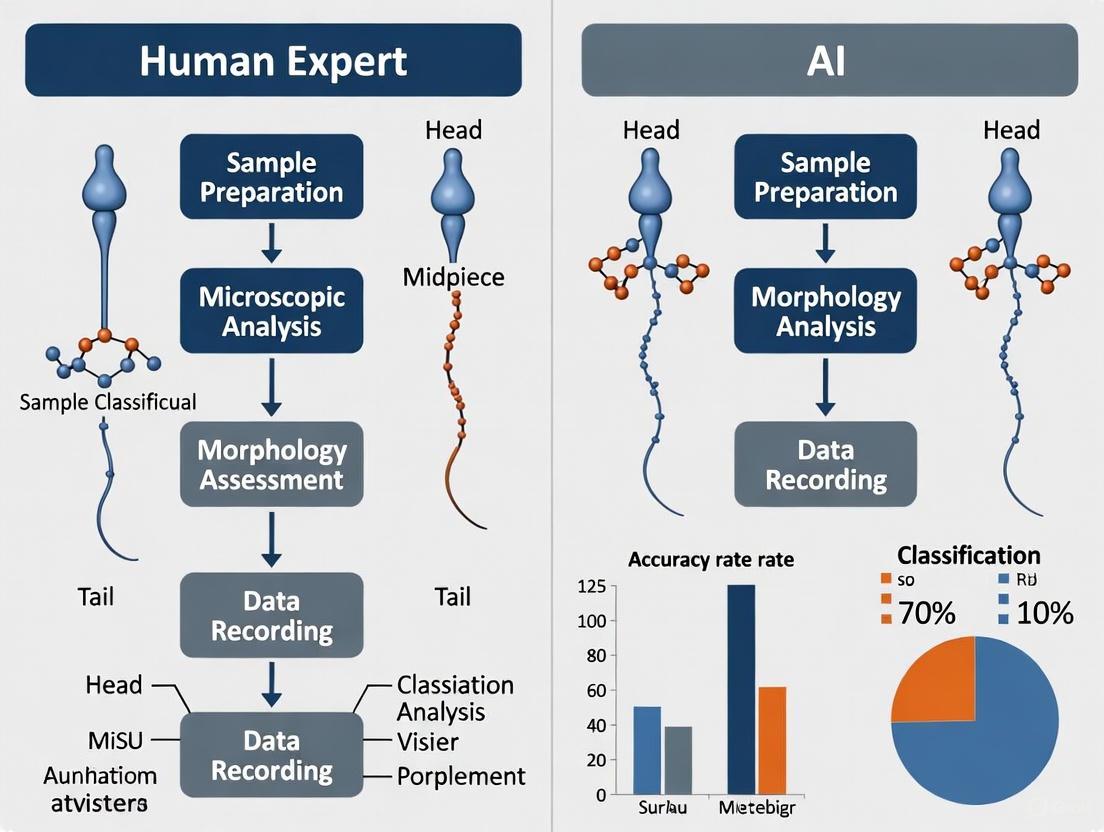
This article provides a systematic comparison between human expert and artificial intelligence (AI) methodologies for sperm morphology classification, a critical component of male infertility diagnosis.
Human Expert vs. AI in Sperm Morphology Classification: A Comprehensive Analysis of Accuracy, Standardization, and Future Directions
Abstract
This article provides a systematic comparison between human expert and artificial intelligence (AI) methodologies for sperm morphology classification, a critical component of male infertility diagnosis. We explore the foundational challenges of manual assessment, including high inter-observer variability and subjectivity, and contrast them with emerging AI solutions leveraging convolutional neural networks (CNNs) and deep feature engineering. The analysis covers methodological advances in automated systems, optimization strategies to overcome data and technical limitations, and rigorous validation of AI performance against expert benchmarks. Recent studies demonstrate AI models achieving accuracy rates of 90-96%, significantly reducing analysis time from 30-45 minutes to under one minute while improving standardization. For researchers and drug development professionals, this synthesis offers critical insights into the evolving landscape of reproductive diagnostics, highlighting pathways for integrating AI to enhance precision, efficiency, and clinical outcomes in fertility care.
The Foundational Challenge: Understanding Variability in Human Sperm Morphology Assessment
Male infertility constitutes a significant global health challenge, implicated in approximately 50% of all infertility cases among couples, either as a sole factor or in combination with female factors [1] [2]. Within the diagnostic landscape of male infertility, sperm morphology—the study of sperm size, shape, and structural integrity—has emerged as a cornerstone parameter due to its profound clinical relevance. The morphological assessment of spermatozoa provides crucial diagnostic and prognostic information, serving as a key predictor of fertilization potential in both natural conception and assisted reproductive technologies (ART) [1] [3]. Despite its established importance, sperm morphology evaluation has historically presented significant challenges in standardization, often relying on subjective manual analysis by experienced technicians, which leads to considerable inter-observer and inter-laboratory variability [1] [4].
The clinical imperative for accurate morphology assessment stems from its ability to reflect underlying testicular and epididymal function, offering insights that extend beyond fertility to encompass broader male health concerns [5] [3]. With the declining trends in semen quality parameters observed globally, particularly among young men, the rigorous evaluation of sperm morphology has gained renewed importance in the clinical evaluation of male fertility potential [3]. This article examines the evolving landscape of sperm morphology assessment, comparing traditional manual techniques with emerging artificial intelligence (AI) approaches, and explores how technological advancements are addressing long-standing limitations in standardization and accuracy, ultimately enhancing the clinical utility of this fundamental diagnostic parameter.
Traditional Morphology Assessment: Methods, Limitations, and Clinical Significance
Established Staining Techniques and Methodological Approaches
The accurate evaluation of sperm morphology necessitates precise staining techniques that provide clear differentiation of sperm components while minimizing structural artifacts. The World Health Organization (WHO) manual endorses several staining methods, with Diff-Quick and Papanicolaou being among the most widely utilized in clinical andrology laboratories [4]. These staining protocols enable detailed visualization of sperm head, midpiece, and tail structures, allowing for the identification and classification of morphological abnormalities according to standardized criteria.
A comparative study examining Diff-Quick and Spermac staining methods revealed significant methodological differences impacting morphological classification. While both techniques provided comparable assessment of head and tail abnormalities, Spermac staining demonstrated superior visualization of the midpiece, resulting in the identification of substantially higher rates of midpiece defects (55.7% ± 2.1% versus 24.8% ± 2.0%, p<0.0001) compared to Diff-Quick [4]. This discrepancy highlights how technical methodologies can directly influence diagnostic outcomes, potentially affecting patient management decisions. The same study found that Diff-Quick staining yielded a significantly higher percentage of morphologically normal sperm (3.98% ± 0.4% versus 2.8% ± 0.3%, p=0.0385), underscoring how staining selection alone can alter the clinical interpretation of semen quality [4].
Classification Systems and Reference Standards
Sperm morphology assessment employs standardized classification systems to categorize observed abnormalities. The most prominent frameworks include the Tygerberg strict criteria and the modified David classification, which provide systematic approaches for identifying and documenting specific defect types [1] [4]. The David classification, for instance, delineates 12 distinct morphological classes encompassing seven head defects (tapered, thin, microcephalous, macrocephalous, multiple, abnormal post-acrosomal region, abnormal acrosome), two midpiece defects (cytoplasmic droplet, bent), and three tail defects (coiled, short, multiple) [1].
The reference range for normal sperm morphology has become increasingly stringent over time, with the current WHO lower reference limit established at 4% morphologically normal forms [4]. This threshold serves as a critical benchmark in male fertility assessment, with values below this cutoff associated with reduced fertilization potential in both natural conception and ART cycles. The clinical significance of morphology is particularly pronounced when multiple semen parameter abnormalities coexist, with morphology often demonstrating the strongest correlation with fertility outcomes among conventional semen parameters [1] [5].
Table 1: Comparison of Staining Techniques for Sperm Morphology Assessment
| Staining Method | Normal Morphology (%) | Midpiece Defects (%) | Head Defects (%) | Tail Defects (%) | Key Advantages |
|---|---|---|---|---|---|
| Diff-Quick | 3.98 ± 0.41 | 24.82 ± 2.05 | 93.42 ± 0.66 | 16.60 ± 1.34 | Rapid procedure, established standard |
| Spermac | 2.80 ± 0.33 | 55.74 ± 2.06 | 94.24 ± 0.61 | 14.84 ± 1.39 | Superior midpiece visualization |
| Papanicolaou | WHO Reference Standard | - | - | - | Comprehensive structural detail |
Inherent Limitations of Traditional Assessment
Despite its clinical importance, traditional sperm morphology assessment faces several fundamental limitations. The process remains inherently subjective and operator-dependent, with classification consistency heavily influenced by technician expertise and experience [1] [3]. This subjectivity is evidenced by significant inter-expert variability, even among highly trained professionals. One study analyzing agreement between three experts reported varying consensus levels: total agreement (3/3 experts) in some cases, partial agreement (2/3 experts) in others, and no agreement among experts in certain classifications [1].
The manual evaluation process is also notably time-consuming and labor-intensive, requiring the systematic assessment of at least 200 individual spermatozoa per sample under high magnification (1000×) with oil immersion [4] [3]. This substantial analytical workload, combined with the inherent subjectivity, has compromised both the reproducibility and clinical reliability of traditional morphology assessment, creating an imperative for more standardized, objective approaches [3]. Additionally, conventional staining methods render sperm unsuitable for subsequent therapeutic use in ART, necessitating separate sample processing for diagnostic and treatment purposes [6].
The Rise of AI in Sperm Morphology Analysis
Artificial Intelligence Methodologies and Approaches
Artificial intelligence, particularly deep learning algorithms, has emerged as a transformative approach to overcoming the limitations of traditional sperm morphology assessment. Convolutional Neural Networks (CNNs) represent the predominant architectural framework in this domain, capable of automating the extraction of discriminative features from sperm images without relying on manual feature engineering [1] [3]. These AI models are trained on extensive datasets of annotated sperm images, learning to recognize and classify morphological patterns with increasing accuracy through iterative exposure to labeled examples.
The AI pipeline for sperm morphology analysis typically encompasses several sequential stages: image acquisition, pre-processing, data augmentation, model training, and validation [1]. Pre-processing techniques are employed to enhance image quality, denoise signals, and standardize dimensions, while data augmentation strategies expand limited datasets through transformations like rotation, scaling, and contrast adjustment, improving model robustness and generalizability [1]. Following training, model performance is rigorously evaluated using separate test datasets to assess metrics such as accuracy, precision, recall, and area under the curve (AUC) values [6] [2].
Transfer learning approaches, where pre-trained models like ResNet50 are adapted for sperm classification tasks, have demonstrated particular efficacy, especially when limited training data are available [6]. One study utilizing this approach achieved impressive performance metrics, including a test accuracy of 93%, precision of 0.95 for abnormal sperm detection, and recall of 0.95 for normal sperm identification [6]. The processing efficiency of these AI systems is equally notable, with reported average prediction times of approximately 0.0056 seconds per image, enabling rapid analysis of thousands of sperm cells [6].
Performance Comparison: AI Versus Human Experts
Multiple studies have directly compared the performance of AI-based systems against traditional manual assessment by human experts, with consistently promising results. A deep learning model developed on the SMD/MSS (Sperm Morphology Dataset/Medical School of Sfax) dataset demonstrated classification accuracy ranging from 55% to 92% across different morphological categories, approaching the consistency level of expert embryologists [1]. This study utilized a substantial dataset initially comprising 1,000 sperm images, expanded to 6,035 images through data augmentation techniques, with classifications established by consensus among three human experts serving as the reference standard [1].
In another investigation focusing on unstained live sperm evaluation—a significant advancement beyond conventional fixed and stained preparations—an AI model exhibited strong correlation with both computer-aided semen analysis (CASA) (r=0.88) and conventional semen analysis (r=0.76) [6]. This capability to assess sperm without staining is particularly valuable in ART settings, as it preserves sperm viability for subsequent therapeutic use immediately after evaluation [6]. The performance advantages of AI systems extend beyond classification accuracy to encompass superior consistency, processing speed, and freedom from fatigue-related variability that affects human analysts.
Table 2: Performance Metrics of AI Models in Sperm Morphology Classification
| Study | AI Methodology | Dataset Size | Accuracy | Precision | Recall/Sensitivity | Key Finding |
|---|---|---|---|---|---|---|
| Deep-learning based model for sperm morphology [1] | Convolutional Neural Network (CNN) | 1,000 images (expanded to 6,035) | 55-92% | - | - | Accuracy approaches expert-level consistency |
| AI model for unstained sperm assessment [6] | ResNet50 Transfer Learning | 21,600 images (12,683 annotated) | 93% | 0.95 (abnormal) 0.91 (normal) | 0.91 (abnormal) 0.95 (normal) | Strong correlation with CASA (r=0.88) and conventional analysis (r=0.76) |
| SVM Classifier [3] | Support Vector Machine | >1,400 sperm cells | AUC: 88.59% | >90% | - | High discriminatory power for sperm head classification |
Achievement of AI versus Human Expert in Sperm Morphology Assessment
Experimental Protocols in Sperm Morphology Research
Protocol 1: Traditional Staining and Manual Assessment
The conventional methodology for sperm morphology assessment follows a standardized protocol established by WHO guidelines. Semen samples are initially collected after 2-7 days of sexual abstinence and allowed to liquefy at 37°C [4]. Smear preparation involves placing a small semen aliquot (typically 6-10μL) onto a clean glass slide, with spreading techniques designed to achieve a monolayer distribution of spermatozoa to prevent overlap and ensure optimal visualization [4].
For Diff-Quick staining, the established protocol involves sequential immersion of air-dried smears in specific solutions: fixation in a 0.1% triarylmethane solution for 5 seconds, followed by immersion in 0.1% xanthenes solution for 5 seconds, 0.1% thiazines solution for 5 seconds, and a final rinse in distilled water for 5 seconds before air drying [4]. Alternatively, Spermac staining employs a more complex procedure including fixation in formaldehyde solution for 5 minutes, followed by sequential staining in three different solutions (A, B, and C) for 1 minute each, with distilled water washes between each staining step [4].
Manual morphological assessment is performed by trained technologists using brightfield microscopy under oil immersion at 1000× magnification. A minimum of 200 spermatozoa are systematically evaluated and classified according to established criteria (Tygerberg or David classification), with results expressed as the percentage of morphologically normal forms and the prevalence of specific defect categories [4]. Quality control measures include regular participation in external quality assurance programs and internal consistency checks to minimize inter-technician variability.
Protocol 2: AI-Assisted Morphology Classification
AI-based morphology assessment begins with image acquisition, typically using specialized microscopy systems. One protocol utilizes the MMC CASA (Computer-Assisted Semen Analysis) system for image capture, employing brightfield mode with an oil immersion 100× objective to acquire individual sperm images [1]. Each image contains a single spermatozoon encompassing the head, midpiece, and tail regions, ensuring comprehensive morphological assessment.
Image pre-processing represents a critical step in the AI pipeline, involving data cleaning to handle missing values or inconsistencies, and normalization to standardize image dimensions and intensity values [1]. Specific pre-processing techniques include resizing images to standardized dimensions (e.g., 80×80×1 grayscale) using linear interpolation strategies to minimize distortion artifacts [1].
For model development, datasets are typically partitioned into training (80%) and testing (20%) subsets, with a portion of the training set often reserved for validation during the development phase [1]. Data augmentation techniques are employed to address class imbalance and expand effective dataset size, including transformations such as rotation, scaling, flipping, and contrast adjustment [1]. The deep learning model is then trained using iterative optimization algorithms to minimize classification error, with performance validation conducted on the withheld test set to evaluate generalizability to unseen data.
AI-Assisted Sperm Morphology Analysis Workflow
Comparative Analysis: Human Expertise Versus AI Algorithms
Accuracy and Consistency Metrics
The fundamental distinction between human experts and AI algorithms in sperm morphology classification centers on the trade-off between experiential knowledge and computational consistency. Human experts bring sophisticated pattern recognition capabilities honed through extensive training and practical experience, enabling nuanced interpretation of borderline cases and integration of contextual clinical information [1] [3]. However, this expertise is inevitably accompanied by inherent subjectivity and inter-observer variability, even among highly trained professionals within the same laboratory [1].
In contrast, AI algorithms offer perfect consistency, applying identical classification criteria to every sperm cell analyzed without influence from fatigue, distraction, or temporal performance fluctuations [2] [3]. This computational objectivity addresses one of the most significant limitations of traditional morphology assessment. Studies directly comparing classification consistency have demonstrated that while human experts show varying agreement levels (total, partial, or no agreement across three experts), AI models maintain stable performance when presented with the same images [1]. The emerging consensus suggests that AI systems can achieve accuracy levels approaching or even exceeding human experts for well-defined morphological classifications, particularly for obvious abnormalities, though challenging borderline cases may still benefit from human oversight [1] [6] [3].
Processing Efficiency and Clinical Workflow Integration
A decisive advantage of AI-based systems lies in their processing efficiency and potential for workflow integration. Manual morphology assessment is notoriously time-consuming, requiring 15-30 minutes per sample for a trained technologist to evaluate 200 spermatozoa under high magnification [3]. This analytical burden creates practical limitations in high-volume clinical settings and restricts the number of sperm that can be reasonably assessed, potentially compromising statistical reliability.
AI systems demonstrate dramatically superior processing speeds, with one study reporting an average prediction time of 0.0056 seconds per image, enabling the analysis of thousands of sperm cells in minutes rather than hundreds in substantially longer timeframes [6]. This efficiency advantage permits more comprehensive sample characterization through the evaluation of larger sperm numbers while reducing technologist workload and enabling resource reallocation to higher-value tasks [2] [3].
From a clinical workflow perspective, AI systems offer the additional advantage of operating effectively on unstained, live sperm samples, as demonstrated by confocal laser scanning microscopy approaches [6]. This capability is particularly valuable in ART settings where preserving sperm viability for subsequent procedures is essential, eliminating the trade-off between diagnostic assessment and therapeutic utility that characterizes conventional staining methods.
Table 3: Comparative Analysis of Human Expert vs. AI-Based Sperm Morphology Assessment
| Parameter | Human Expert Assessment | AI-Based Assessment |
|---|---|---|
| Classification Basis | Subjective pattern recognition | Computational algorithm |
| Consistency | Variable (inter- and intra-observer variability) | Perfect (identical criteria applied consistently) |
| Processing Speed | 15-30 minutes per sample (200 sperm) | ~0.0056 seconds per image |
| Throughput | Limited by human fatigue and attention | Virtually unlimited |
| Staining Requirement | Generally required for optimal visualization | Possible with unstained, live sperm |
| Borderline Case Handling | Contextual interpretation and judgment | Algorithmic classification based on training |
| Standardization | Variable between laboratories and technicians | Consistent across implementations |
Essential Research Reagents and Materials
The experimental protocols for sperm morphology assessment, whether traditional or AI-assisted, rely on specific research reagents and materials that directly impact analytical outcomes. The selection of appropriate staining kits, fixation methods, and microscopy equipment represents a critical methodological consideration with substantial implications for result interpretation and cross-study comparability.
Table 4: Essential Research Reagents for Sperm Morphology Analysis
| Reagent/Material | Function/Purpose | Examples/Alternatives |
|---|---|---|
| Diff-Quick Stain | Rapid staining for general morphology assessment | Panótico Rápido kit (Laborclin) |
| Spermac Stain | Enhanced midpiece visualization and differentiation | Spermac stain (FertiPro N.V.) |
| Formaldehyde Solution | Fixation for morphological preservation | 4% paraformaldehyde for specific protocols |
| Glutaraldehyde | Alternative fixative for structural integrity | 2.5% glutaraldehyde in 0.1M sodium cacodylate buffer |
| RAL Diagnostics Kit | Staining for conventional morphology assessment | Used in SMD/MSS dataset development |
| Computer-Assisted Semen Analysis System | Automated image acquisition and initial morphometry | MMC CASA system, IVOS II (Hamilton Thorne) |
| Confocal Laser Scanning Microscope | High-resolution imaging of unstained, live sperm | LSM 800 for AI model development |
| Phase Contrast Microscope | Evaluation of unstained sperm morphology | Alternative to brightfield microscopy |
Future Directions and Clinical Implications
The integration of AI technologies into sperm morphology assessment represents a paradigm shift in male fertility evaluation, with profound implications for clinical practice and research. Current evidence indicates that AI-assisted approaches can enhance diagnostic accuracy, improve standardization, and increase analytical efficiency, addressing longstanding limitations of conventional methodology [1] [6] [2]. The ability to analyze unstained, live sperm samples using confocal microscopy and AI algorithms is particularly promising for ART applications, enabling simultaneous diagnostic assessment and therapeutic utilization [6].
Future developments in this field will likely focus on several key areas: the creation of larger, more diverse, and standardized datasets to enhance model generalizability; the refinement of algorithms for detecting subtle morphological features with clinical significance; and the integration of multi-parameter assessments combining morphology with motility, DNA fragmentation, and other functional parameters [2] [3]. Additionally, the validation of AI systems across diverse clinical settings and population groups will be essential to establish universal reliability and facilitate widespread adoption.
From a clinical perspective, the enhanced objectivity and efficiency offered by AI-assisted morphology assessment has the potential to improve infertility diagnosis accuracy, optimize treatment selection, and provide more precise prognostic information for couples [2] [3]. As these technologies continue to evolve and validate through rigorous clinical studies, they are poised to transform sperm morphology from a subjective, highly variable parameter into a precise, reproducible cornerstone of male fertility evaluation, ultimately advancing the standard of care in reproductive medicine.
The accurate classification of biological samples is a cornerstone of diagnostic medicine and scientific research. In fields ranging from reproductive biology to auditory neuroscience, manual analysis by human experts has traditionally been the gold standard. However, this approach is inherently susceptible to subjectivity, leading to potential inconsistencies in interpretation and diagnosis. This guide objectively examines the quantifiable variability between human experts across multiple domains, with a specific focus on sperm morphology classification, and contrasts this performance with emerging artificial intelligence (AI) solutions. As male factors contribute to approximately 50% of infertility cases, the precision of sperm analysis is of paramount importance [7]. The integration of AI and computer-assisted semen analysis (CASA) systems represents a paradigm shift, offering enhanced objectivity, standardization, and throughput in fertility diagnostics [8]. This analysis leverages recent comparative studies to provide researchers and drug development professionals with a clear understanding of the capabilities and limitations of both human and automated classification methods.
Quantifying Inter-Expert Variability in Manual Classification
Inter-expert variability is a well-documented phenomenon that challenges the reliability of manual classification across numerous scientific disciplines.
Evidence from Sperm Morphology Assessment
The assessment of sperm morphology is particularly prone to subjectivity. A seminal study developing a deep-learning model for sperm classification provided a stark quantification of this variability. Three experts independently classified 1,000 sperm images according to the modified David classification, which includes 12 distinct morphological defect classes. The analysis revealed a clear lack of consensus [1]:
- Total Agreement (TA): All three experts agreed on the same label for all categories in only 55% of cases.
- Partial Agreement (PA): Two out of three experts agreed on the same label for at least one category in 92% of cases.
- No Agreement (NA): The experts completely disagreed on the classification for 8% of the sperm images.
This discrepancy occurred despite all experts being from the same laboratory and possessing extensive experience, underscoring the inherent challenge of standardizing subjective visual criteria [1].
Variability in Other Diagnostic Fields
This phenomenon is not isolated to sperm analysis. Research into Auditory Brainstem Response (ABR) interpretation, a key tool for evaluating hearing capacity, found significant inconsistencies. Four expert examiners manually classified wave components in 160 ABR samples. While differences in latency annotations were generally below 0.1 ms (a clinically acceptable threshold), several comparisons showed larger errors and standard deviations exceeding 0.1 ms, indicating notable discrepancies in their identification of key signal components [9].
Similarly, a study on the manual classification of fixations in eye-tracking data concluded that "fixation classification by experienced untrained human coders is not a gold standard." Researchers found that while coders showed high agreement using sample-based Cohen’s kappa, substantial differences emerged when examining specific parameters like fixation duration and the number of fixations, suggesting the application of different implicit thresholds [10].
Table 1: Quantified Inter-Expert Variability Across Different Fields
| Field of Study | Classification Task | Number of Experts | Key Metric of Variability |
|---|---|---|---|
| Sperm Morphology [1] | David classification (12 defect classes) | 3 | Total Expert Agreement: 55% |
| Auditory Brainstem Response (ABR) [9] | Identification of Jewett wave latency | 4 | Presence of outliers with latency differences > 0.1 ms |
| Eye-Tracking [10] | Fixation classification in adult and infant data | 12 | Substantial differences in fixation duration/number |
Experimental Protocols for Benchmarking Human vs. AI Performance
To objectively compare human expert and AI performance, researchers employ structured experimental protocols. The following methodologies are drawn from recent, high-impact studies.
Protocol 1: Developing an AI Model for Unstained Sperm Morphology
A 2024 study aimed to develop an AI model that could assess live, unstained sperm, which is crucial for use in Assisted Reproductive Technology (ART) as it keeps sperm viable for procedures like Intracytoplasmic Sperm Injection (ICSI) [6].
- Sample Preparation: Semen samples were collected from 30 healthy volunteers. Each sample was aliquoted into three parts for parallel analysis.
- Imaging and Dataset Creation: A 6 µL droplet of sample was dispensed onto a standard chamber slide. Sperm images were captured using a confocal laser scanning microscope at 40x magnification in Z-stack mode (0.5 µm interval). Embryologists and researchers manually annotated over 12,000 sperm images, categorizing them into "normal" or one of eight "abnormal" classes based on strict WHO 6th edition criteria. The inter-observer correlation for this annotation was high (0.95 for normal, 1.0 for abnormal morphology).
- AI Model Training: A ResNet50 deep learning model was trained on this dataset. The model's performance was evaluated on a separate test set of images it had not seen during training.
- Comparison: The performance of the AI model was benchmarked against both Conventional Semen Analysis (CSA) and a Commercial CASA system (IVOS II, Hamilton Thorne) that analyzed fixed, stained sperm.
Protocol 2: Deep Learning for Stained Sperm Head Classification
Another approach leverages transfer learning to classify stained sperm heads according to WHO criteria [11].
- Datasets: The study used two public datasets, the Human Sperm Head Morphology (HuSHeM) and the SCIAN-MorphoSpermGS, which contain pre-classified images of sperm heads.
- AI Model Training: Instead of training a model from scratch, the VGG16 convolutional neural network, pre-trained on the general ImageNet database, was retrained (a process called transfer learning) on the sperm image datasets. The model was fine-tuned to classify sperm into five WHO categories: Normal, Tapered, Pyriform, Small, and Amorphous.
- Performance Benchmarking: The AI's classification accuracy was tested on dataset images and its performance was compared directly against earlier, non-deep-learning machine learning approaches (like Cascade Ensemble-Support Vector Machines) that relied on manual extraction of shape-based features.
Diagram 1: Experimental Workflow for Comparing Human and AI Classification. This flowchart illustrates the parallel pathways for evaluating human expert and AI-based sperm classification, culminating in a comparative performance analysis.
Comparative Performance: Human Experts vs. AI Models
Quantitative data from controlled experiments demonstrate that AI models can not only match but in some cases exceed the performance of human experts, while offering greater consistency.
Performance in Sperm Morphology Classification
- Unstained Sperm Analysis: The in-house AI model demonstrated a stronger correlation with the Commercial CASA system (r=0.88) than Conventional Semen Analysis did with the same CASA system (r=0.57). This indicates that the AI's assessment of live sperm was more aligned with an established automated method than the manual method was [6].
- Stained Sperm Head Classification: On the HuSHeM dataset, the deep learning model (VGG16) achieved an average true positive rate of 94.1%, matching the performance of a state-of-the-art dictionary learning approach and significantly exceeding a Cascade Ensemble-SVM approach (78.5%) [11].
- Addressing Expert Disagreement: A deep learning model trained on a dataset where images were labeled based on total expert agreement (3/3 experts) achieved an accuracy of 92%. In contrast, when tested on images where experts had only partial agreement (2/3), accuracy dropped to 55%, highlighting the model's performance is closely tied to the consistency of the human "gold standard" used for its training [1].
Performance in Other Medical Imaging Tasks
The value of AI in reducing variability is also evident in other areas. A study on intravascular ultrasound (IVUS) image segmentation found that the difference between algorithmic contours and experts' contours was within the range of inter-expert variability. Furthermore, inter-expert variability was itself lower when using higher-resolution 60 MHz imaging compared to 40 MHz, showing that improved data quality can reduce human subjectivity [12].
Table 2: Performance Comparison of Human Experts vs. AI Classification Models
| Study & Task | Human Expert Performance Metric | AI Model Performance Metric | Conclusion |
|---|---|---|---|
| Sperm Morphology (Stained) [11] | Used as benchmark | 94.1% True Positive Rate (VGG16 model) | AI performance competitive with, and sometimes superior to, expert-level classification. |
| Sperm Morphology (Unstained) [6] | Correlation with CASA: r=0.57 | Correlation with CASA: r=0.88 (AI model) | AI assessment of live sperm showed stronger alignment with an automated standard than manual analysis. |
| IVUS Image Segmentation [12] | Measured inter-expert variability | Algorithmic differences within inter-expert variability | AI performance can fall within the range of human expert disagreement. |
The Scientist's Toolkit: Research Reagent Solutions
The experiments cited rely on a suite of specialized materials and software. The following table details key components essential for research in this field.
Table 3: Essential Research Reagents and Tools for Sperm Classification Studies
| Item Name | Type | Function in Research |
|---|---|---|
| RAL Diagnostics Staining Kit [1] | Chemical Reagent | Stains sperm smears for manual or CASA-based morphological analysis according to WHO standards. |
| Diff-Quik Stain [6] | Chemical Reagent | A Romanowsky-type stain variant used for rapid staining of sperm for morphological assessment. |
| Leja Chamber Slides (20 µm) [6] | Laboratory Consumable | Standardized chambers for preparing semen samples for microscopic analysis, ensuring consistent depth. |
| IVOS II CASA System [6] | Instrumentation | A commercial computer-assisted semen analyzer used for automated assessment of sperm concentration, motility, and morphology. |
| LensHooke X1 PRO [13] | Instrumentation | A portable, AI-enabled CASA device that uses optical microscopy and algorithms to provide rapid semen analysis. |
| Confocal Laser Scanning Microscope [6] | Instrumentation | Provides high-resolution, Z-stack images of unstained live sperm for creating detailed training datasets for AI models. |
| HuSHeM / SCIAN Datasets [11] | Digital Resource | Publicly available, expert-annotated image datasets of sperm heads used for training and benchmarking AI algorithms. |
| ResNet50 / VGG16 Models [6] [11] | Software/Algorithm | Pre-trained deep convolutional neural networks that can be adapted for specific image classification tasks like sperm morphology. |
Diagram 2: Logical Hierarchy of Sperm Classification Technologies. This diagram categorizes the main technological approaches to sperm classification, from traditional manual methods to advanced AI-driven techniques, highlighting the shift towards deep learning.
The diagnostic evaluation of male infertility heavily relies on semen analysis, with sperm morphology assessment—the detailed examination of sperm size, shape, and structural integrity—being a critical prognostic factor for natural conception and the success of Assisted Reproductive Technologies (ART) such as In Vitro Fertilization (IVF) [14] [15]. Historically, this assessment has been performed manually by trained embryologists following World Health Organization (WHO) guidelines, which define normal sperm morphology by specific metrics, including an oval head (length: 4.0–5.5 μm, width: 2.5–3.5 μm) and an intact acrosome covering 40–70% of the head [15]. However, this manual process is fraught with subjectivity, leading to what is known as a "standardization crisis" characterized by significant inconsistencies both across different laboratories and between various classification systems. This crisis undermines diagnostic reliability, compromises patient care, and confounds research outcomes.
The core of the problem lies in the inherent limitations of human-based visual analysis. Manual sperm morphology assessment is labor-intensive, requiring the examination of at least 200 sperm per sample, a process that can take 30 to 45 minutes and is prone to substantial inter-observer variability [14] [15]. Studies report diagnostic disagreements of up to 40% between expert evaluators, with kappa values, a statistical measure of inter-rater reliability, sometimes falling as low as 0.05–0.15, indicating minimal agreement beyond chance [15]. This lack of reproducibility stems from subjective interpretations of complex and subtle morphological features, differences in training, and the immense mental fatigue associated with visually scrutinizing hundreds of cells per sample. These inconsistencies are compounded when different classification systems (e.g., WHO strict criteria, David classification, Kruger criteria) are applied, further complicating the comparability of results between clinics and clinical studies [14].
In response to this crisis, Artificial Intelligence (AI) has emerged as a transformative tool. AI-powered systems, particularly those employing deep learning, offer a pathway to standardized, objective, and highly reproducible sperm morphology analysis. By automating the classification process, these systems can overcome human subjectivity, reduce analysis time from nearly an hour to under a minute, and establish a consistent benchmark for sperm quality evaluation [15]. This article provides a comparative guide, contextualized within broader research on human expert versus AI classification accuracy, to objectively evaluate the performance of these emerging technologies against traditional manual methods, detailing the experimental protocols and data that underscore their potential to resolve the standardization crisis.
Quantitative Performance Comparison: Human Experts vs. AI Models
A direct comparison of performance metrics reveals the significant advantage AI models hold over traditional manual analysis in terms of both accuracy and consistency. The following table summarizes key quantitative findings from recent studies, highlighting the objective improvements offered by automation.
Table 1: Performance Comparison of Sperm Morphology Analysis Methods
| Method / Study | Reported Accuracy / Metric | Dataset / Context | Key Performance Insight |
|---|---|---|---|
| Manual Analysis by Embryologists | Kappa values of 0.05 - 0.15 [15] | Routine clinical practice | High inter-observer variability, indicating poor diagnostic agreement. |
| Up to 40% coefficient of variation (CV) between experts [15] | Multiple laboratory comparisons | Significant inconsistency in results across different labs. | |
| Conventional ML (Bayesian Model) | 90% accuracy [14] | 4-class head morphology classification | Good performance but reliant on handcrafted features, limiting its scope. |
| Deep Learning (Proposed CBAM-ResNet50) | 96.08% ± 1.2% accuracy [15] | SMIDS dataset (3,000 images, 3-class) | Statistically significant improvement over baselines; high reproducibility. |
| Deep Learning (Proposed CBAM-ResNet50) | 96.77% ± 0.8% accuracy [15] | HuSHeM dataset (216 images, 4-class) | Demonstrates model robustness and superior performance on a different dataset. |
| Stacked CNN Ensemble (Spencer et al.) | 95.2% accuracy [15] | HuSHeM dataset | Example of a high-performing alternative AI architecture. |
The data unequivocally demonstrates that AI models not only match but substantially exceed the consistency of human experts. While human analysts show unacceptably high variability, advanced deep learning frameworks achieve near-perfect agreement and high accuracy across multiple, independent datasets. This transition from subjective judgment to quantitative, algorithm-driven assessment is the cornerstone for resolving the standardization crisis.
Experimental Protocols: Validating AI Performance
The superior performance of AI models is validated through rigorous, standardized experimental protocols. The following workflow details the standard methodology for training and evaluating a deep learning model for sperm morphology classification, as used in state-of-the-art research.
Diagram 1: AI Sperm Classification Workflow illustrates the standard pipeline for automated sperm morphology analysis, from image input to final classification.
Detailed Methodology
The experimental protocol can be broken down into the following key stages, which ensure the validity and reliability of the results:
Dataset Preparation and Curation:
- Public Datasets: Research is typically conducted on publicly available, benchmark datasets to enable direct comparison with other models. Commonly used datasets include:
- Data Annotation: Images in these datasets are annotated by experts, providing the "ground truth" labels used to train and test the AI models. The quality and consistency of these annotations are critical, though the existence of multiple datasets itself hints at the challenge of standardization.
AI Model Training and Validation:
- Deep Learning Architecture: A typical advanced approach involves using a pre-trained Convolutional Neural Network (CNN) like ResNet50 as a "backbone." This is often enhanced with a Convolutional Block Attention Module (CBAM), which helps the model learn to focus on the most diagnostically relevant parts of the sperm cell (e.g., head shape, acrosome) while ignoring irrelevant background noise [15].
- Deep Feature Engineering (DFE): This is a hybrid approach where the deep learning model is not used end-to-end. Instead, high-dimensional feature representations are extracted from intermediate layers of the network. These features are then processed using classical techniques like Principal Component Analysis (PCA) to reduce noise and dimensionality before being fed into a classifier like a Support Vector Machine (SVM) with an RBF kernel. This DFE pipeline has been shown to boost performance significantly, for instance, from ~88% accuracy to over 96% [15].
- Validation Protocol: To ensure the model is not simply "memorizing" the data, a 5-fold cross-validation protocol is standard. The dataset is split into five parts; the model is trained on four and tested on the fifth, with this process repeated five times. The final accuracy is the average across all five tests, providing a robust measure of generalizability [15].
Performance Evaluation and Statistical Analysis:
- Key Metrics: Performance is evaluated using standard metrics including accuracy, sensitivity, specificity, and F1-score. The Area Under the Receiver Operating Characteristic Curve (AUC) is also frequently reported [2].
- Statistical Significance: The improvement offered by a new model is validated using statistical tests like McNemar's test to confirm that the performance gain over a baseline model is not due to random chance [15].
The Scientist's Toolkit: Essential Research Reagents and Materials
To replicate or build upon this research, scientists require access to specific datasets, software, and hardware. The following table details key resources in the "Research Reagent Solutions" for AI-based sperm morphology analysis.
Table 2: Essential Research Tools for AI-Based Sperm Morphology Analysis
| Tool Name / Category | Type / Format | Primary Function in Research |
|---|---|---|
| HuSHeM Dataset [15] | Image Dataset (216 images) | Benchmarking model performance on 4-class sperm head morphology classification. |
| SMIDS Dataset [15] | Image Dataset (3,000 images) | Training and validating models for larger-scale 3-class classification tasks. |
| SVIA Dataset [14] | Multimodal Dataset (Videos & Images) | Developing models for detection, segmentation, and classification from video data. |
| ResNet50 Architecture | Deep Learning Model | Serving as a powerful, pre-trained backbone for feature extraction from sperm images. |
| Convolutional Block Attention Module (CBAM) | Software Algorithm | Enhancing CNN performance by forcing the model to focus on salient sperm features. |
| Support Vector Machine (SVM) | Machine Learning Classifier | Performing final classification on engineered deep features in hybrid pipelines. |
| Principal Component Analysis (PCA) | Statistical Algorithm | Reducing dimensionality of deep features to improve classifier efficiency and performance. |
The field is actively evolving, with new, larger datasets like VISEM-Tracking [14] and SVIA [14] emerging. These datasets contain hundreds of thousands of annotated objects and video data, enabling the development of next-generation models for not just classification, but also detection, tracking, and segmentation of sperm cells.
The "standardization crisis" in sperm morphology analysis, driven by the inherent subjectivity and variability of manual expert assessment, presents a significant obstacle in both clinical andrology and reproductive research. The quantitative data and experimental protocols detailed in this comparison guide provide compelling evidence that AI-driven classification is not merely an incremental improvement but a paradigm shift. Deep learning models, particularly those enhanced with attention mechanisms and feature engineering, deliver consistently superior accuracy, objectivity, and reproducibility compared to human experts.
For researchers, scientists, and drug development professionals, the adoption of these AI tools offers a path toward globally comparable and reliable diagnostic standards. This will not only enhance the quality of clinical diagnostics and personalized treatment planning for infertility but also ensure that data from multi-center clinical trials for new pharmaceuticals is robust and consistent. By transitioning from subjective human judgment to quantitative, algorithm-based analysis, the field can finally overcome the inconsistencies of laboratory-specific practices and historical classification systems, ushering in a new era of precision and reliability in male fertility assessment.
Sperm morphology assessment is a cornerstone of male fertility evaluation, providing critical diagnostic and prognostic information for assisted reproductive technologies (ART). For decades, this analysis has relied on the expertise of trained technologists who manually classify sperm cells according to World Health Organization (WHO) guidelines, establishing a de facto gold standard. This manual process requires technologists to examine at least 200 sperm per sample, categorizing them based on strict criteria for head, neck, and tail abnormalities. However, despite its foundational role, this expert-driven approach is inherently subjective, leading to significant variability that directly impacts diagnostic consistency and clinical decision-making. Understanding the precise performance metrics and limitations of human experts is crucial for contextualizing the emergence of artificial intelligence (AI) solutions in reproductive medicine and for establishing a meaningful baseline against which automated systems can be fairly evaluated [3].
This guide objectively compares the performance of expert technologists against standardized benchmarks and emerging AI methodologies. By synthesizing data from recent studies, we quantify the accuracy, variability, and efficiency of human sperm morphology assessment, providing researchers and clinicians with a comprehensive evidence base for evaluating current practices and future innovations in semen analysis.
Quantitative Performance Metrics of Expert Technologists
The performance of expert technologists in sperm morphology assessment is characterized by several key metrics, including diagnostic accuracy, inter-observer variability, and processing speed. The table below summarizes quantitative findings from controlled studies.
Table 1: Performance Metrics of Expert Technologists in Sperm Morphology Analysis
| Performance Metric | Reported Value/Range | Study Context / Classification System | Comparative AI Performance |
|---|---|---|---|
| Initial Accuracy (Untrained) | 53% - 81% | Varies by system complexity (2 to 25 categories) [16] | AI models (e.g., CBAM-ResNet50) report >96% accuracy [15] |
| Post-Training Accuracy | 90% - 98% | After 4 weeks of standardized training [16] | |
| Inter-Observer Agreement (Kappa) | 0.05 - 0.15 (Very low) [15] | Among trained technicians | AI offers consistent, non-varying outputs |
| Inter-Observer Variability (CV) | Up to 40% [15] | Coefficient of variation between experts | |
| Time per Sample | 30 - 45 minutes [15] | Manual assessment of ~200 sperm | AI processing in <1 minute [15] |
| Correlation with CASA | r = 0.57 [6] | Conventional Semen Analysis vs. CASA | AI correlation with CASA: r = 0.88 [6] |
Key Findings from Performance Data
- Impact of Classification Complexity: Technologist accuracy is heavily influenced by the complexity of the classification system used. One study demonstrated that untrained users' accuracy dropped from 81% using a simple 2-category (normal/abnormal) system to 53% when using a detailed 25-category system [16]. This inverse relationship between system complexity and accuracy highlights a fundamental trade-off in manual diagnosis.
- Effectiveness of Standardized Training: Training significantly improves human performance. A cohort of novices exposed to a visual aid and video training significantly improved their initial test accuracy, achieving 94.9% on a 2-category system. Repeated training over four weeks further increased final accuracy rates to 98% (2-category) and 90% (25-category), while also improving diagnostic speed from 7.0 seconds to 4.9 seconds per image [16].
- Correlation with Other Methods: The strength of correlation between conventional semen analysis (CSA) performed by experts and computer-aided semen analysis (CASA) is reported to be r=0.57, indicating a moderate relationship. In contrast, an AI model showed a stronger correlation with CASA (r=0.88), suggesting that AI may align more closely with automated systems than human experts do [6].
Detailed Experimental Protocols for Benchmarking
To ensure reproducibility and transparent comparison, the following section outlines the key methodological details from the studies cited in this guide.
Protocol 1: Assessing Inter-Expert Variability and Training Efficacy
This protocol, derived from Seymour et al. (2025), details the process for quantifying baseline performance and the impact of standardized training on expert technologists [16].
- Sample Preparation: Semen smears are prepared following WHO guidelines and stained with a RAL Diagnostics staining kit or similar Romanowsky-type stain (e.g., Diff-Quik) [16].
- Data Acquisition: Images are acquired using a microscope equipped with a 100x oil immersion objective in bright-field mode. The CASA (Computer-Aided Semen Analysis) system's morphometric tool can be used to determine the precise dimensions of each spermatozoon [1].
- Expert Classification: Each sperm image is independently classified by multiple expert morphologists. The classification follows a defined system, such as the modified David classification, which includes up to 12 classes of morphological defects across the head, midpiece, and tail [1].
- Establishing Ground Truth: A consensus diagnosis from multiple experts is used to establish the "ground truth" for each image, applying a machine-learning principle to ensure data quality for human training [16].
- Blinded Assessment & Re-Testing: Technologists, both novice and experienced, are tested on standardized image sets. Their accuracy and speed are recorded. The training involves repeated testing over a period, such as four weeks, to measure improvement and plateau effects [16].
Protocol 2: Comparative Performance Analysis vs. AI
This protocol, based on Kılıç (2025) and others, describes a methodology for direct comparison between expert technologists and AI models [6] [15].
- Dataset Curation: A high-resolution dataset of sperm images is created. For live sperm assessment, confocal laser scanning microscopy at 40x magnification can be used to capture images without staining [6]. For fixed sperm, stained images at 100x magnification are standard.
- Blinded Evaluation: The same set of images (e.g., a test dataset of at least 200 sperm cells per sample) is presented to both expert technologists and the AI model for classification [15].
- Ground Truth Validation: The classifications from both humans and AI are compared against a pre-established, validated ground truth, typically defined by a consensus panel of senior experts [16] [15].
- Metric Calculation: Key performance metrics are calculated for both groups, including accuracy, precision, recall, F1-score, and processing time. Statistical tests (e.g., McNemar's test) are applied to determine the significance of performance differences [15].
Table 2: Essential Research Reagent Solutions for Sperm Morphology Studies
| Reagent / Material | Function in Experimental Protocol |
|---|---|
| Diff-Quik Stain | A Romanowsky-type stain variant used to color sperm structures (head, midpiece, tail) for clear visualization under a microscope on fixed samples [6]. |
| RAL Diagnostics Stain | A commercial staining kit used for preparing semen smears, enabling the differentiation of sperm morphological components [1]. |
| LEJA Slides (20 µm depth) | Standardized glass slides with a fixed chamber depth of 20 micrometers, used for creating consistent wet preparations for motility assessment or fixed smears for morphology analysis [6]. |
| Confocal Laser Scanning Microscope | Provides high-resolution, Z-stack images of unstained, live sperm, allowing for the creation of detailed datasets while keeping sperm viable for use in ART [6]. |
| CASA System (e.g., IVOS II) | An automated system that acquires sequential images via a microscope camera, used for objective analysis of sperm concentration, motility, and, to a limited extent, morphology [6] [8]. |
Visualizing Workflows and Relationships
The following diagrams illustrate the core experimental workflows and logical relationships involved in establishing expert technologist baselines.
Expert Technologist Assessment Workflow
Comparative Analysis Logic: Human vs. AI
The established performance baseline for expert technologists reveals a critical paradox in reproductive medicine: while human expertise forms the diagnostic gold standard, it is characterized by significant variability and inefficiency. The data show that even with extensive training, human accuracy plateaus, particularly with complex classification systems, and remains susceptible to subjective interpretation. These limitations have tangible consequences for clinical diagnostics, research consistency, and ultimately, patient care pathways.
This quantitative baseline is not merely a record of limitations but an essential framework for innovation. It provides the rigorous, empirical foundation necessary for the development and validation of AI-driven tools designed to augment human expertise. By addressing the specific gaps in accuracy, speed, and reproducibility identified in human performance, next-generation computational pathology solutions can transition from research concepts to clinically validated tools that enhance diagnostic precision and standardize male infertility assessment on a global scale.
Methodological Revolution: How AI and Deep Learning are Transforming Sperm Analysis
The field of medical image analysis is undergoing a revolutionary transformation, driven by advanced deep learning architectures capable of extracting meaningful patterns from pixel data. For researchers investigating complex diagnostic challenges like sperm morphology classification—a task historically plagued by subjectivity and inter-expert variability—understanding these architectures is crucial. Convolutional Neural Networks (CNNs), Residual Networks (ResNet), and Vision Transformers (ViTs) each offer distinct approaches to visual data processing, with significant implications for diagnostic accuracy and reliability [17] [1]. As of 2025, over half of surveyed fertility specialists report using AI tools in their practice, with embryo and sperm selection remaining dominant applications [17]. This guide provides an objective comparison of these core architectures, framed within the context of ongoing research comparing human expert versus AI classification accuracy in reproductive medicine.
Architectural Foundations: How AI Processes Visual Data
Core Components and Operational Mechanisms
Each architecture employs fundamentally different approaches to processing visual information, leading to varied performance characteristics in medical imaging tasks.
Convolutional Neural Networks (CNNs) process images through a hierarchical series of convolutional layers that detect patterns from local regions. Using filters that slide across the image, CNNs first identify elementary features like edges and textures, progressively building up to more complex patterns through deeper layers. This design incorporates inductive biases including translation invariance and locality, making them highly efficient for pattern recognition in images [18] [19]. Their architecture typically alternates between convolutional layers for feature extraction and pooling layers for spatial dimension reduction, culminating in fully connected layers for classification [19] [20].
ResNet (Residual Networks) address the vanishing gradient problem that plagues very deep CNNs through skip connections that allow gradients to flow directly through the network. These identity mappings enable the training of substantially deeper networks (e.g., ResNet-18, ResNet-50, ResNet-152) without performance degradation, capturing more complex feature hierarchies [21]. This architectural innovation has proven particularly valuable in medical imaging where subtle morphological differences can have significant diagnostic implications.
Vision Transformers (ViTs) fundamentally depart from the convolutional paradigm by treating images as sequences of patches. These patches are flattened, linearly embedded, and processed through self-attention mechanisms that model global relationships between all patches simultaneously [18] [22]. Unlike CNNs that build from local features, ViTs maintain a global view throughout processing, enabling them to capture long-range dependencies more effectively—a potential advantage for complex morphological assessments where contextual relationships matter [23].
Table 1: Core Architectural Characteristics Comparison
| Architecture | Core Operating Principle | Key Innovation | Inductive Bias |
|---|---|---|---|
| CNN | Local feature extraction via convolutional filters | Hierarchical feature learning | Strong (locality, translation equivariance) |
| ResNet | Deep network training via residual/skip connections | Identity mappings enabling very deep networks | Strong (inherited from CNN) |
| Vision Transformer | Global context via self-attention on image patches | Sequence-based image processing | Weak (learned from data) |
Visualizing Architectural Differences
The diagram below illustrates the fundamental workflow differences between these three architectures for image classification tasks:
Diagram 1: Architectural Workflows for Image Classification. CNNs process images through local feature extraction hierarchies, ResNet enhances deep CNNs with skip connections, while Vision Transformers use global self-attention mechanisms from the onset.
Performance Comparison: Experimental Data and Diagnostic Accuracy
Quantitative Performance Metrics Across Medical Imaging Tasks
Table 2: Performance Comparison Across Medical Imaging Applications
| Application Domain | Architecture | Reported Accuracy | Dataset Characteristics | Key Strengths |
|---|---|---|---|---|
| Sperm Morphology Classification [1] | CNN | 55-92% (across morphological classes) | 1,000 images expanded to 6,035 via augmentation | Effective with limited data, handles class imbalance |
| Colorectal Cancer Detection [21] | ResNet-50 | >80% (accuracy), >87% (sensitivity) | Colon gland images, 20-40% test splits | High sensitivity for malignant cases, deep feature learning |
| General Medical Diagnostics [24] | Generative AI/ViT-based | 52.1% (overall diagnostic accuracy) | 83 studies across multiple specialties | Competitive with non-expert physicians |
| Robustness to Image Corruption [22] | FAN-ViT (Base) | 83.9% (clean), 66.4% (corrupted) | ImageNet-1K with corruption benchmarks | Superior generalization under noisy conditions |
| Hybrid Human-AI Diagnostics [25] | Ensemble (Multiple AI + Physicians) | Highest accuracy | 2,100+ clinical vignettes, 40,000+ diagnoses | Complementary error patterns improve collective accuracy |
Sperm Morphology Classification: A Case Study in Methodology
Recent research on sperm morphology classification provides a detailed experimental framework for comparing AI and human performance. A 2025 study developed the SMD/MSS (Sperm Morphology Dataset/Medical School of Sfax) dataset containing 1,000 individual spermatozoa images classified by three experts according to the modified David classification, which includes 12 distinct morphological defect categories spanning head, midpiece, and tail anomalies [1].
Experimental Protocol:
- Image Acquisition: Samples were prepared from 37 patients, excluding high-concentration samples (>200 million/mL) to prevent image overlap. Images were captured using an MMC CASA system with bright field mode and oil immersion 100x objective [1].
- Expert Classification: Three experienced embryologists independently classified each spermatozoon, with statistical analysis (Fisher's exact test) determining significant differences in classification (p < 0.05) [1].
- Data Augmentation: The original 1,000-image dataset was expanded to 6,035 images using augmentation techniques to balance morphological class representation and mitigate overfitting [1].
- CNN Implementation: A convolutional neural network was developed in Python 3.8 with preprocessing including image denoising, normalization, and resizing to 80×80×1 grayscale. The dataset was partitioned 80:20 for training and testing, with 20% of the training set used for validation [1].
- Performance Validation: The model's 55-92% accuracy range across different morphological classes was benchmarked against the expert consensus, with analysis of inter-expert agreement distribution (categorized as no agreement, partial agreement, or total agreement) [1].
The experimental workflow for this case study is visualized below:
Diagram 2: Sperm Morphology Classification Workflow. Experimental protocol showing image acquisition, expert classification with agreement analysis, data augmentation, and CNN model development stages.
The Scientist's Toolkit: Essential Research Reagents and Materials
Table 3: Essential Research Materials for AI-Based Morphological Analysis
| Item | Specification | Research Function |
|---|---|---|
| MMC CASA System [1] | Microscope with digital camera, bright field capability | Standardized image acquisition of sperm samples |
| RAL Diagnostics Staining Kit [1] | Standard staining reagents | Enhances morphological feature contrast for imaging |
| Python 3.8 with Deep Learning Libraries [1] | TensorFlow/PyTorch, OpenCV | CNN model implementation and training |
| Data Augmentation Pipeline [1] | Rotation, flipping, scaling transformations | Expands limited datasets and improves model generalization |
| SMD/MSS Dataset [1] | 1,000+ annotated sperm images, 12 morphological classes | Benchmarking model performance against expert classification |
| High-Performance Computing [22] | NVIDIA L4 GPUs with Ada Lovelace architecture | Accelerates ViT training and inference (FP8 with sparsity) |
| TAO Toolkit 5.0 [22] | Low-code AI toolkit with pre-trained ViT models | Streamlines implementation of advanced architectures |
Human vs. AI Diagnostic Performance: Comparative Insights
The interplay between human expertise and AI classification capabilities represents a critical research frontier. A comprehensive meta-analysis of generative AI models in medical diagnostics found an overall diagnostic accuracy of 52.1%, with no significant performance difference compared to physicians overall (p = 0.10) or non-expert physicians specifically (p = 0.93) [24]. However, AI models performed significantly worse than expert physicians (p = 0.007), highlighting the continued value of specialized expertise [24].
Fascinatingly, research on hybrid human-AI collectives demonstrates that combining human expertise with AI models produces the most accurate diagnostic outcomes [25]. This synergy arises from error complementarity—the phenomenon where humans and AI make systematically different types of errors, allowing each to compensate for the other's limitations [25]. In studies involving over 2,100 clinical vignettes and 40,000 diagnoses, adding even a single AI model to a group of human diagnosticians—or vice versa—substantially improved diagnostic quality [25].
For sperm morphology classification specifically, the inherent subjectivity of manual assessment creates particular challenges. Studies report significant inter-expert variability, with technicians classifying the same spermatozoon differently based on their experience and interpretive frameworks [1]. This variability underscores the potential value of AI systems in standardizing assessments, particularly in contexts where specialized expertise is unavailable.
Architectural Selection Guidelines for Research Applications
Choosing the appropriate architecture depends on multiple factors specific to the research context:
Data Availability Considerations:
- Limited datasets (<10,000 images): CNNs and ResNet architectures typically outperform ViTs due to their stronger inductive biases and more sample-efficient learning [18] [23].
- Large-scale datasets (>100,000 images): Vision Transformers increasingly dominate, showing superior scaling behavior and potential for higher asymptotic performance [18] [22].
- Data quality issues: ViTs demonstrate enhanced robustness against image corruption and noise in some studies, though this varies by specific architecture and task [22].
Computational Resource Constraints:
- Edge deployment/limited compute: Lightweight CNN variants (MobileNet, EfficientNet) offer the best tradeoff between performance and efficiency [18] [23].
- Cloud-based/high-performance computing: ViTs and very deep ResNet models leverage available computational power for maximum accuracy [22].
Task-Specific Considerations:
- Localized feature detection: CNNs maintain advantages for tasks requiring identification of local morphological patterns [20].
- Global context understanding: ViTs excel when diagnostic decisions require integration of information across the entire image [22] [23].
- Transfer learning scenarios: Pretrained CNNs (ResNet, VGG) offer proven effectiveness for fine-tuning on medical tasks with limited data [20].
Future Directions and Research Opportunities
The architectural landscape continues to evolve rapidly, with several emerging trends particularly relevant to medical image classification:
Hybrid architectures that combine convolutional inductive biases with transformer attention mechanisms (e.g., ConvNeXt, Swin Transformers) are gaining prominence, offering potential pathways to overcome the limitations of both approaches [18] [23]. These hybrids leverage CNN efficiency for local feature extraction while incorporating ViT-style global context modeling.
Self-supervised pretraining methods (e.g., MAE, DINO) are reducing the labeled data requirements for ViTs, potentially mitigating one of their primary limitations in medical domains where expert annotations are scarce and expensive [23].
Multimodal integration represents another frontier, with ViT-based architectures increasingly powering models that combine image analysis with clinical text data, potentially enabling more comprehensive diagnostic assessments [23].
For researchers specifically investigating sperm morphology classification, promising directions include developing specialized architectures that address class imbalance issues inherent in morphological datasets and creating standardized benchmarking frameworks to enable more systematic comparison of AI performance against human expert consensus across multiple laboratories and classification systems.
As the field progresses, the most impactful applications will likely emerge from human-AI collaborative systems that leverage the complementary strengths of both approaches, rather than positioning AI as a simple replacement for human expertise [25].
The application of Artificial Intelligence (AI) in male infertility treatment represents a paradigm shift in assisted reproductive technology (ART). Male factors contribute to approximately 50% of infertility cases, making accurate sperm analysis crucial for successful treatment outcomes [3]. Traditional manual sperm morphology assessment faces significant challenges with standardization due to its subjective nature, which is heavily reliant on operator expertise [1]. This subjectivity results in substantial inter-observer variability, complicating both diagnosis and treatment planning [2].
AI technologies, particularly deep learning models, promise to overcome these limitations by providing objective, automated, and accurate sperm analysis [6]. However, the performance and reliability of these AI systems are fundamentally constrained by the quality, size, and diversity of the curated datasets used for training. The inherent complexity of sperm morphology, characterized by subtle structural variations across head, neck, and tail compartments, presents fundamental challenges for developing robust automated analysis systems [3]. This review comprehensively examines the critical role of curated datasets and augmentation techniques in bridging the gap between human expertise and AI classification accuracy in sperm morphology analysis.
Comparative Analysis of Key Sperm Morphology Datasets
The development of high-performance AI models for sperm morphology classification relies on specialized datasets curated for this specific task. The landscape of available datasets has evolved significantly, with each offering distinct advantages and limitations.
Table 1: Comparison of Key Sperm Morphology Datasets for AI Training
| Dataset Name | Initial Image Count | Augmented Image Count | Annotation Basis | Key Features | Notable Limitations |
|---|---|---|---|---|---|
| SMD/MSS [1] | 1,000 | 6,035 | Modified David classification (12 defect classes) | Covers head, midpiece, and tail anomalies; Expert consensus labeling | Limited initial sample size; Requires augmentation |
| HuSHeM [3] | 1,475 | Not specified | WHO criteria | Publicly available; Focus on head morphology | Does not cover full sperm structure |
| SVIA [3] | 125,000 annotated instances | Not specified | Comprehensive annotation | Includes detection, segmentation, and classification tasks | Complex annotation process |
| Confocal Microscopy Dataset [6] | 12,683 annotated images from 21,600 total | Not specified | WHO criteria for unstained sperm | Uses confocal laser scanning microscopy; Assesses live sperm without staining | Specialized equipment required |
The SMD/MSS (Sperm Morphology Dataset/Medical School of Sfax) dataset exemplifies the modern approach to dataset creation. Initially comprising 1,000 images of individual spermatozoa, it was expanded to 6,035 images through data augmentation techniques [1]. This dataset stands out for its use of the modified David classification system, which includes 12 distinct classes of morphological defects covering head, midpiece, and tail anomalies [1]. This comprehensive coverage enables AI systems to learn the nuanced differences between various sperm abnormalities that are critical for accurate diagnosis.
In contrast, the HuSHeM (Human Sperm Head Morphology) dataset and its modified version (MHSMA) focus primarily on sperm head morphology, with the MHSMA dataset containing 1,540 images of different sperm types with features such as acrosome, head shape, and vacuoles [3]. While valuable for specific applications, this focused approach limits the model's ability to assess complete sperm structures. The newer SVIA (Sperm Videos and Images Analysis) dataset represents a more ambitious effort, comprising 125,000 annotated instances for object detection, 26,000 segmentation masks, and 125,880 cropped image objects for classification tasks [3]. This multi-faceted approach supports more comprehensive model training but requires extensive annotation resources.
A specialized dataset developed using confocal laser scanning microscopy demonstrates how imaging technological advances can enhance dataset quality. This dataset contains 12,683 annotated images of unstained live sperm captured at 40× magnification, enabling assessment of sperm morphology without traditional staining that renders sperm unusable for subsequent procedures [6]. This approach highlights how dataset curation methodologies can directly address clinical limitations.
Experimental Protocols for Dataset Creation and AI Model Training
Dataset Development Methodologies
The creation of high-quality sperm morphology datasets follows rigorous experimental protocols to ensure accuracy and consistency. For the SMD/MSS dataset, researchers employed a systematic approach beginning with sample collection from 37 patients with varying morphological profiles [1]. Samples with sperm concentrations exceeding 200 million/mL were excluded to prevent image overlap and facilitate capture of complete sperm structures. Smears were prepared according to WHO manual guidelines and stained with RAL Diagnostics staining kit [1].
Image acquisition utilized the MMC CASA system with an optical microscope equipped with a digital camera, using bright field mode with an oil immersion 100× objective [1]. Each image contained a single spermatozoon, ensuring clear structural representation. Critical to the dataset's reliability was the annotation process involving three independent experts with extensive experience in semen analysis. These experts classified each spermatozoon according to the modified David classification system, which includes 12 distinct morphological defect categories [1]. To handle inevitable inter-expert disagreement, the researchers established three agreement scenarios: no agreement (NA), partial agreement (PA) where 2/3 experts concurred, and total agreement (TA) with complete consensus [1].
The confocal microscopy dataset followed a different protocol optimized for live sperm analysis. Semen samples from 30 healthy volunteers were dispensed as 6 μL droplets onto standard two-chamber slides [6]. Images were captured using a confocal laser scanning microscope at 40× magnification in confocal mode with Z-stack intervals of 0.5μm covering a total range of 2μm [6]. Embryologists and researchers manually annotated well-focused sperm images using the LabelImg program, achieving a remarkable coefficient of correlation of 0.95 for normal sperm morphology detection and 1.0 for abnormal morphology detection [6]. This high inter-annotator agreement demonstrates the protocol's effectiveness for consistent labeling.
Data Augmentation Techniques and AI Training
To address the common challenge of limited dataset size, researchers employ sophisticated data augmentation techniques. For the SMD/MSS dataset, augmentation transformed the original 1,000 images into 6,035 images, significantly expanding the training database [1]. Standard augmentation approaches include geometric transformations (rotation, scaling, flipping), color space adjustments, and noise injection, which help create a more diverse and robust training set while maintaining label integrity.
The AI training pipeline typically follows a structured workflow. For the deep learning model trained on the confocal microscopy dataset, researchers utilized a ResNet50 transfer learning model, a deep neural network designed for image classification [6]. The model was trained on 9,000 images (4,500 normal and 4,500 abnormal sperm morphology) with the objective of minimizing differences between predicted and actual labels [6]. The training achieved a test accuracy of 0.93 after 150 epochs, with precision of 0.95 and recall of 0.91 for detecting abnormal sperm morphology, and precision of 0.91 and recall of 0.95 for normal sperm morphology [6]. The model's processing speed was approximately 0.0056 seconds per image, demonstrating the potential for real-time clinical application [6].
Diagram 1: AI Dataset Creation Workflow (63 characters)
Performance Comparison: AI Models vs. Human Experts
The ultimate validation of AI systems in sperm morphology analysis lies in their performance compared to human experts and conventional analysis methods. Quantitative comparisons reveal significant insights into the current state of AI capabilities in this domain.
Table 2: Performance Metrics of AI Models vs. Conventional Methods
| Assessment Method | Accuracy | Precision | Recall/Sensitivity | Correlation with Reference | Key Strengths |
|---|---|---|---|---|---|
| In-house AI Model (Confocal) [6] | 93% | 91-95% | 91-95% | r=0.88 with CASA | Assesses live unstained sperm; High speed |
| Deep Learning (SMD/MSS) [1] | 55-92% | Not specified | Not specified | Not specified | Comprehensive defect classification |
| Conventional Semen Analysis (CSA) [6] | Not specified | Not specified | Not specified | r=0.76 with CASA | Standard clinical method |
| Computer-Aided Semen Analysis (CASA) [6] | Not specified | Not specified | Not specified | r=0.57 with CSA | Automated but limited accuracy |
The in-house AI model developed using confocal microscopy demonstrates particularly strong performance, showing a correlation coefficient of 0.88 with computer-aided semen analysis (CASA) and 0.76 with conventional semen analysis (CSA) [6]. Notably, the correlation between CASA and conventional analysis was weaker (r=0.57), suggesting that the AI model may potentially exceed the consistency of established automated methods [6]. The model achieved this performance while analyzing unstained live sperm, a significant advantage over methods that require staining and thereby render sperm unusable for clinical procedures.
The deep learning model trained on the augmented SMD/MSS dataset showed variable accuracy ranging from 55% to 92% across different morphological classes [1]. This variability highlights the challenge of achieving consistent performance across all sperm abnormality categories, with some morphological defects proving more difficult to classify than others. Nevertheless, the upper range of 92% accuracy approaches expert-level performance, demonstrating the potential of comprehensively annotated datasets combined with appropriate augmentation techniques.
Human expert performance itself shows variability, with studies reporting inter-expert agreement coefficients of 0.95 for normal sperm morphology detection and 1.0 for abnormal morphology detection in optimally prepared datasets [6]. In more challenging classification scenarios involving multiple defect categories, total agreement among all three experts (TA) occurs in only a subset of cases, with partial agreement (PA) between two experts being more common [1]. This natural variation in human assessment establishes the performance benchmark that AI systems must meet or exceed to achieve clinical utility.
Diagram 2: AI Sperm Analysis Process (52 characters)
Essential Research Reagents and Solutions
The experimental protocols for creating high-quality sperm morphology datasets rely on specialized reagents and equipment that ensure consistency and reproducibility across studies.
Table 3: Essential Research Reagents for Sperm Morphology Dataset Creation
| Reagent/Equipment | Function | Example Specifications | Significance |
|---|---|---|---|
| Confocal Laser Scanning Microscope [6] | High-resolution imaging of unstained live sperm | 40× magnification, Z-stack interval 0.5μm | Enables analysis without staining, preserving sperm viability |
| RAL Diagnostics Staining Kit [1] | Sperm staining for conventional morphology assessment | Romanowsky-type stain | Standardized staining for consistent morphological evaluation |
| MMC CASA System [1] | Image acquisition and initial analysis | 100× oil immersion objective | Provides high-magnification images for expert annotation |
| LabelImg Program [6] | Manual annotation of sperm images | Bounding box annotation for each sperm | Enables precise labeling for supervised learning |
| Hamilton Thorne IVOS II [13] | Computer-assisted semen analysis | Phase-contrast microscopy, integrated camera | Reference method for validation studies |
The confocal laser scanning microscope represents a particularly significant advancement, as it enables the creation of datasets containing high-resolution images of unstained live sperm [6]. This technology acquisition protocol using Z-stack intervals of 0.5μm covering a 2μm range captures detailed morphological information without the need for chemical staining that would compromise sperm viability [6]. This capability is crucial for developing AI models that can assess sperm for clinical use in procedures such as intracytoplasmic sperm injection (ICSI).
Standardized staining kits like the RAL Diagnostics staining kit ensure consistent morphological presentation across different samples and laboratories [1]. This consistency is vital for creating datasets that can be used to train models with strong generalization capabilities rather than models that are overly specialized to a particular laboratory's protocols. The combination of specialized equipment and standardized reagents creates the foundation for reproducible, high-quality dataset creation.
The critical role of curated datasets and augmentation techniques in advancing AI-based sperm morphology analysis cannot be overstated. As the field progresses, several key trends are emerging that will shape future research directions. The integration of AI in reproductive medicine is growing, with surveys indicating that AI usage among IVF specialists increased from 24.8% in 2022 to 53.22% in 2025, demonstrating rapid clinical adoption [17]. This growth is paralleled by increasing familiarity with AI technologies, with over 60% of fertility specialists reporting at least moderate familiarity with AI in 2025 [17].
Future research priorities include the development of larger, more diverse multinational datasets to improve model generalization across different populations. There is also a need for more sophisticated augmentation techniques that can better simulate rare morphological abnormalities. Additionally, the creation of standardized benchmarking datasets would enable more direct comparison between different AI approaches and human experts. As these technical advancements progress, parallel efforts must address the practical barriers to implementation, including cost concerns (cited by 38.01% of specialists) and need for training (cited by 33.92%) [17].
The evolution from conventional machine learning to deep learning approaches has fundamentally transformed sperm morphology analysis, but this transformation is intrinsically dependent on the quality and scope of the underlying datasets. The curated datasets (SMD/MSS, HuSHeM, SVIA) and specialized augmentation techniques discussed in this review provide the essential foundation upon which reliable, accurate, and clinically viable AI systems are built. As these data resources continue to expand and diversify, they will increasingly narrow the performance gap between human expertise and AI classification, ultimately enhancing diagnostic precision and treatment outcomes in male infertility management.
The evaluation of male fertility is transitioning from a era of subjective, manual assessments to a new paradigm of data-driven, objective analysis powered by artificial intelligence (AI). While initial AI applications focused primarily on automating basic sperm classification—such as counting and morphological sorting—recent advancements have unlocked sophisticated capabilities that extend far beyond these foundational tasks. Modern AI systems now enable precise motility pattern analysis, accurate DNA fragmentation index (DFI) quantification, and powerful predictive modeling for clinical outcomes, addressing long-standing limitations of conventional semen analysis. The traditional manual approach, while established, suffers from significant inter-observer variability, with studies reporting diagnostic disagreement rates as high as 40% and kappa values as low as 0.05–0.15 among trained technicians [15]. Computer-Aided Semen Analysis (CASA) systems improved objectivity for parameters like concentration but remained unreliable for complex morphology assessment [15]. The emergence of advanced machine learning (ML) and deep learning (DL) algorithms now provides a transformative solution, offering unprecedented consistency, efficiency, and diagnostic insight. This evolution is reflected in growing clinical adoption; surveys among international fertility specialists show AI usage in reproductive medicine increased from 24.8% in 2022 to 53.22% in 2025, with over 80% of practices likely to invest in AI within the next five years [17]. This guide provides a comparative analysis of these advanced AI applications, detailing their experimental protocols, performance metrics against human expert standards, and their burgeoning role in modern andrology research and clinical practice.
Experimental Protocols for Advanced AI Applications
AI Protocol for Sperm Motility and Kinematic Analysis
Objective: To automate the classification of sperm motility patterns and extract sophisticated kinematic parameters that surpass the capabilities of traditional manual assessment and conventional CASA systems.
Sample Preparation: Semen samples are collected and liquefied according to WHO guidelines. For analysis, a 6 µL aliquot is placed on a Leja chamber slide with a standardized 20 µm depth to ensure consistent imaging conditions [6].
Data Acquisition: Sperm movement is recorded using a phase-contrast microscope equipped with a digital camera, maintaining a stable temperature of 37°C. The CASA system (e.g., IVOS II) captures video sequences at a minimum of 60 frames per second to adequately track rapid sperm movement [26]. Each assessment involves analyzing at least 200 spermatozoa across multiple fields to ensure statistical reliability.
AI Analysis Workflow:
- Sperm Detection and Tracking: A convolutional neural network (CNN) or recurrent neural network (RNN) identifies and tracks individual sperm cells across consecutive video frames, assigning a unique identifier to each.
- Trajectory Analysis: The AI calculates kinematic parameters from the tracked paths, including curvilinear velocity (VCL), straight-line velocity (VSL), average path velocity (VAP), linearity (LIN), wobble, and beat-cross frequency.
- Motility Classification: Machine learning models, such as Support Vector Machines (SVM) or Multi-Layer Perceptrons (MLP), classify sperm into progressive, non-progressive, and immotile categories based on the computed kinematic features [26]. Advanced systems can identify subtle, clinically significant movement patterns that are imperceptible to the human eye.
Comparison Standard: Results are validated against manual assessments by experienced embryologists who classify motility according to WHO criteria, and against outputs from established CASA systems.
AI Protocol for DNA Fragmentation Index (DFI) Assessment
Objective: To develop a robust, AI-based solution for predicting DFI from sperm chromatin dispersion (SCD) test images, offering an accurate and cost-effective alternative to manual counting and expensive flow cytometry.
Sample Preparation and Staining: The SCD test is performed using a commercial kit (e.g., Sperm Chroma Kit). Semen samples are mixed with agarose, spread on a slide, and subjected to acid denaturation followed by staining, which causes sperm with non-fragmented DNA to display distinctive halos of dispersed DNA loops [27].
Image Acquisition and Pre-processing: A phase-contrast microscope is used to capture multiple high-resolution images from each sample. A single study can generate over 24,000 sperm images [27]. A critical pre-processing step involves:
- Hue Separation and Morphological Operations: These techniques reduce noise and isolate sperm cells that have taken up the purple stain.
- Connected-Component Analysis: This algorithm automatically segments the images to detect and crop individual sperm-like regions [27].
AI Model Training and Classification:
- Expert Annotation: Cropped sperm images are manually annotated by multiple experienced embryologists into categories such as "big halo," "medium halo," "small halo," or "degraded" (no halo). This annotated dataset serves as the ground truth.
- Model Training: A deep learning model, such as a CNN, is trained on a cloud AI platform (e.g., Azure Custom Vision) using transfer learning. The model is trained to perform either:
- Binary Classification: "Fragmented" (small halo, degraded) vs. "Unfragmented" (big, medium halo).
- Multi-class Classification: Distinguishing between all halo size categories [27].
- DFI Calculation: The AI model processes new images, and the DFI is automatically calculated as the percentage of sperm predicted to be fragmented.
Comparison Standard: The AI-predicted DFI is rigorously validated against manual counts performed by embryologists on the same SCD test images.
AI Protocol for Clinical Outcome Prediction
Objective: To utilize supervised machine learning models that integrate clinical, morphological, and kinematic data to predict the success of fertility treatments such as Intrauterine Insemination (IUI) or In Vitro Fertilization (IVF).
Data Collection: A comprehensive dataset is assembled, typically including:
- Semen Parameters: Concentration, motility, and morphology from CASA or AI analysis.
- Patient Demographics: Male and female age, duration of infertility.
- Female Factor Data: Hormonal profiles, ovarian reserve markers.
- Treatment Protocol Details: Type of ovarian stimulation, IUI/IVF procedure parameters.
- Outcome Data: Fertilization rate, embryo quality metrics, pregnancy confirmation, and live birth rate.
Feature Engineering and Model Selection:
- Data Pre-processing: Handling of missing values, normalization of numerical features, and encoding of categorical variables.
- Feature Selection: Identifying the most predictive variables using techniques like Random Forest importance or Chi-square tests [15].
- Algorithm Training: Various ML models are trained and compared, including:
- Random Forest: An ensemble of decision trees effective for non-linear relationships.
- Logistic Regression: A linear model that provides probabilistic outcomes and good interpretability.
- Support Vector Machines (SVM): Powerful for classification tasks, especially with a radial basis function (RBF) kernel [28].
- Gradient Boosting Machines (e.g., XGBoost, LGBM): Often deliver state-of-the-art performance on structured data.
Model Validation: The model's performance is evaluated using held-out test data or k-fold cross-validation to ensure it can generalize to new, unseen patient data.
Performance Comparison: AI vs. Human Experts vs. Conventional CASA
The following tables synthesize quantitative data from peer-reviewed studies, providing a clear comparison of the accuracy, efficiency, and consistency of advanced AI systems against traditional methods.
Table 1: Performance Comparison in Motility and Morphology Analysis
| Parameter | Method | Accuracy / Correlation | Key Metrics | Limitations |
|---|---|---|---|---|
| Sperm Motility | Manual Analysis | Subjective, high inter-observer variability [29] | Qualitative assessment | Prone to human error and fatigue [29] |
| Conventional CASA | Good correlation with manual (r=0.84-0.90 for motile concentration) [26] | Quantitative for concentration & motility | Limited single-sperm kinematic detail [26] | |
| AI-Based Motility Analysis | Mean Absolute Error (MAE) of 2.92-9.86 for motility % [26] | Detailed single-sperm kinematics, high-throughput | Model performance depends on training data quality | |
| Sperm Morphology | Manual Analysis (Expert) | Up to 40% inter-observer disagreement [15] | Kappa values as low as 0.05-0.15 [15] | Time-intensive (30-45 mins/sample), subjective [15] |
| Conventional CASA | Limited reliability for morphology [15] | Inaccurate debris distinction [1] | Poor classification of midpiece/tail defects [1] | |
| AI-Based Morphology (Stained) | 96.08% accuracy on SMIDS dataset [15] | Processes samples in <1 minute [15] | Requires high-quality, annotated datasets | |
| AI-Based Morphology (Unstained) | r=0.88 correlation with CASA [6] | Assesses live sperm non-invasively | Requires confocal microscopy for high-res images [6] |
Table 2: Performance in DNA Fragmentation and Clinical Outcome Prediction
| Application | Method | Accuracy / Performance | Key Advantages | Limitations |
|---|---|---|---|---|
| DNA Fragmentation (DFI) | Manual SCD Counting | Subjective, inter-observer variability [27] | Low equipment cost | Time-consuming, inconsistent |
| SCSA / TUNEL | High accuracy (gold standard) | Objective, flow cytometry-based | Requires expensive equipment, not widely accessible [27] | |
| AI-Based SCD Analysis (Binary) | F1-Score: 0.81, Accuracy: 80.15% [27] | Standardized, cost-effective, high-throughput | Slightly lower accuracy than multi-class for specific halo sizes [27] | |
| AI-Based SCD Analysis (Multi-class) | F1-Score: 0.72, Accuracy: 75.25% [27] | Highlights distribution of fragmented/non-fragmented | Higher confusion between small/medium halo classes [27] | |
| Clinical Outcome Prediction | Clinician's Judgment | Varies widely based on experience | Incorporates intangible clinical factors | Subjective, difficult to standardize |
| Statistical Models (e.g., LR) | Moderate predictive power (AUC ~0.72) [26] | Interpretable, based on known variables | Limited ability to handle complex, non-linear data | |
| AI/ML Prediction Models | Good predictive accuracy (AUC=0.72 for varicocele repair) [26] | Integrates complex, multi-modal data for superior prognostication | "Black-box" nature can reduce interpretability [28] |
Workflow Visualization of an Advanced AI Analysis System
The following diagram illustrates the integrated workflow of a modern AI system capable of performing motility, DNA fragmentation, and morphology analysis, culminating in clinical outcome prediction.
Diagram Title: Integrated AI Sperm Analysis and Prediction Workflow
This workflow demonstrates how multi-modal data streams are processed in parallel by specialized AI models. The outputs are integrated to create a comprehensive patient profile, which then feeds into a predictive model for assisted reproductive technology (ART) outcomes, thereby supporting personalized clinical decision-making.
The Scientist's Toolkit: Essential Reagents and Materials
For researchers aiming to implement or validate these advanced AI protocols, the following key reagents and solutions are critical.
Table 3: Essential Research Reagents and Solutions for Advanced AI Sperm Analysis
| Item Name | Function / Application | Specific Example / Kit |
|---|---|---|
| Sperm Chromatin Dispersion (SCD) Kit | To differentiate sperm with fragmented vs. non-fragmented DNA based on halo formation after denaturation. Essential for generating ground truth data for AI DFI models. | Sperm Chroma Kit (Cryotec) [27] |
| Romanowsky-type Stains | For staining sperm smears to enable detailed morphological assessment of head, midpiece, and tail structures according to WHO or David classification criteria. | Diff-Quik Stain [6], RAL Diagnostics Staining Kit [1] |
| Standardized Chamber Slides | To create preparations with a consistent depth (e.g., 20 µm) for imaging, ensuring uniform conditions for both motility video capture and morphology analysis. | LEJA Slides (20 µm depth) [6] [26] |
| Confocal Laser Scanning Microscope | To acquire high-resolution, z-stack images of unstained, live sperm at low magnification. Crucial for developing AI models that assess morphology without damaging sperm. | LSM 800 Microscope [6] |
| Pre-annotated Public Datasets | For training, validating, and benchmarking new AI models against established standards, ensuring comparability of research. | SMIDS Dataset, HuSHeM Dataset [15] |
| Cloud-Based AI Training Services | To provide accessible computational power and pre-built algorithms for developing and deploying custom vision models without extensive local infrastructure. | Azure Custom Vision [27] |
The evidence from recent peer-reviewed studies unequivocally demonstrates that advanced AI applications have moved beyond simple classification to offer profound improvements in the analysis of sperm motility, DNA fragmentation, and the prediction of clinical outcomes. These technologies provide a level of quantification, objectivity, and efficiency that is unattainable through consistent manual effort or conventional CASA systems. AI achieves expert-level or superior accuracy in morphology assessment (exceeding 96% [15]), introduces robust automation to DFI calculation [27], and unlocks the predictive potential of complex, multi-parameter datasets [28].
For researchers and drug development professionals, the implications are significant. AI tools enable high-throughput, standardized analysis that can accelerate toxicological studies and the evaluation of new therapeutic agents for male infertility. The emerging ability to use AI on unstained, live sperm is particularly revolutionary for clinical settings, as it allows for the selection of the most competent spermatozoa for use in ART immediately after analysis, potentially improving fertilization and pregnancy rates [6]. The main challenges ahead involve the standardization of protocols across platforms, ensuring generalizability of models to diverse populations, and addressing the "black-box" nature of complex algorithms to build clinical trust. As these hurdles are addressed, the integration of advanced AI into andrology is poised to redefine the standards of male fertility assessment, paving the way for more personalized and effective treatment strategies.
The integration of artificial intelligence (AI) into computer-assisted sperm analysis (CASA) represents a paradigm shift in reproductive medicine. Traditional manual semen analysis, while considered the historical gold standard, is plagued by subjectivity, inter-observer variability, and significant time demands [30]. These limitations have driven the development of CASA systems, which aim to introduce automation and standardization to sperm assessment. The emergence of AI-powered CASA systems marks the next evolutionary step, leveraging sophisticated algorithms to tackle the most challenging aspects of semen analysis—particularly morphology assessment—with unprecedented consistency and efficiency [1]. This transformation is occurring within the broader context of AI revolutionizing clinical workflows, where it demonstrates measurable improvements in efficiency and accuracy across healthcare applications [31] [32] [33].
The fundamental thesis driving this evolution posits that AI-enhanced classification can achieve accuracy levels comparable to, and in some cases surpassing, human expert assessment while offering superior standardization and throughput. This guide provides a comprehensive comparison of current AI-CASA technologies, evaluates their performance against expert manual analysis, and outlines practical integration pathways for clinical and research laboratories seeking to implement these transformative technologies.
Performance Comparison: AI-CASA vs. Traditional Methods
Analytical Capabilities Across System Types
Table 1: Performance comparison of traditional manual assessment versus different CASA approaches
| Analysis Method | Concentration ICC | Motility ICC | Morphology ICC/Kappa | Key Strengths | Significant Limitations |
|---|---|---|---|---|---|
| Manual Assessment | Reference standard | Reference standard | Reference standard | Gold standard, clinical validation | Subjective, variable, time-intensive [30] |
| Traditional CASA | 0.723-0.842 | 0.417-0.634 | 0.008-0.261 (ICC) | Automation, speed | Poor morphology consistency [30] |
| AI-Powered CASA | Not reported | Not reported | 55-92% accuracy range | Standardization, learning capacity | "Black box" problem, data dependency [1] |
Table 2: Direct comparison of three CASA systems against manual methods for diagnosis
| CASA System | Oligozoospermia (κ) | Asthenozoospermia (κ) | Teratozoospermia (κ) | ICSI Treatment Ratio |
|---|---|---|---|---|
| Manual Method | Reference (1.00) | Reference (1.00) | Reference (1.00) | 0.50 |
| CEROS II | 0.664 (Substantial) | 0.249 (Fair) | Not tested | Not reported |
| LensHooke X1 Pro | 0.701 (Substantial) | 0.405 (Moderate) | 0.177 (Slight) | 0.31 |
| SQA-V Gold | 0.588 (Moderate) | 0.157 (Slight) | 0.008 (No agreement) | 0.15 |
The comparative data reveals several critical insights. First, while traditional CASA systems show moderate to good agreement with manual methods for concentration and motility assessments, they demonstrate poor performance in morphology evaluation, with intraclass correlation coefficients (ICC) as low as 0.008-0.261 [30]. This deficiency has profound clinical implications, as morphology assessment directly influences treatment decisions between conventional IVF and ICSI. The studied CASA systems showed significantly different ICSI allocation ratios (0.15-0.31) compared to the manual method benchmark (0.5), potentially leading to skewed treatment pathways [30].
AI-powered systems address these limitations through advanced pattern recognition. Deep learning models for sperm morphology classification demonstrate accuracy ranging from 55% to 92% when trained on adequately augmented datasets [1]. This performance spread highlights both the potential and the current variability of AI approaches. The technology shows particular promise in standardizing the most subjective aspects of semen analysis, potentially reducing inter-laboratory variability that plagues traditional morphology assessment.
Impact on Clinical Decision-Making
The divergence in ICSI treatment allocation between manual and CASA methods underscores a critical consideration for clinical implementation. Traditional CASA systems' tendency to skew treatment toward conventional IVF suggests systematic differences in morphology interpretation that could significantly impact patient care pathways [30]. This demonstrates the necessity for thorough validation and protocol adjustment when integrating automated systems into established clinical workflows.
AI-CASA systems offer the potential to overcome these limitations through more sophisticated classification capabilities. However, their performance is heavily dependent on training data quality and diversity. Systems trained using data augmentation techniques—expanding initial datasets from 1,000 to over 6,000 images—show markedly improved performance, achieving accuracy at the higher end of the reported spectrum (up to 92%) [1]. This highlights the fundamental importance of robust training methodologies for realizing AI's potential in clinical andrology.
Experimental Protocols and Validation Frameworks
Deep Learning Model Development
The development of AI models for sperm morphology assessment follows a structured protocol to ensure reliability and clinical relevance:
Dataset Development Phase: The SMD/MSS (Sperm Morphology Dataset/Medical School of Sfax) protocol exemplifies rigorous dataset creation [1]. Researchers collected 1,000 individual sperm images using an MMC CASA system, with each spermatozoon manually classified by three independent experts according to the modified David classification (12 distinct morphological classes). To address class imbalance and limited data issues, researchers employed data augmentation techniques, expanding the dataset to 6,035 images. This expansion is critical for robust model training, involving transformations that generate morphological diversity while maintaining classification integrity.
Model Architecture and Training: The implemented convolutional neural network (CNN) architecture processes images through several stages [1]. The pre-processing phase involves image cleaning and normalization, resizing images to 80×80×1 grayscale format with linear interpolation. The dataset is partitioned with 80% allocated for training and 20% reserved for testing. The model itself employs a multi-layer CNN architecture optimized for feature extraction from sperm images, with training conducted using Python 3.8 and standard deep learning libraries.
Validation Framework: A critical component involves analyzing inter-expert agreement to establish ground truth [1]. The protocol defines three agreement scenarios: No Agreement (NA), Partial Agreement (PA) with 2/3 experts concurring, and Total Agreement (TA) with 3/3 consensus. This rigorous validation against human expertise provides the benchmark for evaluating model performance, with statistical analysis using Fisher's exact test to assess significance in morphological classification differences.
Traditional CASA Validation Protocol
A comprehensive 2025 study established a validation framework for comparing CASA systems against manual methods [30]. The protocol involved 326 participants recruited between January and October 2020, with manual assessment performed according to WHO fifth edition guidelines serving as the reference standard. Researchers conducted pairwise comparisons between three CASA systems (Hamilton-Thorne CEROS II, LensHooke X1 Pro, and SQA-V Gold) and manual methods for concentration, motility, and morphology parameters.
Statistical analysis employed multiple complementary approaches [30]: Intraclass correlation coefficient (ICC) for continuous variable agreement, linear regression for relationship modeling, Bland-Altman analysis for method comparison, and Cohen's kappa coefficient (κ) for categorical diagnostic agreements (oligozoospermia, asthenozoospermia, teratozoospermia). This multi-faceted validation approach provides comprehensive insights into each system's performance characteristics and limitations.
Integration Roadmap for Clinical and Research Workflows
AI-CASA Implementation Pathway: This roadmap outlines the three-phase approach for integrating AI systems into clinical workflows, from initial validation through ongoing monitoring [34].
Pre-Implementation Considerations
The successful integration of AI-CASA systems begins with comprehensive pre-implementation planning. The model performance validation phase requires extensive evaluation beyond initial development, emphasizing retrospective analysis using local data to ensure generalizability across diverse patient populations [34]. This localization process addresses potential dataset shifts that can dramatically impact model performance in real-world settings.
Data infrastructure mapping represents another critical prerequisite. This involves creating detailed data flow diagrams specifying how electronic health record (EHR) data will feed into AI models and how outputs will display to end-users [34]. Successful implementation typically requires collaboration with information technology teams to build appropriate connectors, often using Fast Healthcare Interoperability Resources (FHIR) standards for EHR integration [34] [33].
Stakeholder incentive alignment ensures that all parties involved in the AI implementation have clearly defined benefits and responsibilities. Adherence to the "five rights" of clinical decision support provides a useful framework: delivering the right information to the right person through the right channel at the right time in the right context [34]. A user-centered design approach that incorporates feedback from both patients and providers during this phase significantly enhances eventual adoption rates.
Peri-Implementation Strategy
The active implementation phase requires careful management to balance innovation with safety. Success metric definition establishes clear benchmarks for evaluating the AI system's impact, focusing not on algorithmic performance alone but on clinically relevant outcomes [34]. For AI-CASA systems, this might include measures such as reduction in inter-technician variability, time savings in morphology assessment, or improvement in diagnostic concordance rates.
Implementation governance creates the oversight structure necessary for coordinated deployment across multiple departments [34]. A clearly defined local governance structure should include representation from information technology, informatics, data science, health equity, legal, compliance, and information security teams. Efficient communication mechanisms across these stakeholders prove essential for addressing implementation challenges promptly.
Silent validation and pilot testing provide final verification before full clinical deployment [34]. During silent validation, the system processes real clinical data without displaying results to end-users, allowing verification that production data feeds function correctly and that model outputs align with retrospective performance. Subsequent pilot studies in limited patient populations allow assessment of education materials, user interfaces, and workflow integration before broad deployment.
Post-Implementation Monitoring
AI system deployment requires ongoing vigilance to maintain performance and safety. Continuous performance monitoring addresses the inevitable model degradation that occurs as clinical practices, patient populations, and disease patterns evolve over time [34]. For AI-CASA systems, this might involve tracking classification concordance rates with expert reviews or monitoring for diagnostic drift in morphology assessment.
Solution performance tracking captures how the AI system's behavior interacts with clinical workflows, which may itself impact performance characteristics [34]. Research indicates that model adjustments post-deployment can sometimes deteriorate performance through unintended consequences, necessitating careful logging of all deployment details and model-clinician interactions.
Bias evaluation represents an ongoing commitment to health equity, requiring continuous assessment of model performance across demographic subgroups [34]. This involves retrospective and prospective measurement of performance disparities and monitoring the distribution of favorable outcomes across patient populations to ensure equitable care delivery.
Table 3: Essential components for AI-CASA research and implementation
| Resource Category | Specific Examples | Function/Purpose | Implementation Considerations |
|---|---|---|---|
| Imaging Systems | MMC CASA System, Hamilton-Thorne CEROS II, LensHooke X1 Pro | Image acquisition, initial sperm parameter analysis | Capture speed (e.g., 50 fps), standardization of staining protocols [1] [35] |
| Reference Datasets | SMD/MSS Dataset, WHO Manual Standards | Model training, validation benchmarks | Data augmentation techniques, multi-expert annotation [1] |
| Analysis Frameworks | Python 3.8 with Deep Learning Libraries (TensorFlow, PyTorch) | Algorithm development, model training | Computational resource requirements, version control [1] |
| Data Standards | FHIR, HL7, Structured Reporting Formats | System interoperability, data exchange | EHR integration pathways, regulatory compliance [34] [33] |
| Validation Tools | ICC Statistics, Bland-Altman Analysis, Cohen's Kappa | Performance verification, method comparison | Establishment of acceptable performance thresholds [30] |
The integration of AI into CASA systems represents a transformative development in reproductive medicine, offering the potential to overcome long-standing limitations in semen analysis standardization. Current evidence demonstrates that while traditional CASA systems provide automation benefits, they struggle with morphology assessment consistency compared to manual methods [30]. AI-enhanced approaches show promising accuracy (55-92%) in classifying sperm morphology [1], but require rigorous validation and implementation frameworks to ensure reliability and clinical utility [34].
The successful adoption of AI-CASA technology depends on addressing several critical challenges. The "black box" problem of AI decision-making necessitates advances in explainable AI (XAI) to build clinician trust and facilitate adoption [36]. Data quality and diversity remain paramount, as biased training datasets can perpetuate healthcare disparities. Implementation costs and infrastructure requirements present additional barriers, particularly for smaller laboratories [17] [36].
Despite these challenges, the future trajectory points toward increasingly sophisticated AI integration in reproductive medicine. The global AI clinical trials market, reaching $9.17 billion in 2025, reflects significant investment and confidence in these technologies [32]. As validation frameworks mature and implementation pathways become more clearly defined, AI-CASA systems are poised to become essential tools for both clinical andrology and reproductive research, ultimately enhancing diagnostic accuracy and improving patient care outcomes in the evolving laboratory landscape.
Bridging the Gap: Overcoming Technical and Clinical Hurdles in AI Implementation
The diagnosis of male infertility, a factor in approximately half of all infertility cases, has for decades relied on conventional semen analysis, a process notoriously prone to subjectivity and inter-observer variability [8] [37]. The emergence of artificial intelligence (AI) promises a paradigm shift, offering the potential for automated, objective, and high-throughput evaluation of sperm quality [8]. However, the development of robust and clinically trustworthy AI models is contingent upon overcoming three fundamental data-centric challenges: the scarcity of large, diverse datasets; the variable quality of annotations provided by human experts; and the limited generalizability of models across different clinical settings and populations [1]. This guide provides a comparative analysis of human expert versus AI performance in sperm classification, examining the experimental protocols that underpin this evolving field and the persistent data dilemmas that define its current frontier. The integration of AI into reproductive medicine is accelerating; a 2025 global survey of fertility specialists revealed that AI usage in reproductive medicine has more than doubled, from 24.8% in 2022 to 53.22% in 2025, with embryo and sperm selection being dominant applications [17].
Performance Comparison: Human Experts vs. AI Models
The efficacy of AI in sperm classification is benchmarked against the performance of human experts, whose own consistency is a critical factor. The following tables summarize quantitative comparisons across key sperm analysis tasks.
Table 1: Performance Comparison in Sperm Morphology Classification
| Classification Task | AI Model / Human Expert | Dataset | Performance Metric | Result | Key Challenge / Context |
|---|---|---|---|---|---|
| Multi-Class Morphology | VGG16 (Deep CNN) | HuSHeM | Average True Positive Rate | 94.1% [11] | Matches APDL approach; exceeds CE-SVM. |
| CE-SVM (Traditional ML) | HuSHeM | Average True Positive Rate | 78.5% [11] | Relies on manual feature extraction. | |
| Adaptive Patch-based Dictionary Learning | HuSHeM | Average True Positive Rate | 92.3% [11] | For cases with full expert agreement. | |
| Multi-Class Morphology | VGG16 (Deep CNN) | SCIAN | Average True Positive Rate | 62% [11] | Matches earlier ML approaches. |
| CE-SVM (Traditional ML) | SCIAN | Average True Positive Rate | 58% [11] | Applied to cases with partial expert agreement. | |
| Sperm DNA Fragmentation | Ensemble AI Model (GC-ViT) | Custom TUNEL | Sensitivity / Specificity | 60% / 75% [38] | Non-destructive prediction from phase-contrast images. |
| Expert Agreement (Morphology) | Three Human Experts | SMD/MSS | Total Agreement (TA) Rate | Variable [1] | Foundational challenge: Annotation Quality |
Table 2: Performance in Broader Sperm Analysis Tasks
| Analysis Task | AI Model | Key Finding | Performance Metric | Result | Implication |
|---|---|---|---|---|---|
| Sperm Concentration | Full-Spectrum Neural Network (FSNN) | High positive correlation with clinical data [37] | Accuracy / R² | 93% / 0.98 [37] | Demonstrates potential for automated, accurate counts. |
| Sperm Motility | Convolutional Neural Network (CNN) | Trained on multinational video dataset (VISEM) [37] | Correlation with lab analysis (r) | 0.969 [37] | Accurate kinematic classification. |
| Sperm Motility | Support Vector Machine (SVM) | Classifies multiple motility categories [37] | Predictive Accuracy | 89% [37] | Effective for categorizing complex movement patterns. |
Experimental Protocols: Building the Models
The development of AI models for sperm analysis follows rigorous experimental pathways, from data collection to validation. The methodologies below detail the protocols used in key studies cited in this guide.
Deep Learning for Sperm Morphology Classification
This study demonstrated the application of a deep convolutional neural network (CNN) for classifying sperm heads according to World Health Organization (WHO) criteria [11].
- Dataset & Preprocessing: The study utilized two public datasets, HuSHeM and SCIAN, containing sperm head images classified into categories like Normal, Tapered, and Amorphous. The model employed transfer learning, retraining a VGG16 network initially trained on the ImageNet database [11].
- Model Training: The network was fine-tuned in two stages. First, the last two fully-connected layers were trained for 100 epochs. Second, a fine-tuning stage unlocked and retrained earlier layers for another 100 epochs, allowing the network to adapt its feature extraction to sperm-specific images [11].
- Validation: Performance was baselineed using a 5-fold cross-validation scheme on the HuSHeM dataset, with results reported as average true positive rates. The model's performance was directly compared to traditional machine learning approaches like Cascade Ensemble Support Vector Machines (CE-SVM) [11].
A Deep-Learning Model for Sperm Morphology on a Novel Dataset
This research created a new dataset and a corresponding deep-learning model to address the challenge of data scarcity and standardization [1].
- Dataset Creation (SMD/MSS):
- Sample Preparation: Smears were prepared from semen samples from 37 patients, stained, and imaged using an MMC CASA system with a 100x oil immersion objective [1].
- Expert Annotation & Inter-Expert Agreement: Each of the 1,000 individual sperm images was classified by three independent experts based on the modified David classification (12 defect classes). Agreement was categorized as Total Agreement (TA), Partial Agreement (PA), or No Agreement (NA), with statistical analysis (Fisher's exact test) to assess differences [1].
- Data Augmentation: To combat data scarcity, the initial dataset of 1,000 images was expanded to 6,035 images using data augmentation techniques, creating a more balanced representation across morphological classes [1].
- Model Development: A Convolutional Neural Network (CNN) was implemented in Python 3.8. The images underwent pre-processing (cleaning, normalization, and resizing to 80x80 pixels in grayscale) before the dataset was partitioned, with 80% used for training and 20% for testing [1].
Non-Destructive AI Assessment of Sperm DNA Fragmentation
This study developed an AI tool to predict sperm DNA fragmentation (SDF)—a key factor in fertility—without destroying the sperm, which is crucial for use in Assisted Reproductive Technologies (ART) [38].
- Sample Collection & Gold-Standard Assay: Semen samples from 35 patients were analyzed using the Terminal deoxynucleotidyl transferase dUTP nick end labeling (TUNEL) assay, the gold standard for SDF detection. This assay fluorescently labels sperm with DNA breaks [38].
- Image Acquisition & Annotation: For each sperm, a triple-image was captured: bright-field, phase-contrast, and fluorescence. A single expert annotated the fluorescence images to establish ground truth (Fragmented, Not Fragmented). To quantify annotation quality and intra-expert variance, the same expert re-annotated the images ten months later, blinded to the first results. Agreement on a per-sperm basis was 81%, highlighting inherent subjectivity [38].
- AI Model Development & Validation: An ensemble AI model was developed that combined image processing with a state-of-the-art transformer model (GC-ViT). It used phase-contrast images alone to predict the TUNEL result. To avoid data leakage, images from the same patient were grouped and assigned entirely to either training or validation sets [38].
The following workflow diagram synthesizes these experimental protocols into a generalized framework for developing AI models in sperm analysis, highlighting the critical data challenges at each stage.
The Scientist's Toolkit: Essential Research Reagents and Materials
The experiments reviewed rely on a suite of specialized reagents, datasets, and computational tools. The following table details these key resources and their functions in the research process.
Table 3: Key Research Reagent Solutions for AI-Based Sperm Analysis
| Item Name | Function / Application | Specific Examples from Research |
|---|---|---|
| Staining Kits | Provides contrast for morphological assessment of sperm smears. | RAL Diagnostics staining kit [1]. |
| Gold-Standard Assay Kits | Validates AI model predictions for DNA damage; provides ground truth labels. | ApopTag Plus Peroxidase in situ apoptosis detection kit (TUNEL assay) [38]. |
| Computer-Assisted Semen Analysis (CASA) System | Automated image acquisition; provides initial morphometric data (head width/length, tail length). | MMC CASA system [1]. |
| Reference Datasets | Serves as public benchmarks for training and validating AI models. | HuSHeM dataset [11], SCIAN dataset [11], VISEM dataset [37]. |
| Augmented Custom Datasets | Addresses data scarcity by expanding and balancing morphological classes for robust model training. | SMD/MSS dataset (augmented from 1,000 to 6,035 images) [1]. |
| Pre-Trained Neural Networks | Enables transfer learning, improving performance when large, labeled medical datasets are scarce. | VGG16 (pre-trained on ImageNet) [11]. |
| Advanced Machine Learning Models | Performs high-accuracy classification and prediction tasks from complex image data. | Convolutional Neural Networks (CNNs) [1] [11] [37], Vision Transformers (GC-ViT) [38]. |
The comparative data and experimental protocols presented in this guide affirm that AI models can achieve sperm classification accuracy that meets or, in some cases, surpasses the consistency of human experts. The field is moving beyond proof-of-concept into clinical validation, with AI tools now capable of predicting not only morphology but also functional parameters like DNA integrity directly from standard microscopy images [38]. However, the reliability of these models is fundamentally constrained by the data used to create them. The challenges of data scarcity, annotation quality, and generalizability are not merely technical hurdles but are central to the responsible and effective translation of AI from research to clinical practice. Future progress will depend on collaborative efforts to build larger, more diverse, and meticulously curated datasets, develop standardized annotation protocols to minimize expert variance, and rigorously validate models across multiple clinical environments. By systematically addressing these data dilemmas, the scientific community can unlock the full potential of AI to deliver precise, reproducible, and accessible male fertility diagnostics.
Artificial intelligence (AI) is revolutionizing clinical diagnostics and decision-making, particularly in data-rich fields like reproductive medicine. However, the "black box" problem—where AI models provide accurate results without transparent reasoning—remains a significant barrier to widespread clinical adoption [39] [40]. In high-stakes medical applications, including sperm morphology classification, understanding how an AI system reaches its conclusion is not merely an academic exercise but a clinical necessity. Without interpretability, clinicians cannot verify the reasoning behind diagnoses, identify potential biases, or build the trust required to integrate AI tools into routine patient care [41].
The tension between performance and interpretability represents a core challenge in medical AI. Complex models like deep neural networks often achieve superior accuracy but operate opaquely, while simpler, more interpretable models may sacrifice predictive power [42]. This tradeoff is particularly problematic in reproductive medicine, where decisions have profound implications for patient outcomes. As AI adoption grows in fertility treatment—with usage increasing from 24.8% in 2022 to 53.22% in 2025 among surveyed specialists—addressing the black box problem becomes increasingly urgent [17]. This analysis examines strategies for improving AI interpretability and trust, with a specific focus on sperm classification as a case study demonstrating how these approaches apply in clinical practice.
Quantitative Comparison: Human Experts vs. AI in Sperm Morphology Classification
Performance Metrics Comparison
Table 1: Performance comparison between human experts and AI in sperm morphology classification
| Assessment Method | Accuracy Range | Key Strengths | Key Limitations | Inter-Rater Reliability |
|---|---|---|---|---|
| Human Experts | Variable by expertise [1] | Clinical context integration [1] | Subjectivity & fatigue [1] | Partial agreement (2/3 experts) common [1] |
| Traditional CASA | Limited in clinical practice [1] | Standardized measurements | Difficulty distinguishing debris & classifying midpiece/tail defects [1] | High for simple parameters only |
| Deep Learning AI | 55%-92% [1] | Automation & standardization [1] | Black box problem [1] | Consistent across evaluations |
| AI with XAI Techniques | Similar to standalone AI | Provides reasoning for decisions [39] | Additional computational requirements [39] | High with explainable outputs |
Clinical Integration and Trust Factors
Table 2: Clinical trust and implementation factors comparison
| Factor | Human Experts | Black Box AI | AI with XAI |
|---|---|---|---|
| Transparency | High (reasoning verbally explained) | Low (opaque decision process) [40] | Moderate-High (decision factors revealed) [42] |
| Standardization | Low (varies by expert) | High (consistent application) | High (consistent application) |
| Debugging Capability | High (reasoning traceable) | Low (difficult to identify failure causes) [39] | Moderate (failure modes identifiable) [39] |
| Regulatory Compliance | Established pathways | Challenging for FDA/EMA approval [43] | Easier regulatory pathway [42] |
| Clinical Adoption Rate | Universal standard | Growing (53.22% of fertility specialists) [17] | Emerging best practice |
Experimental Protocols for Human vs. AI Sperm Classification Research
Dataset Development and Annotation Protocol
The SMD/MSS (Sperm Morphology Dataset/Medical School of Sfax) dataset development exemplifies rigorous methodology for comparative AI research [1]. This protocol involves multiple critical phases:
Sample Preparation and Image Acquisition: Researchers collected semen samples from 37 patients with sperm concentrations of at least 5 million/mL, excluding samples exceeding 200 million/mL to prevent image overlap. Smears were prepared according to WHO guidelines and stained with RAL Diagnostics staining kit. Image acquisition utilized an MMC CASA system with bright field mode and an oil immersion 100x objective, capturing approximately 37±5 images per sample, with each image containing a single spermatozoon comprising head, midpiece, and tail [1].
Multi-Expert Annotation and Agreement Analysis: Three experienced experts independently classified each spermatozoon according to the modified David classification, which includes 12 morphological defect classes: seven head defects (tapered, thin, microcephalous, macrocephalous, multiple, abnormal post-acrosomal region, abnormal acrosome), two midpiece defects (cytoplasmic droplet, bent), and three tail defects (coiled, short, multiple) [1]. Researchers established a ground truth file for each image containing the image name, folder number, classifications from all three experts, and sperm head/tail dimensions. Inter-expert agreement was statistically analyzed using IBM SPSS Statistics 23 software with Fisher's exact test, categorizing agreement into three scenarios: no agreement (NA), partial agreement (2/3 experts agree), and total agreement (3/3 experts agree) [1].
Data Augmentation and Balancing: To address dataset limitations, researchers employed augmentation techniques, expanding the original 1,000 images to 6,035 images. This process balanced representation across morphological classes, crucial for training robust deep learning models capable of handling real-world variability in sperm morphology [1].
Deep Learning Model Development Protocol
The AI classification system was implemented using a convolutional neural network (CNN) architecture with these key components:
Image Pre-processing Pipeline: Raw images underwent cleaning to handle missing values, outliers, and inconsistencies. Normalization standardized numerical features to a common scale, preventing dominant features from skewing results. Images were resized to 80×80×1 grayscale using linear interpolation strategy, optimizing them for model processing while preserving critical morphological features [1].
Data Partitioning Strategy: The enhanced dataset of 6,035 images was randomly divided into training (80%) and testing (20%) subsets. From the training subset, 20% was further allocated for validation during the training process, enabling hyperparameter tuning and preventing overfitting [1].
Model Architecture and Training: The CNN architecture was implemented in Python 3.8, though the specific architectural details (number of layers, filter sizes, etc.) were not exhaustively detailed in the available literature. The training process likely employed standard deep learning optimization techniques, though specific methodologies were not fully elaborated in the search results [1].
Visualization of Experimental Workflow and XAI Approaches
Sperm Morphology Classification Workflow
Explainable AI Technique Comparison
Strategic Framework for Enhancing AI Interpretability and Clinical Trust
Technical Approaches to Explainable AI
Post-hoc Explanation Techniques: Post-hoc methods provide interpretability after model training without modifying the underlying architecture. SHAP (SHapley Additive exPlanations), based on cooperative game theory, assigns importance values to each feature, showing its contribution to predictions [39] [40]. LIME (Local Interpretable Model-agnostic Explanations) creates local surrogate models around specific predictions to approximate the black box model's behavior [39] [40]. While valuable, these methods offer approximations rather than true interpretability and can sometimes create a false sense of understanding [40]. In medical contexts, they help identify which factors (e.g., specific morphological features) most influenced an AI's classification decision.
Interpretable-by-Design Models: Instead of explaining complex models after training, interpretable-by-design approaches prioritize transparency from inception. These include decision trees with clear rule-based pathways, linear models with understandable coefficients, and Generalized Additive Models (GAMs) that describe each feature's influence through interpretable functions [39]. Though potentially less complex than deep learning systems, their transparency facilitates clinical validation and trust-building, particularly in regulated medical environments where understanding AI reasoning is prerequisite for adoption [40].
Visualization Techniques: Activation maps and saliency highlights make AI decision processes tangible, especially for image-based tasks like sperm morphology classification [39]. These tools visually emphasize which regions of an image (e.g., sperm head vs. tail) most influenced the AI's classification, allowing embryologists to verify whether the model focuses on clinically relevant features [39]. This approach bridges the gap between technical transparency and human understanding, making AI reasoning accessible to clinical professionals without deep technical expertise.
Operational Trust Building in Clinical Environments
Contextual Explainability: For AI to gain traction in clinical settings, explanations must align with workflow needs and clinical reasoning patterns [44]. Systems should provide junior clinicians with understandable, real-time interpretations of AI outputs that they can challenge or verify based on their expertise [44]. Singapore General Hospital's AI2D model exemplifies this approach, achieving 90% accuracy in predicting antibiotic necessity for pneumonia while providing clinicians with interpretable outputs that support rather than replace professional judgment [44].
Continuous Monitoring and Feedback Loops: Trust requires ongoing validation, not just initial certification [44]. Continuous monitoring pipelines detect "data drift" where model performance degrades as clinical environments evolve [44]. A 2022 Nature Medicine study documented a 17% performance drop in a sepsis detection model within months of deployment due to environmental changes, highlighting the necessity of continuous auditing [44]. Systems like Singapore's aiTriage and CARES 2 tools embed auditability by time-stamping predictions and logging them in clinical records, enabling traceability during patient handovers and follow-up care [44].
Human-Centric Design and Customization: A systematic review of 27 studies on AI clinical decision support systems identified human-centric design as a critical factor in building trust [41]. Systems should prioritize patient-centered approaches and preserve healthcare providers' decision-making autonomy [41]. Customization capabilities that allow clinicians to tailor AI tools to specific clinical needs or patient populations further enhance trust and adoption by aligning technology with real-world practice constraints and opportunities [41].
Essential Research Reagent Solutions for AI-Enhanced Reproductive Research
Table 3: Key research reagents and materials for AI reproduction studies
| Research Component | Specific Product/System | Research Function | Considerations for AI Integration |
|---|---|---|---|
| Staining Kits | RAL Diagnostics staining kit [1] | Standardized sperm visualization for morphology analysis | Consistent staining critical for AI image analysis reproducibility |
| Image Acquisition Systems | MMC CASA system [1] | Automated sperm image capture | Standardized imaging protocols essential for training robust models |
| Data Augmentation Tools | Python libraries (e.g., TensorFlow, PyTorch) [1] | Balance morphological class representation in datasets | Techniques must preserve biologically relevant features |
| Explainable AI Frameworks | SHAP, LIME, Attention Maps [39] [40] | Interpret black box model decisions | Must provide clinically meaningful explanations |
| Model Evaluation Platforms | IBM SPSS Statistics [1] | Statistical analysis of AI vs. human performance | Should assess both accuracy and clinical utility |
The journey from black box to clinically transparent AI requires multidisciplinary collaboration across embryology, computer science, and clinical practice. Technical explainability alone is insufficient; trust emerges from repeated, verified interactions between AI systems and clinical experts [44]. The 55-92% accuracy range demonstrated by deep learning models in sperm classification [1] approaches expert-level performance, but without interpretability, such systems remain supplementary tools rather than clinical partners.
Future progress demands "interpretability by design" rather than post-hoc explanations [40]. This paradigm shift requires regulatory frameworks that prioritize transparency without stifling innovation [45], and clinical validation protocols that assess both accuracy and explainability. As AI adoption in reproductive medicine continues growing—with over 80% of fertility specialists likely to invest in AI within 1-5 years [17]—addressing the black box problem becomes increasingly urgent. Through continued refinement of explainable AI techniques, stakeholder-centered design, and robust validation frameworks, AI can transition from a black box to a trusted clinical collaborator, enhancing rather than replacing expert judgment in reproductive medicine and beyond.
The critical analysis of sperm morphology is a cornerstone of male fertility assessment, a process traditionally reliant on the expertise of clinical observers. This manual analysis, however, is susceptible to inter-observer variability, potentially affecting diagnostic consistency and reliability [46]. The emergence of artificial intelligence (AI) and deep learning offers a pathway to automate this process, promising enhanced objectivity and scalability. The central question, however, is not merely whether AI can match human experts, but how different AI architectures—from feature-engineered traditional models to sophisticated deep networks enhanced with attention mechanisms—compare in performance and reliability.
This guide provides a structured comparison of these technological approaches, framing the discussion within a broader research thesis comparing human expert and AI classification accuracy. We dissect the experimental protocols, quantitative results, and underlying methodologies that define the current state-of-the-art, offering researchers and drug development professionals a clear overview of the tools available to modernize and enhance diagnostic processes in clinical and research settings.
Comparative Performance Analysis of Classification Approaches
Research demonstrates a clear performance evolution from conventional machine learning to more advanced deep learning and hybrid models. The following table summarizes key quantitative findings from seminal studies in sperm morphology classification and related computer vision tasks.
Table 1: Performance Comparison of Sperm Morphology Classification Approaches
| Classification Approach | Dataset | Key Features/Methodology | Reported Accuracy | Key Findings |
|---|---|---|---|---|
| Conventional Machine Learning | SMIDS [46] | Wavelet-transform & descriptor-based features + Support Vector Machine (SVM) | 83.8% | Performance is highly dependent on the quality of hand-crafted features and preprocessing. |
| Conventional Machine Learning | HuSHeM [46] | Dictionary Learning + SVM | 92.9% | High accuracy on a specific dataset, but required manual image orientation, reducing objectivity. |
| Deep Learning (MobileNet) | SMIDS [47] [46] | End-to-end learning from raw images using a lightweight CNN architecture | 87.0% | Outperformed conventional feature-based methods, demonstrating the power of learned high-level features. |
| Human Expert Annotators | CIFAR-N Benchmark [48] | Aggregated human performance on image classification | 81.9% - 82.8% | Provides a baseline; humans can be outperformed by machines in overall accuracy but may offer complementary strengths. |
The data indicates that deep learning models, such as MobileNet, can surpass the accuracy of conventional feature-based methods. Furthermore, a meta-analysis of AI versus human performance across various medical domains found that AI models matched or exceeded human expert performance in a significant majority of studies [49]. However, even when AI outperforms humans in aggregate accuracy, studies of perceptual differences reveal that the pattern of errors made by machines and humans can differ significantly, suggesting potential for hybrid systems that leverage the strengths of both [48].
The Role of Attention Mechanisms: A Focus on CBAM
Attention mechanisms represent a significant advance in deep learning, enabling networks to dynamically focus on the most informative parts of an input, much like human perception.
What is the Convolutional Block Attention Module (CBAM)?
The Convolutional Block Attention Module (CBAM) is a lightweight and effective attention module that sequentially infers attention maps along two independent dimensions: channel and space [50] [51].
- Channel Attention: This component identifies "what" is important in an image by modeling the interdependencies between feature channels. It highlights feature maps that are most relevant for the task at hand.
- Spatial Attention: This component identifies "where" the most informative regions are located within the feature maps. It generates a spatial attention map that highlights key regions across all channels.
The synergy of channel and spatial attention allows CBAM to direct the network's focus to critical object parts, which is especially valuable for fine-grained classification tasks like distinguishing between subtle morphological differences in biological cells [50] [51].
Experimental Protocol for Integrating CBAM
Integrating an attention module like CBAM into a deep learning framework involves a systematic procedure:
- Backbone Selection: Choose a pre-trained Convolutional Neural Network (CNN) as the feature extraction backbone (e.g., ResNet, VGG).
- Module Integration: Insert the CBAM module into the backbone network. CBAM can be integrated after the convolutional layers within a residual block in ResNet, or after specific convolutional stages in VGG [51].
- Fine-Tuning: The combined network is trained on the target dataset. Initial layers may be frozen to preserve general features, while deeper layers and the CBAM module are fine-tuned. Standard practices include using an Adam optimizer, learning rate scheduling, and early stopping to prevent overfitting [50].
- Performance Evaluation: The model's performance is assessed on a held-out test set using metrics like accuracy, precision, recall, and Area Under the Curve (AUC). The results are compared against a baseline model without CBAM and other attention mechanisms [50].
Table 2: Performance of ResNet50V2 Enhanced with Different Attention Mechanisms on a Medical Image Dataset [50]
| Model Configuration | Test Accuracy | AUC | Key Strength |
|---|---|---|---|
| Baseline ResNet50V2 | 92.6% | 0.987 | Baseline performance |
| + Squeeze-and-Excitation (SE) | 98.4% | 0.999 | Best overall performance; effective channel recalibration |
| + Convolutional Block Attention Module (CBAM) | 93.5% | 0.993 | Combined "what" and "where" attention |
| + Self-Attention (SA) | 91.6% | 0.988 | Captures long-range dependencies |
| + Attention Gated Network (AGNet) | 94.2% | 0.992 | Multi-scale learning |
As shown in Table 2, while CBAM provides a solid improvement over the baseline, other attention mechanisms like SE and AGNet may yield higher accuracy gains for specific tasks. Research on embedding modes has shown that the way CBAM is integrated (e.g., in parallel) can further enrich the local information the network focuses on, leading to better performance [51].
Hybrid Models: Synergizing Human Expertise and AI
The "human versus machine" paradigm is evolving into "human with machine." Hybrid models aim to leverage the unique strengths of both AI and human experts.
The Workflow of a Hybrid Human-AI System
A hybrid system for sperm classification would not simply replace the expert but augment their capabilities. The workflow can be conceptualized as follows:
Diagram Title: Hybrid Human-AI Classification Workflow
This collaborative model operates on a simple but powerful principle: the AI handles cases where it is highly confident, freeing up human experts to focus their cognitive effort on the more ambiguous or difficult cases that require nuanced judgement [49] [48]. This approach has been shown to outperform either humans or AI working alone, improving overall system accuracy and efficiency [48].
Experimental Protocol for Human-AI Teaming
To validate a hybrid model, a rigorous experimental design is required:
- Data Collection and Annotation: A dataset of sperm images is compiled and annotated by multiple human experts to establish ground truth labels. This set should include expert disagreements to reflect real-world ambiguity.
- AI Model Training and Calibration: An AI model (e.g., a CBAM-enhanced CNN) is trained on a portion of the data. The model's output must be calibrated to produce a reliable confidence score for each prediction.
- Defining the Collaboration Threshold: A confidence threshold is determined (e.g., via validation set). Predictions with confidence above this threshold are automatically accepted.
- Performance Evaluation: The hybrid system's performance is tested on a held-out test set. Metrics are compared against:
- Human-only performance (using expert annotations).
- AI-only performance (using the model's direct predictions).
- The performance of other collaborative models, such as AI-AI teaming [48].
The Scientist's Toolkit: Essential Research Reagents and Materials
The following table details key computational and data resources essential for research in this field.
Table 3: Key Research Reagents and Solutions for AI-Based Morphological Analysis
| Item Name | Type | Function/Application |
|---|---|---|
| Public Sperm Morphology Datasets | Data | Provides benchmark data for training and evaluating models (e.g., SMIDS, HuSHeM). Critical for reproducibility and comparative studies [46]. |
| Pre-trained CNN Models | Software/Model | Models like ResNet, VGG, and MobileNet pre-trained on ImageNet. Used as a starting point for transfer learning, reducing required data and training time [50] [47]. |
| Attention Module Code | Software/Algorithm | Implementations of SE, CBAM, Self-Attention, etc. (e.g., from public code repositories). Allows for integration and testing of different attention mechanisms [50] [51]. |
| Automated Masking & Pre-processing Tools | Software/Algorithm | Tools for directional masking, de-noising, and image segmentation. Eliminates the need for manual image orientation, enhancing objectivity and automation [46]. |
| Robust Loss Functions | Software/Algorithm | Loss functions like GCE or FW designed for learning with noisy labels. Mitigates the impact of label noise often present in human-annotated medical datasets [48]. |
The journey toward fully optimized biomedical image classification is multi-faceted. Our analysis shows that while deep learning models, particularly those enhanced with attention mechanisms like CBAM, can surpass the performance of both traditional feature-based methods and even human experts in aggregate accuracy, the future lies in synergy. The most robust and effective systems will likely be hybrid models that strategically leverage the computational power and consistency of AI for clear-cut cases, while reserving the nuanced perceptual intelligence of human experts for the most challenging classifications. For researchers and drug development professionals, this represents a paradigm shift from replacement to augmentation, promising more accurate, efficient, and reliable diagnostic tools.
The integration of Artificial Intelligence (AI) into reproductive medicine, particularly for sperm morphology classification, represents a paradigm shift from subjective manual assessments to data-driven, automated diagnostics. Male infertility factors contribute to approximately 20-30% of infertility cases, making accurate sperm analysis crucial for effective treatment [52]. Traditional manual sperm morphology assessment, while a cornerstone of fertility evaluation, suffers from significant limitations including high inter-observer variability (reporting up to 40% disagreement between experts), lengthy evaluation times (30-45 minutes per sample), and inconsistent standards across laboratories [15]. These limitations create a compelling case for AI-powered solutions that can offer objectivity, standardization, and efficiency.
Global surveys of fertility specialists reveal a growing recognition of AI's potential, yet widespread clinical adoption remains tempered by significant barriers. Recent comparative analyses of international surveys conducted in 2022 (n=383) and 2025 (n=171) among IVF specialists and embryologists demonstrate a gradual increase in AI adoption, rising from 24.8% in 2022 to 53.22% (including both regular and occasional use) in 2025 [17]. Despite this growth, practical and ethical challenges—including implementation costs, lack of validation, and training requirements—continue to hinder routine clinical implementation. This review systematically examines these barriers through the lens of global survey data, while quantitatively comparing the performance of AI systems against human expert sperm classification to assess the real-world viability of these emerging technologies.
Quantitative Comparison: Human Expert vs. AI Sperm Classification Accuracy
Rigorous comparative studies and performance metrics are essential to evaluate AI's potential to overcome the limitations of manual sperm analysis. The data below summarizes key performance indicators for both human experts and AI systems across multiple studies.
Table 1: Performance Comparison of Human Experts vs. AI in Sperm Morphology Classification
| Assessment Method | Reported Accuracy | Inter-Observer Variability | Processing Time per Sample | Key Limitations |
|---|---|---|---|---|
| Human Experts (Manual Assessment) | Not quantitatively reported (reference standard) | High (up to 40% disagreement between experts; kappa values as low as 0.05–0.15) [15] | 30-45 minutes [15] | Subjectivity, fatigue, extensive training requirements, inconsistency across laboratories |
| Deep Learning Framework (CBAM-enhanced ResNet50 with DFE) | 96.08% ± 1.2% (SMIDS dataset); 96.77% ± 0.8% (HuSHeM dataset) [15] | Minimal (inherently standardized) | <1 minute [15] | Requires large, diverse datasets for training; computational resources needed |
| Convolutional Neural Network (CNN) on SMD/MSS Dataset | 55% to 92% (variation across morphological classes) [1] | Minimal (inherently standardized) | Not specified, but automated processing is rapid | Performance varies by sperm morphological class; dependent on image quality |
| Support Vector Machine (SVM) for Sperm Morphology | AUC of 88.59% on 1400 sperm images [52] | Minimal (inherently standardized) | Not specified, but automated processing is rapid | Model performance dependent on feature engineering and selection |
Table 2: Global Adoption Trends and Perceived Benefits of AI in Reproductive Medicine (2022-2025 Survey Data) [17]
| Survey Aspect | 2022 Survey Results (n=383) | 2025 Survey Results (n=171) | Trend Interpretation |
|---|---|---|---|
| AI Adoption Rate | 24.8% used AI | 53.22% (regular or occasional use); 21.64% regular use; 31.58% occasional use | Significant increase in adoption over 3-year period |
| Primary AI Application | Embryo selection (86.3% of AI users) | Embryo selection (32.75% of respondents) | Embryo selection remains dominant application, but use cases are diversifying |
| Key Barriers to Adoption | Not specified in excerpt | Cost (38.01%); Lack of training (33.92%) | Cost and training emerge as dominant practical concerns |
| Perceived Risks | Not specified in excerpt | Over-reliance on technology (59.06%); Ethical concerns | Human-factor and ethical considerations remain significant |
| Future Investment Plans | Not specified in excerpt | 83.62% likely to invest in AI within 1-5 years | Strong optimism about future integration |
The experimental data reveals that well-designed AI systems can not only match but potentially exceed human expert performance in sperm classification accuracy while offering dramatic improvements in processing time. The deep learning framework incorporating CBAM-enhanced ResNet50 with deep feature engineering achieved remarkable accuracy of 96.08% ± 1.2% on the SMIDS dataset and 96.77% ± 0.8% on the HuSHeM dataset, representing significant improvements of 8.08% and 10.41% respectively over baseline CNN performance [15]. These performance gains are particularly notable given the system's ability to complete analyses in under one minute compared to 30-45 minutes for manual assessment [15].
Perhaps more importantly, AI systems effectively address the critical problem of inter-observer variability that plagues manual morphology assessment. Where human experts exhibit disagreement rates as high as 40% with kappa values indicating minimal agreement (0.05-0.15) [15], AI systems provide standardized, reproducible evaluations unaffected by subjective interpretation or fatigue. This consistency advantage represents a substantial benefit for clinical settings requiring reliable, comparable results across multiple patients and timepoints.
Experimental Protocols: Methodologies for AI vs. Human Comparison Studies
Deep Learning Framework for Sperm Morphology Classification
The state-of-the-art approach combining Convolutional Neural Networks (CNNs) with attention mechanisms and feature engineering represents the current frontier in AI-based sperm classification methodology [15]:
Dataset Preparation and Preprocessing:
- Image Acquisition: Sperm images were acquired using standardized microscopy systems (MMC CASA system) with bright field mode and oil immersion ×100 objective [1].
- Expert Annotation: Each sperm image underwent manual classification by three independent experts with extensive experience in semen analysis, following modified David classification (12 classes of morphological defects) or WHO guidelines [1] [15].
- Data Augmentation: Techniques including rotation, flipping, and scaling expanded datasets from 1000 to 6035 images to balance morphological classes and improve model robustness [1].
- Image Preprocessing: Included denoising to address insufficient lighting or poor staining, normalization, and resizing to 80×80×1 grayscale for consistency [1] [15].
Model Architecture and Training:
- Backbone Network: ResNet50 or Xception architectures served as feature extractors [15].
- Attention Mechanism: Integration of Convolutional Block Attention Module (CBAM) sequentially applied channel-wise and spatial attention to focus on relevant sperm features (head shape, acrosome size, tail defects) while suppressing background noise [15].
- Feature Engineering: Extraction of high-dimensional features from multiple network layers (CBAM, Global Average Pooling, Global Max Pooling) combined with feature selection methods including Principal Component Analysis, Chi-square test, and Random Forest importance [15].
- Classification: Final classification using Support Vector Machines with RBF/Linear kernels and k-Nearest Neighbors algorithms on the optimized feature set [15].
- Validation: Rigorous 5-fold cross-validation on benchmark datasets (SMIDS with 3000 images, HuSHeM with 216 images) with statistical significance testing (McNemar's test) [15].
Protocol for Human Expert Comparison Studies
To ensure fair comparison between AI systems and human performance, studies implemented standardized assessment protocols:
Human Expert Evaluation:
- Blinded Assessment: Multiple embryologists independently evaluated the same sperm images without knowledge of others' classifications [15].
- Standardized Criteria: Strict adherence to WHO guidelines or modified David classification for morphological assessment [1] [15].
- Statistical Analysis of Agreement: Inter-expert agreement measured using kappa statistics, with reported values as low as 0.05-0.15 indicating substantial diagnostic disagreement even among trained technicians [15].
Performance Metrics:
- Accuracy: Proportion of correctly classified sperm images against ground truth established by expert consensus [15].
- Processing Time: Direct measurement of time required for complete sample analysis [15].
- Reproducibility: Assessment of consistency across repeated evaluations and between different experts [15].
Experimental Workflow for AI vs. Human Sperm Classification Comparison
Barriers to Clinical Adoption: Insights from Global Surveys
Cost Implementation Barriers
The financial burden of AI integration represents the most significant barrier identified in global surveys, with 38.01% of fertility specialists citing cost as the primary impediment to adoption [17]. This concern stems from multiple financial factors:
- High Initial Investment: Advanced AI diagnostic systems require substantial upfront capital expenditure, including hardware, software licenses, and integration services.
- Maintenance Expenses: Ongoing costs include software updates, technical support, and potential hardware maintenance contracts.
- Infrastructure Requirements: Many AI systems necessitate complementary investments in updated microscopy, imaging systems, or laboratory information management systems.
- Uncertain Return on Investment: Many institutions face difficulty justifying these expenditures without clear evidence of improved patient outcomes or operational efficiencies that generate financial returns.
The broader in vitro diagnostics (IVD) market context reinforces these financial concerns, with high implementation costs consistently identified as a growth moderator across the diagnostic industry [53] [54]. This is particularly challenging for smaller fertility clinics and facilities in resource-limited settings where budget constraints are more acute.
Validation and Regulatory Challenges
The clinical validation of AI systems for sperm classification faces several complex challenges:
- Algorithm Generalizability: AI models trained on specific populations or imaging systems may not perform equally well across diverse patient demographics, laboratory protocols, or equipment variations [52].
- Regulatory Hurdles: IVD manufacturers operate in a tightly regulated environment with agencies like the U.S. FDA and EU's IVDR imposing strict validation, documentation, and post-market surveillance requirements that can slow product approvals and increase compliance costs [54] [55].
- Clinical Utility Demonstration: Beyond technical accuracy, AI systems must demonstrate improved clinical outcomes and operational efficiencies to justify adoption. Current evidence, while promising, remains limited in scale and scope [17] [52].
- Black Box Concerns: The opaque nature of some complex AI models raises concerns about interpretability and accountability in clinical decision-making [15].
Specialist Training and Workflow Integration
The human factor in AI implementation represents another critical barrier, with 33.92% of specialists citing lack of training as a significant adoption hurdle [17]:
- Workflow Disruption: Integrating AI systems often requires reengineering established laboratory processes and workflows, creating temporary efficiency losses during transition periods.
- Training Requirements: Embryologists and technicians need comprehensive training not only to operate AI systems but also to interpret results appropriately and understand system limitations.
- Resistance to Change: Surveys indicate that 59.06% of specialists express concerns about over-reliance on technology, suggesting cultural resistance to replacing human expertise with algorithmic decision-making [17].
- Staffing Considerations: While AI automation may reduce manual labor requirements, it simultaneously creates demand for staff with hybrid expertise in both embryology and data science—a rare skillset combination.
The Scientist's Toolkit: Essential Research Reagents and Materials
Table 3: Essential Research Materials for AI Sperm Classification Studies
| Item | Function/Application | Specifications/Examples |
|---|---|---|
| Sperm Morphology Datasets | Training and validation of AI models | SMIDS (3000 images, 3-class) [15]; HuSHeM (216 images, 4-class) [15]; SMD/MSS (1000 images extended to 6035 via augmentation, 12-class) [1] |
| Computer-Assisted Semen Analysis (CASA) System | Standardized image acquisition | MMC CASA system with bright field mode, oil immersion ×100 objective [1] |
| Staining Reagents | Sperm visualization and morphological assessment | RAL Diagnostics staining kit [1] |
| Deep Learning Frameworks | Model development and training | Python 3.8 with TensorFlow/PyTorch; CNN architectures (ResNet50, Xception) [1] [15] |
| Attention Mechanisms | Enhanced feature extraction from sperm images | Convolutional Block Attention Module (CBAM) [15] |
| Feature Selection Algorithms | Dimensionality reduction and optimized feature representation | Principal Component Analysis, Chi-square test, Random Forest importance, variance thresholding [15] |
| Classification Algorithms | Final sperm morphology categorization | Support Vector Machines (RBF/Linear kernels), k-Nearest Neighbors [15] |
| Statistical Analysis Tools | Performance validation and significance testing | McNemar's test, 5-fold cross-validation, kappa statistics for inter-rater reliability [15] |
The comparative data between human experts and AI systems in sperm classification reveals a complex landscape of technological promise tempered by practical implementation barriers. AI methodologies, particularly deep learning frameworks enhanced with attention mechanisms and feature engineering, demonstrate compelling advantages in classification accuracy (up to 96.77%), processing speed (under one minute versus 30-45 minutes), and elimination of inter-observer variability that has long plagued manual assessment [15]. These technical capabilities position AI as a transformative technology in male infertility diagnostics.
However, global surveys of fertility specialists identify significant barriers that continue to hinder widespread clinical adoption. Financial constraints (cited by 38.01% of specialists), validation challenges, and training deficiencies (33.92%) represent the most substantial impediments [17]. Additionally, concerns about over-reliance on technology (59.06%) highlight the importance of maintaining embryologists' central role in diagnostic processes while leveraging AI as a decision-support tool rather than a replacement for human expertise [17] [56].
The path forward requires a balanced approach that acknowledges both the limitations of traditional methods and the implementation challenges of AI solutions. Future development should focus on creating more affordable and accessible AI systems, conducting robust multicenter validation studies, developing comprehensive training programs for clinical staff, and establishing ethical frameworks for responsible implementation. As these barriers are addressed, AI-assisted sperm classification holds tremendous potential to standardize fertility testing, improve diagnostic accuracy, and ultimately enhance patient care in reproductive medicine worldwide.
Barriers and Solutions for Clinical AI Adoption
Head-to-Head Validation: Quantifying AI Performance Against the Expert Gold Standard
The integration of Artificial Intelligence (AI) into reproductive medicine is transforming the diagnostics of male infertility. Semen analysis, particularly the assessment of sperm morphology, is a cornerstone of fertility evaluation but has long been plagued by subjectivity and inter-laboratory variability due to its reliance on manual, expert-dependent techniques [8] [1]. To address these limitations, AI-powered Computer-Aided Sperm Analysis (CASA) systems are being developed to automate evaluations, enhance objectivity, and uncover subtle predictive patterns beyond human perception [8].
This review systematically examines the performance of AI models in sperm classification against the traditional benchmark of human expert analysis. By synthesizing quantitative data on standard performance metrics—including accuracy, sensitivity (recall), and specificity—across recent studies, this article provides a foundational comparison for researchers, scientists, and drug development professionals engaged in developing and validating novel diagnostic tools for reproductive health.
Performance Comparison: AI vs. Human Experts
The evaluation of AI models against human experts reveals a performance landscape that is nuanced, with AI demonstrating significant potential and, in some cases, surpassing human capabilities. The following table summarizes key quantitative findings from recent studies.
Table 1: Performance Metrics of AI Models in Sperm Classification
| Study / Model Description | Reported Accuracy | Reported Sensitivity (Recall) | Reported Specificity | Key Comparative Finding |
|---|---|---|---|---|
| Deep Learning Model for Sperm Morphology (SMD/MSS Dataset) [1] | 55% to 92% | Not Explicitly Reported | Not Explicitly Reported | Performance approached expert-level judgment, offering a path to automation and standardization. |
| Hybrid MLFFN–ACO Diagnostic Framework [7] | 99% | 100% | Not Explicitly Reported | Demonstrated superior predictive accuracy for male fertility status, highlighting the efficacy of bio-inspired optimization. |
| AI (GPT-4) vs. Human Expert in Psychological Advice [57] | Comparable (p=0.10) | Comparable (p=0.08) | Not Explicitly Reported | In a blinded study, AI matched human experts in scientific quality and cognitive empathy; clinicians could not reliably distinguish between them (p=0.27). |
Beyond the specific domain of sperm analysis, research in other fields offers insightful context for human-AI collaboration. A broader analysis of over 100 studies found that, on average, human-AI combinations did not outperform the best human-only or AI-only systems [58]. Success depends on each party doing what they do best; for instance, AI excels at data-driven, repetitive tasks, while humans outperform in areas requiring contextual understanding and emotional intelligence [58] [59]. This principle of complementary strengths is crucial for designing effective diagnostic workflows in clinical settings.
Detailed Methodologies of Key Experiments
Deep-Learning Model for Sperm Morphology Classification
This study aimed to develop an automated, standardized system for sperm morphology assessment using a Convolutional Neural Network (CNN) to overcome the subjectivity of manual analysis [1].
- Data Acquisition & Preparation: Sperm smears were prepared from 37 patient samples according to World Health Organization (WHO) guidelines and stained with a RAL Diagnostics kit. A total of 1,000 images of individual spermatozoa were acquired using an MMC CASA system equipped with a digital camera [1].
- Expert Classification & Ground Truth: Each sperm image was independently classified by three experienced experts based on the modified David classification, which defines 12 classes of morphological defects (e.g., tapered head, microcephalous head, coiled tail). A ground truth file was compiled with the image name, classifications from all three experts, and sperm dimensions. The inter-expert agreement was analyzed, categorizing results as Total Agreement (TA), Partial Agreement (PA), or No Agreement (NA) [1].
- Data Augmentation: To address the limited and heterogeneous original dataset, the research team employed data augmentation techniques, expanding the number of images from 1,000 to 6,035 to create a more balanced dataset across morphological classes [1].
- Model Training & Evaluation: A CNN algorithm was implemented in Python 3.8. The augmented dataset was randomly partitioned, with 80% used for training and 20% for testing. Image pre-processing involved cleaning, normalization, and resizing to 80x80 pixel grayscale images to facilitate model learning [1].
Hybrid Diagnostic Framework with Bio-Inspired Optimization
This research introduced a novel hybrid framework for the early prediction of male infertility, combining a Multilayer Feedforward Neural Network (MLFFN) with an Ant Colony Optimization (ACO) algorithm [7].
- Dataset: The publicly available Fertility Dataset from the UCI Machine Learning Repository was used, comprising 100 clinical samples with 10 attributes related to lifestyle, environment, and clinical history. The target was a binary classification of "Normal" or "Altered" seminal quality. The dataset exhibited class imbalance (88 Normal vs. 12 Altered) [7].
- Data Preprocessing: A Min-Max normalization technique was applied to rescale all features to a [0, 1] range, ensuring consistent contribution and preventing scale-induced bias during model training [7].
- Model Development & Optimization: The MLFFN was integrated with the ACO algorithm, which enhanced learning efficiency and convergence by simulating ant foraging behavior for adaptive parameter tuning. This hybrid approach was designed to overcome the limitations of conventional gradient-based methods and improve generalization [7].
- Interpretability: A Proximity Search Mechanism (PSM) was incorporated to provide feature-level insights, highlighting key contributory factors such as sedentary habits and environmental exposures, thereby making the model's predictions clinically interpretable [7].
Workflow Diagram of AI-Based Sperm Analysis
The following diagram illustrates the generalized logical workflow for developing and validating an AI model for sperm classification, synthesizing the protocols from the reviewed studies.
Research Reagent Solutions for AI-Based Fertility Diagnostics
The experimental protocols cited rely on a combination of physical laboratory tools and computational resources. The following table details these essential materials and their functions.
Table 2: Key Research Reagents and Materials for AI-Driven Sperm Analysis
| Item / Solution | Function in the Experimental Protocol |
|---|---|
| RAL Diagnostics Staining Kit | Used to prepare sperm smears for microscopy, enhancing the contrast and visibility of sperm structures for image acquisition [1]. |
| MMC CASA System | An integrated hardware system (microscope, camera, software) for the automated acquisition and initial morphometric analysis of sperm images [1]. |
| SMD/MSS Dataset | A dedicated image dataset of classified spermatozoa, used for training and validating deep learning models for morphology assessment [1]. |
| UCI Fertility Dataset | A publicly available dataset containing clinical, lifestyle, and environmental factors from 100 individuals, used for developing predictive models of male fertility status [7]. |
| Ant Colony Optimization (ACO) Algorithm | A nature-inspired metaheuristic algorithm used to optimize model parameters and feature selection, enhancing predictive accuracy and convergence [7]. |
The analysis of sperm morphology, concentration, and motility is a cornerstone of male fertility assessment [26]. For decades, this process has relied on manual evaluation by trained technicians, a method that, while established, is inherently subjective and time-consuming [15] [29]. The emergence of Artificial Intelligence (AI), particularly deep learning, promises a paradigm shift by introducing automation, objectivity, and significantly enhanced efficiency to semen analysis [8] [2]. This guide provides a comparative analysis of the processing times and throughput of AI-based and manual sperm classification, offering objective data and experimental details for researchers and scientists in the field of reproductive medicine.
Quantitative Comparison of Processing Speed and Efficiency
A direct comparison of processing times reveals the profound efficiency advantage of AI-driven systems over manual analysis. The table below summarizes key performance metrics from recent studies.
Table 1: Comparative Processing Times for Sperm Analysis
| Analysis Method | Reported Processing Time | Sample Size / Throughput | Key Performance Metrics | Source |
|---|---|---|---|---|
| Manual Morphology Assessment | 30–45 minutes per sample | ~200 spermatozoa per sample | Inter-observer variability up to 40%; Kappa values as low as 0.05–0.15 | [15] |
| AI-Based Morphology Classification | <1 minute per sample | 0.0056 seconds per image; 25,000 images in ~140 seconds | Accuracy: 96.08% (SMIDS) & 96.77% (HuSHeM datasets) | [6] [15] |
| Manual Semen Analysis (General) | Time-consuming; reliant on human effort | Limited by technician availability and fatigue | Subjective; results vary with technician skill and judgment | [29] |
| AI-Based Semen Analysis (General) | Fast; automated process | High-throughput; analyzes thousands of images rapidly | Objective and consistent results; detailed motility parameters | [29] |
The data demonstrates that AI can reduce the time for a complete morphology assessment from nearly an hour to under a minute—an improvement of several orders of magnitude [15]. This speed does not come at the cost of accuracy; instead, AI models achieve expert-level or superior performance, with accuracies exceeding 96% on standardized datasets [15]. Furthermore, AI systems provide unparalleled scalability, processing tens of thousands of sperm images in minutes, a task that is infeasible for a human expert [6].
Detailed Experimental Protocols and Methodologies
To ensure the reproducibility of results, this section outlines the experimental protocols from key studies cited in this comparison.
Protocol for Manual Sperm Morphology Assessment
The conventional manual method, as per WHO guidelines, involves the following steps [6] [15]:
- Sample Preparation: A semen smear is created on a glass slide, air-dried, and then stained (e.g., with Diff-Quik stain) to enhance contrast.
- Microscopy: A technician examines the slide under a light microscope at 100x magnification.
- Evaluation and Counting: The technician systematically assesses at least 200 individual spermatozoa across multiple fields of view. Each sperm is visually inspected against strict Tygerberg criteria (e.g., head shape: smooth, oval; length: 4.0–5.5 µm; width: 2.5–3.5 µm; intact acrosome covering 40–70% of the head; no neck/midpiece/tail defects) and classified as "normal" or "abnormal."
- Calculation: The percentage of spermatozoa with normal morphology is calculated from the total counted.
This process is labor-intensive and its duration is directly proportional to the number of spermatozoa assessed, fundamentally limiting its throughput [15].
Protocol for AI-Based Morphology Assessment (ResNet50 with CBAM)
A state-of-the-art AI approach, as described by Kılıç (2025), involves a highly automated workflow [15]:
- Dataset Curation: A dataset of sperm images is compiled. For live sperm analysis, high-resolution images may be captured using confocal laser scanning microscopy at 40x magnification without staining [6].
- Image Annotation: Experienced embryologists manually annotate images, drawing bounding boxes around each sperm and labeling them as "normal" or "abnormal" based on WHO criteria. This creates a "ground truth" dataset for training.
- Model Training: A deep learning model, such as a ResNet50 architecture enhanced with a Convolutional Block Attention Module (CBAM), is trained on the annotated dataset. The CBAM allows the model to learn to focus on the most morphologically relevant parts of the sperm (e.g., head shape) [15].
- Feature Engineering and Classification: Deep feature embeddings are extracted from the model. Dimensionality reduction techniques like Principal Component Analysis (PCA) may be applied before a classifier (e.g., Support Vector Machine) makes the final morphology prediction [15].
- Validation: The model's performance is rigorously evaluated on a separate, unseen test dataset using metrics like accuracy, precision, and recall.
Once trained, the model can analyze new images almost instantaneously.
Protocol for Automated Multi-Parameter Sperm Analysis
A sophisticated deep learning framework for simultaneous analysis of motility and morphology in live, unstained sperm demonstrates the multi-tasking capability of AI [60]:
- Video Capture: A video of a fresh, unstained semen sample is recorded.
- Sperm Tracking with Improved FairMOT Algorithm: An enhanced multi-object tracking algorithm follows individual sperm across video frames. Improvements include incorporating sperm head movement distance, angle, and intersection-over-union (IOU) values to achieve more accurate tracking.
- Morphological Segmentation with BlendMask and SegNet: The BlendMask instance segmentation method isolates individual sperm cells. Subsequently, a SegNet semantic segmentation network separates and identifies the head, midpiece, and principal piece of each sperm.
- Automated Classification: The system classifies sperm based on their progressive motility and detailed morphological characteristics, calculating the percentage of sperm that are both progressively motile and morphologically normal. This system achieved a morphological accuracy of 90.82% when validated against manual assessments by experienced physicians [60].
Workflow and System Diagrams
The stark contrast in efficiency between manual and AI-driven analysis stems from their fundamental workflows. The diagrams below illustrate the logical sequence of steps for each method, highlighting the automated, high-throughput nature of AI.
Manual Sperm Morphology Assessment Workflow
AI-Based Sperm Morphology Assessment Workflow
The Scientist's Toolkit: Essential Research Reagents and Materials
The following table details key materials and technologies used in advanced AI-based sperm analysis research, providing a reference for laboratory setup and experimental design.
Table 2: Key Research Reagents and Solutions for AI-Based Sperm Analysis
| Item Name | Function / Application | Specific Example / Note |
|---|---|---|
| Confocal Laser Scanning Microscope | Captures high-resolution, z-stack images of live, unstained sperm at low magnification, providing the raw data for AI model training and validation. | LSM 800; used for creating novel datasets with 40x magnification and 0.5 µm Z-stack interval [6]. |
| Standardized Chamber Slides | Provides a consistent and controlled depth for semen sample preparation, ensuring uniform imaging conditions for accurate analysis. | Leja slides (20 µm depth) [6]. |
| CASA System | Serves as a benchmark for traditional automated analysis of sperm concentration and motility; often used in comparative validation studies for new AI models. | IVOS II (Hamilton Thorne); Sperm Class Analyzer (Microptic) [6] [61]. |
| Annotation Software | Allows embryologists to manually label sperm images (e.g., normal/abnormal), creating the "ground truth" dataset required for supervised learning in AI model development. | LabelImg program [6]. |
| Deep Learning Framework | Provides the programming environment and tools for building, training, and validating complex AI models for image analysis and classification. | ResNet50, CBAM, BlendMask, SegNet, FairMOT [60] [15]. |
| Staining Solutions | Used in conventional and CASA methods to contrast sperm for manual or semi-automated assessment. Not required for AI analysis of live, unstained sperm. | Diff-Quik stain (Romanowsky stain variant) [6]. |
The experimental data and comparative analysis presented in this guide lead to a clear conclusion: AI-based sperm classification holds a definitive and substantial advantage over manual methods in terms of speed and scalability. AI reduces analysis time from tens of minutes to seconds, enables the high-throughput processing of thousands of sperm cells, and delivers highly accurate, objective results [6] [15] [29]. While manual assessment remains a valuable diagnostic tool, its limitations in throughput and subjectivity constrain its scalability. For research and clinical environments requiring rapid, reproducible, and large-scale semen analysis—such as in drug development or high-volume fertility clinics—the integration of robust, validated AI systems is no longer just an innovation but a necessity for advancing the field of andrology.
The morphological assessment of human sperm is a cornerstone of male fertility diagnosis. This guide provides a detailed, evidence-based comparison between the traditional method of manual evaluation by human experts and the emerging alternative of automated Artificial Intelligence (AI) classification systems. By objectively analyzing performance data on consistency, accuracy, and throughput, this review aims to inform researchers and clinicians about the capabilities and limitations of each approach, highlighting AI's potential to standardize a critical yet highly subjective clinical procedure.
The Foundational Challenge: Inter-Expert Disagreement in Manual Analysis
The manual assessment of sperm morphology, as outlined by the World Health Organization (WHO), is performed by trained embryologists or technicians who visually classify sperm cells based on the shape and integrity of the head, midpiece, and tail. Despite standardized guidelines, this process is inherently subjective [14].
Quantifying Expert Disagreement: The consistency between different experts—inter-observer variability—is a significant source of diagnostic inconsistency. Studies measuring this phenomenon have found concerningly low levels of agreement.
- Kappa Statistic Analysis: The kappa statistic measures inter-rater reliability for categorical items, where 1 indicates perfect agreement and 0 indicates agreement no better than chance. In sperm morphology assessment, reported kappa values can be as low as 0.05–0.15, indicating a level of disagreement that calls diagnostic consistency into question [15].
- Analysis of Agreement Distribution: A study analyzing classification agreement among three experts found that total agreement (TA), where all three experts assigned the same label to a sperm cell, was not universal. The analysis had to account for scenarios of partial agreement (PA) and even no agreement (NA) among the experts, underscoring the underlying complexity of the classification task [1].
This high inter-expert disagreement translates directly into challenges for clinical reproducibility and reliable patient diagnosis across different laboratories and technicians [14] [15].
The Emerging Alternative: AI and Its Intra-Model Reliability
AI, particularly deep learning using Convolutional Neural Networks (CNNs), offers an automated alternative. These models are trained on thousands of sperm images to learn and recognize morphological features associated with expert-classified categories. A key advantage of a trained AI model is its intra-model reliability—the ability to produce the same output for the same input every time, eliminating the intra- and inter-observer variability inherent in human assessment [28].
Established AI Performance Metrics: Numerous studies have benchmarked AI models against human experts, demonstrating not only high consistency but also high accuracy.
Table 1: Performance Metrics of Selected AI Models for Sperm Morphology Classification
| AI Model / Study | Dataset Used | Reported Performance Metric | Result | Key Innovation |
|---|---|---|---|---|
| CBAM-enhanced ResNet50 [15] | SMIDS (3-class) | Test Accuracy | 96.08% | Attention mechanisms & deep feature engineering |
| CBAM-enhanced ResNet50 [15] | HuSHeM (4-class) | Test Accuracy | 96.77% | Attention mechanisms & deep feature engineering |
| In-house AI (ResNet50) [6] | Confocal Microscopy Images | Test Accuracy | 93.00% | Analysis of unstained, live sperm |
| Deep Learning (VGG16) [11] | HuSHeM | Average True Positive Rate | 94.10% | Transfer learning on a pre-trained network |
| Deep Learning [1] | SMD/MSS (12-class) | Accuracy Range | 55% - 92% | Use of data augmentation to expand dataset |
Beyond raw accuracy, AI systems offer a dramatic increase in throughput. While manual evaluation of a single sample can take a trained embryologist 30–45 minutes, AI models can process thousands of images in minutes, reducing analysis time to less than one minute per sample [15] [6].
Direct Comparison: Key Experimental Data
To facilitate an objective comparison, the table below synthesizes quantitative data on human expert and AI model performance from the literature.
Table 2: Direct Comparison: Human Expert vs. AI Model Performance
| Performance Criteria | Human Expert (Manual Assessment) | AI Model (Automated Classification) |
|---|---|---|
| Inter-Rater Reliability (Kappa) | 0.05 - 0.15 [15] | Not Applicable (Intra-model consistency is 100%) |
| Reported Accuracy | Subject to high variability (see agreement distribution) | Up to 96.77% on benchmark datasets [15] |
| Typical Processing Time | 30 - 45 minutes per sample [15] | < 1 minute per sample [15] |
| Key Strength | Clinical expertise, ability to handle complex edge cases | Objectivity, high throughput, reproducibility |
| Primary Limitation | Subjectivity, fatigue, high variability [14] | Dependence on quality/quantity of training data [14] |
Experimental Protocols in Focus
Protocol 1: Assessing Inter-Expert Agreement
A detailed study on building a sperm morphology dataset (SMD/MSS) provides a clear methodology for quantifying inter-expert disagreement [1].
- Sample Preparation & Image Acquisition: Semen samples are smeared onto slides, stained, and imaged using a microscope equipped with a digital camera (e.g., an MMC CASA system) at 100x magnification.
- Independent Expert Classification: Each sperm image is independently classified by multiple experts (e.g., three) based on a standardized classification system like the modified David classification, which includes 12 classes of morphological defects.
- Data Compilation & Agreement Analysis: A ground truth file is compiled with all expert classifications. The level of agreement (Total, Partial, or None) is then statistically analyzed using software like IBM SPSS, with Fisher's exact test used to evaluate significant differences.
Protocol 2: Developing a Deep Learning Model for Classification
A high-performing study using a CBAM-enhanced ResNet50 model outlines a typical AI development workflow [15].
- Dataset Curation: A dataset of sperm images (e.g., SMIDS, HuSHeM) is acquired. Images are pre-processed through cleaning, normalization, and resizing (e.g., to 80x80 pixels grayscale).
- Model Architecture & Training: A deep learning architecture (e.g., ResNet50) is selected and often enhanced with attention modules (e.g., CBAM) to help the model focus on morphologically relevant parts. The dataset is partitioned (e.g., 80% for training, 20% for testing). The model is trained on the training set, and its parameters are adjusted to minimize classification error.
- Feature Engineering & Validation: Deep feature engineering (DFE) pipelines may be employed, using techniques like Principal Component Analysis (PCA) for dimensionality reduction before a final classifier (e.g., Support Vector Machine) makes the prediction. The model is rigorously evaluated on the unseen test set using metrics like accuracy, typically via 5-fold cross-validation.
Diagram: Workflow comparison showing divergent reliability outcomes between human expert and AI model pathways.
The Scientist's Toolkit: Research Reagent Solutions
For researchers aiming to implement or validate AI-based sperm morphology analysis, the following tools and datasets are essential.
Table 3: Essential Research Materials and Datasets
| Item / Resource | Function / Application | Example Specifications / Notes |
|---|---|---|
| RAL Diagnostics Staining Kit [1] | Preparation of sperm smears for traditional or CASA-based morphology analysis. | Standardized staining for consistent visualization of sperm structures. |
| Diff-Quik Stain [6] | A Romanowsky stain variant for rapid staining of sperm smears for CASA or manual assessment. | Commonly used in clinical settings for morphology assessment. |
| Public Dataset: HuSHeM [11] [15] | Benchmark dataset for training and validating AI models on sperm head morphology. | Contains stained sperm head images; used for 4-class or 5-class classification. |
| Public Dataset: SMIDS [15] | Benchmark dataset for AI model training and validation. | Contains 3000 images across 3 classes (normal, abnormal, non-sperm). |
| Confocal Laser Scanning Microscope [6] | Acquiring high-resolution, low-magnification images of unstained, live sperm for novel AI model development. | Enables analysis of sperm without rendering them unusable for ART. |
| LabelImg Program [6] | Software for manual annotation of sperm images to create ground truth datasets for AI training. | Critical for generating the standardized, high-quality data needed for robust AI. |
The data reveals a clear trade-off. Human expert analysis, while the long-standing clinical standard, is fundamentally limited by poor inter-expert reliability, leading to diagnostic variability. AI models, in contrast, offer exceptional intra-model reliability, high throughput, and increasingly expert-level accuracy. The primary challenge for AI lies in its dependence on large, well-annotated datasets for training. For the field of andrology, the integration of AI represents a compelling path toward standardized, efficient, and objective sperm morphology analysis, potentially reshaping clinical diagnostics and improving patient care in reproductive medicine.
The evaluation of gametes and embryos represents a critical determinant of success in Assisted Reproductive Technology (ART). For decades, this assessment has relied exclusively on the subjective expertise of embryologists and clinicians. However, the emergence of artificial intelligence (AI) is poised to revolutionize this field by introducing unprecedented levels of objectivity, standardization, and predictive power. This guide provides a comprehensive comparison between human expert evaluation and AI-based classification systems, with a specific focus on sperm morphology analysis—a domain where both approaches are most actively applied and compared. We objectively evaluate the performance of these competing methodologies using recently published experimental data, detailing protocols, and providing key metrics to inform researchers and clinicians in reproductive medicine.
The global surveys of fertility specialists reveal a significant shift in adoption patterns, with AI usage increasing from 24.8% in 2022 to 53.22% in 2025 among respondents. This surge reflects growing recognition of AI's potential to address longstanding challenges in reproductive biology, particularly in morphological assessment where human subjectivity introduces substantial variability. This analysis delves into the quantitative evidence supporting this transition, examining both the enhanced capabilities and persistent limitations of AI systems in clinical ART contexts.
Performance Comparison: Human Expertise vs. AI Classification Systems
Quantitative Analysis of Sperm Morphology Assessment
Table 1: Performance metrics for sperm morphology classification
| Assessment Method | Reported Accuracy | Sample Size | Key Strengths | Primary Limitations |
|---|---|---|---|---|
| Human Experts (Manual) | High inter-observer variability | N/A | Clinical experience, Pattern recognition | Subjectivity, Fatigue, Intra-observer variability [1] [14] |
| Conventional ML (SVM) | 88.59% (AUC) | 1,400 sperm | Feature-based classification | Limited to designed features [2] |
| Deep Learning (CNN) | 55%-92% (Accuracy range) | 6,035 images | Automated feature extraction, High-throughput | Data quality dependency [1] |
| AI-CASA System | >90% (Sensitivity/Specificity) | 42 patients | Standardization, Rapid analysis (<1 minute) | Requires validation against clinical outcomes [62] |
Broader ART Success Prediction Models
Table 2: Performance of predictive models for ART outcomes
| Prediction Focus | Model Type | Performance (AUC) | Key Predictive Features | Sample Size |
|---|---|---|---|---|
| Live Birth | Random Forest | >0.80 [63] | Female age, Embryo grade, Usable embryos, Endometrial thickness | 11,728 records |
| Clinical Pregnancy | Multivariate Logistic | 75.34% [64] [65] | Female age, Vitamin D, AMH, AFC, Endometrial thickness, Oocytes retrieved | 188 patients |
| Embryo Selection | Multi-modal AI | 99.5% (Reported, requires validation) [66] | Static images, Time-lapse videos, Clinical data | Developing |
Experimental Protocols and Methodologies
Deep Learning Framework for Sperm Morphology Classification
Dataset Development and Preparation: The SMD/MSS (Sperm Morphology Dataset/Medical School of Sfax) protocol begins with sample preparation from patients with sperm concentration ≥5 million/mL, excluding samples >200 million/mL to prevent image overlap. Smears are prepared according to WHO guidelines and stained with RAL Diagnostics staining kit [1]. Image acquisition utilizes an MMC CASA system with bright field mode and oil immersion 100× objective, capturing approximately 37±5 images per sample. The critical labeling phase involves three independent experts classifying each spermatozoon according to the modified David classification, which includes 12 distinct morphological defect categories spanning head, midpiece, and tail abnormalities [1].
Data Augmentation and Model Training: The original dataset of 1,000 images undergoes significant expansion to 6,035 images through data augmentation techniques to balance morphological class representation. The deep learning algorithm implements a convolutional neural network (CNN) architecture in Python 3.8, with these phases [1]:
- Image Pre-processing: Denoising to address insufficient lighting or poor staining, followed by normalization/standardization with resizing to 80×80×1 grayscale.
- Data Partitioning: 80% for training, 20% for testing, with 20% of training set reserved for validation.
- Model Training: Implementation of CNN architecture for automated feature extraction and classification.
Validation Protocol for AI-Based Semen Analysis in Clinical Practice
Training and Implementation Framework: A recent prospective validation study implemented an AI-enabled computer-assisted semen analyzer (LensHooke X1 PRO) operated by urology residents. The training protocol included [62]:
- Structured Didactic Module: 8 hours covering semen analysis principles
- Hands-on Supervision: 10 hours of supervised sessions with the AI-CASA device
- Competency Verification: Two observed assessments requiring intra-class correlation coefficient (ICC) >0.85
Validation Metrics and Clinical Correlation: The system demonstrated strong reliability measures with inter-operator variability for progressive motility across residents of ICC = 0.89 and intra-operator repeatability of ICC = 0.92. The clinical utility was assessed through pre- and post-varicocelectomy analysis, showing statistically significant improvements across multiple conventional and kinematic parameters at 3-month follow-up (p<0.05), confirming the system's sensitivity to clinically meaningful changes [62].
The Scientist's Toolkit: Essential Research Reagents and Platforms
Table 3: Key research reagents and platforms for gamete quality assessment
| Category | Specific Tool/Platform | Research Application | Key Function |
|---|---|---|---|
| Imaging & Analysis Systems | MMC CASA System [1] | Sperm image acquisition | Bright-field microscopy with digital camera |
| LensHooke X1 PRO [62] | Automated semen analysis | AI algorithms with autofocus optical technology | |
| Time-lapse Imaging Systems [66] | Embryo development monitoring | Continuous embryo imaging without disruption | |
| Staining Kits | RAL Diagnostics Staining Kit [1] | Sperm morphology analysis | Cellular structure visualization |
| Datasets | SMD/MSS Dataset [1] | AI model training | 1,000 expert-classified sperm images |
| SVIA Dataset [14] | Computer vision training | 125,000 annotated instances for detection | |
| Analytical Assays | Elecsys Vitamin D Total Assay [65] | Nutritional status assessment | CLIA-based vitamin D measurement |
| Access AMH Assay Kit [65] | Ovarian reserve evaluation | Automated anti-Müllerian hormone quantification |
Workflow Comparison: Traditional vs. AI-Enhanced Morphological Assessment
Discussion: Clinical Correlation and Future Directions
Integration Challenges and Ethical Considerations
The adoption of AI in ART laboratories presents unique implementation challenges. Current barriers identified by fertility specialists include cost (38.01%), lack of training (33.92%), and ethical concerns regarding over-reliance on technology (59.06%) [17]. These practical constraints highlight the transitional phase where AI systems must demonstrate not only technical superiority but also clinical utility and return on investment.
Ethical considerations extend beyond accuracy metrics to encompass data privacy, algorithm transparency, and appropriate human oversight. The "black box" nature of some complex neural networks raises concerns about accountability in clinical decision-making. Future developments in Explainable AI (XAI) may address these issues by providing clearer insights into classification rationale, thereby building trust among clinicians and patients [66].
Correlation with Clinical Outcomes
The ultimate validation of any classification system lies in its correlation with meaningful clinical endpoints. Current evidence suggests that AI-derived morphology assessments show promising concordance with treatment outcomes. In varicocelectomy patients, AI-CASA systems detected statistically significant postoperative improvements in sperm parameters that aligned with expected clinical responses [62]. For embryo selection, emerging multi-modal AI approaches that integrate time-lapse imaging with clinical data show potential for superior pregnancy prediction compared to traditional morphology alone [66].
However, long-term prospective studies correlating AI classification with live birth rates remain limited. The critical research gap involves connecting algorithmic improvements in classification accuracy to enhanced cumulative live birth rates across diverse patient populations. Future validation studies should prioritize this clinical correlation over mere technical performance metrics.
The current evidence demonstrates that AI-based classification systems offer significant advantages in standardization, throughput, and objectivity for sperm morphology assessment. With accuracy ranges between 55-92% compared to expert classification, and rapid analysis capabilities producing results within approximately one minute, AI presents a compelling alternative to traditional manual methods [62] [1]. However, human expertise remains invaluable for complex edge cases, quality control, contextual clinical decision-making.
The most promising future direction lies not in replacement but in synergy—developing integrated workflows where AI handles high-volume standardized analysis while human experts focus on exception handling and holistic patient care. As algorithms continue to evolve through expanded datasets and more sophisticated neural architectures, the clinical correlation and predictive value for ART success will likely strengthen, ultimately enhancing outcomes for patients undergoing fertility treatment worldwide.
Conclusion
The comparative analysis reveals a paradigm shift in sperm morphology classification, with AI systems demonstrating superior consistency, remarkable speed (reducing analysis from 45 minutes to under 60 seconds), and accuracy rivaling or exceeding expert embryologists. However, the transition from research to clinical practice requires overcoming significant hurdles, including the need for large, diverse, and standardized datasets, resolving the 'black box' nature of complex algorithms, and ensuring robust clinical validation through multicenter trials. Future directions must focus on developing explainable AI that earns clinician trust, creating cost-effective solutions accessible across resource settings, and pursuing rigorous clinical trials to definitively link AI-driven morphology assessments to improved live birth rates. For the biomedical research community, the integration of AI represents not a replacement for human expertise, but a powerful partnership that promises to standardize diagnostics, unlock novel biological insights, and ultimately personalize fertility treatments for better patient outcomes.
References
- 1. Deep-learning based model for sperm morphology ... [https://pmc.ncbi.nlm.nih.gov/articles/PMC12599357/]
- 2. Artificial intelligence (AI) approaches to male infertility in IVF [https://eurjmedres.biomedcentral.com/articles/10.1186/s40001-025-02479-6]
- 3. Deep learning-based approach for sperm morphology analysis [https://bmcurol.biomedcentral.com/articles/10.1186/s12894-025-01946-w]
- 4. Comparison of Diff-Quick and Spermac Staining Methods for ... [https://pmc.ncbi.nlm.nih.gov/articles/PMC10471943/]
- 5. Diagnosis and treatment of infertility in men: AUA ... [https://www.asrm.org/practice-guidance/practice-committee-documents/diagnosis-and-treatment-of-infertility-in-men-auaasrm-guideline-part-i-2020/]
- 6. Artificial intelligence model for the assessment of unstained ... [https://pmc.ncbi.nlm.nih.gov/articles/PMC12060770/]
- 7. Enhancing the precision of male fertility diagnostics ... [https://www.nature.com/articles/s41598-025-25052-x]
- 8. Revolutionizing Sperm Analysis with AI: A Review of ... [https://www.mdpi.com/2079-3197/13/6/132]
- 9. Assessment of inter-examiner agreement and variability in the ... [https://biomedical-engineering-online.biomedcentral.com/articles/10.1186/1475-925X-11-86]
- 10. Is human classification by experienced untrained ... [https://pmc.ncbi.nlm.nih.gov/articles/PMC7875941/]
- 11. Deep learning for the classification of human sperm [https://www.sciencedirect.com/science/article/abs/pii/S0010482519302112]
- 12. Assessment of Inter - Expert and of an Automated... Variability [https://pubmed.ncbi.nlm.nih.gov/28107355/]
- 13. Validation of AI-based semen analysis by urologists in ... [https://www.frontiersin.org/journals/urology/articles/10.3389/fruro.2025.1702569/full]
- 14. Deep learning-based approach for sperm morphology analysis [https://pmc.ncbi.nlm.nih.gov/articles/PMC12538767/]
- 15. Deep feature engineering for accurate sperm morphology ... [https://journals.plos.org/plosone/article?id=10.1371/journal.pone.0330914]
- 16. Use of a sperm morphology assessment standardisation ... [https://www.nature.com/articles/s41598-025-07515-3]
- 17. Global Trends in the Use of Artificial Intelligence (AI) in ... [https://jivfww.scholasticahq.com/article/140673-global-trends-in-the-use-of-artificial-intelligence-ai-in-reproductive-medicine-insights-from-surveys-of-international-fertility-specialists]
- 18. CNN vs Vision Transformer (ViT): Which Wins in 2025? [https://hiya31.medium.com/cnn-vs-vision-transformer-vit-which-wins-in-2025-e1cb2dfcb903]
- 19. A review of convolutional neural networks in computer vision [https://link.springer.com/article/10.1007/s10462-024-10721-6]
- 20. Convolutional Neural Networks (CNNs) in Computer Vision [https://medium.com/@4AInsights/convolutional-neural-networks-cnns-in-computer-vision-10573d0f5b00]
- 21. Deep Learning in Image Classification using Residual ... [https://www.sciencedirect.com/science/article/pii/S1877050921000284]
- 22. Improve Accuracy and Robustness of Vision AI Apps with ... [https://developer.nvidia.com/blog/improve-accuracy-and-robustness-of-vision-ai-apps-with-vision-transformers-and-nvidia-tao/]
- 23. Vision Transformers Vs CNNs: Who Leads Vision In 2025? [https://aicompetence.org/vision-transformers-vs-cnns/]
- 24. A systematic review and meta-analysis of diagnostic ... [https://pmc.ncbi.nlm.nih.gov/articles/PMC11929846/]
- 25. Human–AI collectives make the most accurate medical ... - Berlin [https://www.mpib-berlin.mpg.de/press-releases/human-ai-collectives-medicine]
- 26. Current Updates on Involvement of Artificial Intelligence ... [https://pmc.ncbi.nlm.nih.gov/articles/PMC10890589/]
- 27. Deep Learning-Based Robust Automated System for ... - PMC [https://pmc.ncbi.nlm.nih.gov/articles/PMC10256941/]
- 28. Artificial Intelligence in Andrology: From Semen Analysis to ... [https://pmc.ncbi.nlm.nih.gov/articles/PMC10782130/]
- 29. The Differences between Manual and AI Semen Analysis [https://www.andrologycenter.in/blog/the-differences-between-manual-and-ai-semen-analysis/]
- 30. ICSI/IVF treatments allocation using CASAs compared to ... [https://pmc.ncbi.nlm.nih.gov/articles/PMC11813069/]
- 31. How AI Is Transforming Clinical Trials | AHA [https://www.aha.org/aha-center-health-innovation-market-scan/2025-10-21-how-ai-transforming-clinical-trials]
- 32. AI Clinical Trials: Complete Guide for 2025 [https://nwai.co/ai-clinical-trials-complete-guide-for-2025/]
- 33. AI in Healthcare 2025: What Use Cases Are Already Working ... [https://gartsolutions.medium.com/ai-in-healthcare-2025-what-use-cases-are-already-working-and-whats-still-emerging-e630c04f9bd7]
- 34. Implementing AI Models in Clinical Workflows: A Roadmap [https://pmc.ncbi.nlm.nih.gov/articles/PMC11666800/]
- 35. Optimizing CASA Data: Transforming Sperm Coordinates ... [https://www.protocols.io/view/optimizing-casa-data-transforming-sperm-coordinate-dpwj5pcn.html]
- 36. Clinical research AI: Transformative Opportunities 2025 [https://lifebit.ai/blog/clinical-research-ai-complete-guide/]
- 37. Current Updates on Involvement of Artificial Intelligence ... [https://www.mdpi.com/1648-9144/60/2/279]
- 38. Validation of an Artificial Intelligence Tool for the Detection ... [https://arxiv.org/html/2510.11142v1]
- 39. From Black Box to Clarity: Approaches to Explainable AI [https://www.aryaxai.com/article/from-black-box-to-clarity-approaches-to-explainable-ai]
- 40. AI Black Box: What We're Still Getting Wrong about Trusting ... [https://hyperight.com/ai-black-box-what-were-still-getting-wrong-about-trusting-machine-learning-models/]
- 41. Trust in Artificial Intelligence–Based Clinical Decision ... [https://www.jmir.org/2025/1/e69678]
- 42. Mastering Explainable AI in 2025: A Beginner's Guide to ... [https://superagi.com/mastering-explainable-ai-in-2025-a-beginners-guide-to-transparent-and-interpretable-models/]
- 43. Artificial intelligence in healthcare and medicine: clinical ... [https://pmc.ncbi.nlm.nih.gov/articles/PMC12455834/]
- 44. Trust in healthcare AI must be felt by doctors and patients [https://www.weforum.org/stories/2025/08/healthcare-ai-trust/]
- 45. Decoding Black Box AI: The Global Push for Explainability ... [https://trendsresearch.org/insight/decoding-black-box-ai-the-global-push-for-explainability-and-transparency/?srsltid=AfmBOopDTULtYNtcI5ie5eq78Trq9kjYoe0zXFvRhOYyu5xMxmMh52k_]
- 46. Automated sperm morphology analysis approach using a ... [https://www.sciencedirect.com/science/article/abs/pii/S0010482520302043]
- 47. A fully automated hybrid human sperm detection and ... [https://pubmed.ncbi.nlm.nih.gov/32144650/]
- 48. Human and AI Perceptual Differences in Image ... [https://arxiv.org/html/2304.08733v2]
- 49. From “Human versus Machine” to “Human with Machine” - NCBI [https://www.ncbi.nlm.nih.gov/books/NBK610540/]
- 50. Evaluating the Impact of Attention on a Fine-Tuned... Mechanisms [https://pmc.ncbi.nlm.nih.gov/articles/PMC12008990/]
- 51. The Comparison of Attention with Different Embedding... Mechanisms [https://www.jstage.jst.go.jp/article/transinf/E106.D/5/E106.D_2022DLP0006/_article]
- 52. Artificial intelligence (AI) approaches to male infertility in IVF [https://pmc.ncbi.nlm.nih.gov/articles/PMC11971770/]
- 53. Worldwide In Vitro Diagnostics (IVD) Market Forecasted to ... [https://www.morningstar.com/news/business-wire/20251111660934/worldwide-in-vitro-diagnostics-ivd-market-forecasted-to-grow-at-4-pa-reaching-109b-by-2030-market-report-by-decibio-consulting-llc]
- 54. In Vitro Diagnostics Market to Hit USD 197.06 Billion by ... [https://www.biospace.com/press-releases/in-vitro-diagnostics-market-to-hit-usd-197-06-billion-by-2032-driven-by-a-surge-in-chronic-and-infectious-disease-burden-coherent-market-insights]
- 55. Global In-Vitro Diagnostics Market Size and Forecast 2025 ... [https://vocal.media/longevity/global-in-vitro-diagnostics-market-size-and-forecast-2025-2033-zo7ai026c]
- 56. Artificial intelligence in assisted reproductive technology [https://www.sciencedirect.com/science/article/pii/S1472648325000628]
- 57. Artificial intelligence vs. human expert: Licensed mental health ... [https://pmc.ncbi.nlm.nih.gov/articles/PMC12169703/]
- 58. When humans and AI work best together [https://mitsloan.mit.edu/ideas-made-to-matter/when-humans-and-ai-work-best-together-and-when-each-better-alone]
- 59. AI vs. Human Intelligence [https://online.maryville.edu/blog/ai-vs-human-intelligence/]
- 60. Multidimensional morphological analysis of live sperm ... [https://www.sciencedirect.com/science/article/pii/S2001037024000497]
- 61. Comparison of two automated sperm analyzers using 2 ... [https://www.sciencedirect.com/science/article/abs/pii/S246878472100026X]
- 62. Validation of AI-based semen analysis by urologists in training [https://pmc.ncbi.nlm.nih.gov/articles/PMC12634335/]
- 63. Predictive models for live birth outcomes following fresh ... [https://translational-medicine.biomedcentral.com/articles/10.1186/s12967-025-07045-6]
- 64. Assessing vitamin D's impact on pregnancy success [https://pubmed.ncbi.nlm.nih.gov/40040781/]
- 65. Assessing vitamin D's impact on pregnancy success [https://www.frontiersin.org/journals/reproductive-health/articles/10.3389/frph.2025.1510484/full]
- 66. Fertility Treatments in 2025: Advances in IVF and Egg ... [https://medistiq.com/advancesinivf/]